Bornholm is, in a sense, Denmark’s largest art museum. The island is full of traces of artists who have looked at the rocks, the light, and the views, dived into the sea, dug into the clay and granite, and tried to turn it all into art. It makes perfect sense that Bornholm Art Museum was built in such a way that the landscape itself became part of the collection. The museum sits like a Henning Larsen-inspired 1980s sculpture west of Salene Bay, beside the jagged granite columns and deep-sea caves of the Helligdomsklipperne cliffs. The windows let in the sea, rocks, and light as parts of a permanent collection display, with the Helligdomskilden spring as a main highlight. It rises up in the museum foyer and trickles, like a delicate water sculpture, along a granite channel through the building’s various levels before being carried out into the Baltic.
As for the art itself, wandering through a collection in which place and art are connected as effortlessly as they are here is a sumptuous slice of pure summer pleasure. Few people ever tire of lying on sun-warmed rocks, following winding coastal paths, and watching sea and sky change colour in the most delirious ways, and the collection keeps gently sending you back out into that kind of landscape.
This is site-specificity in its most immediate and least overthought form. On Bornholm, it makes more sense to ask where a work comes from and what it is made of than how it was conceived. This holds true of the classic Bornholm painters and the Gudhjem Surrealism of the 1930s – Gustaf Munch-Petersen’s programmatic poem ‘Det underste land’ (The Lowest Land), for instance, is said to have been directly inspired by snorkelling trips off northern Bornholm – but above all it holds true of the museum’s substantial collection of sculpture and ceramics, which maintains a constant conversation with the island it has, in many cases, quite literally risen out of and been nourished by. If Bornholm is not Denmark’s largest museum, it is certainly its largest sculpture park.
That makes Bornholm Art Museum both an extraordinarily obvious and an extraordinarily difficult place to exhibit a sculptor such as Kirsten Ortwed. In Off-Shore, Ortwed’s largest solo exhibition in twenty years, five of the museum’s galleries are filled with works spanning five decades, and all the while Bornholm itself looms large outside as a vast fellow artist and co-sculptor. Nature’s own practice has, of course, little obvious connection with Ortwed’s. She is no nature romantic. Insofar as she has ever been a romantic at all, she is a pre-punk industrial romantic. She voluntarily settled in the Ruhr in Germany in the 1970s, when pollution was at its worst, working amidst coal, industry, and heavy machinery. She is also a newcomer to Bornholm. Only two works, both of which lend the exhibition its title – Off-Shore, from 2024 and 2026 – appear to be directly connected with the island.
Even so, Ortwed and Bornholm mirror one another in ways that are almost suspiciously apt. On both sides of the museum windows there is mass, fracture, surface, weight, chance, and form. Bornholm’s rocky landscape is the result of millions of years of geological time and arbitrary weathering. Ortwed’s works are the product of five decades of stubbornness and a fondness for the power of chance. It is almost as though Bornholm beat her to the punch by doing most of the work in advance, solving some of the problems she has spent an entire artistic life investigating.
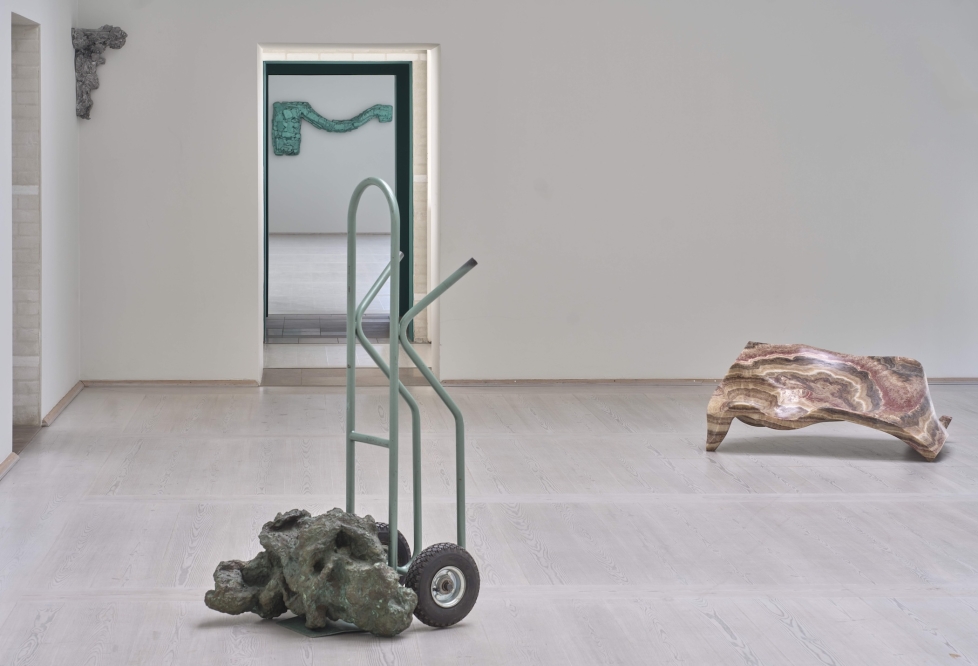
The comparison may be slightly unfair, but that is also what makes the exhibition interesting. Ortwed shows no signs of having come to Bornholm in order to be inspired by the rocks and the sea. She certainly did not sit on a warm block of granite to carve its likeness at sunset, or, like some latter-day Sonja Ferlov, gather clay from the Bobbeå and water-worn sticks from the beach to transform them into Surreal poetry. If Bornholm is nature’s great sculpture park, Ortwed is the kind of artist who arrives hauling sack trucks, moulds, rubber, chains, bronze and other man-made problems.
It is almost as though Bornholm has caught her out: she has spent a lifetime avoiding the obvious, only to end up in a place where her art fits in unnervingly well. After all, she began saying “no” early in her career. She said no to painting but yes to sculpture, only to immediately say no to the plinth, the monument, and the representational figure; she has said no to sculpture as object, no to conventional materials, no to decoration and beauty. Not least, she has said no to gender, which, with good reason, was a major preoccupation among many fellow women artists of her generation.
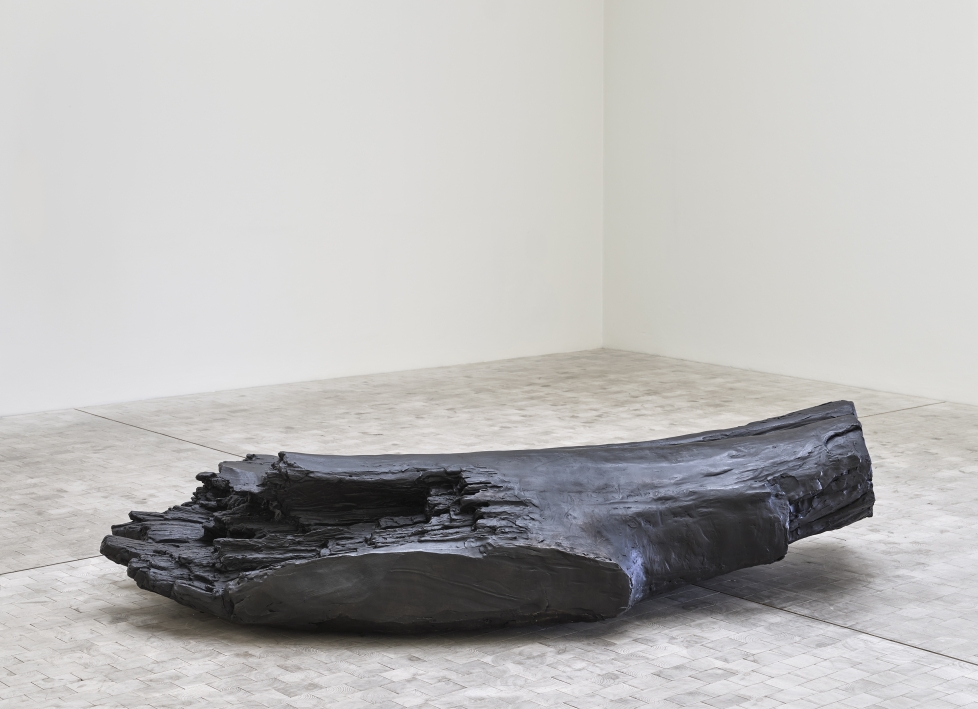
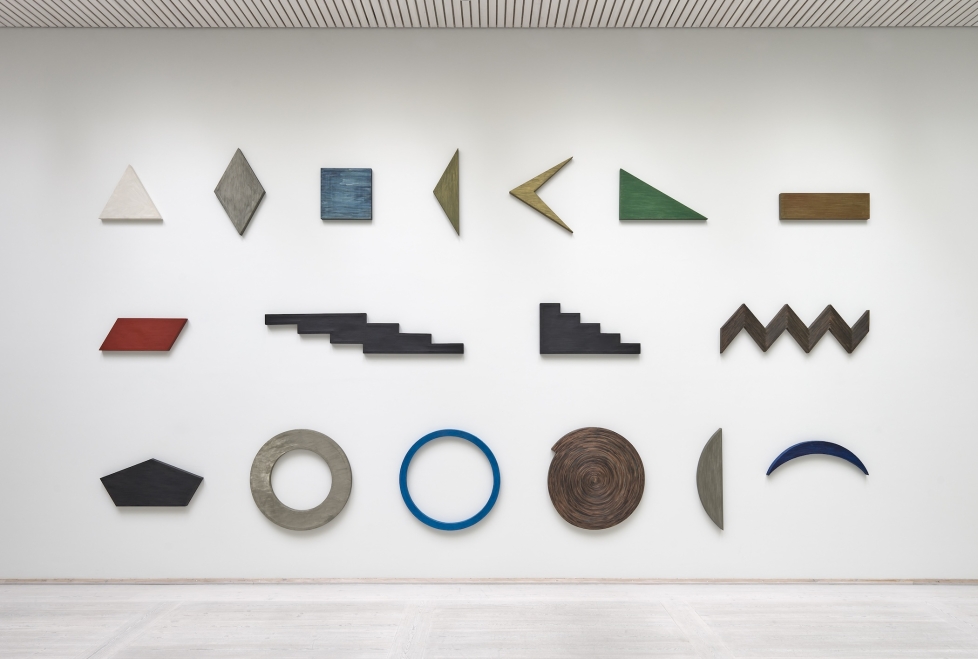
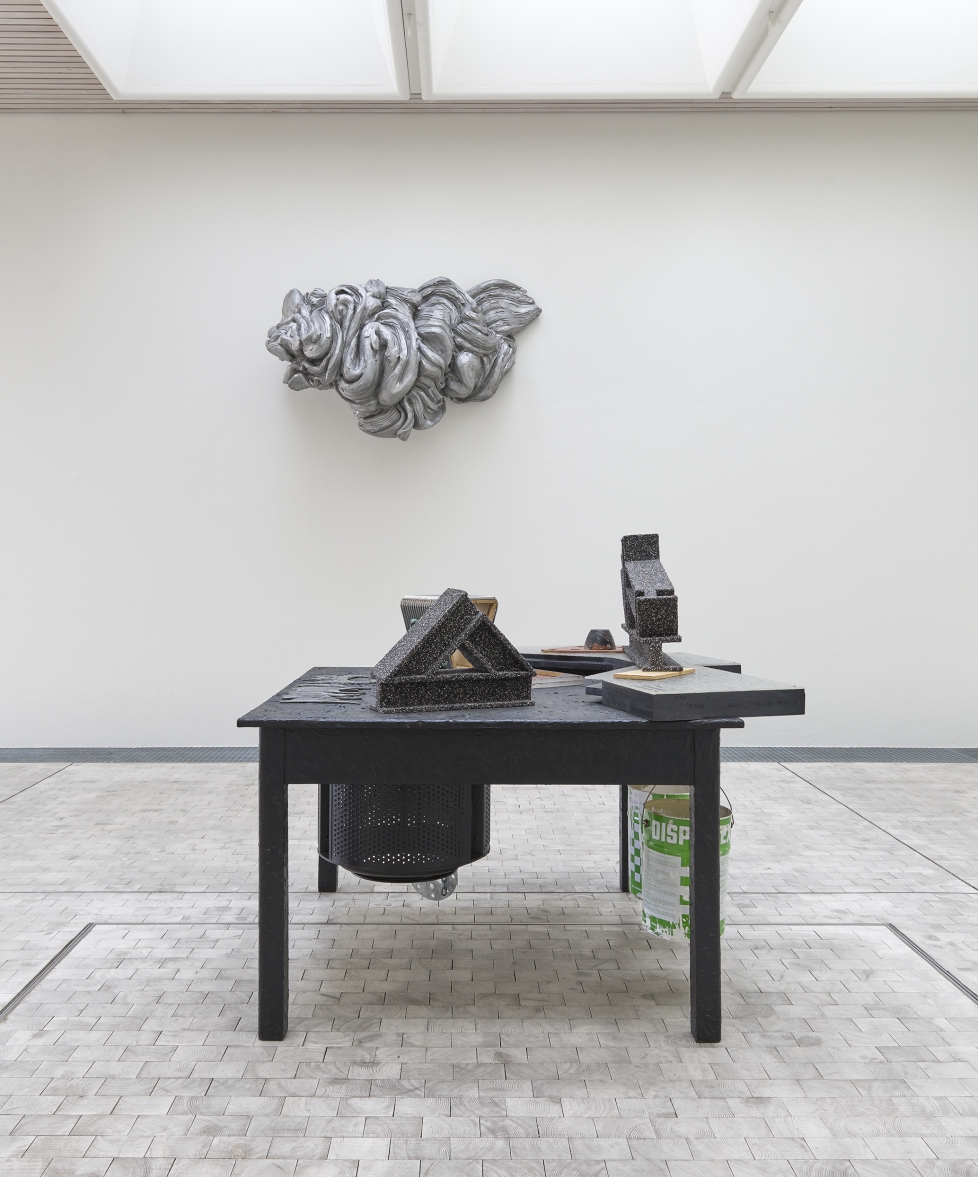
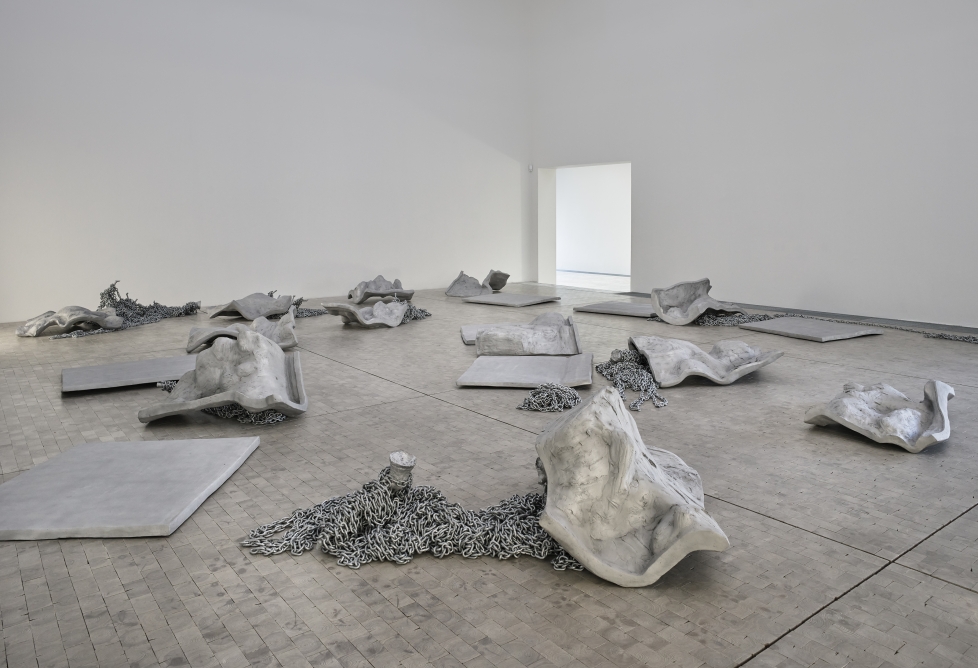
Perhaps that is another reason why Off-Shore is not a traditional retrospective. The five exhibition galleries do not present five chapters in a story of progressive development, tracing the artist from young rebel to mature master. Instead, works from different decades cut across chronological time, forming what the museum itself calls “landscapes of sculptures.” Some hang on the wall, some lie on the floor, some almost block your path; some withdraw and only become visible when you change position. With few exceptions, there is no single correct distance from which to view the works. You have to move around them, come close, step away again, look down on and up at them. Sculpture is not simply the object standing there. It is also the movement it forces into being, as Mikkel Bogh explains far better in the very worthwhile exhibition catalogue than I am capable of doing here.
Ortwed’s challenge to the very question of what a sculpture can be goes all the way back to her early works. If we nevertheless proceed in something approaching chronological order, the 1970s saw her in emphatically “anti” mode, as it was called at the time. Her anti-sculptures from the period were made from rubber on canvas and stretchers and hung on the wall rather than standing on a plinth. They are still genuinely great and might just as well have been made a few days ago. Later came chains, industrial materials, and other readymades. Sack trucks became plinths. Instead of modelled, clay was dropped from a great height and then cast.
In Tons of Circumstances, which Ortwed presented at the Venice Biennale in 1997, empty moulds – that is, the negative impressions of something that might have become a sculpture – become the sculpture themselves. It is a very Ortwedian trick: she takes something that, in a material sense, is on its way to becoming art and insists that it is already art enough.
With Space Cloud from 2008, everything suddenly feels very contemporary. Ortwed turns the relationship between the physical and the immaterial on its head. The cloud-like wall sculpture is cast in aluminium, an environmentally burdensome material, and its title acquires particular resonance in light of the period in which it was made, when “the cloud” (which we now know rests on heavy industry and a massive consumption of energy and water) was being sold globally as weightless, free, and climate-neutral – a digital escape from our paper-bound world. Ortwed may not have conceived it in those terms, but today the work reads as an uncannily precise materialisation of an age in which the immaterial has acquired an extreme physical underbelly. The gold-glazed ceramic work River Like Gold explores a similar tension between the flowing and the densely static – between seduction, imaginary value, and an extremely heavy reality.
Alongside the many works in the exhibition, we are also reminded of Ortwed’s numerous important public commissions, which can be explored in the catalogue. Here, bronze really comes into its own. One example is To Raoul Wallenberg, the large bronze raft from 1998–2001 on Raoul Wallenbergs Torg in Stockholm: here the material appears simultaneously weighty and dissolved. A series of bronze forms lies in a formation that feels at once densely solid and almost liquid. The same is true of Full Length from 2008, erected in the Copenhagen Harbour.
While the exhibition and catalogue flit back and forth through vast volumes of time, materials, and space, the more recent works referenced in the title, Off-Shore, become the exhibition’s pivotal pieces. Despite their modest scale, they can be said to pull everything together. First, because Bornholm seems directly inscribed in them. Being placed in this particular museum near Gudhjem, it is difficult not to see the sea and the horizon in them, even though they depict neither. The forms hover at the edge of recognisability: one might resemble a piece of driftwood, the other a stone or some branches, but they never quite resolve into motifs from nature.
Second, the title makes them appear as the key to the whole exhibition. Off-Shore (as in offshore) literally means something situated away from the coast, out at sea. But the word also carries more complicated meanings. It refers to energy production at sea and to things moved out beyond any country’s jurisdiction: oil platforms and offshore wind farms, but also companies in tax havens and money operating somewhere other than where it properly belongs. Offshore means something still connected to the mainland yet positioned beyond its rules.
Off-Shore might almost be a self-portrait. At any rate, it is a particularly brilliant title for a retrospective of Ortwed. Because on closer inspection she was never really “anti” so much as “offshore” in relation to the mainland of art itself, and not least the Danish art world. She spent most of her life abroad, but never placed herself outside the world of art. Quite the opposite: she has been far too preoccupied with sculpture ever to abandon it. Instead, she has stationed herself at the edges of its definitions, consistently occupying a position from which she could clearly see art’s rules without being entirely subject to them.
Although Ortwed may seem like visual art’s answer to Nina Hagen or Debbie Harry, she has not, in fact, spent fifty or sixty years saying no. What she has really investigated is what remains after you say no. When the plinth disappears, the floor becomes interesting. When the classically modelled figure disappears, the body and its absence become palpable and art can let in banal human stand-ins such as the commercial wax figures and mannequins in Buck of Necks (2022), or the semi-Catholic torso in the Gabriel-Orozcoan Replica Cross My Heart (2013). When the noble material disappears, the material’s own resistance comes to the fore. When sculpture is no longer a bounded object, space becomes visibly part of it; and when the work refuses to tell us what it means, our own urge to find meaning suddenly becomes embarrassingly obvious.
Her many highly self-conscious noes also make her work full of shadows in the Jungian sense. Not that Ortwed is exactly a Jungian, though she belongs to a generation for whom both Wilhelm Reich and C. G. Jung were favourite points of reference. For Jung, the shadow is simply everything our conscious self-image refuses to acknowledge but which nevertheless keeps resurfacing and shaping us. What we try to suppress does not disappear; it lives on in our projections.
That is why it’s important to understand Ortwed’s noes. As already noted, she does not want a style, but she clearly has a language, as Kristian Vistrup Madsen pointed out in a brilliant portrait of her in 2020. She does not want to take centre stage, yet it is difficult to imagine a stronger artistic persona than one built over an entire lifetime on insisting that you do not want one. She does not want gender brought in as an explanation for anything, but her macho, one-of-the-boys tussling with heavy machinery and cumbersome materials makes it difficult to entirely remove gender from the reading.
Ortwed is sceptical of the art world’s academic explanations. Younger generations talk too much and feel too little, in her view. She wants the material to come first, for us to feel before we explain. But she loves language in the form of titles, which is quite a mercy for anyone trying to write their way towards understanding what is happening in her work.
The title Off-Shore is an excellent example of just how much a single word can suggest and let in. Suddenly you are not simply standing before a given form in bronze or aluminium, you also have all sorts of other things whirling around at the back of your mind: drilling platforms, oil, libertarian capitalism, tax havens, globalisation, geography, and borders. She wants to keep art free of language, yet at the same time gives it a title that sets language in motion. That is not a contradiction to be resolved, but one of the work’s productive paradoxes. Perhaps this is one of the great differences between Ortwed and Bornholm’s historical landscape art: she does not give us a specific scene to ponder, but a physical and linguistic situation that our own minds and bodies begin to fill with imagery and motifs.
Which brings us back to Bornholm. Because Bornholm, too, is offshore in relation to the rest of Denmark – geographically, historically, and culturally. The island is defined by everything that is not mainland. You have to cross water to get there. And although Bornholm is part of Denmark, its distance from the rest of the country and proximity to Russia have also had political and historical consequences, as the end of the Second World War so amply demonstrated. Perhaps that is precisely why, for generations, the island has served as a place where artists could step slightly outside the normative sphere and look at the world afresh. It is, of course, a far more innocent offshore position than the Cayman Islands or the libertarian island refuges of Peter Thiel and Jeffrey Epstein, where money and privilege are used to evade common rules and democratic scrutiny. On Bornholm, you are still inside, but far enough out to see the country from the outside.
That is also why the meeting between Ortwed and Bornholm feels like such a good fit. The traits that define the island are the same that Ortwed has worked with all her life: stepping a little outside the given, the generally accepted, in order to see it afresh. The island already possesses the mass, fractures, cavities, and materiality she has spent a lifetime investigating. Nature and the works almost seem to swap roles: an Ortwed bronze becomes geological while a rock turns abstract. A hole in a sculpture resembles a cave, and a cave outside starts to look like something Ortwed might have installed in a gallery. Bornholm never becomes art’s subject matter, but perhaps its measure.
That is both the exhibition’s problem and its great strength. Ortwed’s works take on tremendous physical intensity in this setting, but they also begin to look as though they have always belonged here. But they never did. She is not a Bornholm artist; she arrived on the island with an artistic language of her own. The result is compelling, showing what happens when that language collides with a place that already has such a strong artistic dialect of its own.
Perhaps that is why Off-Shore works best when you do not choose between Ortwed and Bornholm, but leave them to growl and snap slightly at one another, like the waves slapping against the coast at Sandkås. If Bornholm says “look at the light, the bedrock, and all these strange formations,” then Ortwed replies: “Yes, and what if that is not enough?” What if a sculpture does not need to depict anything in order to be full of meaning, and what if absence is just as physical as mass? What if what lies outside of art’s rules is every bit as interesting as the rules themselves?
Here, Ortwed’s attitudes become more than a historical rebellion. What was once a no to a particular sculptural tradition has become a sustained method. Ortwed is no longer rebelling against anything in particular; she simply keeps nudging the work away from the place where we think we have understood it. Over an entire lifetime, she has positioned herself slightly to one side of what we expect a sculpture, a woman, and an artist to be.
Maybe that is what Off-Shore really means. Not being completely gone, far out on the open sea, but being just outside the perimeter. Because whatever lies just outside is still defined by what lies within. You can never entirely escape the mainland; you carry it with you like a shadow. Ortwed said no to the monument and ended up turning sculpture into something even larger. She said no to style and developed a language. She said no to ego and created a remarkably distinct artistic persona – one we now swoon over as though she were a diva, a Danish Louise Bourgeois. She says no to gender as a category and makes her entire body the premise of the heavy works she has kneaded and hammered and poured all her physical strength into. And, finally, she says no to explanation, only to give us a title that can occupy almost an entire review.
Translated from Danish