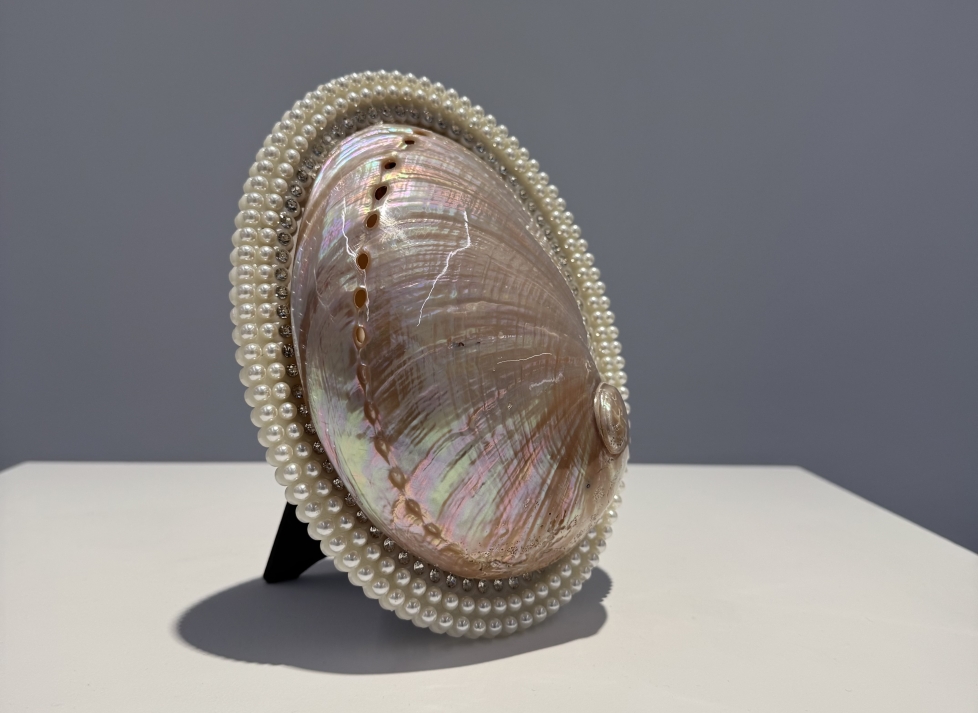
In a Paris whose streets are strewn with melted rubbish bins and charred hire bikes, the art centre Lafayette Anticipations is currently home to a little treasure trove by Hélène Fauquet. It is the artist’s first institutional solo exhibition in her home country, and I don’t know what I was expecting, but I’m relieved that Fauquet hasn’t got carried away and indulged in a grand gesture. ‘Big’ has never been her scale, and it isn’t here either, in the top-floor gallery of this small, nimble art centre in central Paris.
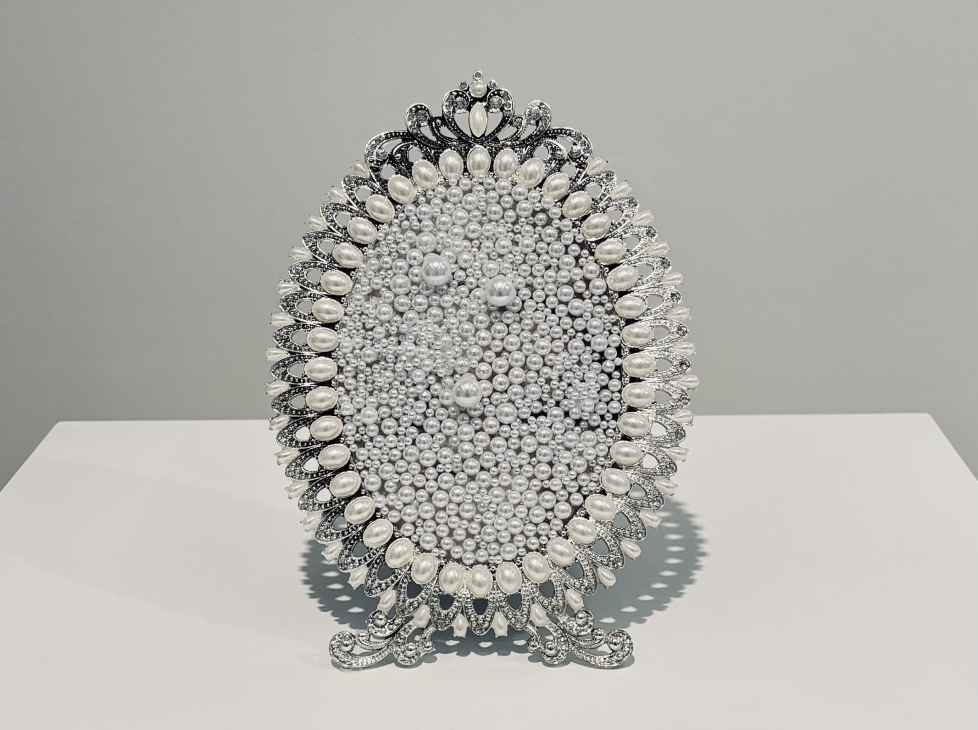
Vivresse (a contraction of vie and ivresse: life and intoxication/rapture) is an exhibition that literally sparkles. It consists, quite simply, of seven small sculptures on individual plinths. Each sculpture comprises a silver-plated or pearl-studded picture frame of the luxurious sort you’d expect to find on an executive’s mahogany desk or an expensive shelving unit. But instead of portraits of someone’s loved ones, the frame is filled with one or more conches, or other sea-snail or bivalve shells, attached much like oysters cement themselves to stones or rocks underwater. It all looks very alluring. Who doesn’t love conches or beautiful seashells? The more eccentric, pearlescent, spiralling or outlandish, the better.
Spotlights on the lacquered seashells, pearls, and silver frames enhance the glossy, polished effect, poised somewhere between a jeweller’s window and a cabinet of kitsch curios. But there’s a delightfully sweet-tempered humour to it, too – a hint of a jewellery shop for children. Or, as the exhibition text puts it, “a collection of curiosities salvaged from the depths of the underwater city of Bikini Bottom” – the city from the cartoon SpongeBob SquarePants, which I hadn’t given much thought to for at least a decade but, funnily enough, kept encountering during my weeks in Paris. One example was a photograph of a Parisian protester dressed as SpongeBob SquarePants holding up a placard with the words “Taxer les riches” (“Tax the rich”) during one of the recent large demonstrations.
All this reminded me of a truth that will hold for as long as human art critics still exist, in all our various guises, as we get up in the morning, have a coffee, and eventually find our way to an art centre: our experience of an artwork is also shaped by the moment we find ourselves in – chronologically, politically, mentally, and physically. Put another way, I find it hard to ignore what it means to be in Paris at this particular moment. So allow me to rewind to before the press preview of Fauquet’s exhibition on Monday, 19 October, which also marked the start of fair week in Paris.
The art world is a bubble. It has its own ecosystem – and its own financial bubble. Nowhere is this more obvious than at an art fair, such as when Art Basel Paris moves into the almost unbearably beautiful Grand Palais. Paris is a metropolis and can swallow any number of industry jamborees – fashion, music or art – without the rest of the city really noticing. Conversely, very little gets inside the bubble we tellingly call ‘the art world’. From the inside, it feels as though the art world has taken over the gorgeous city for the entire week to look at art, talk about art and, of course, trade in it.
Over the past decade, the bubble seems to have grown bigger and more global. And one part of the art market in particular appears to be roaring ahead at full tilt. You can sense it in the attitudes and social codes that pander to the world’s one percent. Some would say it shows in the art, too – in all the bling and luxury – that we are living through a kind of Rococo revival where the art world once again, just as in the eighteenth century, provides a playground for the ultra-rich. The artist–patron relationship is an age-old pas de deux, one that seems particularly paradoxical in a world as chaotic and unsettled as today’s. As the influential gallerist David Zwirner told the journalist Judith Benhamou on the fair’s opening day: “There are two things happening at the same time. The world is insecure, but the wealth creation is extraordinary.”
But this year, the bubble burst.
On Saturday, 17 October, to be precise. Just two days before the art bubble was due to become seriously inflated with the opening of Art Basel Paris, and the younger fair, Paris Internationale, in yet another stylishly renovated building, this time by the canal in the 10th arrondissement, and with numerous shows in the city’s institutions and galleries. The demonstrations across France were the culmination of weeks of protests led by lycée students with perfectly reasonable, frankly touching, demands for better conditions (more teachers, better sanitation, heating in winter, fewer rats). They also expressed a sense of powerlessness at the prospect of a future offering just a fraction of the opportunities and welfare that their parents’ generation had enjoyed.
Every day, the newspapers carried new accounts from ordinary lycée students. I was struck by how much they resembled the MeToo testimonies of the 2010s – except that this time the heartbreak came from the republic’s young people, bereft of hope. On 17 October, the students were joined by a broad cross-section of the population. In Paris, more than half a million people took to the streets to protest the state of affairs in an increasingly unequal republic, where rising food and energy prices make everyday life a constant grind.
The following afternoon, Sunday, when I crossed Place de la République, tensions were still simmering. Masked youths tore across the square, changing direction according to where the riot police were lobbing tear gas. In the middle of the square, surrounded by smoke and swinging batons, a couple of skaters were practising tricks. Quite a scene. More shops were looted that evening, and the next day, Monday, 19 October, Lafayette Anticipations duly opened its new autumn exhibitions.
Just before the press preview, I was sitting in a café. Everyone at the tables around me was talking about it: la manif, la violence … I caught similar snippets from passers-by. Paris is used to demonstrations and street battles, but this time it was different. There were far more people involved, many of them very young; there was greater police brutality, more smashing and looting. The city was shaken. How would the art centre respond to all this, I wondered, as I walked through the streets of the Marais, where shopkeepers were either fixing shattered windows or boarding up their shopfronts with large sheets of plywood.
A spread of coffee and croissants had been laid out for the press. Then the director, Clément Delépine, took the microphone and said: n o t h i n g. Well, obviously he welcomed us and briefly introduced the new exhibitions, but not a single word on the city burning. I don’t know what I had expected; perhaps just a remark that these were wild times in Paris, or something. Don’t get me wrong: I am generally sceptical of slogans such as “silence is consent” or, indeed, of presuming to know what others think. But here, the silence seemed almost pointed.
Perhaps what got to me was simply that, by pretending nothing was happening, the director had somehow drawn all of us present into his bubble. We were still inside the art bubble that Monday afternoon. A few hours later, curfews were imposed in parts of the city close to the art centre. Three days later, Art Basel Paris announced that the fair would close early – cancelling the entire weekend – for safety reasons. Now that really was something.
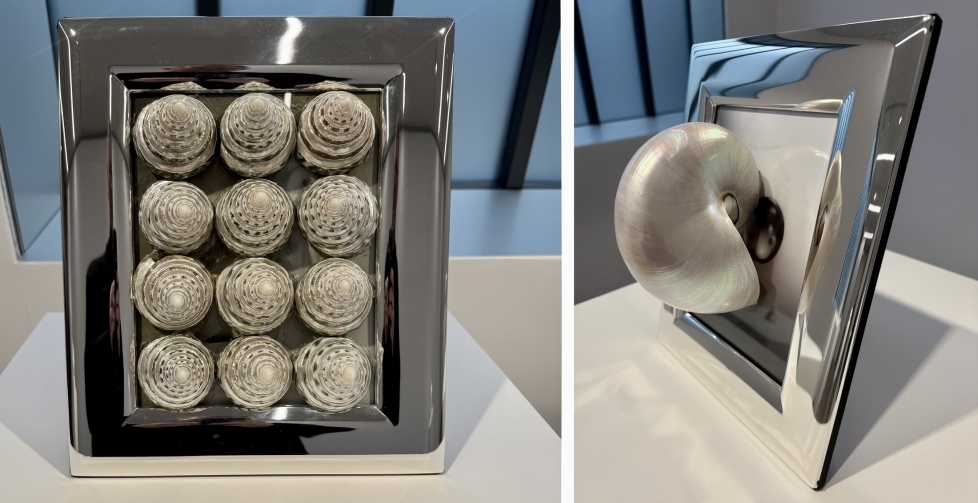
The spectacular images of the city’s luxury boutiques being looted were still rattling around in the back of my mind as I stepped into Hélène Fauquet’s gleaming exhibition. They probably dialled up my associations with jewellery shops and treasure troves an extra notch. But Fauquet didn’t invent our magpie-like craving for bright, shiny baubles. She simply plays on it – and probably also on the blingy Rococo age we live in. I find it all the more interesting that she does so in miniature.
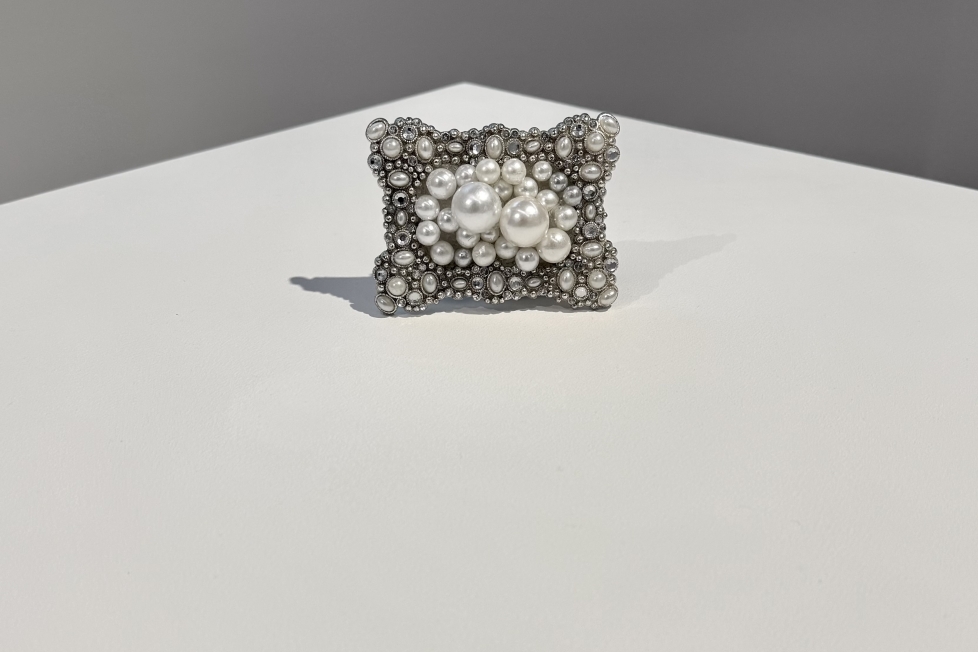
The works in the exhibition are all the size of a paperback or smaller. The smallest – an elegant frame inset with pearls and faceted stones, surrounding an image field bubbling with white pearls (hence the title, Cellulite) – measures no more than about 8 × 10 cm. This makes the works precious and cute, much like the miniature sculptures fashioned from sterling silver, micro-LED screens, and gemstones by the American artist Marc Kokopeli, a contemporary of Fauquet’s. I love how, with both artists, the twinkle in the eye competes with the sparkle of silver, stones, and pearls.
Then there are Fauquet’s Surrealist leanings. Large conches growing out of the picture frame and jutting into the room – such as the big, beautiful pink one in Metallic Monk (2026) – set the mind racing in that direction. Ever since I first stopped in front of these works on the stand of the New York gallery Ulrik at Paris Internationale in 2025, I’ve associated them with a particular work by the Surrealist Dora Maar: the iconic 1934 photomontage of a woman’s hand with painted fingernails reaching out of a conch, as though it had taken over a sea snail’s home.
The Surrealists’ fondness for the ocean depths as a route to the unconscious and the erotic is one thing; the technique of montage itself is another. Fauquet sits there, glue tube in hand – or so I imagine – fixing pearls and conches in place, conjuring a dream vision poised precisely between two and three dimensions. Not least because the shells are mounted directly onto the artist’s own photographs of bubbles in viscous, transparent substances (water, gels, creams).
Before the shells came into the picture, the decorative frames contained only these photographs. In a few works in the exhibition, you can only just make out the edge of one of these bubbles. Just a little watery bubble that lasted a few seconds before bursting. Now it is hidden by a seashell that once protected a small mollusc, its rightful owner. The more I try to picture this inner encounter between worlds, the more intoxicated I become by Hélène Fauquet’s silent, trippy box-within-a-box aesthetic. I mean that as a compliment.
Out in the street, the smell of burning tyres still hangs in the air. Burning hire bikes, whose batteries keep the flames alive, are the defining image of the 2020s street battles. They burn on long after the protesters have gone home, bearing witness to the continuing struggle for the city. The future belongs to the young, they say. Now even the young no longer believe it.
Burst bubbles in a Rococo age.
Translated from Danish