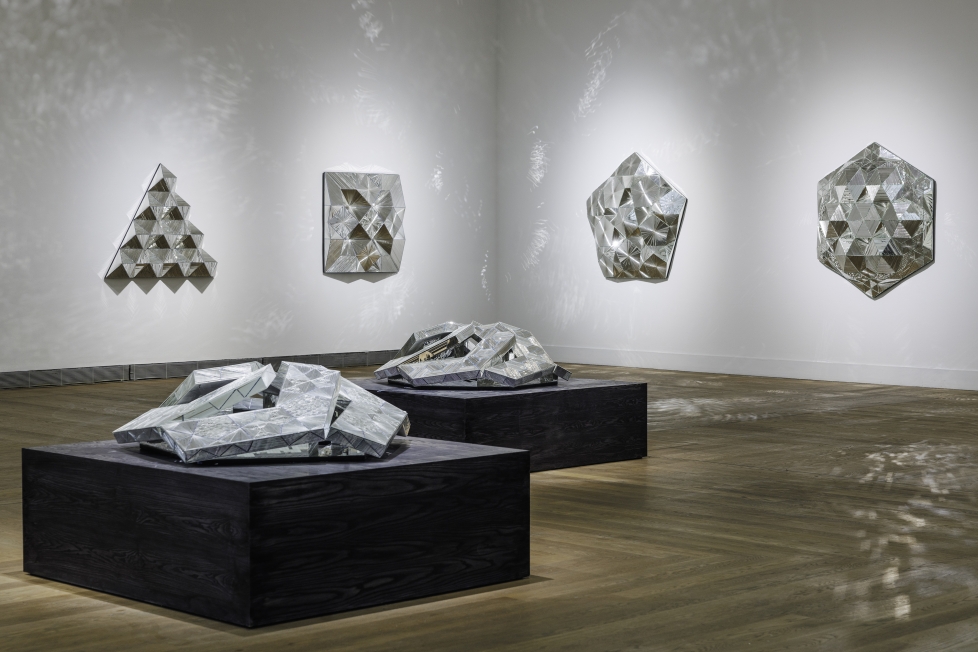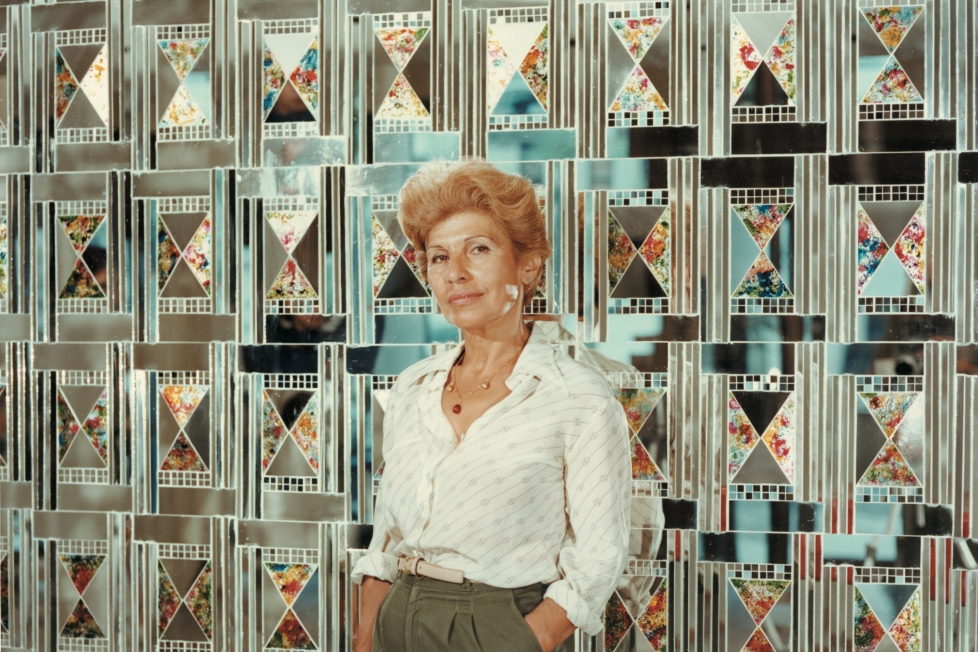
Moderna Museet’s survey of works by Monir Shahroudy Farmanfarmaian (1922–2019) glimmers and glistens, as the artist’s signature mirrored-glass reliefs reflect the light from the ceiling lamps. If small motors were to be attached to these objects, one could easily create a kind of ‘Deleuzian disco’, where space and time, artwork and viewer dissolve into one another.
And yet, this exhibition, comprising over a hundred works dating from 1970 to 2015, is not quite that much fun. The Shahroudy Farmanfarmaian is no Yayoi Kusama, transforming museums into Instagram-friendly amusement parks. In this respect, the show reflects Moderna Museet’s evolution from the experience-based regime of the 2010s – when artists like Kusama and Olafur Eliasson were among its staples – to the postcolonial exhibition politics of the past decade.
I use the term ‘postcolonial’ loosely to describe the project of rethinking established Western-centric hierarchies and genealogies. Although Iran was never formally a colony, the country’s modern history has been closely associated with the regional interests of global geopolitical superpowers in ways that were crucial to Farmanfarmaian’s life and work. Under the rule of Mohammad Reza Pahlavi (1941–1979), she was able, as a woman from the social elite, to travel, train as an artist, and work freely. During the political upheavals that followed the Islamic Revolution of 1979, her home and studio in Tehran were confiscated. The artist spent the next twenty-five years in exile before finally being able to return to Iran in the early 2000s.
The artist’s development was also intimately tied to her rediscovery of Iran’s cultural heritage, while she was working on a US-funded government project in the 1960s. The experience left a deep impression on her, and she started to make works drawing on traditional mirror mosaics, Persian gardens, and illuminated Qur’anic manuscripts. Today these works carry a hint of nostalgia that one perhaps needs to be Iranian to fully understand. For others, their shimmering geometries might suggest a bygone era, when dreams of affluence and personal liberation could still turn life into a glittering celebration and art into a ‘promise of happiness’.
Yet, apart from Bahman Kiarostami’s film Monir (2017) – shown in a half-hidden room to the side – neither the artist’s life nor the social and political contexts of her practice are given much prominence within this exhibition. Instead, the works’ formal properties have guided a non-chronological display with poetic subtitles like “Spring,” “Longing,” and “Fragments.”
The exhibition opens with Untitled (1976), a square box containing glass panels that support a multilayered geometric composition in orange and blue bearing Persian script. A statement reminding us the viewer a Western perspective should not be regarded as hegemonic here?
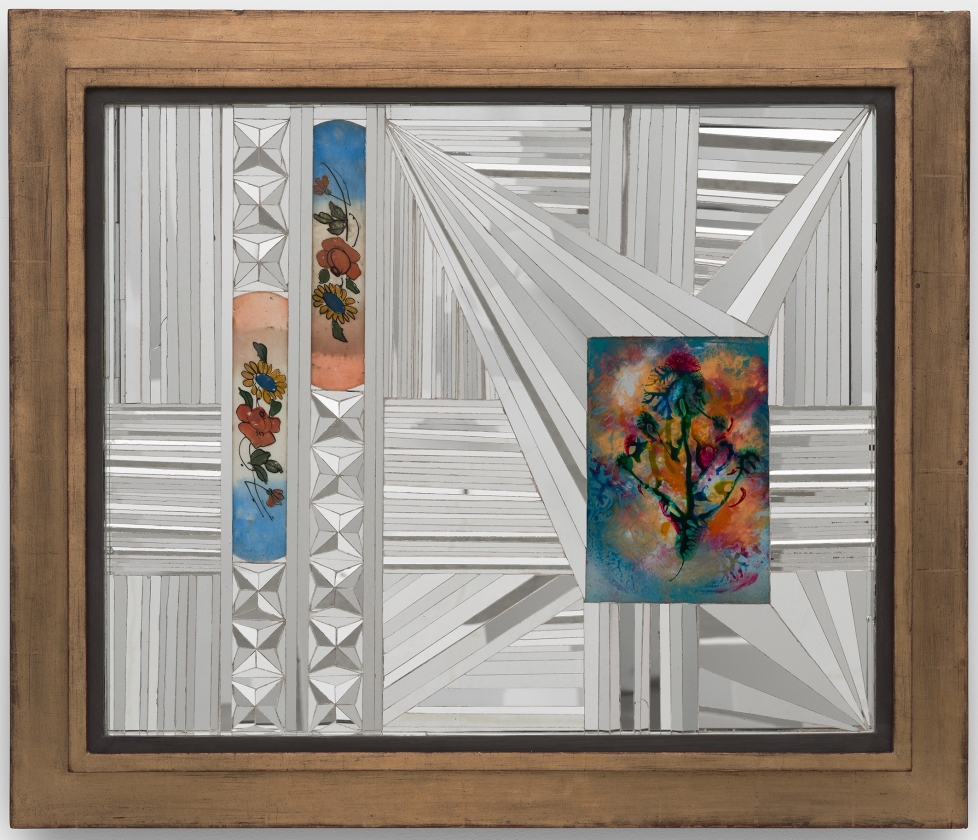
Around the corner, Poetry Books (1970) depicts two books, one stood upright and closed, the other on the ground and slightly open. At first, the surface appears to be orange, but the work changes as I move in front of it, and I realise that it is made of mirror strips reflecting the colour of the opposite wall. Beside it hangs Untitled (1974), a similar piece, where the mirrors create spatial recesses that frame a Rorschach-like floral painting.
There is something awkward about these works that makes them interesting. Perhaps they are simply exercises in combining traditional mirror mosaic with motifs drawn from reverse glass painting – which played an important role during the Qajar dynasty (1798–1925), when the technique was used for both portraits and religious imagery – and with poetry, which, as I understand it, has played an important role in Iran, not merely as a literary form but as a vehicle for philosophical, spiritual, and social commentary. In short, the works combine forms and techniques that are, in different ways, bound up with Iranian cultural identity.
Here, however, the works also serve another purpose as allegories of art and poetry as experiences that are both open-ended and enigmatic, drawing the viewer in while simultaneously shutting them out. There is something in these works that radiates and flutters, making me think more of a question – something that sustains a tension – than an answer that settles the matter and tells us how things are.
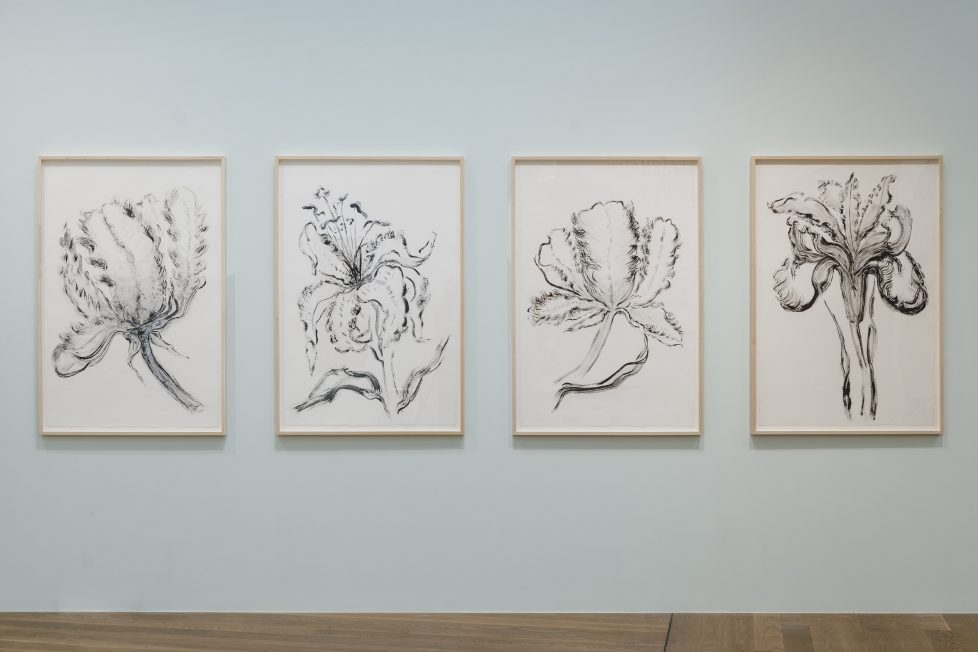
Opposite hang a series of large, fluid ink paintings of flowers from the early 2000s. Full of nooks and crannies, these images resemble labyrinths for the eye. They are conventionally beautiful, but they also seem to reflect on what it means to be beautiful – to entice or capture someone’s attention.
Again, I think of the glass box with the Persian writing, which is itself a kind of trap. Or perhaps a “delay in glass,” to borrow Marcel Duchamp’s description of his own work, The Bride Stripped Bare by Her Bachelors, Even (1915–1923). Delay, to my mind, stands opposed to linearity, and self-identical presence. Indeed, it also turns out to be a recurring feature of the show, taking the form of various surfaces that are left ajar or set at angles so that they create reflections, vistas, or open spatial configurations.
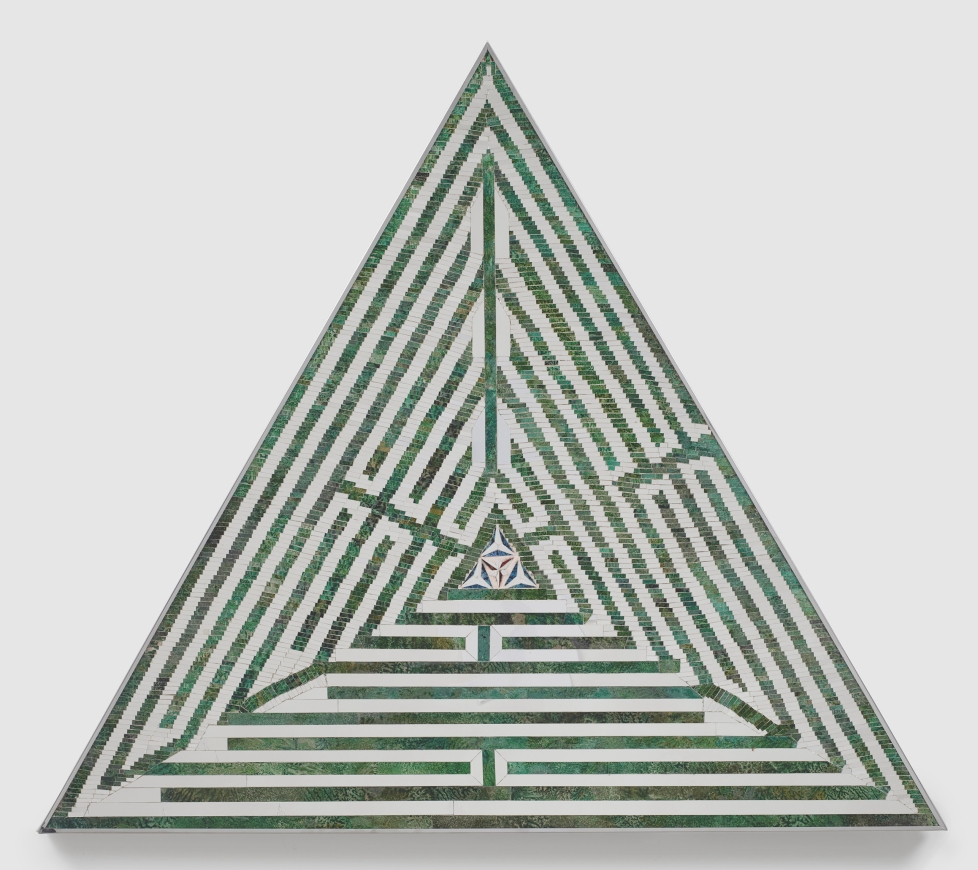
The most exemplary traps are a series of two-dimensional labyrinths: one triangular, one square, one pentagonal, and so on. They belong to the many works that the artist made in the 2000s, after returning to Tehran where she was once again able to collaborate with the craftsmen who had helped her produce her mirror-mosaics in the 1970s. The labyrinths capture the viewer’s eye but also remind us that a maze is not merely a trap: it is also an image of time in which paths branch, intersect, and diverge, and where every new choice opens up new possibilities.
The same motif is anticipated in the drawings that the artist made in the late 1970s and early 1980s by dipping flies in ink. The insect’s creeping movements turns the surface of the paper into a visual space, which is simultaneously a trace of something that has happened: time and space are woven together into an event recorded on the paper.
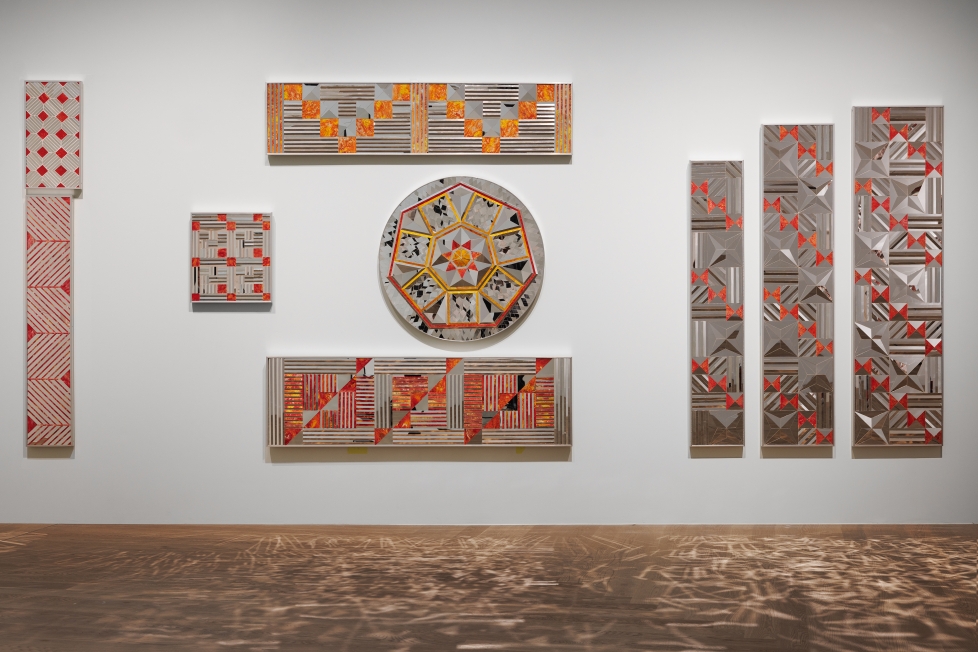
Besides highlighting the humour in Shahroudy Farmanfarmaian’s work, these aleatory drawings suggest a preoccupation with contingencies that are neither subjective nor objective; which can be reduced neither to the artwork’s material properties nor to the viewer’s personal experience. In the large reliefs hanging on the walls or resting on plinths at the far end of the exhibition, the shimmering itself becomes an event unfolding between the object, the light, and the viewer’s movement through the space.
The fact that the glittering alternately evokes disco lighting and reflections on the surface of water can be read as a sign of indecisiveness. Yet evoking an ambivalent space in between is precisely the point. Similarly, what connects the aleatory and the shimmering remains an open question. Shahroudy Farmanfarmaian seduces the eye and keeps the mind guessing.
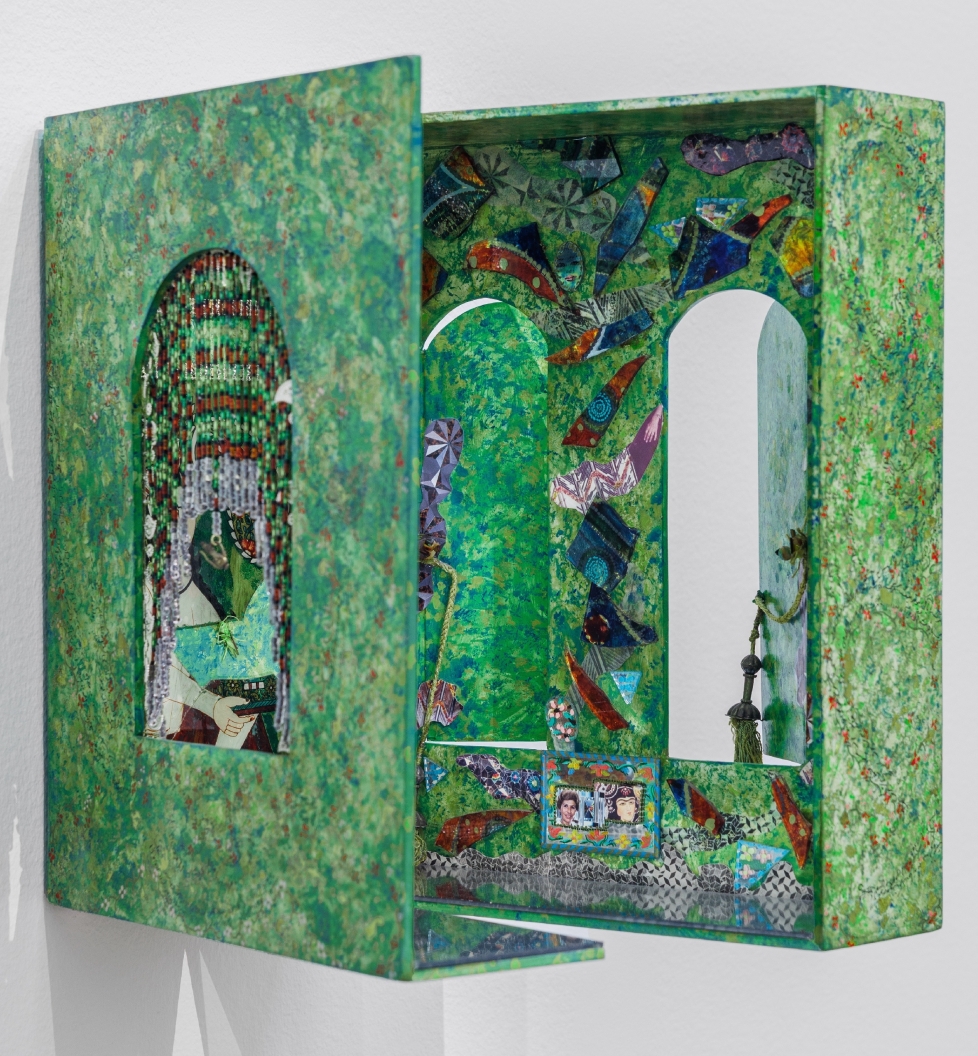
A more touching, almost sentimental, element is the series of dollhouse-like “heartache boxes” made after her husbands death in the early 1990s. Together with the beautiful sketches and collages from the early 1980s, they offer a deeper understanding of the artist’s complex oeuvre.
Moderna Museet’s exhibition is the first major presentation of Shahroudy Farmanfarmaian in the Nordics, but it follows a series of shows held in the decades both before and after the artist’s death in 2019. The pinnacle was perhaps her exhibition at the Guggenheim in New York in 2015, the first retrospective of an Iranian artist ever held at the prestigious museum, and a sort of homecoming for the artist who lived in the city during long periods of her life, first in the 1940s and 1950s, and then in the 1980s and 1990s.
What strikes me, above all, is how Shahroudy Farmanfarmaian’s work unfolds between the contingent and the universal, between what is rooted in a particular context and what remains open to anyone. Perhaps this is one of the defining questions of our time: not how art might transcend its social and cultural origins, but how it might make that context the starting point for experiences and meanings that cannot be contained by it. The exhibition’s greatest strength, then, is how its non-chronological form lets these tensions play out without trying to solve them.