The end of a mythological summer is approaching. The peoples of the fair Danish isles have been aghast over problem wolves, “caterpillars from hell,” and how to interpret a 3,000-year-old Greek epic poem. The latter was actually quite interesting until heads exploded in the heatwave and the discussion turned to whether Christopher Nolan’s version of The Odyssey was factually accurate! Time to emerge from our caves and head into museums, art venues, former underground car parks, and hair salons – or wherever else art happens to be this autumn.
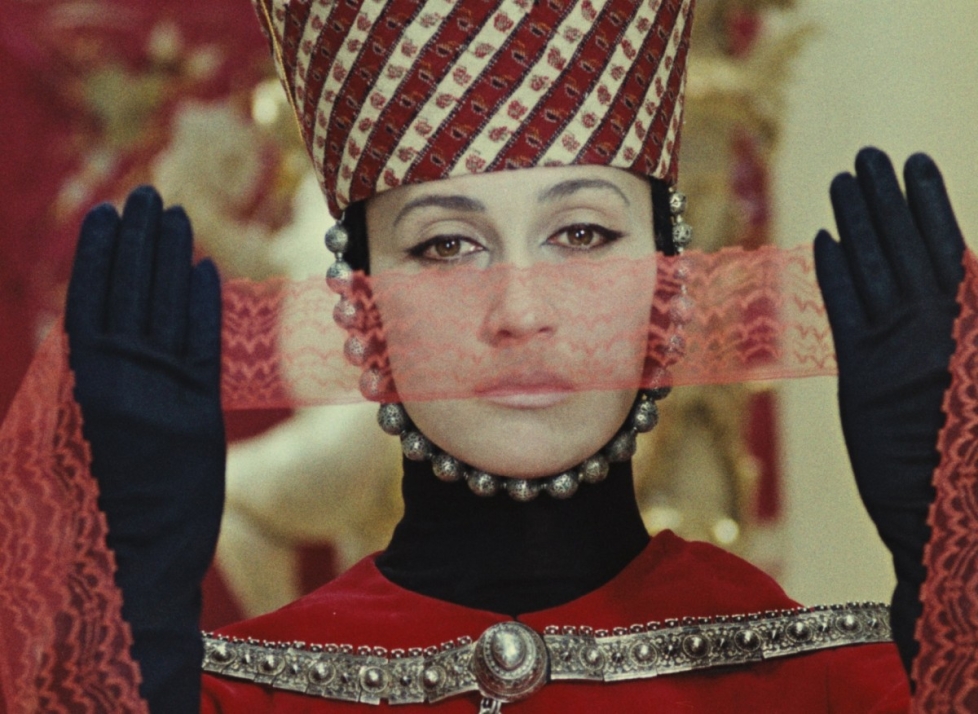
First things first. There is still time to catch Cinemateket’s programme devoted to the extraordinary Sergei Parajanov (1924–90). Born in Georgia to Armenian parents, he was educated in Ukraine, where he made his first semi-abstract, folkloric, downright trippy, and beautiful films – think Jack Smith meets Transcaucasian folk myths. Copenhagen’s art institutions have their ups and downs, but the Parajanov programme is a good example of why the film centre’s programming remains among the juiciest in town. Its headlamp is always aimed at art. And, of course, this is an especially apt moment to show Parajanov, who was imprisoned by the Soviet regime on charges of homosexuality and Ukrainian nationalism.
Since Russia’s invasion of Ukraine, a recurring exhibition taking place during the opening days of the Venice Biennale has become an important marker of resistance. That exhibition is organised by the private Kyiv art institution Pinchuk Art Centre. In 2022 it was opened (under the title This Is Ukraine: Defending Freedom) by Ukrainian President Volodymyr Zelenskyy, who spoke about art’s responsibility in the struggle for freedom. That was on day fifty-seven – back when Ukraine still counted the war in days. This year, too, Still Joy– From Ukraine Into the World, featuring Ukrainian and international artists, was among the exhibitions drawing the biggest crowds. SimonePost’s pastel-coloured chandeliers made of sweets and meringues certainly popped up in my feed quite a few times. The exhibition comes to Gammel Strand in Copenhagen in mid-September.
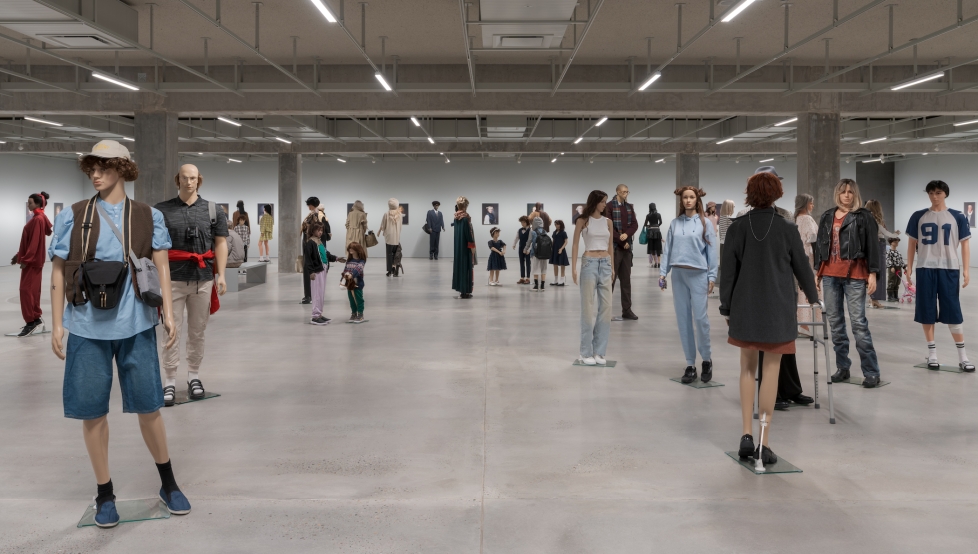
Before the summer, ARoS in Aarhus opened an exhibition by Nina Beier & John Miller. The duo has filled the museum’s new underground gallery with an array of mannequins in all shapes and attitudes. Some look like ordinary museum visitors contemplating photographs of old portrait paintings, which also form part of the installation. Others are simply hanging around or lost in whatever is playing through their headphones. I am looking forward to experiencing The Populace in the flesh.
Duo exhibitions can be rather dreary affairs, mostly because they are often the product of a lazy institution that either has not thought the idea through or is trying to get two solo presentations for the price of one. It is obviously a different matter when the show is sharply curated, or when it presents a genuine collaboration between two artists, as in the case of Beier and Miller. Copenhagen offers several good examples of such set-ups right now.
Last week, Andersen’s Contemporary opened a poppy firecracker of an exhibition by Danish artist Esben Weile Kjær and Swiss artist Sylvie Fleury, who have been collaborating for the past couple of years. And at the new Copenhagen exhibition space Comb, you can currently see A Deux, featuring three duos: Nina Beier and Marie Lund, Lucy McKenzie and Paulina Ołowska, and Ada Frände (Annika Eriksson and Fatima Hellberg). All are long-term collaborations, the latter even between mother and daughter.
Not to be outdone, SMK – National Gallery of Denmark will feature no fewer than four duos in the exhibition Couples Therapy. Bank & Rau, Hesselholdt & Mejlvang, J&K, and Randi & Katrine have all worked together for two decades or more. There is something admirable about such long-term collaborations, begun in art school and sustained for so long that they become intertwined with adulthood and family life. As the exhibition title suggests, it cannot always have been easy. At the same time, I have often thought that durable duos and groups were something of a peculiarity of Danish art. Perhaps an offshoot of Denmark’s cooperative movement and culture of associations? Superflex, A Kassen, Birgit Johnsen & Hanne Nielsen, Elmgreen & Dragset, Astrup & Bordorff, AVPD … it’s not hard to come up with living, active examples.
Collaborative doesn’t exactly describe the practice of Tracy Emin, a consummate solo act who, since the formative YBA days of the late 1980s, has never been shy about cultivating the myth of the artist. The last time I came across her was in Oslo in 2022, at the spectacular unveiling of her bronze sculpture Mother, which involved the fifteen-tonne work being lowered from a crane and deposited on the quayside outside the Munch Museum. There is every reason to think that her retrospective at Louisiana in October will be one of the season’s major exhibitions. Not least because millennial artists frequently refer to Emin as ‘mother’.
Amalie Smith belongs to that generation too, but I must admit I have no idea what she makes of Emin. What I do know is that Smith is one of the few people who can lay equal claim to being both a visual artist and an author. I am looking forward to Levende (Alive), her solo exhibition opening at Kunsthal Charlottenborg in a few weeks, in which Smith “zooms in on all things alive across past, present and future.”
Superflex’s retrospective is still on at Arken when, next month, the museum opens yet another retrospective devoted to an artist of the same generation. Ann Lislegaard’s survey is titled Animoid, a term borrowed from Philip K. Dick’s 1968 novel Do Androids Dream of Electric Sheep? Science fiction often plays a major role in Lislegaard’s investigations of how technology and language alter the way we see the world. Earlier this year, a version of the exhibition was shown at Henie Onstad Kunstsenter outside Oslo. Arken’s exhibition will be the most extensive presentation of Lislegaard’s work ever staged in Denmark. This makes sense not only because the Norwegian-born artist lives in Copenhagen, but also because Lislegaard was a professor at the Royal Danish Academy of Fine Arts for many years – in fact in the very department that has now acquired a new professor.
John Skoog is now professor at the School of Media Arts at the Copenhagen academy. A Swedish artist now living in Denmark, Skoog has spent the past ten years teaching at the Hochschule für Bildende Künste Mainz. He is also the founder of the nomadic Copenhagen film club Terrassen, and earlier this year premiered his feature film Värn (Redoubt). Writing about the film and its accompanying exhibition at Moderna Museet Malmö, Kunstkritikk’s Stockholm editor Frans Josef Petersson observed: “Indeed, Redoubt possesses a quiet dignity, even a gentle beauty, which can certainly feel like resistance in a world dominated by the crude imperatives and vulgar affects of power.” Skoog represents a new generation among the academy’s professors, a breath of fresh air for the institution.
While Copenhagen’s Chart Art Fair and Enter Art Fair get under way this coming weekend, O–Overgaden crowbars a serious group exhibition in among the festivities. In Protest and in Care opens on Friday, curated by Anne Kølbæk Iversen as part of her postdoctoral project “Crip Time: Art of Impairment, Withdrawal, and Impatience”. The list of featured artists includes international and homegrown names such as Panteha Abareshi, Jesse Darling, Jakob Jakobsen, and Victor Vejle.
Den Frie’s autumn exhibition, opening mid-September, also serves up an appetising roster of artists, including Lutz Bacher, Hanne Darboven, Julie Falk, Martine Syms, and Sofie Winther. According to the venue, Nervetråde (Nerve Fibres) takes as its point of departure “the nervous state of mind that permeated literature and visual art around the turn of the twentieth century, when Den Frie was founded.” It sounds like the perfect warm-up for Halloween. I’m there for it.
Translated from Danish.