It’s become a cliché to say it, but Seth Price’s practice is decidedly hard to label. In addition to an exhibition-friendly line of plastic-based paintings and sculptures, and highly regarded essays like his now classic Dispersion (2002) and the more recent Machine Time (2022), his portfolio also counts less commonplace items such as a an all-white clothing collection inspired by military garments (part of Folklore U.S., his work for Documenta 13 in 2012); a database profiling thousands of art collectors (Organic Software, 2015); an attempt at erasing himself from the internet; and an autofictional novel with the lovely title Fuck Seth Price (2015).
You could be forgiven for thinking that Price has irony and slipperiness as his guiding virtues. Yet, as he insists in this interview, which he generously made time for during a recent visit to Oslo in conjunction with the screening of his ongoing film Redistribution at Cinemateket (as part of the launch an artists’ film and video art programme organised by Abirami Logendran), his constant search for untried tools and forms is more than anything driven by a deep commitment to an ethos of play and experimentation.
Originating from a slide lecture and continuously re-edited and released in new versions (eleven so far), Redistribution is a moving, funny, lucid, and strange piece of autobiography, or “a box that can hold everything,” to quote its maker. It stitches together the many pursuits that have occupied Price since he started out as a budding artist in the late 1990s, and it’s shot through with incisive reflections on art, media, and culture stretching back millennia. If you’re after a comprehensive peek into his head, it’s a gateway that seems hard to match.
Redistribution grew out of a presentation you gave at the Guggenheim Museum in New York in 2007. Did you have this film in mind back then?
I asked the museum to record the talk I gave, but I wasn’t yet sure what I would do with it. They hired somebody who had a tiny consumer format mini-DV camera who set it up at the back of the auditorium. It was low-quality consumer video from a hundred feet away, and I was like, what am I going to do with this? Then I thought I could probably do a lot with it, I just need to add things.
I had a show planned for the Kunsthalle Zurich in early 2008, and I thought, well, in the video I’m talking about a lot of the artworks that are going to be in that show, what if I put the video in? It seemed, at the time, so wrong to put the artist as a persona and voice into the exhibition. I was talking about processes and materials, not meanings, but an artist talking about their own work inside the exhibition could be horrible to hear.
Dealing with your own image seems to be something that recurs in your work, like when you tried to erase your online presence a few years ago. And obviously your novel Fuck Seth Price has some of that.
I see those things as part of a general shift in the way that artists were asked to show up more and more in the last fifteen to twenty years, because of social media of course, but also a shift in wanting to see more of the person, the creator. There’s an increased interest in biography, or a need for it. There’s a public desire for artists to speak, to explain what they’ve done, to justify themselves.
But Redistributionis maybe the first piece you’ve made that offers this level of direct, intimate access to your biographical self?
The book, there’s very little that’s actually autobiographical in it. It’s more like putting fiction adjacent to the artist who wrote it makes for a kind of friction, or force field. Redistribution is, in fact, autobiographical. But the editing makes it into something else. And it also includes a lot of fiction. There was no camera crew from Basel, for example, that was all staged.
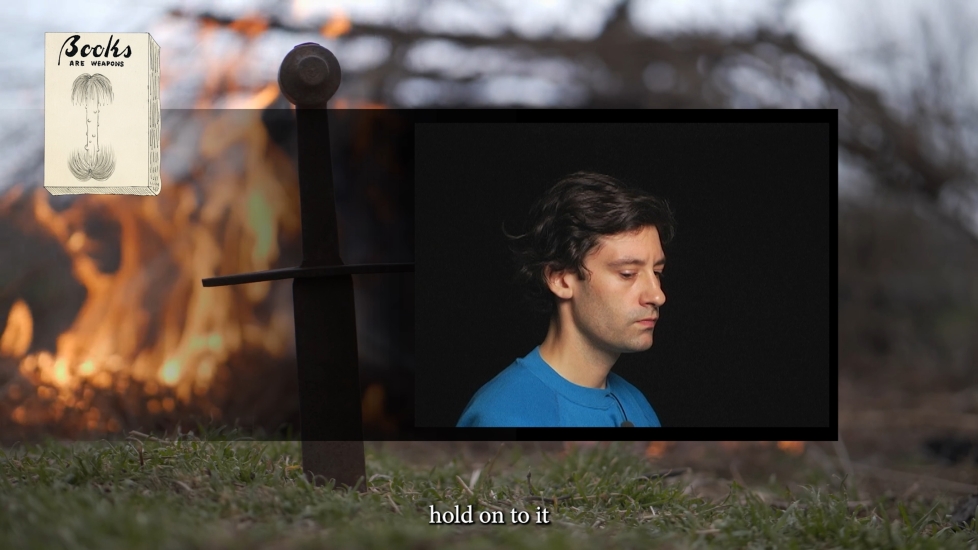
But even through your editing, you’re kind of present as a subject in the film, receiving these older images of yourself, responding to and reflecting on them.
Yeah, part of it is having to deal with this heap of fragments that I inherited from an earlier self. The challenge is in some ways the same as in 2007: inhabit this framework, this persona, but now also the unmediated, pathetic self. But it’s always tempered. It’s changed and modulated by having to coexist with other material, other approaches. Which keeps it exciting. The first task is to keep it exciting for yourself, as an artist.
Redistribution has this very open-ended and unstructured quality, which gives it a rough feel. But there are also many moments of smoothness in it, where the image and the sound and your observations come together in a very seductive way, drawing the viewer in. How do you think about that dynamic?
One of the nice things about the film is that I can bring in these other forms, things I was writing, or music I was making, or photos, and pour it all in there. Then it becomes a question of organisation. But if you can get the transitions right, you can take people anywhere. That comes out of working with music, making mixes or flows where you’re going from one energy to a different energy and it’s all about how you cut it. Sometimes it’s exciting to bring something in quickly, and people love that shift, and sometimes it’s too jarring and you have to be smoother.
It sounds like a pretty sensual way of working?
Editing is sensual, I think. It’s rhythmic and musical.
You sent me this short lecture where you discuss your work in relation to Duchamp and aleatory composition. These approaches are somewhat at odds, no?
I don’t know. I wonder if they are. If you’re a painter who uses chance procedures, you’re surprising yourself with material, composition, line, colour, which, when it works, invites you to go in with more conscious decisions. You get involved sensually because chance sparked something in you. Duchamp was probably not a purely aleatory producer in the way that we now think of it. I think he was looking for ways to get himself involved sensually by lavishing attention on something which could seem entirely arbitrary.
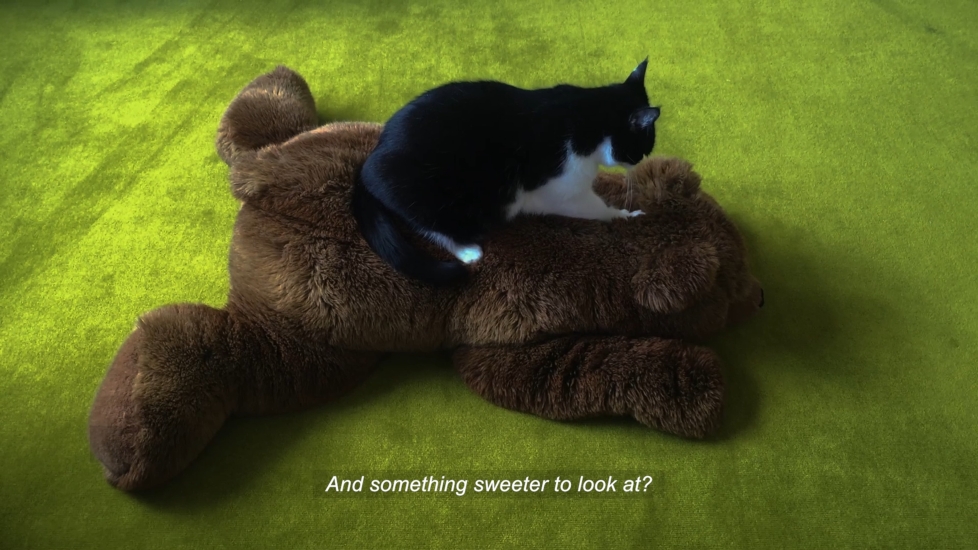
Another topic in your Duchamp lecture was the pitfalls of professionalism and amateurism. Professionalism seems to have a stranglehold on art these days. There’s this obsessive concern with outcomes, with predicting performance and minimising the risk of failure. Is your creative process hampered by these sorts of concerns?
To me, art making is play. You’re trying to make sure that you can continue doing it in a way that’s pleasurable to you, and that’s where play and experiment are crucial. The careerist impulse that you’re talking about, tamping down avenues where the result is less certain, the risk is that you lose interest in what you’re making. I like wandering into new areas, finding my way into a field where I don’t know the names of things and picking things up off the ground, trying to figure out what they do, then hopefully leaving before I learn all the names.
You are an artist that seems pretty enmeshed in digital media. Media technology has changed a lot over the past twenty years, and it has, I think, attracted a more ominous aura in that time. Has your relationship to it changed?
I think I’ve always treated technology as just another tool that’s lying around. I’m using it because it’s there, it’s accessible to me. It does need to somehow spark, though. For years, painting was a tool that was there, was accessible to me, but I couldn’t find a way in, so I didn’t push it. Then one day I saw a way in, I don’t know why. Technology is the same way. I never made art with social media, for example, because it wasn’t interesting to me as a medium. It wasn’t that it was sinister or off-putting, there just was no spark that showed me a way in.
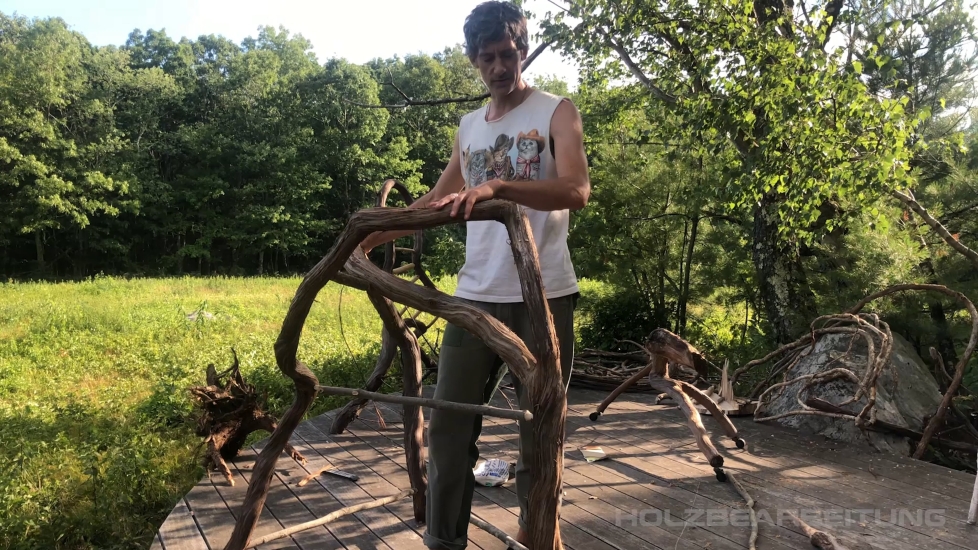
I’ve noticed quite a few artists pull back from it almost entirely and try to rekindle an almost premodernist idea of art. There’s this section in the film where you are making some crooked wooden furniture, it felt a little akin to that.
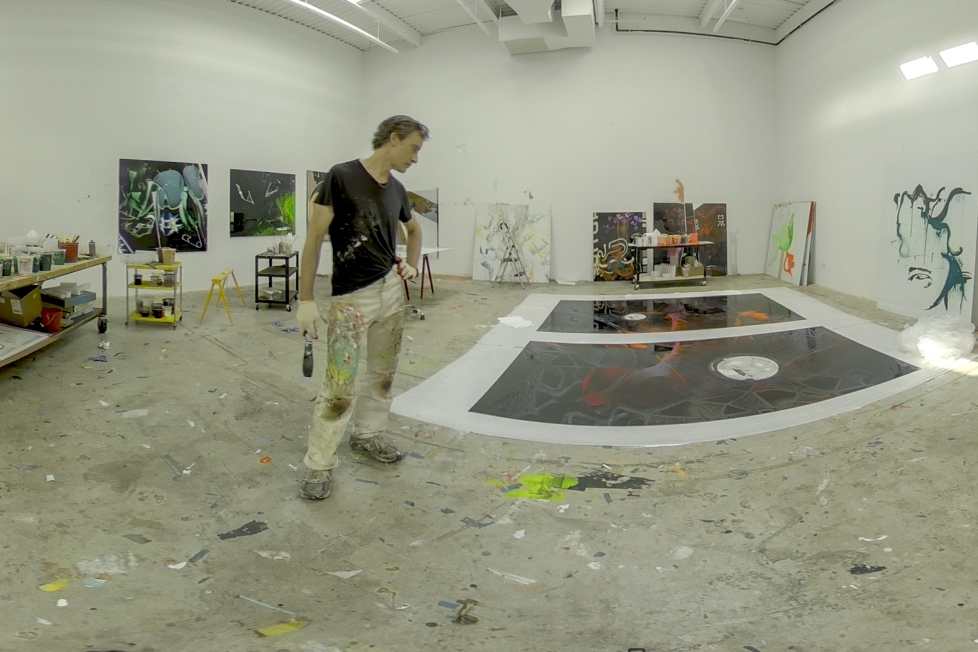
Well, again, that was a tool that was around. It was during the Covid lockdown, I was at this cabin in the forest, and I started tinkering with wild grape vines. It was the same with the videos I started making in 2000 using internet search terms: that was the tool that was available. I didn’t have a studio or own a computer, but I was showing up at work every day and sitting down in front of a computer with video editing software and a browser, so I started using that. A few years later I got a studio, and then Reena Spaulings offered me a show, and I had an idea for sculptures. It was the first time I ever made sculpture. It was because I had a place to play around with it and a place to show it.
You have written a few essays over the years. They have a very different texture from a lot of your visual work, more generous, accessible. That’s the vibe I get from the writing you’ve used in the film too, a lot of it has an aphoristic, I would say almost soundbite-y punch.
In the film I can include writing I’ve done in other contexts, quite abstract or as you say aphoristic writing, and it gets a charge from being put next to personal matters. It goes into a prism and comes out multiplied. It can be itself, and a supplement to the image, and also a reflection of something more personal or biographical.
In the film you describe your early years in New York and the way that you were out to absorb or capture everything. Now it’s what everyone does. But the incentives are completely opposite, almost.
Once you have a distribution platform it changes things. There was an unusual historical period, let’s say 1998 to 2003, when you have new tools for manipulating content – Photoshop, Final Cut Pro, Logic, all of these ways of changing the image, the video image, the audio signal – but you don’t have distribution yet. Myspace is just getting going, we don’t have Youtube until 2005, you don’t have platforms like Bandcamp to put your music on, social media doesn’t give you a way to share pictures yet. It’s a brief period when there’s this glorious new way of manipulating the world, and no way to share it. I think that had a real effect on how I made art.
Do you have mixed feelings about digging up and distributing this footage from thirty years ago now?
Oh, of course. It’s not easy. But that’s what makes it interesting. It’s the same as the original impulse behind the film, that it felt like what you’re not supposed to do in a sculpture exhibition. It brings a productive friction. It keeps it unstable and unknowable.
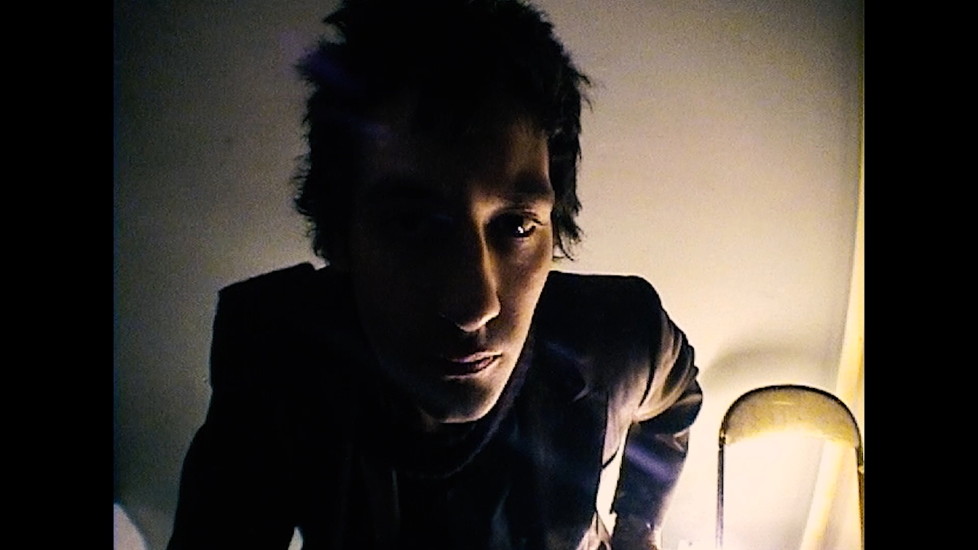
The depiction of your work in the film toggles between this private, diaristic perspective and a demonstratively impersonal one. How do you massage these together?
The film is in some ways about what I am doing at any given moment, which makes it diaristic. That was the frame. That was the idea of setting up a box that can hold anything. But the approach to the material could be done in a distanced way. I hired a videographer to go to the opening of a group show about chairs by artists that I was in and film it like a news segment. I didn’t go, I wanted it to be her thing. I looked at her footage and tried to feel into this scenario that I was just one part of, and make it into a story. I overlaid some writing I was doing in another context, because images like to have stories and vice versa, and the grain of a voice brings presence to an image. If I can keep these things grounded in the personal and the voice but also keep them open, then I can make it modular, and plug pieces into each other now and years later unplug them and attach them somewhere else, and the grounding in the personal means it all remains coherent and true to what I’m thinking about.
Your own voice, literally speaking, dominates the audio. It feels like an important binding agent in the film, grounding the images, as you say. Yet, in parts of your Guggenheim-lecture you’ve swapped it for a female voice. Why?
In 2009, I shot myself delivering a lot of new material in close-up, from the side. I wore the same clothes as the original, I cut my hair the same. I wanted to be able to cut away from the lecture and take the film anywhere, and I wanted it to feel smooth, as you say. The problem was, the quality of the audio was different. So I redubbed the old footage, word for word. It made it very theatrical, and kind of cyborg. You could tell something was off, but it wasn’t clear what. Well, by 2016, I started getting sick of that. I was imagining a rising and falling storm that could drown out certain things. Then it occurred to me that I could put any voice in there, and there was no point trying to hide it, in fact it should be obvious. You know, you make sweeping decisions, and you think you have to live with them, and suddenly you see a way to start over. I auditioned voice actors, and I hired a woman who did work for Grand Theft Auto. I just liked her voice. We did the sessions in a professional recording studio. It was a cool experience. Until recently she dominated the film, but now it’s back to about half and half.
At one point in the film you pull up ancient cave paintings. You don’t shun away from positioning your work within a deep historical narrative and to insist on the cultural importance of art.
This is, for me, existential. We don’t know what art is and why it’s so important, and art means being with the question. Underneath art, or in it, or suffusing it, is meaning, doubt, faith, skepticism. It’s that feeling in the moment when you’re looking at a painting, to choose to be with it, or to choose to turn away because there’s nothing there, or decide to look again because maybe there is something there, after all. It doesn’t have to be a big deal, it’s present when you decide to turn off the first episode of a streaming series that’s your friend’s favorite, but it’s not your thing. It’s a negotiation of consciousness and experience and feeling. It means searching for yourself in an object or experience. These things sound pretentious when you talk about them, of course, but the only way to get there is to risk that.