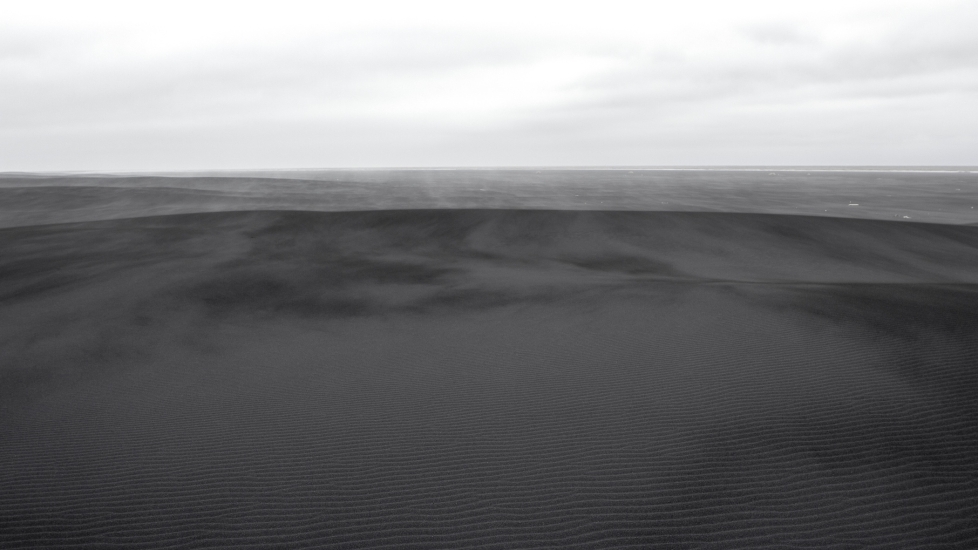
I’ve no idea how long I’ve been sitting here on the carpet in front of Sigurður Guðjónsson’s work, lost in my own thoughts. Time seems to disintegrate, to grow brittle and porous, as the video loops on the enormous screen before me.
Not that there’s a great deal going on in Guðjónsson’s work. Or perhaps there is. The video, about an hour long and shot in a single take, shows a landscape of black volcanic soil merging into a lead-grey sky, with no clear horizon between the two. A howling wind sends sand flying across the ground at furious speed, whipping it into formations like a veil or a ghostly, scudding mist. It’s all very simple, yet dramatic and striking. And, once you’ve sat in front of it for a while, oddly meditative too.
Guðjónsson, who represented Iceland at the Venice Biennale in 2022, tends to work this way. His works have nothing and everything to do with Icelandic nature. Here at Listasafn Íslands, the National Gallery of Iceland in Reykjavík, Hula (Veil) is an inscrutable record of the immense forces at work in the Icelandic landscape. I’m no longer sure whether the video is in black and white or in colour, where it begins and ends, or which is sky and which is earth. All we see is the howling wind and the sand in flight, as in an hourglass turned over each time the sand runs out.
The National Gallery of Iceland occupies three sites in central Reykjavík. Its temporary exhibitions are all held in what was once an icehouse for storing frozen goods. Across from the gallery showing Guðjónsson’s work is an exhibition devoted to the Icelandic modernist Jóhannes S. Kjarval (1885–1972), whose paintings of lava, moss and Icelandic mountains are a perfect match for Guðjónsson’s landscape video. Kjarval, who encouraged a whole generation of Icelandic artists to look to the island’s distinctive landscape, painted in a wealth of styles, from the dappled light of Impressionism to the almost graphic simplicity of rough, expressive brushstrokes and black contours. I stop in front of a small print of a group of white figures being swallowed up by a black mountain – elves, perhaps, or some of the countless other creatures of legend said to inhabit Iceland’s remote crags and caves.
Rather like the country’s harsh, black-and-white landscape, it’s striking to see how much of Icelandic art shares a stringent graphic austerity, even when it’s about something else entirely. It feels as if the landscape and its contrasts seep in everywhere: as if those lines that periodically rip the earth open and let its molten insides bleed out, those striped layers of ice and ash, run through everything here, even the subconscious. They’re there all the time, nature and the drawn line, even here in the middle of Reykjavík.
I’ve zigzagged my way through the hordes of tourists in Gore-Tex on Laugavegur, the city’s main street, and down to the harbour where the sight of the Esja massif, its snow-capped peaks rising on the far side of the bay, takes my breath away. Here, at the end of the old harbour pier, stands Marshallhúsið. Olafur Eliasson has his studio on the top floor of this former industrial building, and some of the city’s leading galleries and exhibition spaces occupy the floors below. Once a herring and fishmeal factory, the building takes its name from the Marshall Plan, the American reconstruction programme that helped pay for it after the Second World War. It’s been a cultural centre since 2017. Today, the white cubes are lined up one after another, and there isn’t the faintest whiff of fish.
Nýlistasafnið (the Living Art Museum) is an artist-run museum with a collection of just over 2,200 works by artists from Iceland and abroad. Founded in 1978 by a group of artists, the institution is devoted to contemporary art by the living. And you will not find the collection on display at Marshallhúsið, but a solo show by the young Icelandic artist Ívar Glói Gunnarsson Breiðfjörð.
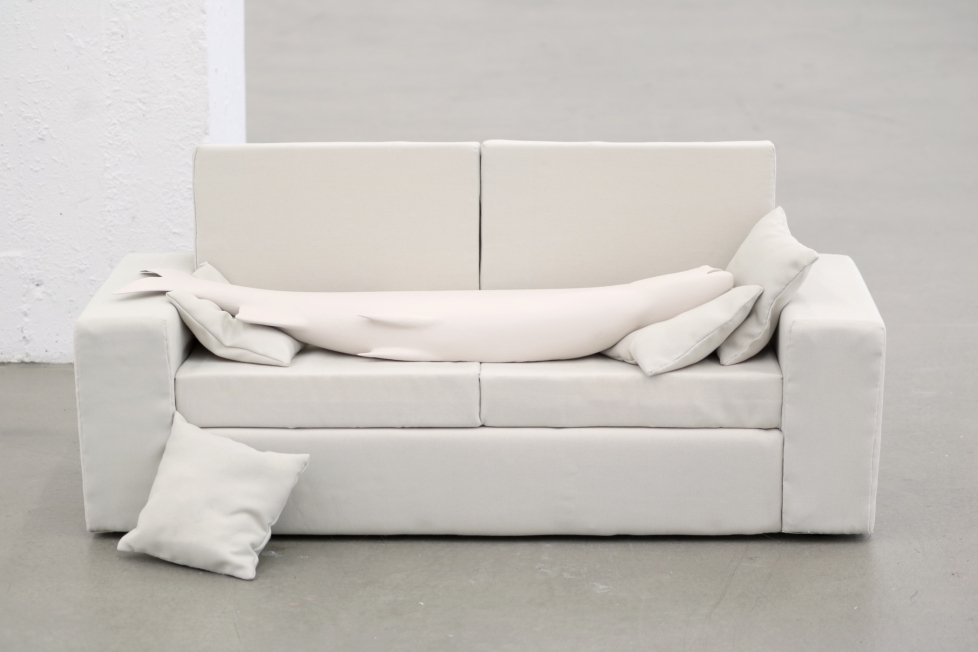
A resin fish is having a nap on a tiny little sofa, surrounded by pretentious-looking photographs of book spines with no titles. The walls, put up for the occasion across the windows and down the length of the gallery, are pierced with little star-shaped holes, as if to make it quite clear that the whole thing is a construction. Svaf allan daginn (Slept All Day) is at once utterly exacting and distinctly crude, like a slapstick send-up of the kind of exhibition that holds forth, at length and with great solemnity, on space and the proportions of the body. And yet it does just that, drawing attention to the space, the history of the building, and the institutional setting, like a joke with a serious point at its core.
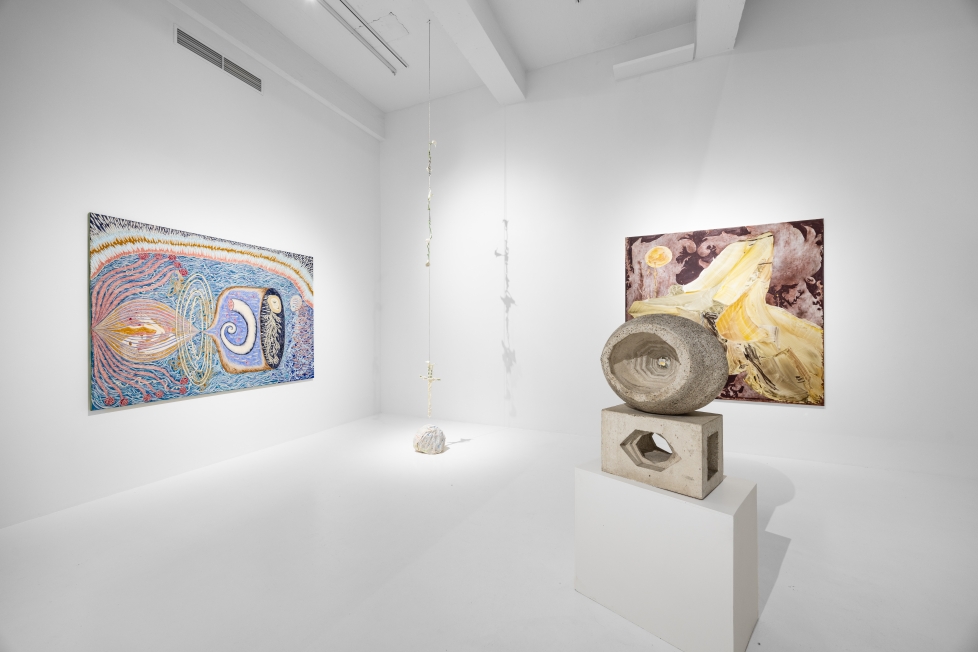
At Þula, the commercial gallery opposite, the group show Dreymendur og draumgjafar (Weaving Cosmologies) offers a much-needed break from all that rigour. The exhibition revolves around spiritual and occult ways of understanding the world as responses to a loss of meaning and a general sense of unease. I find myself once again thinking of Kjarval’s elves, even if the young freelance curator Þórhildur Tinna Sigurðardóttir draws on more general tropes of contemporary art.
I’m especially taken with the young Icelandic artist Kristín Morthens’s semi-figurative paintings with their strong symbolic undercurrents and luscious earth colours set against pale lilac pastels. Morthens is a good match for the American artist Hayden Dunham’s equally luscious layers of organic and synthetic materials, which look like tiny, living landscapes of ice, and for the Danish artist Cecilia Fiona’s canvas silhouette of a dress, with its references to myths and sagas. Something about the tactility, the layers, the feel of the materials really works in this show. It’s a far cry from the detached coolness often found on the Icelandic art scene.
Back among the Gore-Tex brigade, passing souvenir shops selling Icelandic jumpers and cuddly toy puffins, I wonder how the gaze that mass tourism turns on the Icelandic landscape – my own included – shapes what we see when we look at Icelandic art. There’s a delicate irony in the fact that tourism became the island’s biggest industry just after a vast volcanic eruption put Iceland on the map in 2010. The many blockbusters that use Iceland’s wild landscape as a backdrop have helped things along nicely, most recently Christopher Nolan’s The Odyssey, in which the black lava desert on the island’s south coast offers a plausible take on what Hades might look like.
Little wonder, perhaps, that an outsider sees nature and its mythical creatures everywhere in Icelandic art, even when the art is talking about something else entirely. What we see is (also) what we imagine, an image in the reflected glow of what is already dancing in the mind’s eye. In my case, that’s an image of mountains, ice and ash clouds.