He came like a whirlwind one April evening, with stiletto heels and a relentless make-it-big mentality. After a number of high-profile exhibitions at Moderna Museet, Hendrik Folkerts has moved on to become Chief Curator of Programming at Kunsthaus Zürich. But first a grand adieu: House of Nisaba. New Stories of Painting, featuring 29 artists exploring figurative painting ”shaped by discontinuity, ambiguity and multiplicity”.
House of Nisaba brings together a compelling group of painters based on the tenet that figuration has undergone a global renaissance in the last fifteen years, and that many of its most vital practitioners work with queer and other marginalised experiences. Since intellectually ambitious surveys of this kind are rare at major museums, I expected the show to fill a gap in contemporary discourse. Yet despite its lavish intentions, it soon became clear to me that it places surprisingly little trust in painting as a medium.
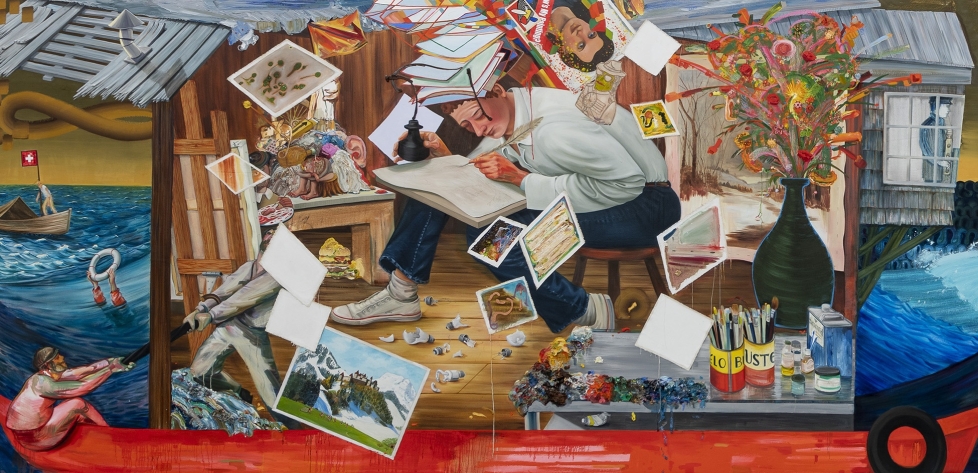
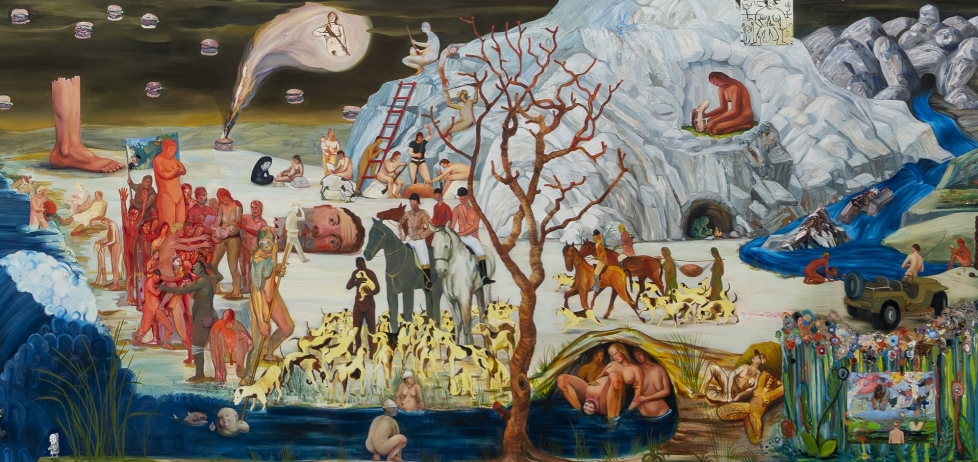
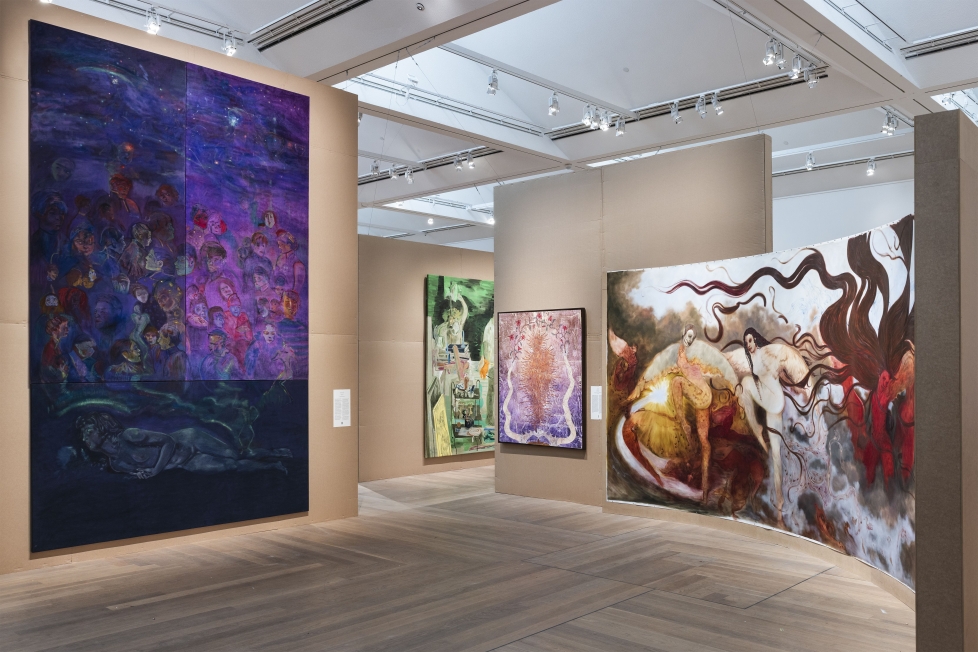
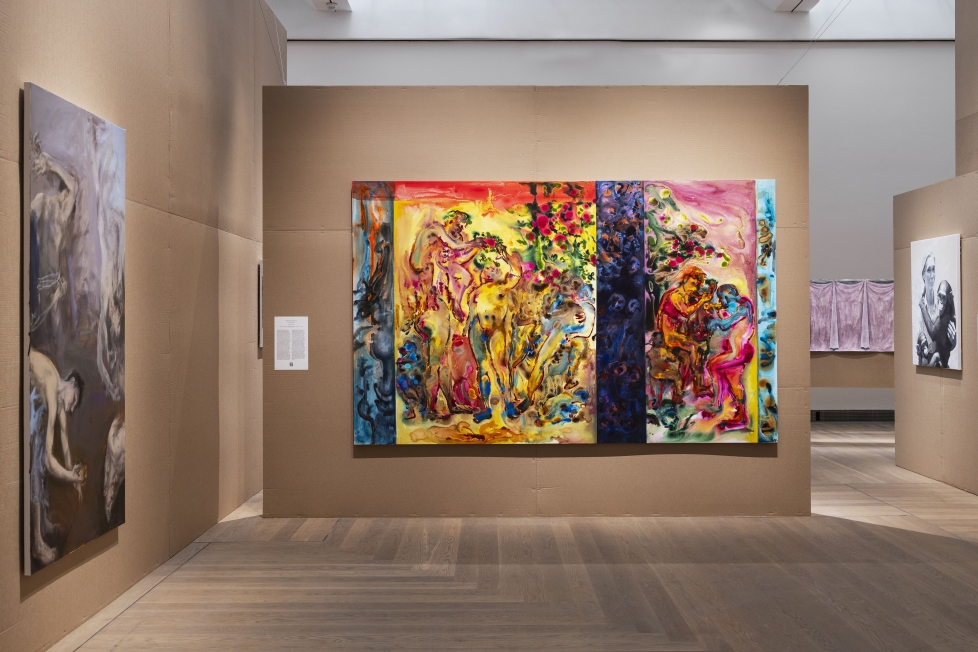
In the middle of Moderna Museet’s large exhibition hall stands a labyrinth made of cardboard, an example of the show’s playful eccentricity. A text running along the outside of a curved wall leads the viewer towards Nicole Eisenman’s 10-metre-wide diptych Progress: Real and Imagined (2006). The left panel depicts a struggling artist bent over their work, while the right shows various groups of nude figures. Although visually teeming and difficult to decipher, the narratives in the right panel appear to emanate from the figure on the left, inviting self-referential and allegorical readings.
Here, Eisenman’s work not only functions as an anchoring point for the renaissance of figuration. It also establishes an approach to painting that blends seriousness and humour, drastic pictorial strategies and complex compositions, while remaining critical of painting’s immediacy and sensuality. Indeed, here we find the allegorical approach hinted at in the title reference to Nisaba, the Mesopotamian goddess of writing.

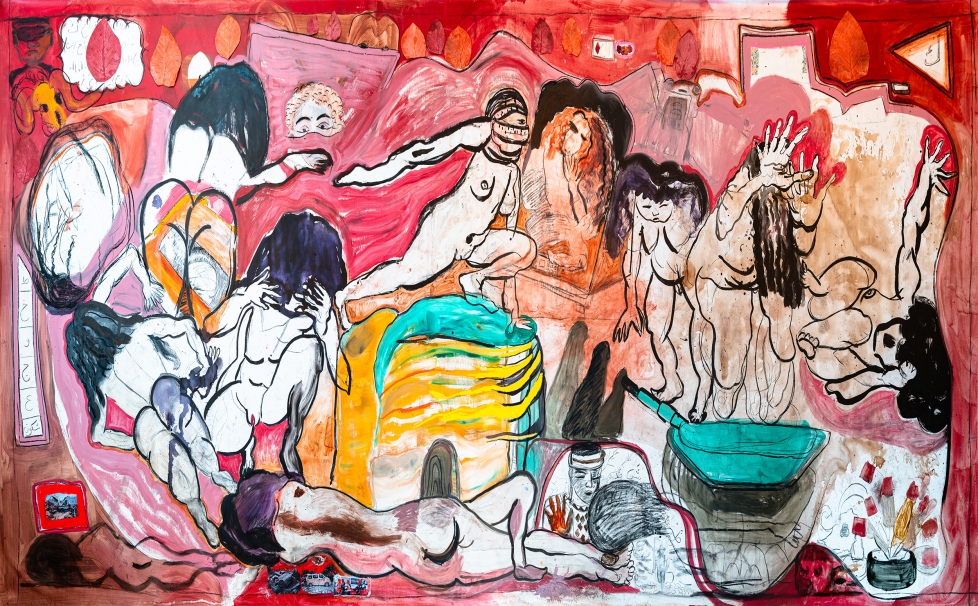
I enter the cardboard labyrinth and encounter a monumental painting by the Lebanese artist Mounira Al Solh. Expressively painted nude women swirl through a crimson space. As with Eisenman, Al Solh’s painting seems to depict a sequence of events, a collapse of time on a single surface. But after the American’s meticulous style, her sensuous expression feels like a liberation. I step back to take in the whole work, only to bump into a wall. A sense of claustrophobia creeps in, a spatial and intellectual confinement.
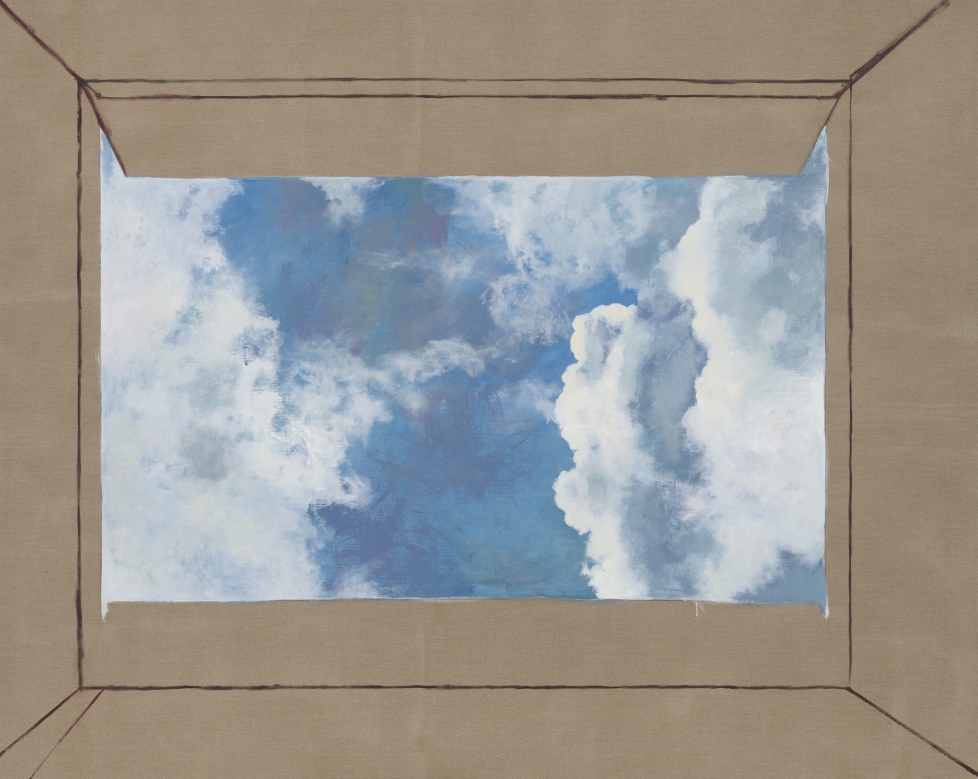
Next up is an equally large painting by Mohammed Sami, the London-based artist who used to live in Sweden after arriving as a refugee from Iraq. The work depicts a cloudy sky seen from inside a cardboard box, whose sides form a frame around the image. In contrast to the exhibition’s dominant mode, Sami’s work is more architectural and classical than baroque and overflowing. It also has a gravity that makes the others feel a bit light. Still, depicting the world from inside a box can be read as a wry comment on both identity politics and the boxiness of the exhibition itself.
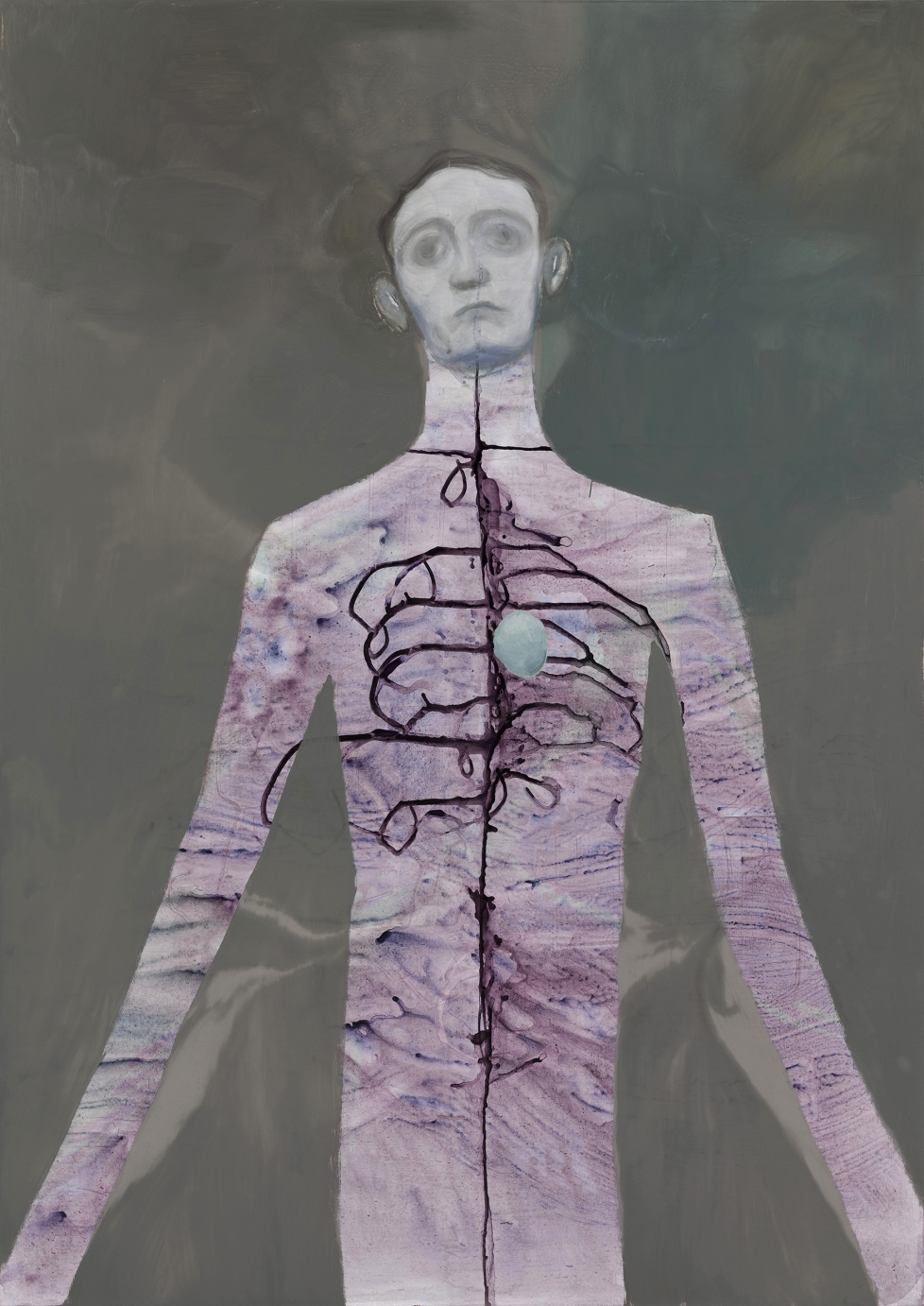
Next, the corridor opens into a space where Jill Mulleady’s brooding, four-and-a-half-metre-high Shift (2026) towers on a freestanding wall next to phantasmagorical creatures by Felipe Baeza and Naudline Pierre. While Mulleady and Pierre’s intricate compositions evoke European Symbolism from the turn of the century, Baeza’s figure channels everything from psychedelia and surrealism to Mesoamerican and Catholic imagery.
Still, all three partake in the fragmented subjectivities and contradictory temporalities found in Al Solh and Eisenman, while also introducing a more contemplative, almost mystical mode. There is a strong thread running through the works, engaging with night and dreams, imagination and creation, as well as with the process of painting itself. The problem is that my gaze does not settle on the paintings themselves, but on the traffic between them, which undermines the slowness of the medium. It feels more like scrolling through a feed than walking through an exhibition.
While figuration thrives on bodies, gazes, and details that reward slow apprehension, here I am pushed through at a pace that makes me restless. As I move from a meticulous “cosmogram” by the Brazilian painter Alex Červený, to a Dionysian explosion by the Swede Martin Gustavsson, and an oddly melancholy portrait by the Russian artist Sanya Kantarovsky, my perception short-circuits. The works themselves delight, but my gaze cannot linger long enough for the different temperaments to unfold.
The problem is that the art is forced to adapt to the exhibition achitecture, rather than the other way around, while the viewer is reduced to a gaze and their body to an intrusive appendage. The architects, Formafantasma, seem to believe that an exhibition is only about wall space, overlooking that it is just as much about floor space. Ideally, as a viewer, you should be able to move both vertically and horizontally in front of the works, especially when it comes to large-scale painting. But here, you can’t.
Also, the curatorial concept hinges on displaying only one work per artist, specially produced for the exhibition, something I find to be equally ill-advised. The development of ’performative curating’ during the early 2000s involved artists producing new works based on a site-specific or critical framework realised in collaboration with the curator. No such idea exists here; newness is simply assumed to be a quality in and of itself.
One must ask why a public institution like Moderna Museet should be a production site for paintings which, one must assume, will soon be up for sale on the private market. Of course, a museum should be able to produce new works, but here it amounts to a net loss for the public, who are deprived of the opportunity to engage with the exhibited artists at a deeper level. What the curatorial framework ultimately does is to reduce the paintings into commodity fetishes, rather than engage with them as entry points to a critical understanding of the artistic tendencies they belong to.
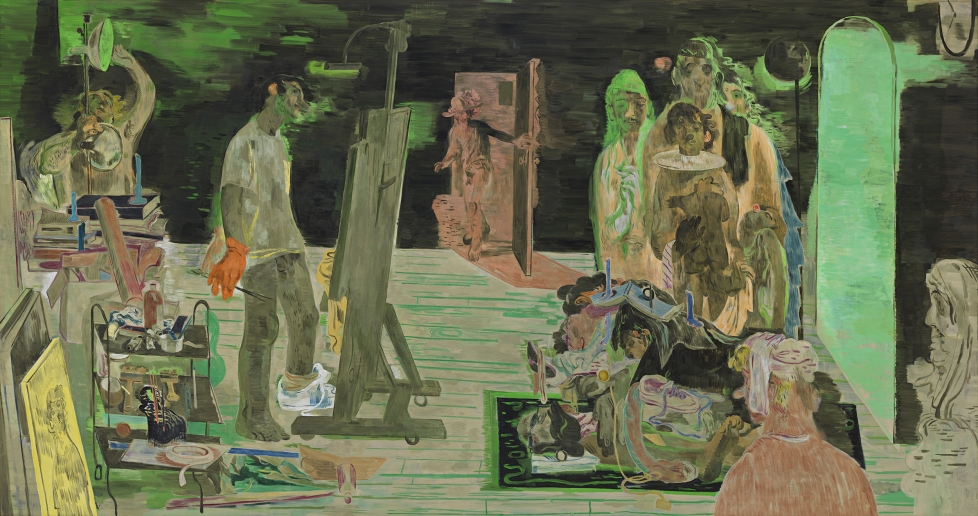
But the problem runs even deeper. What is prefigured by Eisenman’s diptych – and followed up by Salman Toor and Hortensia Mi Kafchin, both of whom contribute large-scale paintings depicting the artist as an anti-hero or a victim – is a fetishisation of the artistic subject in itself. Folkert’s argument that it is no longer possible to find a common ground between artistic expressions is echoed in how these artists portray their own position as that of a dreamer, martyr, or solitary visionary. Here, the exhibition turns to the cult of genius, positing the artist as the only one who holds the keys to decode the works’ supposedly complex allegories.
In the end, House of Nisaba posits figuration as a new tendency that must be seized in the present moment. But perhaps the process itself has been too fast, resulting in something that feels more produced than considered. At the same time, Folkerts’ feminist and decolonial agenda highlights how LGBTQ+ discourse and painting – shaped by heteronormative and Eurocentric genealogies – tend to operate as separate fields of knowledge. This may in turn explain why informed engagement with critical theory is so rarely combined with a deeper sensitivity to painting. Still, House of Nisaba ultimately fails to build on that contradiction in any meaningful way.