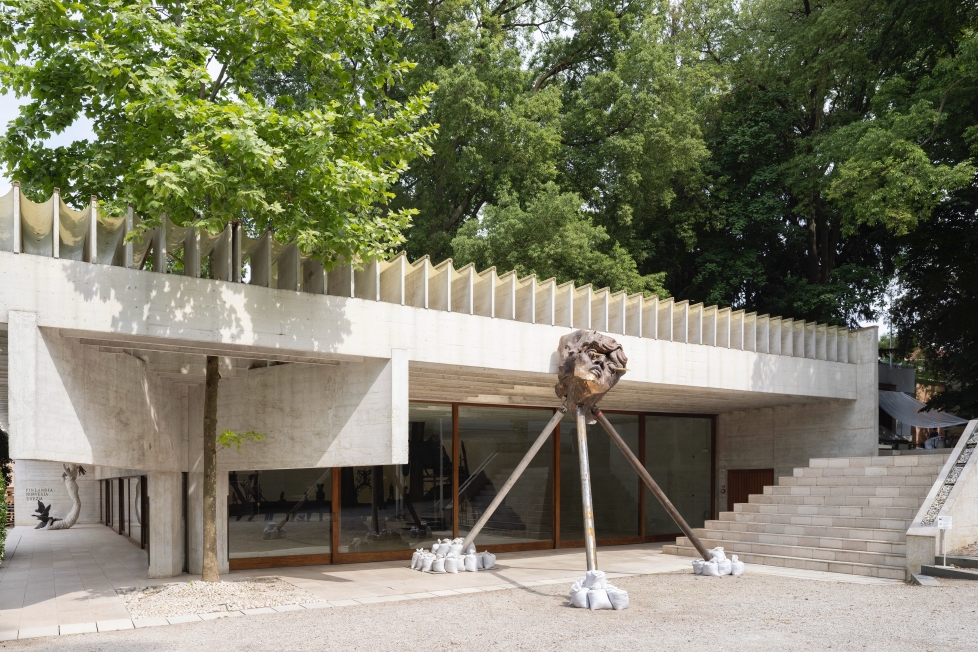
The strongest part of the Nordic Pavilion at the 61st Venice Biennale is located outdoors. Three hefty poles have been placed outside the building’s southwestern facade, and it takes my brain a microsecond to register that they are not temporary supports for the protruding roof. When I look up, I realize that Sverre Fehn’s architecture is entirely intact, and that a heavy bronze head rests atop what I had assumed was scaffolding. The face is unmistakably sculpted by the Finnish artist Benjamin Orlow, yet I have never before seen such intensity in his work. Its features bear traces of Michelangelo’s David (1501–1504), but the eyes belong to Medusa.
Wooden stakes piercing the sculpture’s pupils underscore that its terrifying gaze is directed toward the neighboring Russian pavilion. A dark bird perched on a nearby wall contemplates the same view. Compared to Orlow’s brutal monument, the Swedish artist Klara Kristalova’s sculpture is almost restrained, though its symbolism is unmistakable. Enough subtlety.
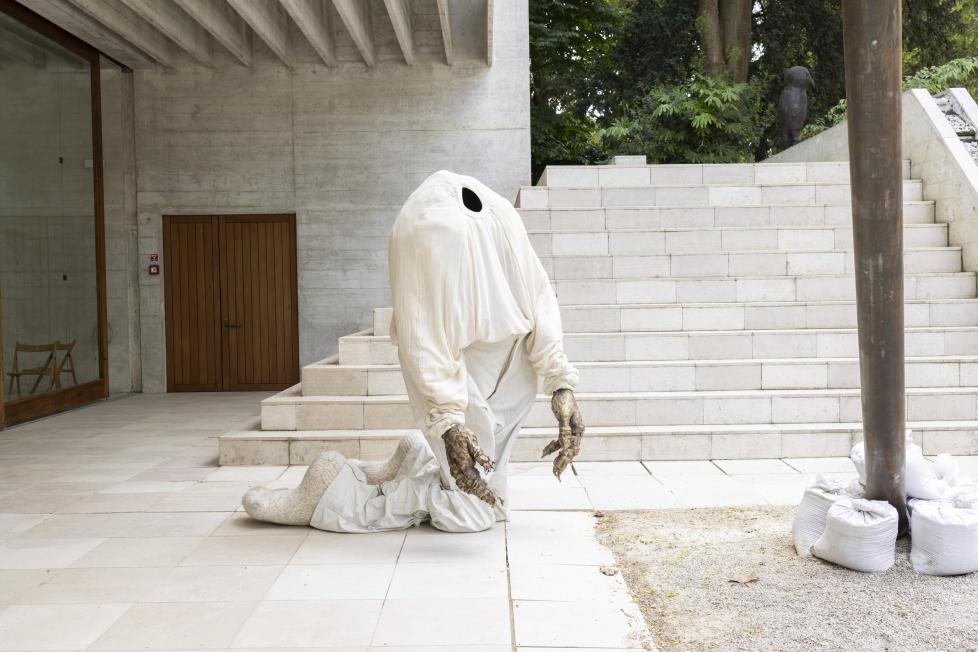
The Nordic Pavilion’s third artist, Norwegian Tori Wrånes, sets the tone in front of the building’s main facade. Here the atmosphere is entirely different: birds and giant bodies dressed in practical white garments sewn from old sails merge into something resembling a pillar. In theory, a long chain of headless bodies ought to provoke unease, yet Wrånes’s work does not bring body horror to mind. Instead, I perceive it as an event unfolding; an animation in sculptural form. What is depicted is supernatural, but not malevolent.
This year it was Finland’s turn to oversee the Nordic Pavilion. Kiasma curator Anna Mustonen has organized the exhibition around the theme of mythologies. Her decision to bring together Kristalova, Orlow, and Wrånes stems from the fact that all three incorporate the visual worlds of myths and fairy tales into their work. When I interviewed Mustonen a little over a year ago, I came away with the impression that she was acutely aware that her theme could be accused of being inward-looking and National Romantic – at worst even tone-deaf or nationalistic. In today’s cultural climate, references to Nordic folklore are already ideologically charged.
The question of how to relate to the realities of the outside world, meanwhile, forms the central thread of this year’s Biennale. In the Austrian and Luxembourg pavilions, the solution is simply to use excrement and urine as material and/or theme. Of course, a bit of piss and shit in the fine salons can be entertaining, but from a Finnish perspective such gestures would be unthinkable. Partly because the Finnish art scene is extremely prudish, but also because there is a fear of provoking resentment back home. Today, Finland harbors a simmering contempt for culture and a right-wing populist finance minister who happily cuts funding to the arts sector.
Thankfully, Mustonen’s exhibition cannot, even with the greatest effort, be interpreted as pandering to populists. Kristalova, Orlow, and Wrånes may work with mythology, but they reject the patriotic and patriarchal connotations of fairy tales, focusing instead on the transgressive and grotesque. Before this year’s Biennale, I was not especially worried that the Nordic Pavilion would give off nationalist vibes. But the risk that the theme might devolve into a collection of escapist piffle was still real. Finland has a long history of retreating into nature romanticism whenever the occasion arises.
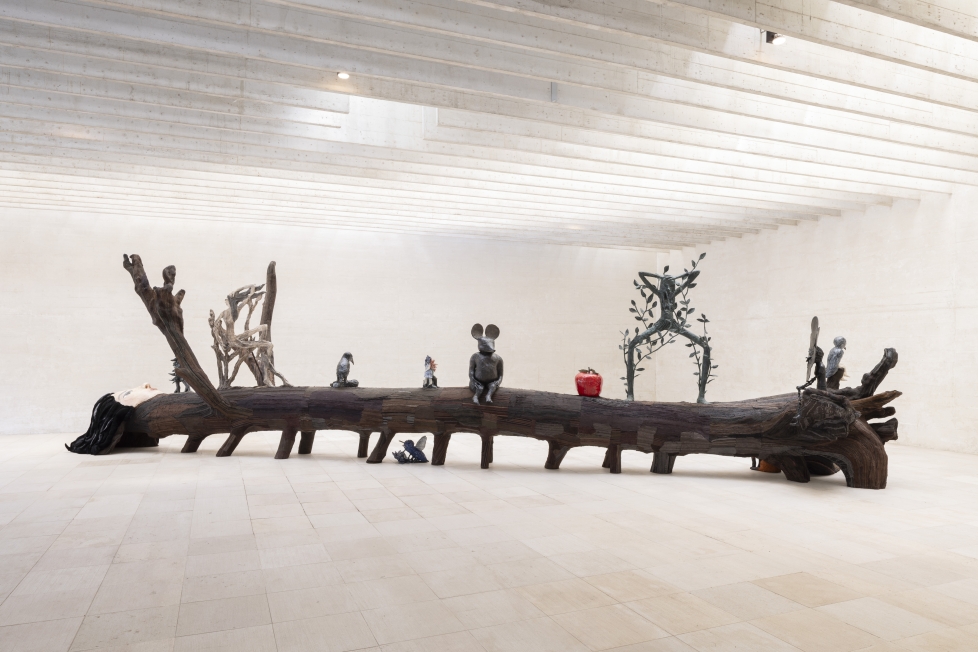
It is therefore with some relief that I wander through the pavilion taking in the prudently titled exhibition How Many Angels Can Dance on the Head of a Pin. The common denominator is that the works depict different states of transformation and change. That is difficult to render in an unambiguously cute way, even if Kristalova occasionally seems to try. Inside the pavilion she presents an installation depicting a life-sized fallen tree trunk populated by a series of whimsical creatures in ceramic, bronze, and wood. Some of them feel highly Instagram-friendly, almost ready to become memes.
I can certainly relate both to the gleefully grinning red apple and the spruce tree wearing heeled boots. It is imaginative, but in a conventional manner. Compared to the ceramic sculptures by Célia Vásquez Yui and Seyni Awa Camara that I had just seen in the main exhibition, Kristalova’s creatures feel rather tame.
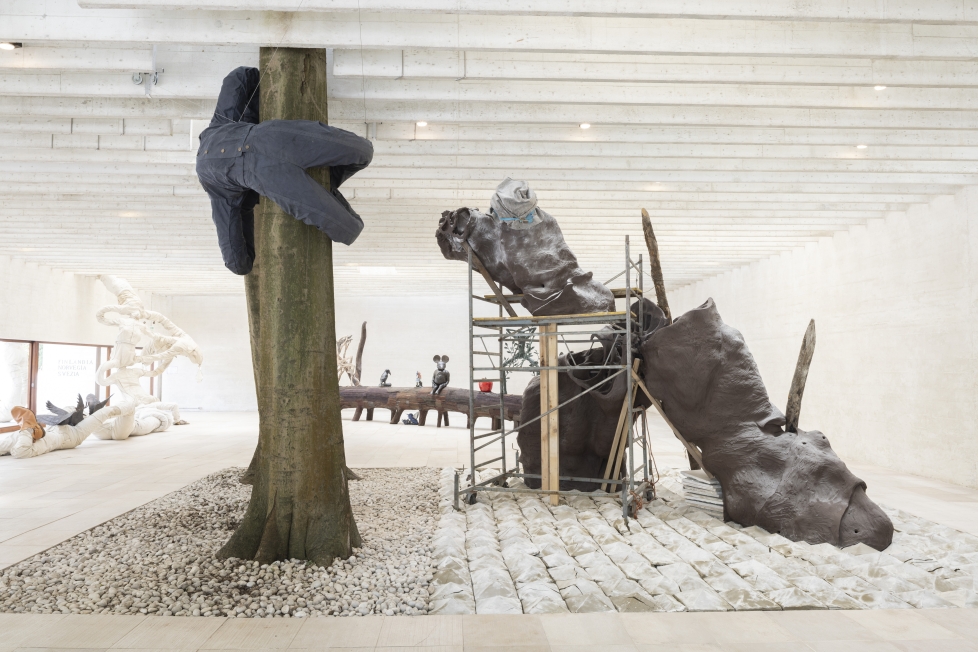
Kristalova’s fairy-tale tree is flanked by large installations by Orlow and Wrånes. Their works are less cool than hers, and therefore also less unconcerned. Wrånes certainly incorporates humor into her gigantic indoor sculpture — a sibling to the work on the other side of the pavilion’s panoramic window — yet she manages to maintain a balance between sincerity and playfulness. I am less fond of the kinetic sculpture that gently humps one of the living trees growing inside the pavilion. The jokey allusion to sexual vitality clashes awkwardly with Orlow’s site-specific clay sculpture, which radiates a sickly aura.
Mustonen’s stated ambition has been to create a group exhibition in which the pavilion’s architecture acts as “a fourth artist.” At first, I dismissed the comment as a typical curatorial platitude. But during the opening event, when I witness a performance in which Wrånes, dressed in a gigantic headless troll costume, slowly drags herself up the steps to the small platform beside the pavilion, my perspective changes. As melancholic singing echoes through the open fly in the troll trousers while Kristalova’s bird and Orlow’s impaled head stand guard, it genuinely feels as though Fehn’s building has fallen entirely under the creatures’ possession.
More reviews, highlights, and dispatches from the 61st Venice Biennale will follow. Stay tuned!