According to Maja Malou Lyse, it all began when she received a phone call from the CEO of a Danish sperm bank. He wanted to donate twenty litres of cum to her, as material for an artwork. The call led to a study visit at the Danish company Cryo – the world’s largest sperm and egg bank – where Lyse became enthralled by the thin walls separating smutty wanking booths from sterile laboratories. Together with the fascinating factoid that sperm becomes more fertile if the person ejaculating it watches VR porn while doing so, this became the point of departure for the Danish Pavilion, Things to Come, curated by Chus Martínez, at the 61st Venice Biennale.
Lyse reached a broader audience in her home country with the educational TV show Sex with Maja in 2019, but has until now had a fairly modest international career. At this year’s Biennale, she is the youngest artist ever to represent Denmark, and one of several artists turning to the political dimensions of reproduction. In Ei Arakawa-Nash’s Japanese Pavilion, for instance, visitors are invited to feed, put to bed, and change manically cheerfull baby dolls wearing sunglasses in an explicit attempt to kick-start baby production. The location hardly makes the subject less charged: this is Italy, after all, where birth rates continue to hit new record lows. In a growth-oriented system, the fertility crisis is not merely an existential matter, but also a question of who will keep the machinery running in the future – working, consuming, and paying taxes.
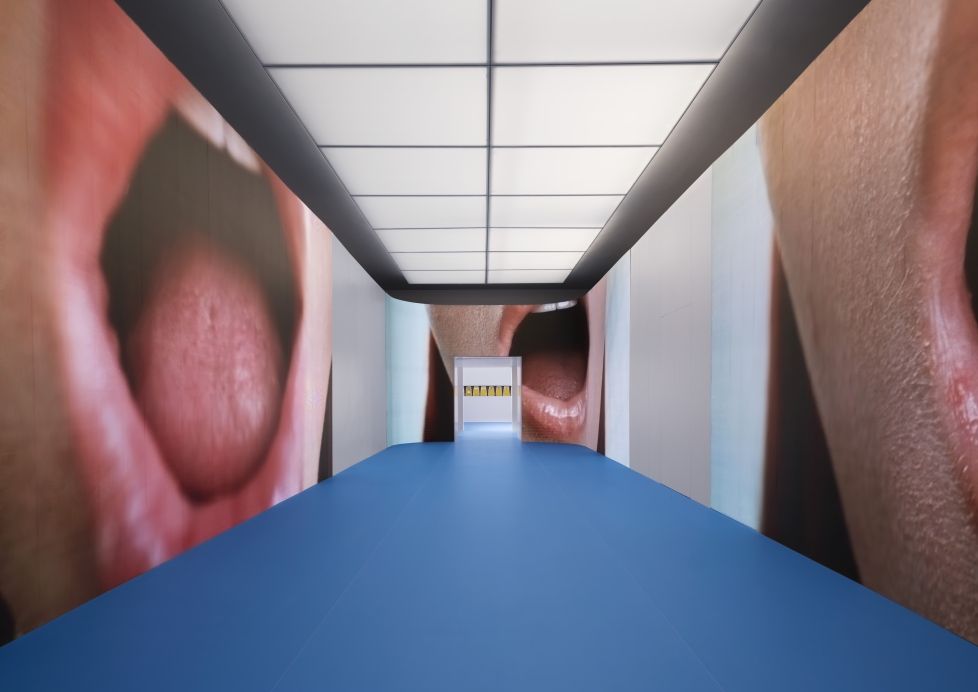
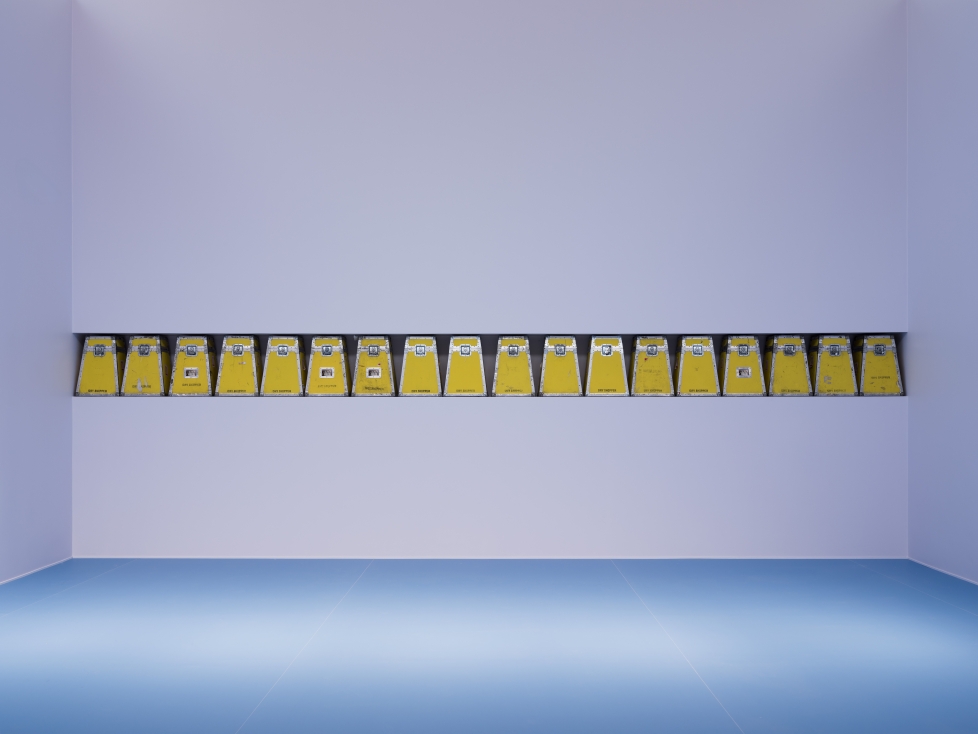
In the Danish Pavilion, the building has been given a futuristic revamp, with a clinically blue floor running seamlessly through the exhibition’s three rooms. Two benches with rounded corners, brushed-steel details, and tubular backrests add to the feeling of a waiting room. In this way, the setting ties into the pavilion’s functionalist legacy, where care for the body and the institutional ordering of it sit uncomfortably close together. In the room to the left, a tight row of bright-yellow storage boxes for biological material has been set into the wall and spotlit in a way that makes them feel like expensive handbags in a luxury boutique-laboratory.
Lyse has a phenomenal sense for creating photogenic installations. If I could wish away the thousands of muddy shoeprints on the floor and the overwhelming mass of bewildered Biennale visitors, an extraordinarily visually precise room would emerge. The aesthetic parallels with the 2010s, and not least with DIS, are visible in the way corporate aesthetics and the body collapse into a sleek, glossy surface shaped by tech’s frictionless fantasies. In the room to the right, the connection to DIS is made still more concrete, as the collective has co-created the crisp three-channel video installation shown there.
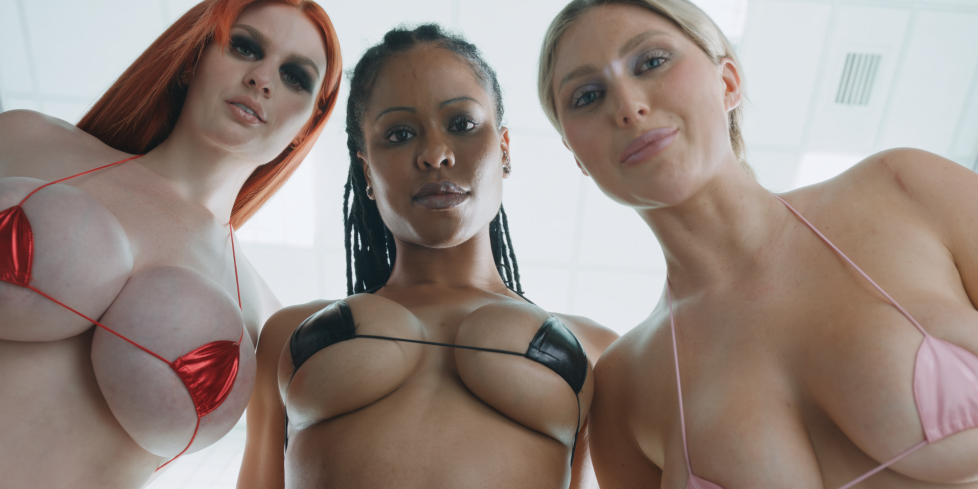
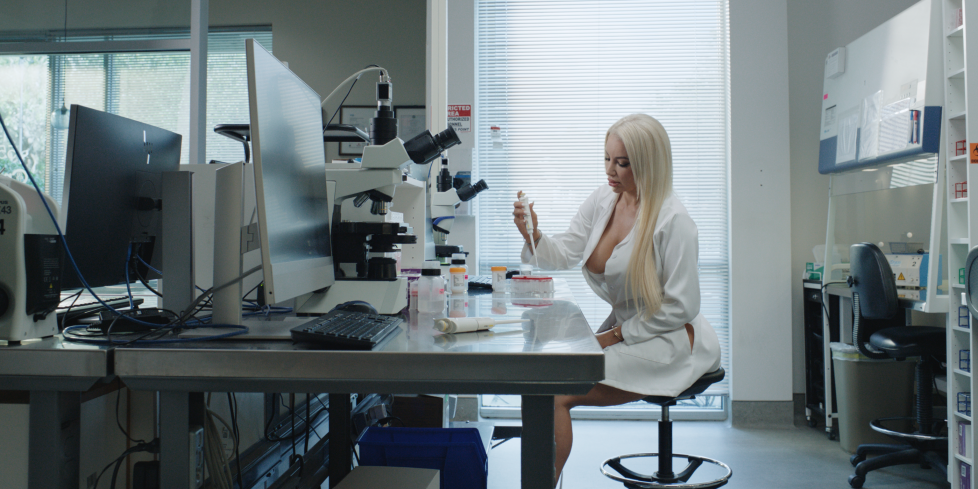
The corners of the room have been rounded off and are covered from floor to ceiling by a video in which a group of fully glammed porn stars move through various sharply lit sterile spaces: a white cube, a laboratory, a CGI-generated forest, a scenographic bedroom. As a visitor, I am devoured by giant tits filling the entire picture plane, only to be thrown into a scene where the bosomy bimbos play scientists, pointing with long acrylics at screens showing swimming sperm. Next, I find myself inside a refrigerator, looking up at a girl who tells me that her fillers are made from dead people’s fat.
In another scene, a man plays the piano with his smoothly shaven pecs. In a third, the artist herself sits high up on a ladder, a blond fake goatee on her chin, tugging on two fishing lines attached to a sexy red-head’s bra for even more bouncing-tit effect. Like the Japanese Pavilion, it all feels like a fertility commercial.
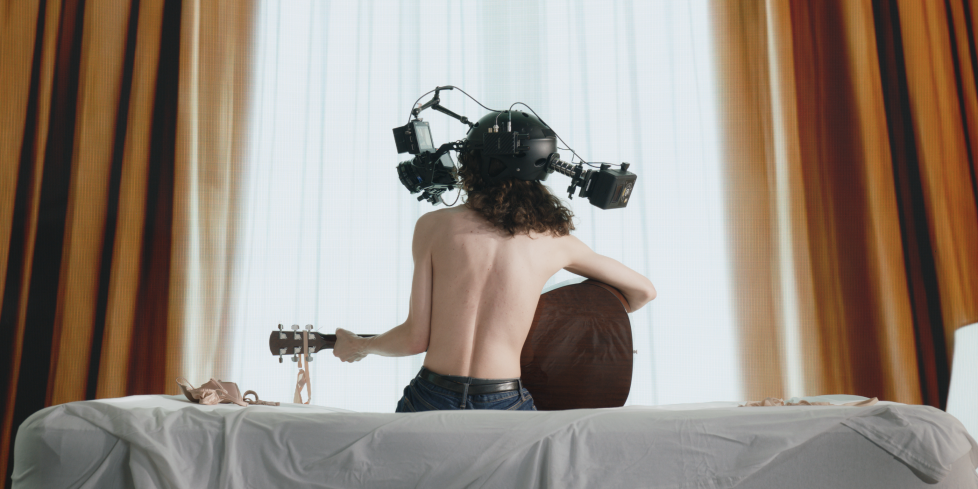
When I eventually end up in a bed with yet another sexy babe before my eyes, seen from the point of view of a guitar-plucking man – while, in the previous scene, I’ve been shown the cumbersome camera helmet that makes the POV image possible – both the film and the exhibition’s narrative begin to buckle under the weight of their many anecdotes and questions: imaging technology, pornography, reproduction, the masculinity crisis, the manipulated body, and so on.
These are themes that are interesting in themselves – not to say highly topical – but here they become so numerous that the film loses direction and lacks depth in relation to the truly interesting question: what’s happening to contemporary cum? Precisely for that reason, the installation in the other room is stronger. Some of the yellow boxes have been fitted with small screens showing clips from a sperm-racing championship, thereby linking the fertility crisis to a broader narrative of masculine collapse.
Underlying the exhibition’s premise – that fertility increases when one watches porn – is a moving belief in the image itself: the idea that art can change us in a physical way. Yet, despite all the gaping mouths and spread crotches, I experience Lyse’s video installation as strangely sexless. That I don’t exactly get off from these bodies, mutated according to contemporary ideals, writhing before the camera may be a personal preference – and possibly an important point in itself. But as the video moves between theory, farce, and an effect-seeking sexy address, the experience never quite has time to settle.
The possibility of confronting the art audience with a kind of circle jerk feels somewhat like a missed opportunity: a lost chance to manifest how the image might actually enter the body. Perhaps what is required is to take one matter all the way, as in Florentina Holzinger’s buzzed-about Austrian Pavilion, where the body is not merely a theme but a material that leaks until the visitor is bathing in bodily fluids. Lyse delivers much of the bang demanded by the Biennale format, but in the Danish Pavilion too many questions compete for the same space.
In general, it seems difficult to escape the framework of the national pavilion. The Nordic Pavilion is framed through regional folklore; Austria gets to stand for the repressed, the perverse, and the European unconscious; and aren’t Jenny Sutela’s tufted textile sculptures in the Finnish Pavilion suspiciously Moomin-like? Against this backdrop, the Danish Pavilion appears as a perfect contemporary export catalogue: Ozempic-thinned janky bodies, sperm and eggs from Denmark’s competitive reproductive industry – and let’s not forget “gladporno” (feelgood porn), a venerable Danish export commodity.
Things only become truly bodily at the pavilion’s afterparty, where we, like sperm directed towards the same goal, try to push past a strict bouncer and into the warmth. There, Cicciolina, the aged patron saint of all bosomy babes, stands on stage surrounded by a gang of happy gays. Hardly a solution to the nativity crisis, but it certainly works as entertainment.
More reviews, highlights, and dispatches from the 61st Venice Biennale will follow. Stay tuned!