Market time again! Despite fuelling up on a cheese sandwich and orange juice during Fair Director Sara Berner Bengtsson’s press introduction, I soon felt like a zombie wandering from booth to booth of paintings in the familiar Nordic idiom: melancholic, atmospheric, nature-lyrical, romantic, expressionistic. There was a lot of garish colour, I noticed, rubbing my temples, before trying to cheer myself up by talking to a few friendly Danish gallerists.
Market Art Fair turns twenty this year, and with fifty-four participating galleries, this is its largest edition to date. Yet it doesn’t quite feel like it. The rationale for leaving Liljevalch’s beautiful kunsthalle on Djurgården remains unclear to me, but it quickly became apparent that this hangar-like building at the far end of Stockholm’s free port is a downgrade. Spontaneous visits are out of the question, and the impersonal setting amplified the uniform presentations and predictable selections. I feel for the art; it is not easy to look good in such impoverished surroundings.
My mood darkened further when I reached the Swedish bank SEB’s eye-searing green booth where it presented parts of its art collection. But it was not the works by artists such as Mamma Andersson, Klara Lidén, and Ann Böttcher that caused my reaction, but the fact that Swedish media some years back revealed SEB as a major financier of arms companies enabling Israel’s killing of Palestinians in Gaza. Yet Market continues its sponsorship arrangement with SEB, initiated in 2023, the same year the war began.
Furthermore, according to Fair Finance Guide, SEB repeatedly ranks at the top of studies of Swedish banks’ support for arms exports to countries with extensive human rights violations, such as Yemen. A suitable partner for one of the Nordic region’s largest art fairs? I think not. We can only hope they at least charge a decent fee, unlike Liljevalchs, which sold itself cheaply to BNP Paribas – later fined in 2025 for facilitating violations of international law in Sudan, leading to the termination of that partnership, something which Kunstkritikk has previously reported on (only in Swedish).
Not only do such problematic sponsorships lend legitimacy to dubious actors, but they also cast art itself in a questionable light. One way of dealing with this is to embrace the questionable as an artistic approach, and Arvida Byström’s AI-generated porn at Stockholm gallery Steinsland Berliner’s booth feels like the only adequate response to the whiff of moral indecency hanging over the fair. Contemporary art used to be about commenting on its own time; now its purpose seems to be helping us look away from it. In fact, Byström’s work is the only work at the entire fair – which consists of roughly 90 per cent figurative-ish painting – that could not plausibly have been made in another era. Her digital tools and references to AI and OnlyFans simply did not exist a few years ago.
What is interesting about Byström is how she plays with the idea of a sanitised fair or salon aesthetic by wrapping her presentation of the ambitious project PET: Projected Emotional Technologies (2026) in a pink gift ribbon, as if it were a present. The central work is an AI-manipulated video in which OnlyFans performers, transformed into animals, adopt sexually suggestive poses while also engaging in some kind of therapeutic sessions with their clients. One receives advice on improving his sex life; another is comforted in his loneliness. It is quite touching, while also forcing me to confront my own emotional response, since, as I understand it, the work concerns prostitution – a subject that inevitably acquires an ambivalent resonance in the context of the art fair.
That said, Market Art Fair has never really been about contemporary art. From its inception twenty years ago, the aim was to remove the less commercial elements from the equation. Instead of a fair for everything encompassed by the term contemporary art (from journals and criticism to curatorial projects and artist-run initiatives), it was meant to become a proper marketplace, hence the name. A fundamentally flawed idea, since it simultaneously removed much of what makes art interesting: the friction, the oddity, the experimental, the critical. The fact that this year’s Talks programme looks more ambitious probably makes little difference.
Today, “the Nordic” is once again a hot topic in cultural policy. Various statements, particularly from the Danish Minister of Culture, have centred on the idea that the precarious geopolitical situation justifies looking after our own regional house and drawing closer together with our Nordic neighbours, with whom we share language, culture, and history (something Kunstkritikk has been doing for the past fifteen years, in fact).
Where this trend-conscious Danish sail will take us remains to be seen, but Market offers some clues. The grand old man of Nordic contemporary art, Olafur Eliasson, was prominently featured by the Icelandic gallery i8 with what look like oversized, brightly coloured posters from a discount chain.
Meanwhile, the Copenhagen gallerist Nicolai Wallner presented new artists he has signed on in a timely bid to become Mr. Nordic: a monumental five-part painting by Clara Gesang-Gottowt hangs alongside works by Carola Grahn, J.G. Arvidsson, and Kirsten Ortwed. These were shown opposite Magnus Karlsson Gallery’s presentation of Petra Lindholm, and the two booths almost read together as parallel explorations of Nordic nature-lyrical moods for the 21st century. As noted at the outset, this kind of painting is a recurring feature in the fair, both by millennials such as Simon Wadsted or Jonatan Pilhgren at Stockholmgalleries Issues and Coulisse, and by a Generation X-er like Munan Øvrelid at Galleri Haaken from Oslo.
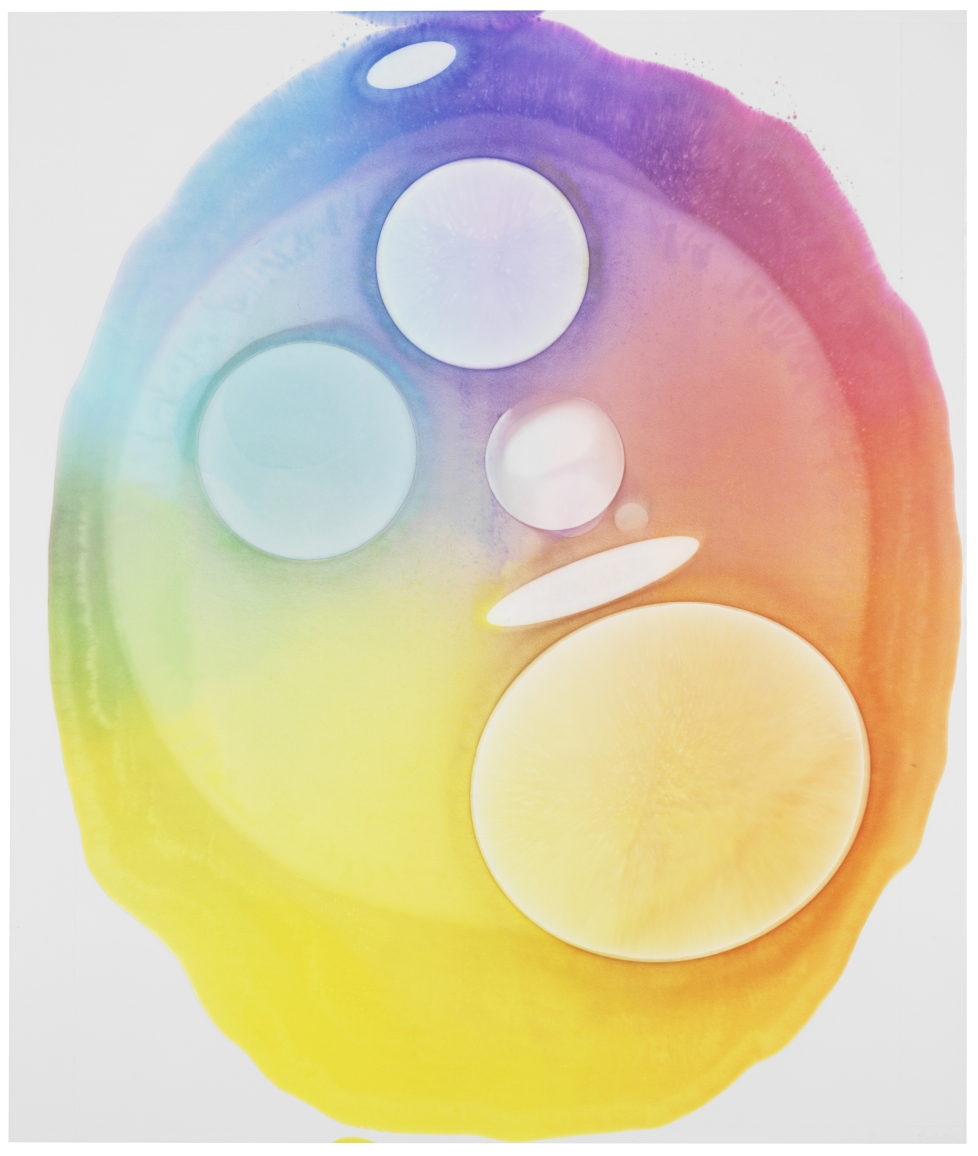
Many of these painters are interesting, but the fair context emphasises the least interesting aspect of the medium – its decorative function – while other dimensions recede. That said, a Nordic art institution ought to stage an exhibition on the return of National Romanticism, even if the nationalist prefix might feel contentious at a time when a decolonisation of how we understand “the Nordic” seems like a prerequisite for the concept’s continued relevance.
At Market, however, artists working from Indigenous perspectives were largely absent. Grahn, whose work engages Sámi identity, at Nicolai Wallner is an exception, as is the Greenlandic photographer Inuuteq Storch, whose documentary images were shown in a discreet back room at Copenhagen gallery Wilson Saplana. But these political perspectives feel, if anything, somewhat marginalised this year.
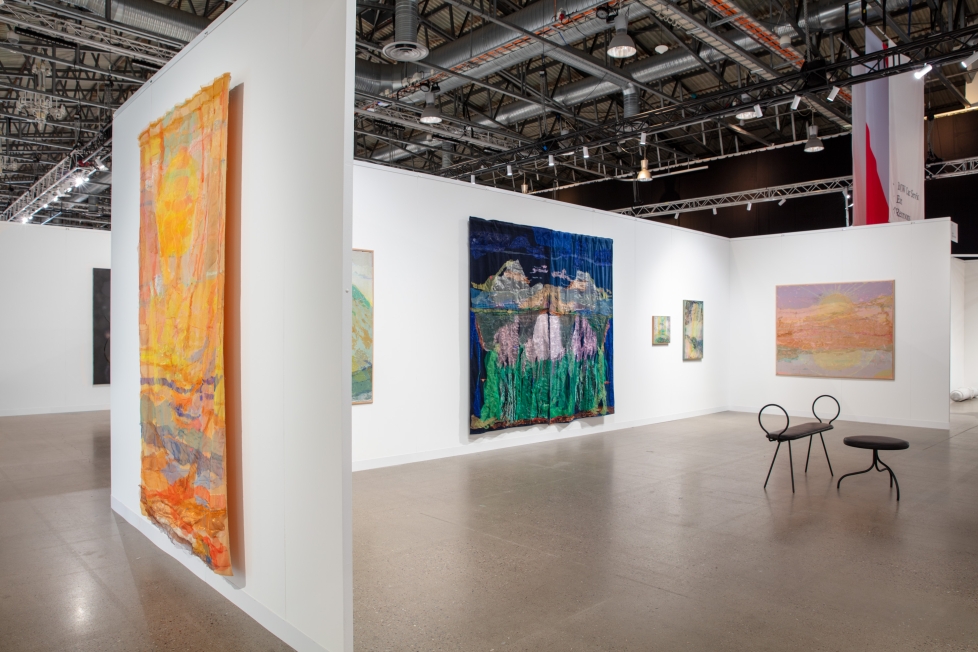
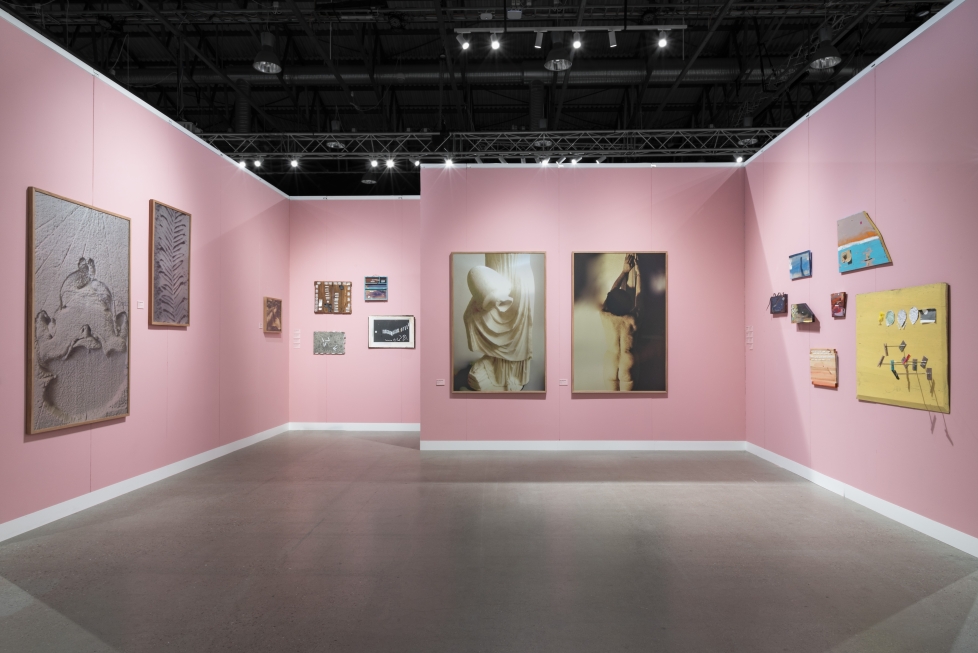
The rest of Wilson Saplana’s pink-painted booth was devoted to female artists such as Jytte Rex and Hannah Heilmann. The latter’s unassuming collages of bread-bag clips and foil yoghurt lids gently remind us that the present is not only made up of genocide, arms exports, and online prostitution, but also of those brief moments at the breakfast table. In all their tenderness, Heilmann’s offbeat works were the highlight of the fair.
Has the present become so unbearable that art’s only response is to look away? There is much to suggest so, and this tendency is amplified at Market Art Fair. At the same time, Berner Bengtsson spoke of a renewed confidence in the Nordic scene, with eleven of the participating galleries founded in the 2020s. We can only hope some of that confidence will rub off on the fair itself in the form of more daring presentations and positions in the years to come.