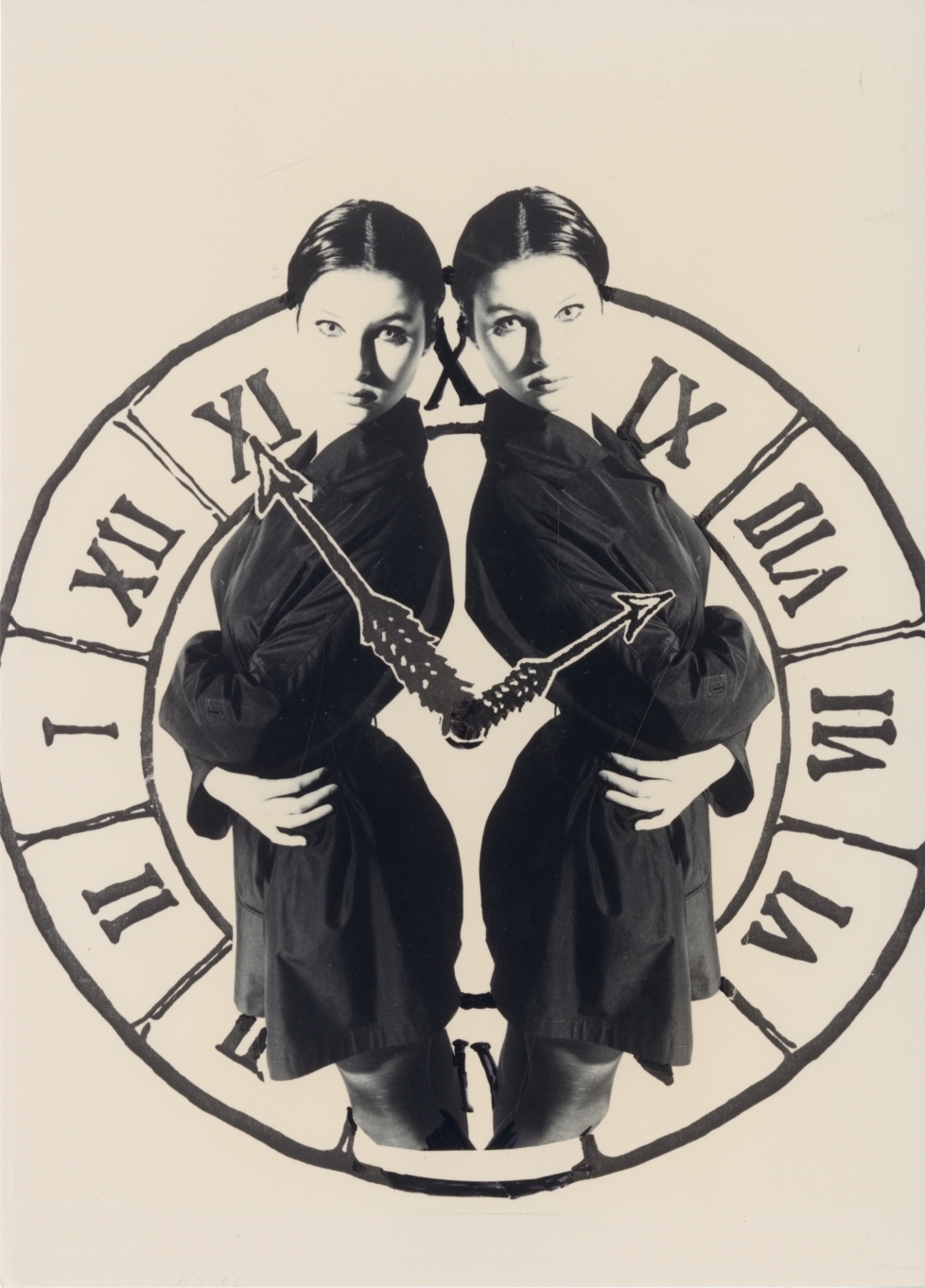
Arriving in Antwerp to see the exhibition on the Antwerp Six, I’m reminded of my first encounter with the work of these Belgian designers. In 1994, while studying art in Chicago, my boyfriend at the time bought me my first Ann Demeulemeester skirt. I had seen it – alongside designs by Martin Margiela and Dries Van Noten – at Ultimo, a small high-fashion boutique, where I was invited to alter a white T-shirt for a window exhibition. I had cut out the center of the T-shirt, replaced it with pink satin, and switched out the short arms with long slender satin sleeves that could be used to enwrap. I called it “auto-erotic lingerie.” It was one of the first exhibitions of my wearable artworks.
In the early 1990s, the relationship between art, fashion, design, architecture, and the body were being rethought into what later came to be known as relational aesthetics. My own work was part of this transformation too. At the time I was reading art and fashion historian Ann Hollander who argued that Western tailoring evolved to reveal the body’s sculptural anatomy through fitted cloth, insisting on the three-dimensional body as the primary object of aesthetic attention in a way that non-Western draped forms never did. It was the middle of the AIDS crisis. The body was central.
I still remember putting the Ann Demeulemeester skirt on for the first time – the bias-cut, the dangling black cotton ribbons that you could wrap around yourself, the asymmetry, the black crepe against my skin. I was enraptured by the way she gave the wearer choices, with ties and buttons, in how they could show and wrap their own body. All this came back to me as I entered the large glass doors of MoMu Fashion Museum of Antwerp and met the long lines of people waiting to come in to see the show.
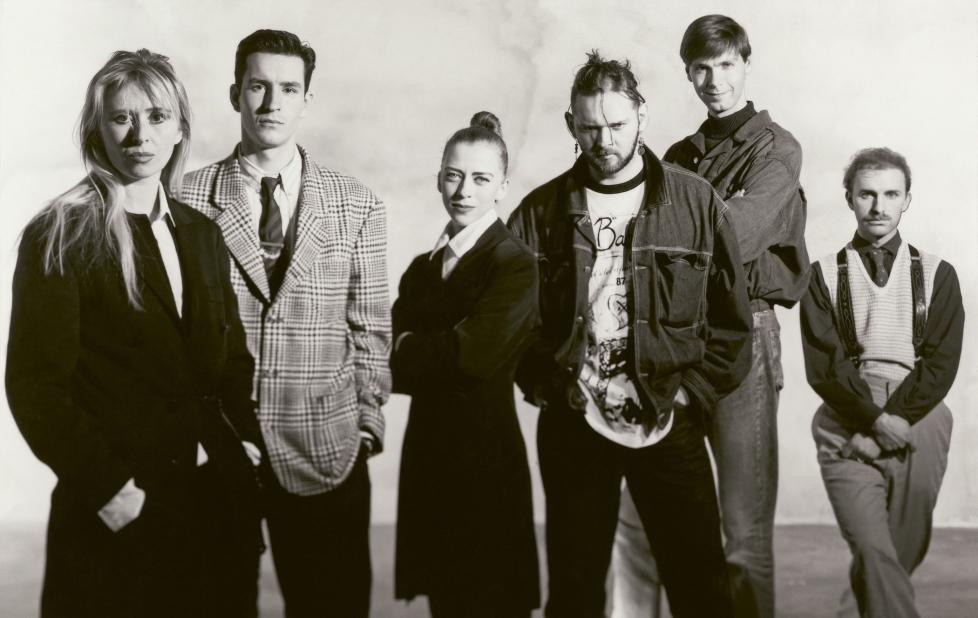
The Six – Dirk Bikkembergs, Ann Demeulemeester, Walter Van Beirendonck, Dirk Van Saene, Dries Van Noten, and Marina Yee – were among the most influential designers on the international scene during the mid-1990s, and all emerged from Antwerp. The moniker itself arose as a marketing convenience in 1986: invited to London Fashion Week and faced with an obscure venue and unfamiliar names, they produced a promotional postcard under the name “Antwerp Six,” attracting the right audience and helping launch their careers.
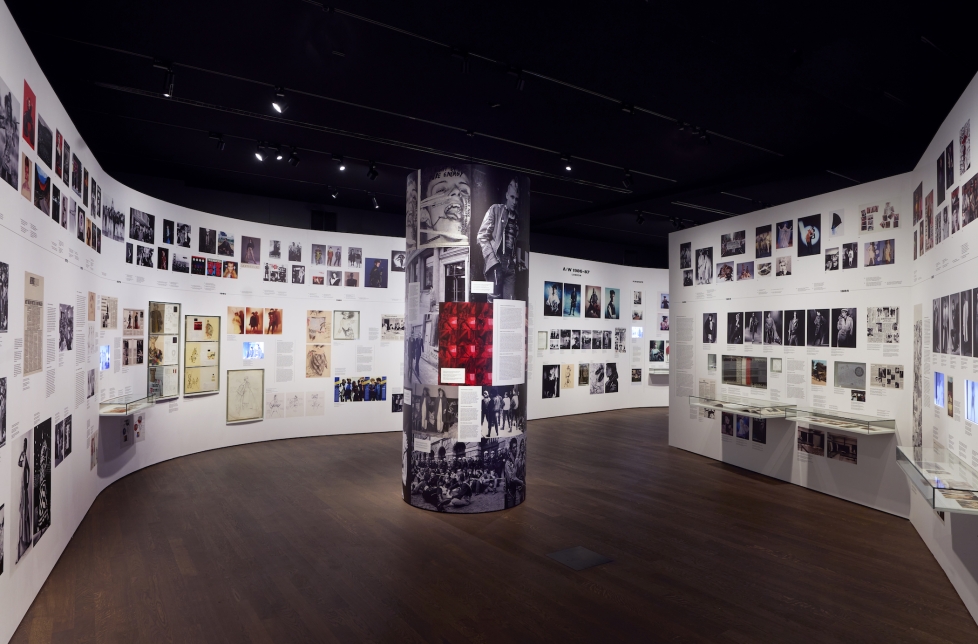
It is not mannequins in garments that open the exhibition – curated by Geert Bruloot, Romy Cockx, and Kaat Debo – but a two-room timeline of images, music, and cultural fragments that situates their emergence within the charged atmosphere of the 1980s. Rather than presenting a unified group, the installation immediately establishes difference – each designer unfolding as a distinct trajectory within a rapidly transforming fashion system. A massive mood board of photographs, text fragments, newspaper and magazine clippings, and small video clips from fashion shows and interviews traces five years of rapid global transformation and creativity. Running along a top tier is a parallel timeline of post-punk music – from Patti Smith to The Residents – situating the designers within a broader cultural atmosphere of performance, subculture, and circulation.
The exhibition’s strategy thus becomes clear. It presents the Antwerp Six not as a unified movement, but as a convergence of conditions. This collaged encounter with counterculture, but also with leading Japanese designers of the time with their focus on deconstruction is where the Six begin.
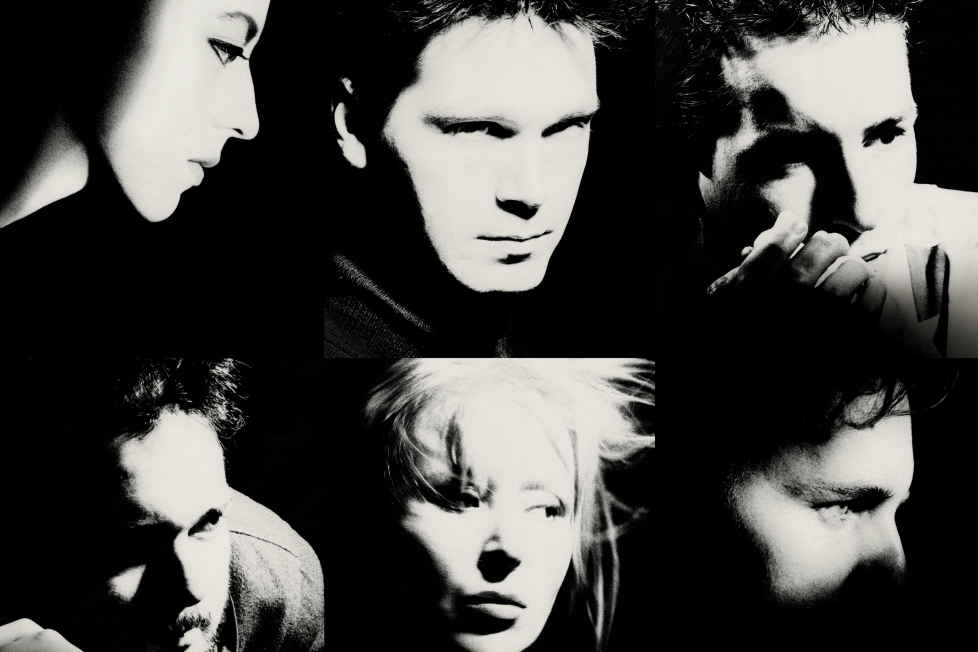
A large area is dedicated to the shock and discovery of designers such as Rei Kawakubo, Yohji Yamamoto, and Issey Miyake who debuted their collections in Paris in 1981, shocking critics with dark, oversized, asymmetrical designs that defied the human form. This, barely ten meters into the show, brings me back once again, this time to New York City, in 1983, when my friend, photographer Sue Kwon, and I were at the Metropolitan Museum of Art – she as an intern for Diana Vreeland at the Fashion Institute, and I worked in the reproduction studio deep in the bowels, making ceramic and plaster replicas of objects from the collection to sell in their shop.
Above ground, Comme des Garçons had just opened its stark Wooster Street store, and in our time off we searched for pieces we could afford, wearing them out into the night at the Roxy, a former roller disco turned wild style hub of early hip-hop, where DJs, breakdancers, and the hip crowd swarmed to the rhythm, or at the Danceteria, a multi-floor Midtown club that fused art, fashion, and music, and drew figures such as Madonna, Keith Haring, and Jean-Michel Basquiat, and was shaped by pioneers like Afrika Bambaataa, whose recent passing feels all too soon.
Even then, without fully articulating it – we were so young – Sue and I were already navigating a tension between system and self that the exhibition in Antwerp now makes so palpable. What I was not aware of at the time was that we were also moving within another dimension: the continued process of decolonisation. First came the Japanese designers’ liberation – the shedding of Western dress codes and a return to their own fashion tradition. The shock of that newness that the Antwerp Six encountered in seeing their work caused a radical shift, prompting them to reconsider their own European tradition of fitted couture and to deconstruct it in response. The timeline and collage of images in the first rooms makes this cross-pollination crystal clear.
The Antwerp Six all started at the Fashion department of the Royal Academy of Fine Arts in Antwerp in the late 1970s. Before I visited the exhibition, I stopped at the school where it all began, a beautiful campus dating back to the 17th century, now a patchwork of old ruins and new buildings.
When the Six arrived, the Fashion department was new but conservative, described as a finishing school for the daughters of the local bourgeoise. These young designers brought with them a rebellious raw, experimental energy inspired by the local art and design scene of improvised fashion events and collective spirit that blurred the boundaries between clothing, performance, and social life. I was to discover that the Fashion department had moved from the historic academy to separate facilities near the MoMu, as growing demand has exceeded the old building and priorities shifted increasingly toward strongly market-oriented engagement.
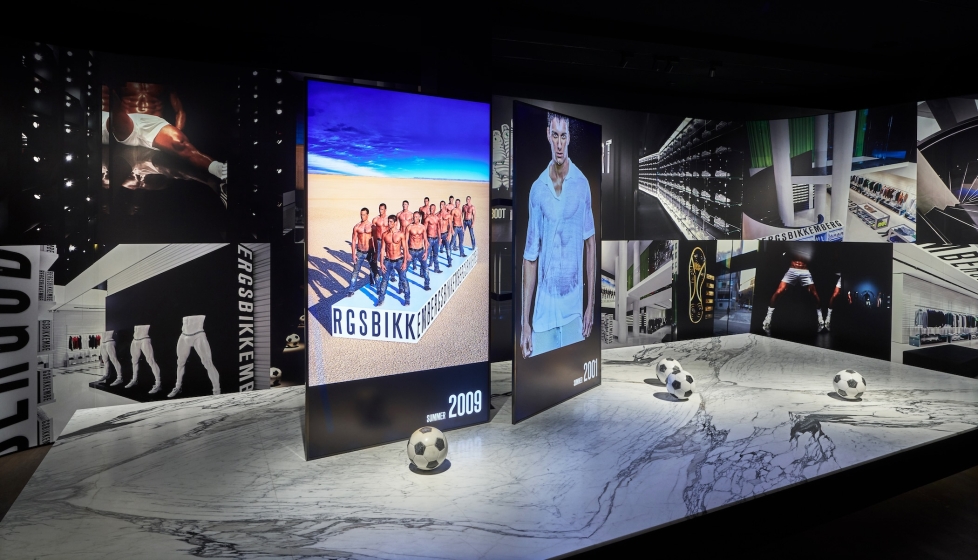
The first designer presented in the exhibition is Dirk Bikkembergs. Striking in its absence of garments, the environment resembles a memorial site with a bench emblazoned with the Bikkembergs logo on its side. It faces a tiled platform with soccer balls scattered around a screen displaying a sequence of anonymous athletic male archetypes wearing Bikkembergs designs.
This installation makes explicit a trajectory that is often implicit in fashion. Bikkembergs’s work aligns with sport, performance, and identity as scalable systems. His early focus on the exercised body anticipated the integration of fashion and athletics that now defines much of the industry. What remains his are the images – the photographs of models wearing his designs – while the brand itself has been absorbed into the larger legal structure of the fashion conglomerate. Bikkembergs likewise sold his brand early (in the 1990s) and lost creative control, with the label continuing as a commercial entity detached from his authorship. The room stages this separation with clarity. Authorship is reduced to image, and the designer becomes detached from what continues in his name.
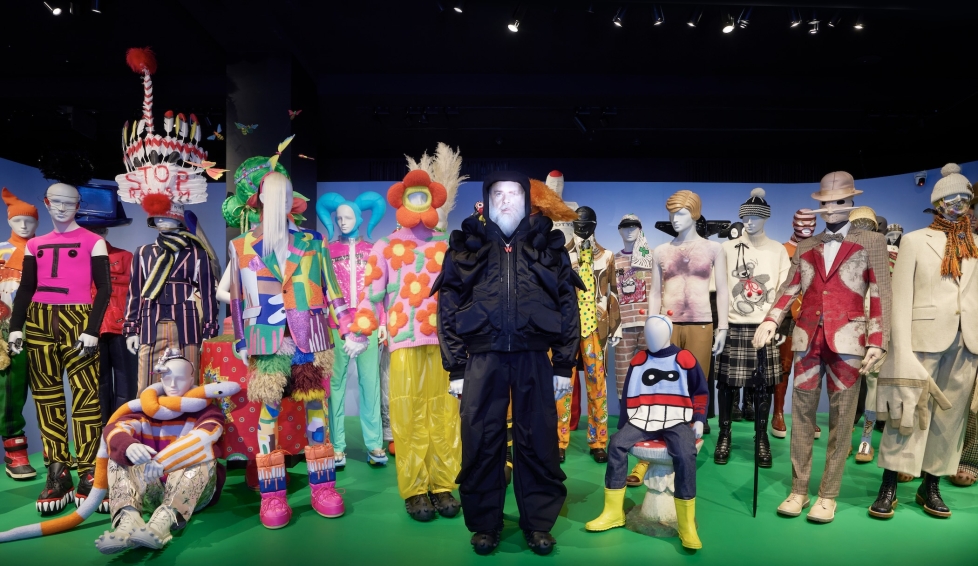
Entering the world of Walter Van Beirendonck marks an immediate shift. At its center is the designer’s avatar, with a terminator-like voice and a screen beneath a hoodie. A towering figure in a black bomber jacket and parachute pants leads an army clad in his expressive designs charged with ebullient nonconformist energy. The use of the monitor and hybrid body recalls the video sculptures of Nam June Paik, a reminder of how fluid and permissible inspiration is across visual art, fashion, and design. The installation captures Van Beirendonck’s trajectory as one of address. His work neither withdraws from the system nor fully aligns with it, but uses visibility to speak outward with attitude, exaggeration, directness, and a refusal of neutrality. He has retained full ownership and creative control of his label.
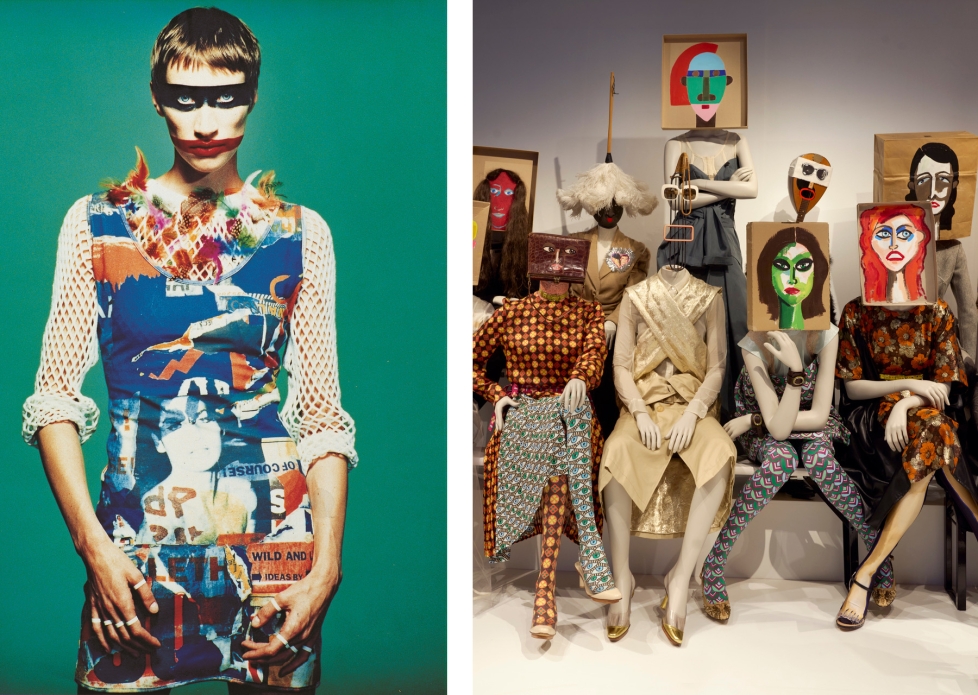
Dirk Van Saene and Van Beirendonck have been life partners since their school days and got married in 2018. Van Saene’s installation is a reconstruction of his final fashion collection: mannequins placed on a motorised conveyor belt, moving slowly through space. He stopped producing fashion collections in 2000 and has since focused on art and ceramics. Van Saene stopped before the advent of the fashion conglomerate, thereby maintaining an independent practice with complete artistic control.
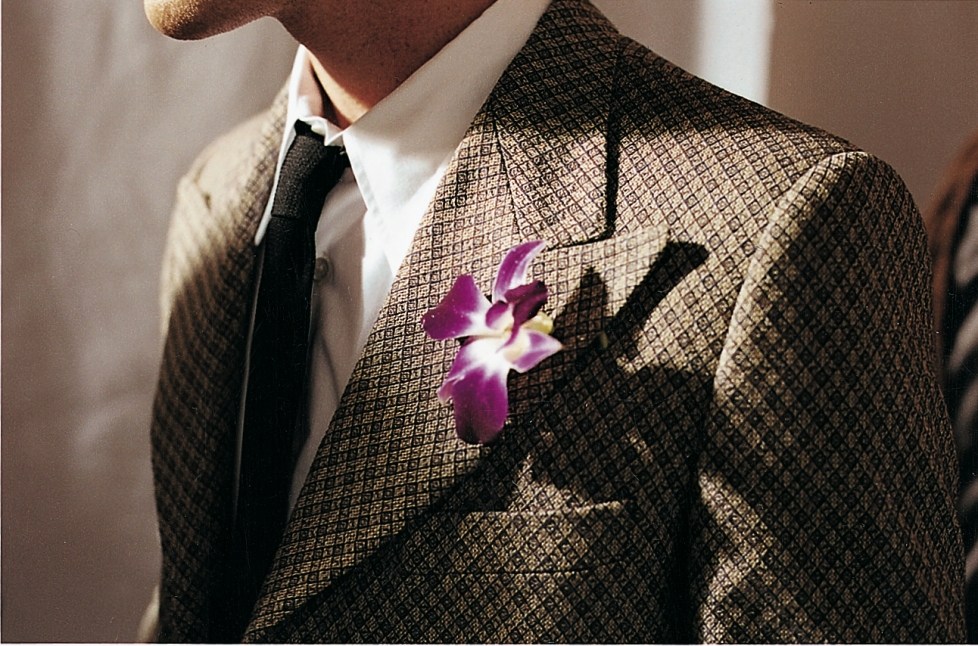
Dries Van Noten’s installation shows off his talent for fusion of natural fabric textures, patterns, and colors that harkens back to a romantic past. Van Noten is mostly gardening these days, and his current assignment is as a special consultant for the garden of the baroque master Peter Paul Rubens, ensuring 365 days of color in the garden. His brand is the most prolific and commercial of all the Six. I visited his three-story flagship store kitty-corner to the museum. Everything there was 100 per cent Van Noten from the lipstick to the shoes. Van Noten sold a majority stake in his company in 2018 and stepped down as creative director in 2024.
I have a soft spot for the immersive world of Ann Demeulemeester. Her room is filled with a playlist composed from her shows and studio. I have had Suicide’s ‘Cheree’ on repeat since seeing the show. The effect is total – leather, lace, shadow, monochrome, black, white, and gorgeous. This is not simply a display of garments, but a constructed environment reflecting a sustained and coherent vision. Demeulemeester’s trajectory is one of containment: her work builds a world that remains internally consistent over time, suggesting authorship that persists through careful control rather than expansion.
Not included in the exhibition, but important to credit, is her husband Patrick Robyn, who co-founded the Ann Demeulemeester label in 1985 and helped shape its visual identity behind the scenes. Demeulemeester and Van Noten are the only designers of the Six who currently have flagship stores in Antwerp, where their universe is scaled into a total experience. Demeulemeester sold her brand in 2013, leaving it under external ownership while remaining involved as an external advisor.
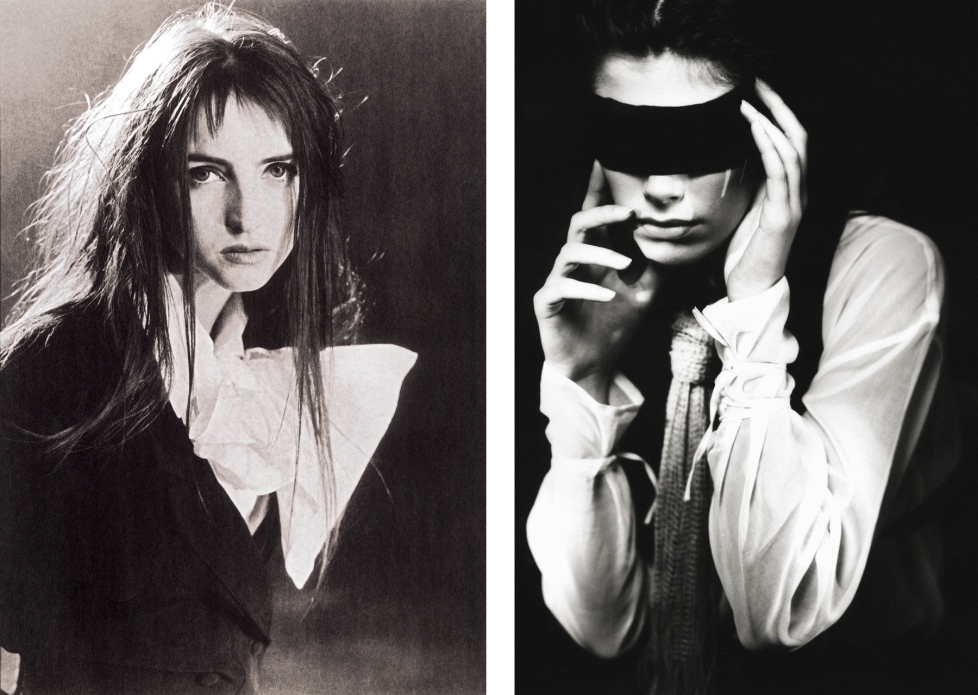
The exhibition concludes with a room featuring invitations, posters, and graphic materials produced by each designer, showing how each artist constructed a visual language beyond their garments. What emerges is not a unified style, but a set of positions and responses to the moment that fashion became a global industry. As conglomerates consolidated power, creativity became newly scalable, but ownership shifted from designers to structures.
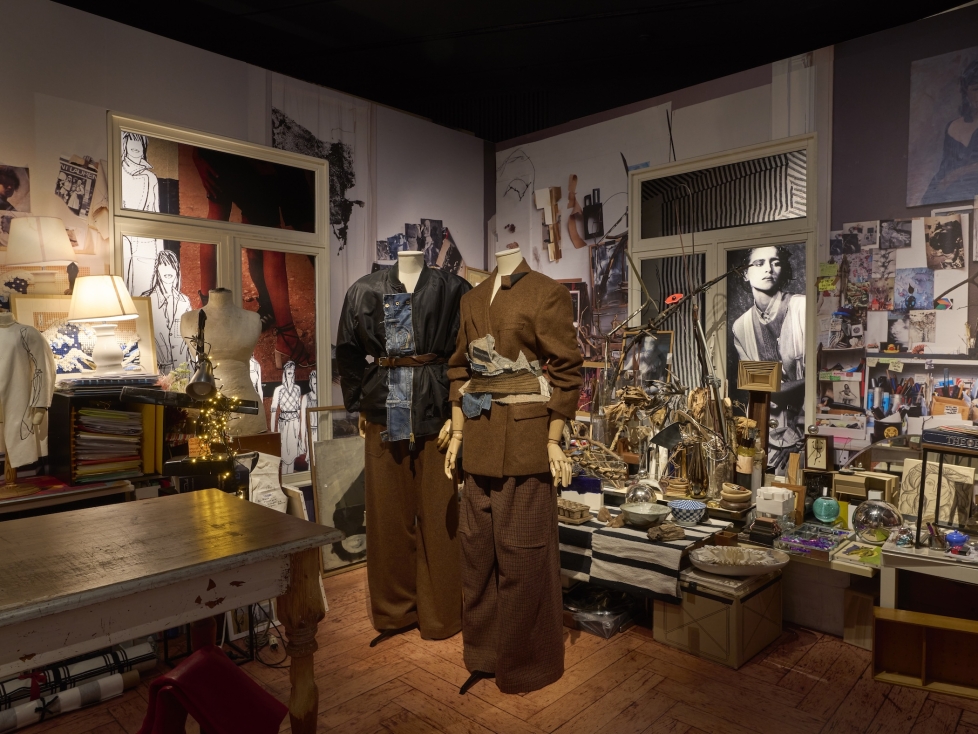
In many ways, the most intimate and emotionally charged installation is that of Marina Yee (1958–2025). Her studio is reconstructed as a space that cannot be entered but only observed through a series of windows. This separation establishes distance, positioning the viewer as a witness to a practice that now appears suspended in time. Inside, the studio is preserved as a tableau: worktables, books, paintbrushes, dress patterns – all the elements of a working environment remain. The effect is both archival and deeply personal, recalling a house museum in which the aura of a life is preserved alongside its objects.
Yee’s recent death after a short battle with cancer intensifies this temporal disjunction. It feels as though decades have passed. It was only coincidently that I learned that her collection was on sale around the corner from the museum at Louis, a small boutique owned by Geert Bruloot, the co-curator of the exhibition. I wondered about what agreements Yee and her family had made to put her unique upcycled designs into production. The salesperson in the shop told me that there were only a few items left because they were flying off the rack after the opening. In the window of the store, beside two mannequins, there were also two of her artworks: a painting and a collage that resembled the creations on view in the exhibition.
Yee never scaled into a conventional brand at all, remaining fully independent and owning her work until her death. Her label is now in an estate-managed phase, and whether it will transition to a formal corporate successor has not been made public. Yee’s practice, grounded in reuse and reconstruction, was meant to resist production as repetition. It seems the exhibition too struggles to position this resistance within a system that continues to absorb and reproduce it.
Of all the Six, Yee’s work remains the most poignant. Not because it offers resolution, but because it reframes the question itself. The issue is no longer how to position yourself within the system, but what assumptions make that system appear inevitable. What the exhibition ultimately articulates are relationships between authorship and production, deconstruction and decolonialization, and the body and the structures that organize it. These relationships remain open, unresolved, and, for that reason, still active.