It is difficult to knock the intentions behind the main exhibition at this year’s Venice Biennale, and not only out of respect for its curator, Koyo Kouoh, who died last year before she was able to bring her vision to fruition, leaving the task of completion to her curatorial team. Under the musical title In Minor Keys, the exhibition invites us to “listen to the insistent signals of earth and life,” to borrow a phrase from Kouoh’s foreword to the catalogue. It devotes itself to healing, regeneration, and care, aiming to wrest craft and alternative forms of knowledge back from the crushing grip of “capital” and “empire.”
The first thing you encounter in the Arsenale, the exhibition’s main venue, is a moving poem by Palestinian writer Refaat Alareer, who was killed in an Israeli airstrike in Gaza in 2023, immediately invoking one of the past few years’ most charged focal points of global attention. This is an emotional trigger of a magnitude that perhaps risks overriding the other, more literally minor keys that are to follow. But it does make clear Kouoh’s ambition to foreground art that “bleeds seamlessly into society,” as she puts it, that is, an art whose meaning is not primarily produced and experienced within the institution.
Among the exhibition’s 110 participants, there is a marked presence of artists from Africa or the African diaspora, and only a small handful could be described as Biennale regulars. A redistribution of attention in favour of the Global South has become a given at major biennials in recent years, and no longer feels like a groundbreaking curatorial gesture. But whereas Adriano Pedrosa’s Venice Biennale in 2024 made its politics of representation the exhibition’s central concern, Kouoh seems more concerned with practice-related aspects of the work than with their demographic coordinates. She also turns Pedrosa’s historically focused exhibition formula on its head by prioritising living artists, making the exhibition less about redressing sins of the past.
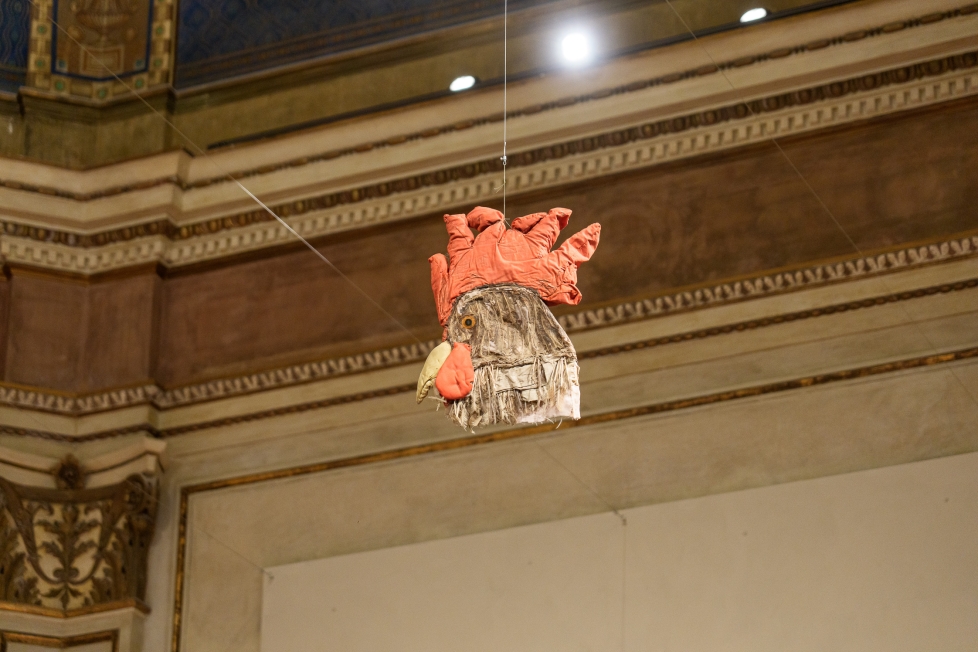
Two deceased artists, Issa Samb (1945–2017) and Beverley Buchanan (1940–2015), have been cast as patron saints, each given what is described as a “shrine” in the Central Pavilion in the Giardini, the smaller of the exhibition’s two venues. Buchanan is represented by pastel drawings and small sculptures, some depicting crooked shacks, others knotty assemblages of found materials – a kind of Arte Povera with socio-political connotations. Samb was the founder of the Dakar-based collective Laboratoire Agit’Art, and his shrine consists of everyday objects that have served as props in his performances, where reciprocal exchange with the audience was central. Samb’s and Buchanan’s emphasis on use and social interaction acts as a tuning fork for the exhibition. Although the exhibition does not particularly invite physical touch, it nevertheless suggests an ambition to restore art’s auratic attachment to real places and bodies, and to reactivate its social context and function.
A separate subcategory in In Minor Keys is made up of collective projects presented under the rubric of “schools,” defined as sites of “knowledge and regeneration.” Here we find, among others, the transdisciplinary, women-led educational platform RAW Material Company, which Kouoh herself founded; Denniston Hill, an artists’ residency based in the scenic Catskills in New York State; and blaxTARLINES, an association of teachers, artists, curators, students, and technicians based in Kumasi, Ghana, which helps build infrastructure for Ghanaian artists and art communities. Nairobi Contemporary Art Institute aims to preserve and promote contemporary art in East Africa, partly by exhibiting and collecting local art. The foregrounding of these institutions underlines the idea of art as a relationship-building, pro-social activity.
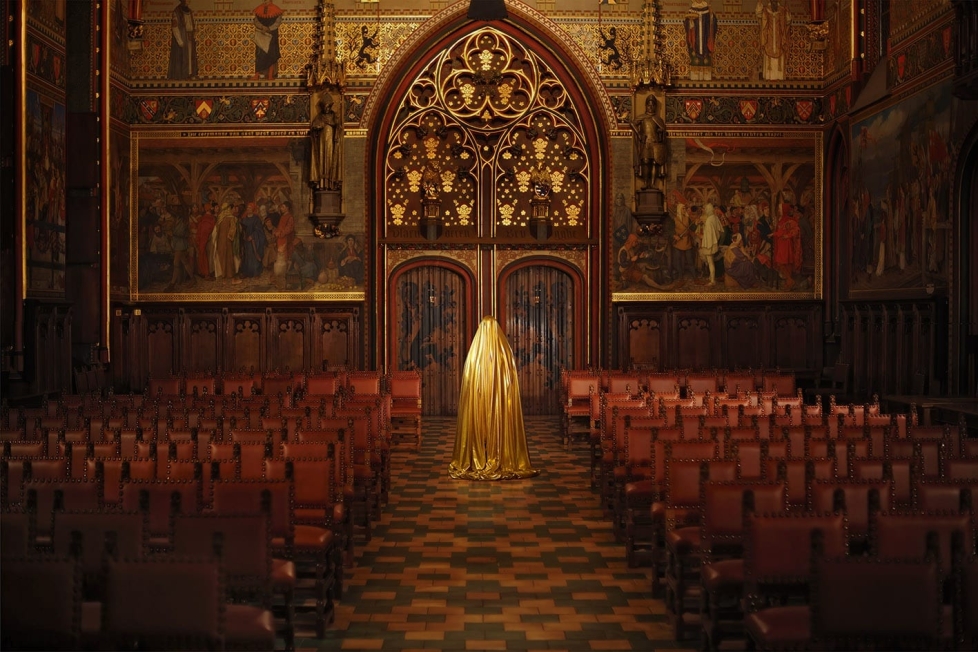
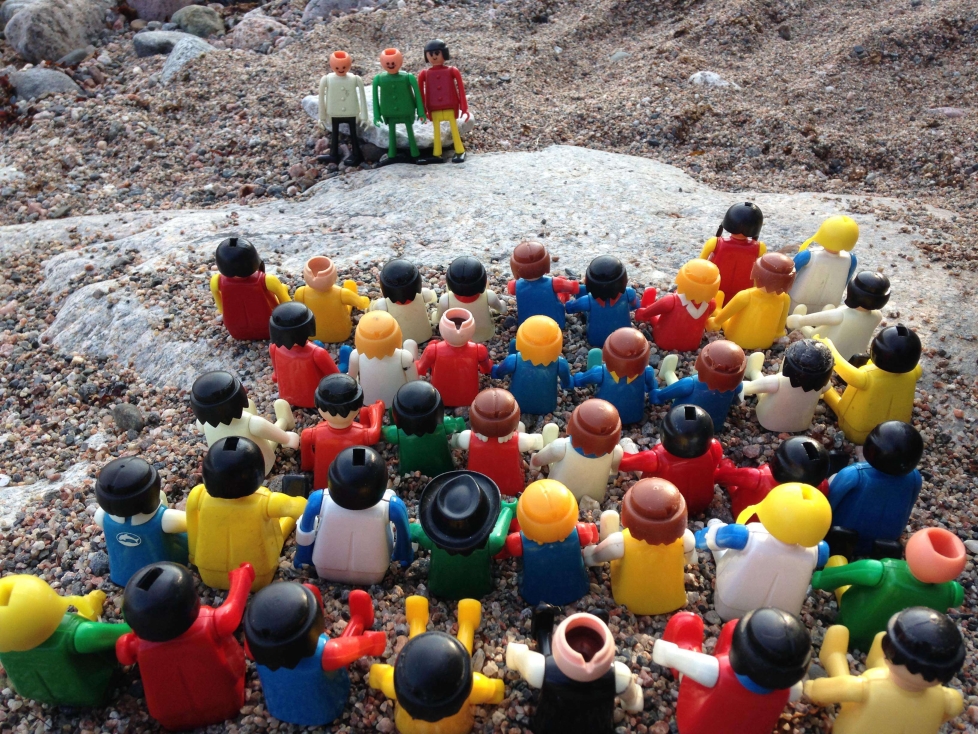
At the other end, we find works that dislodge the art object from its museological stasis by making it the centre of esoteric rituals. The most literal example is Hagar Ophir’s Bound With the Living: Gathering in Venice (2026), which includes a stage where actual spirit-conjuring is to take place, with the aim of allowing her objects to speak. Ritualistic practices are also invoked in more symbolic forms, as in Berni Searle’s Interlaced (2011), a video triptych in which the artist, dressed in black lace, performs a choreography in a sumptuous interior accompanied by a composition based on the Muslim call to prayer. Esotericism is handled at greater remove in Nina Katchadourian’s video The Recarcassing Ceremony (2016), in which she reconstructs a kind of revival séance she and her brother held as children for some toy figures they lost. The documentary is a gently bizarre piece of amateur psychology, bringing a playful mode into a context where postcolonial gravity often threatens to become suffocating.
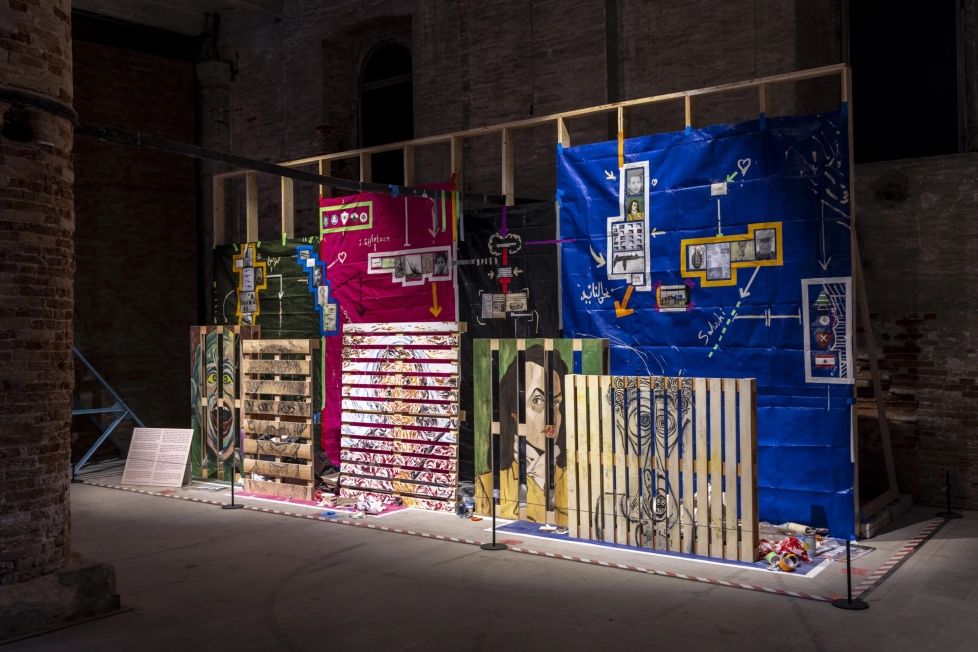
Others, meanwhile, place art within a historical-political frame by linking it to repatriation and cultural loss. Pio Abad’s meticulous ink drawings juxtapose bronze figures from the British Museum with provisional stacks of everyday objects (1897.76.36.18.6, 2023–2026). Walid Raad’s Postscript to the Arabic Edition (1938–2025) is a display of freight pallets which, according to the work’s fictional framing story, were used to transport weapons after the Lebanese Civil War, decorated with copies of famous Turkish and Arab paintings said to have escaped destruction.
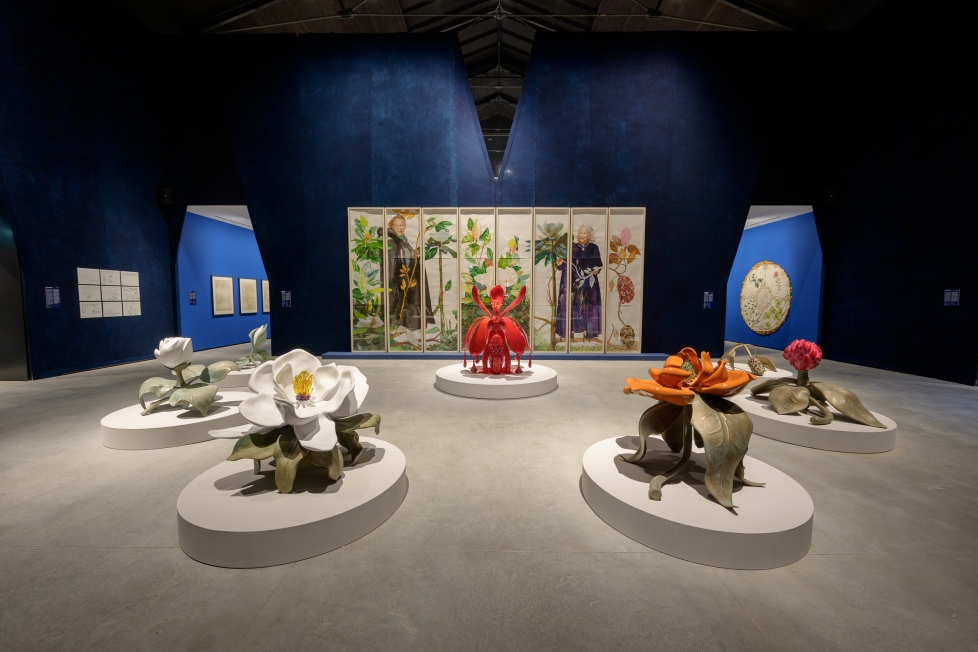
Kouoh herself has also been granted a kind of shrine in the exhibition, in the form of a monumental double portrait of her and the writer Toni Morrison by María Magdalena Campos-Pons (Anatomy of the Magnolia Tree for Koyo Kouoh and Toni Morrison, 2026). The heroic painting of the two women, here equipped with bird’s talons for feet and surrounded by brightly coloured flowers across eight vertical panels, is an aesthetic trial for anyone with a low tolerance for reverential excess. I also wonder how wise it is to make the curator a literal centrepiece in an exhibition, already brimming with her indirect presence through the grief over her death, shared by the co-curators and presumably by many of the artists. It comes uncomfortably close to a cult of personality, which I imagine Kouoh herself might have found misplaced.
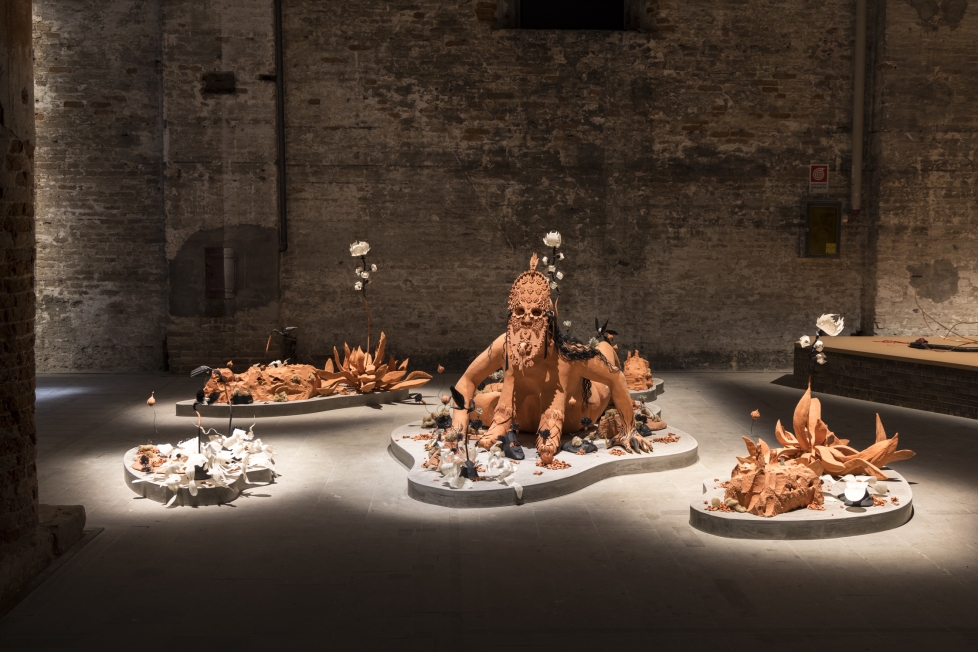
Both in the Giardini and in the Arsenale, there is, moreover, an at times monomaniacal focus on plant life. Otobong Nkanga has clad the columns of the pavilion in the Giardini with locally produced bricks and climbing plants (Soft Offerings to Silenced Voices and to All Who Have Turned to Dust, 2026). Uriel Orlow’s Dedication II (2021–2026) consists of flat screens placed vertically on the floor, showing close-ups of forest floors and tree roots, from which meaning-laden poetic fragments pop up to remind us of the symbiosis between trees and fungal networks, a kind of vegetal communication system. Theo Eshetu’s Garden of the Broken Hearted (2026) is a rotating olive tree onto which a video of the tree is projected. Sandra Knecht’s installation Home is a Foreign Place (2026) boasts a bronze cast of her favourite pear tree, alongside found objects, photographs of the artist in costumes inspired by Swiss folklore, and a restored apiary.
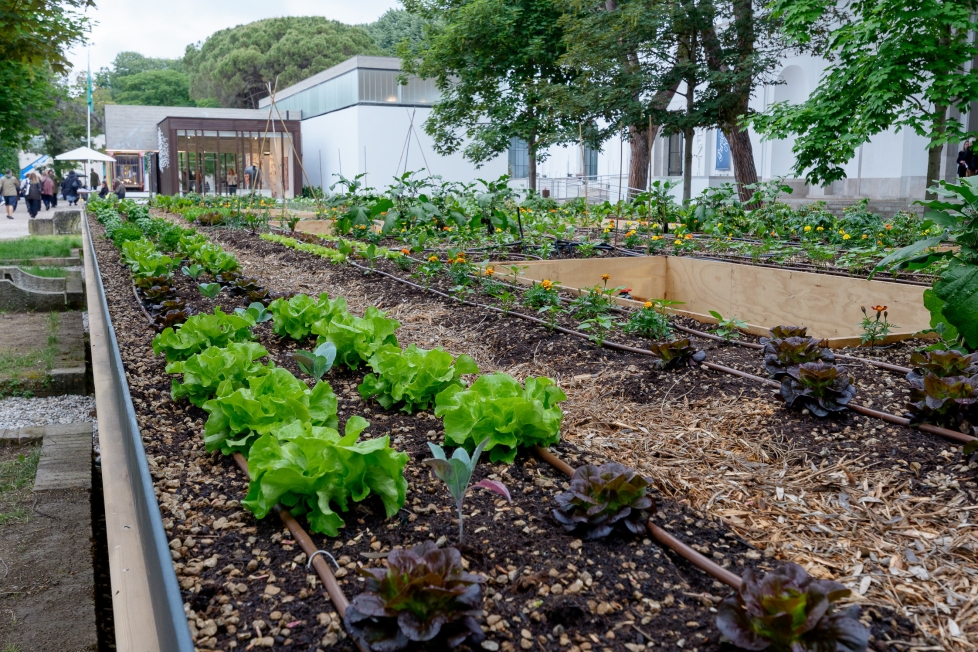
Dan Lie’s Ephemeral temple for decaying beings (2026) consists of enormous flower garlands hanging from the ceiling, serving as stages for microbiological processes. Linda Goode Bryant’s Still Life (2026) includes a garden plot in the Giardini, where formerly incarcerated women grow local vegetables, as well as a film with footage of wild plants covering buildings in Venice. Others use the plant kingdom as a resource for ornamental compositions, such as Wardha Shabbir, with her intricate floral gouache paintings. This adoration of organic materials, both mediated and directly imported, has already become something of a trope in climate-conscious contemporary art, and when encountered in such quantities, it begins to feel like outright eco-political kitsch.
The sense of monotony is intensified by the curators’ decision to refrain from conventional ways of organising the exhibition, such as dividing it into thematically distinct sections. The intention of enabling an experience (inspired by free jazz) that is sensuous rather than didactic, as Kouoh puts it in her catalogue essay, is sympathetic on paper. In practice, however, it means that the material at times threatens to merge into an undifferentiated mass, as you instinctively grasp for ways to reduce the barrage of information. The problem is more pronounced in the vast, corridor-like halls of the Arsenale, where the architecture offers less assistance than in the Giardini. The exhibition design by the Cape Town-based Wolff Architects that consists of long banners suspended from the ceiling, bearing quotations selected by Kouoh, are intended to function as tentative room dividers. But they do little to structure the exhibited material or ease the labour of sorting it.
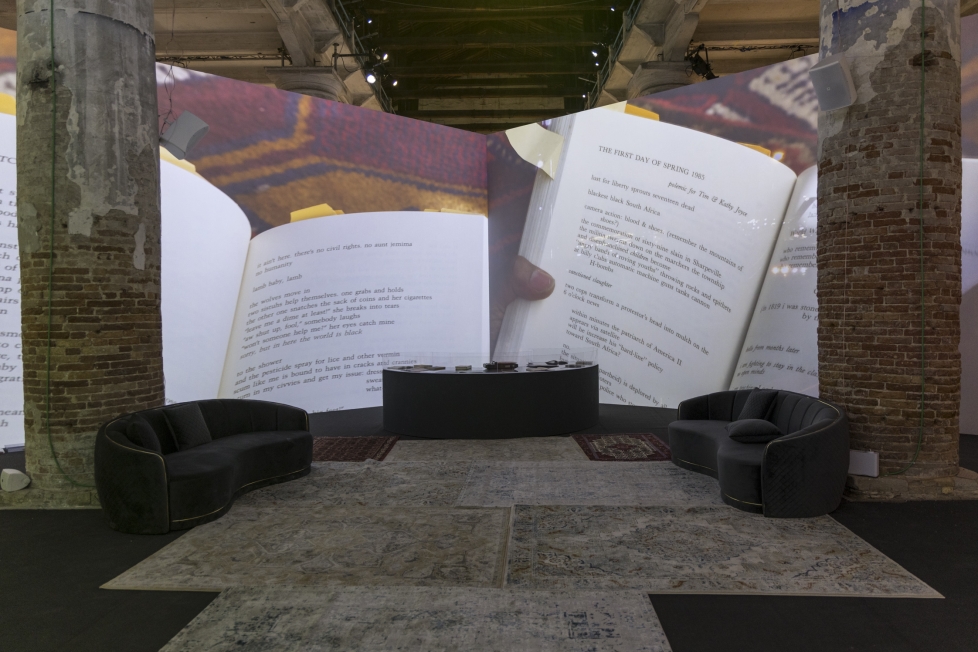
Several works do, however, function as enclosures that visitors can enter, offering a respite from the whole. Cauleen Smith’s installation The Wanda Coleman Songbook (2024), centred on the American poet Wanda Coleman, consists of a seating area with a couple of sofas and a pile of blankets, from which you can watch a four-channel video work showing street scenes from Los Angeles, accompanied by seven different soundtracks by Black composers inspired by Coleman’s poems. A selection of the poems can also be read in open books placed in a vitrine. This oasis is a more laid-back and successful way of integrating literature into the exhibition than the banners shouting quotations at you.
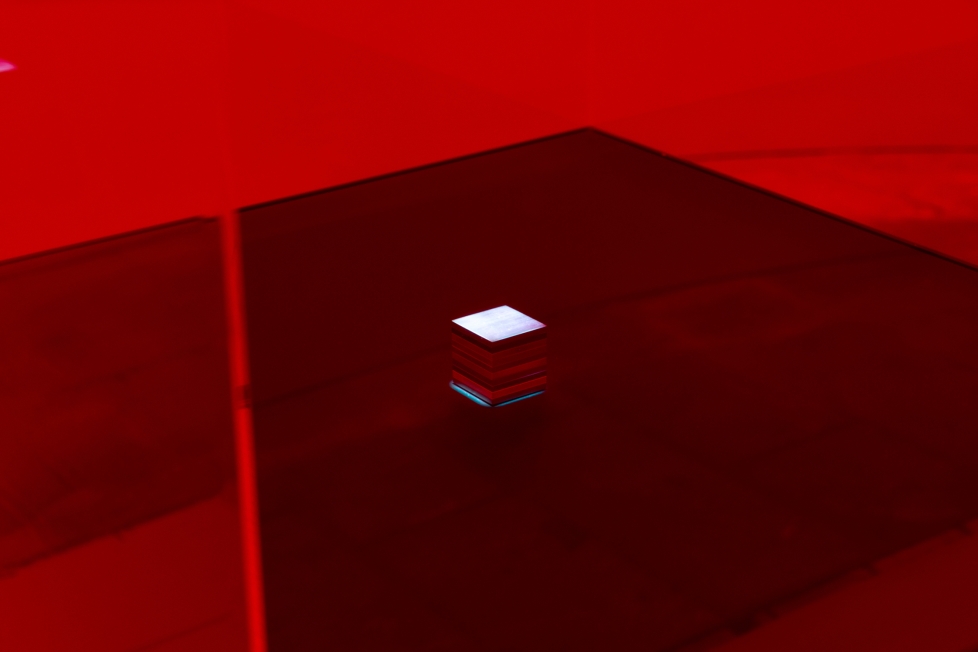
Another respite is Alfredo Jaar’s The End of The World (2023–2024), in which a small square cube of ten essential metals, minerals, and rare earths is placed on a plinth in a room under intense red lighting. It is, in an ironic way, liberating to enter the suggestive, sterile atmosphere and be reminded of the death-defying extractive industry behind the phone that, at that very moment, is warming against my thigh after hours of incessant use. The nightclub glow of the red light evokes the role our desire plays as an engine of this development, although the moral admonition of the wall texts explaining the ecological and social costs of mineral extraction works against this inciting ambivalence.
Jaar’s invocation of a subjectivity compromised by technocapitalism’s libidinal engineering is a welcome counterweight to the regenerative and hopeful poetics and politics that cues the exhibition’s overall tone – and which, it has to be said, feels as if it has run its course as a curatorial prompt for major biennials.
Translated from Norwegian