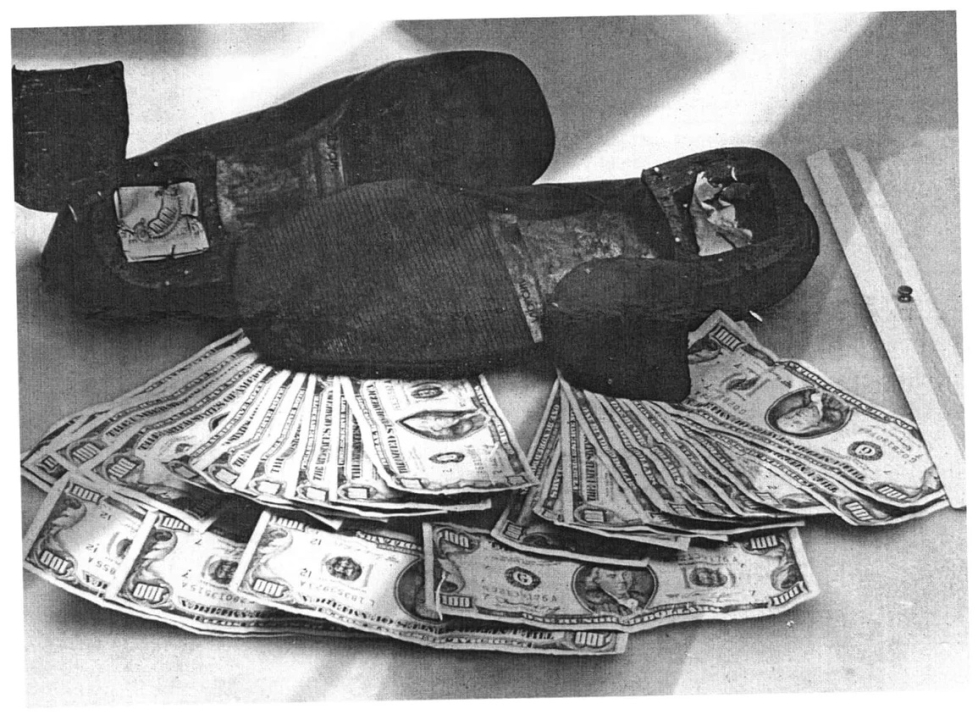
Dora Budor’s exhibition begins with a black-and-white photograph mounted in a glass noticeboard on the small square outside Bonner Kunstverein. The photograph depicts a pair of leather shoes with storage compartments cut into their heels. Neatly arranged dollar bills lie beside the shoes, a sexily packaged clue that the exhibition will examine the relationship between value and the structures that lie behind or alongside it. What is interesting about the photograph is not primarily the dollar bills, but the structure that enables their movement – the carved-out cavities.
Budor, who was born in Croatia, recently concluded a guest professorship at the Royal Danish Academy of Fine Arts to take up a professorship at the Städelschule in Frankfurt. With an interest in architecture, institutions, and the material conditions of (artistic) production, she creates exhibitions that respond to spatial and psychosocial circumstances; here, by engaging with the transformation of a former flower shop into a Kunstverein in the 1980s.
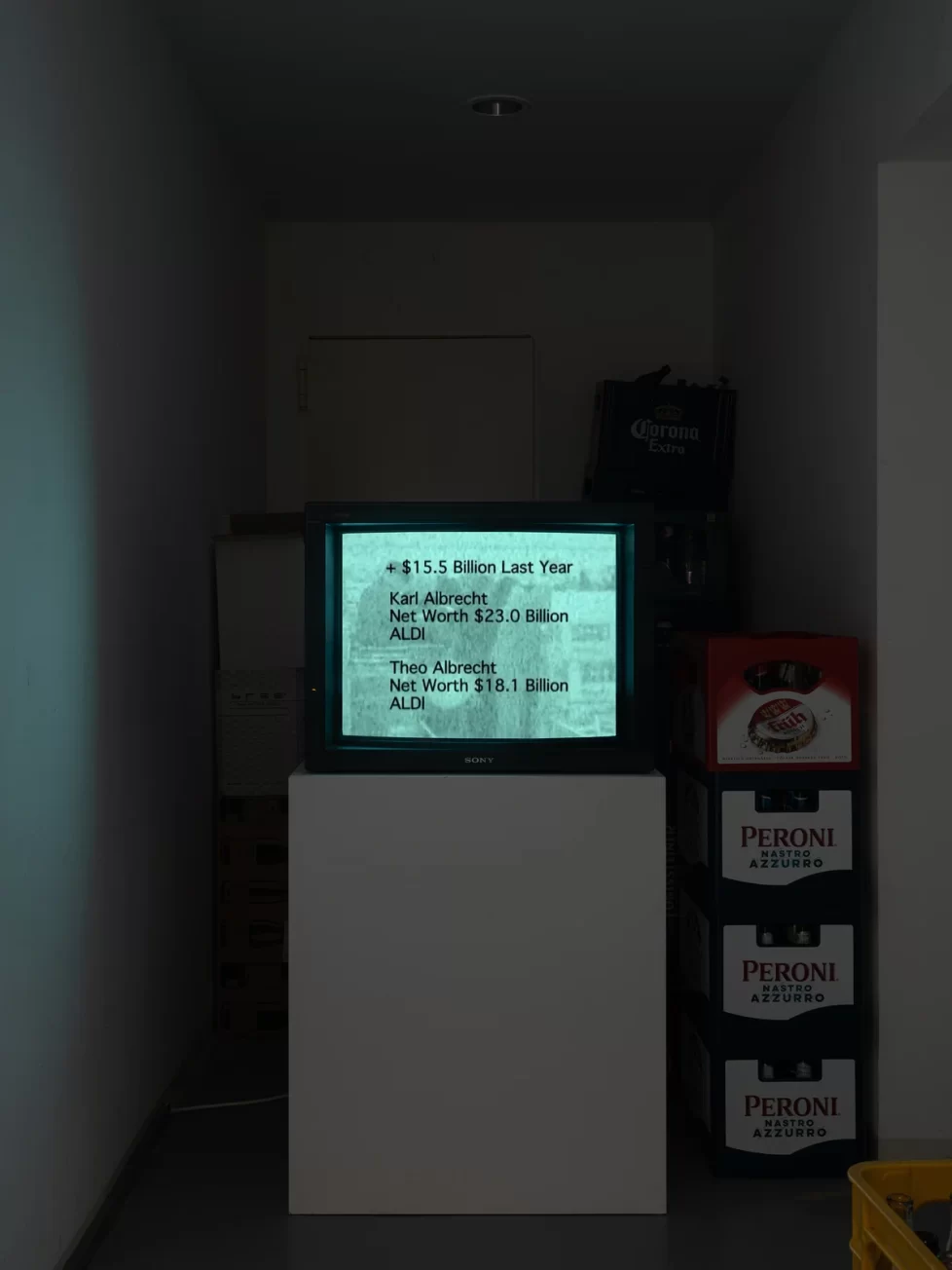
In the dimly lit entrance hall, four moving image works by Yvo Cho, Henrik Olesen, Camilla Will, and Eleanor Ivory Weber are shown. Described in the exhibition materials as “preludes”, they are there to establish a tone or, rather, to activate a gaze. Olesen’s The Body Underneath the Skin is an Overheated Factory (2005) is a 32-minute enumeration of the world’s wealthiest people and their lines of business. It is shown in a small storage room on a bulky CRT monitor wedged between stacks of beer crates. In the elliptical, faintly smoke-scented café, another CRT monitor sits directly on the bar. On it we see Camilla Will lying in bed and dictating the difference between cats and pigs; the footage is interspersed with photographs of Rotterdam (Dictated from Bed, 2011).
Without literally having to divide any of the screens in two, Budor achieves a kind of split screen by presenting the videos in out-of-the-way spaces. The gaze established by the preludes is a double gaze, an interplay between the works and the rooms in which they have been installed.
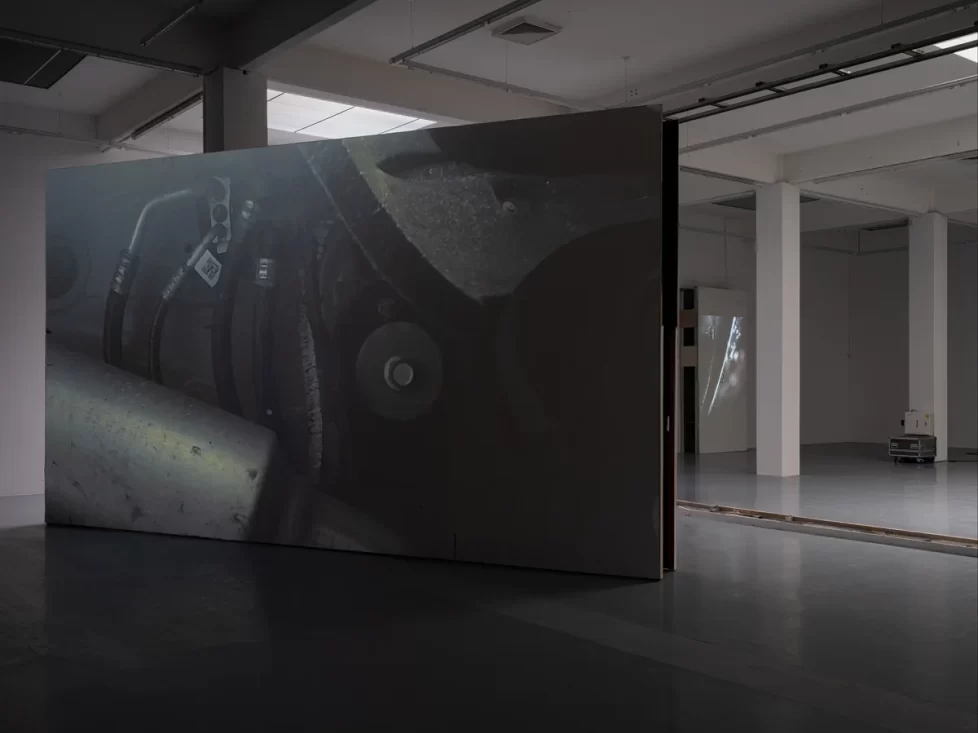
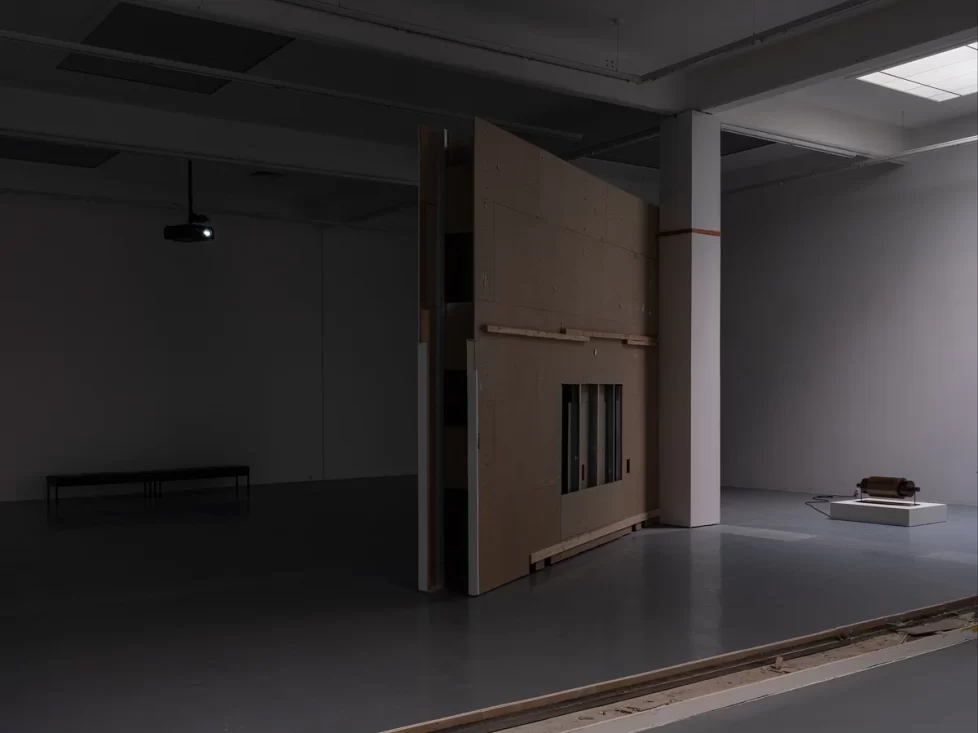
The Kunstverein’s large exhibition hall is dominated by a monumental freestanding wall. The wall has been hastily cut out from its former position, where it divided the room in two, and the remains form something like a plinth running across the floor. On one side of the wall, Medium (2025) is projected: seven minutes of blurry shots of cables and metal constructions that are difficult to fully identify. Undercarriages of cars? The insides of electrical cabinets? The video work emits a subdued, abstract soundscape of traffic that merges with the projector’s own hum.
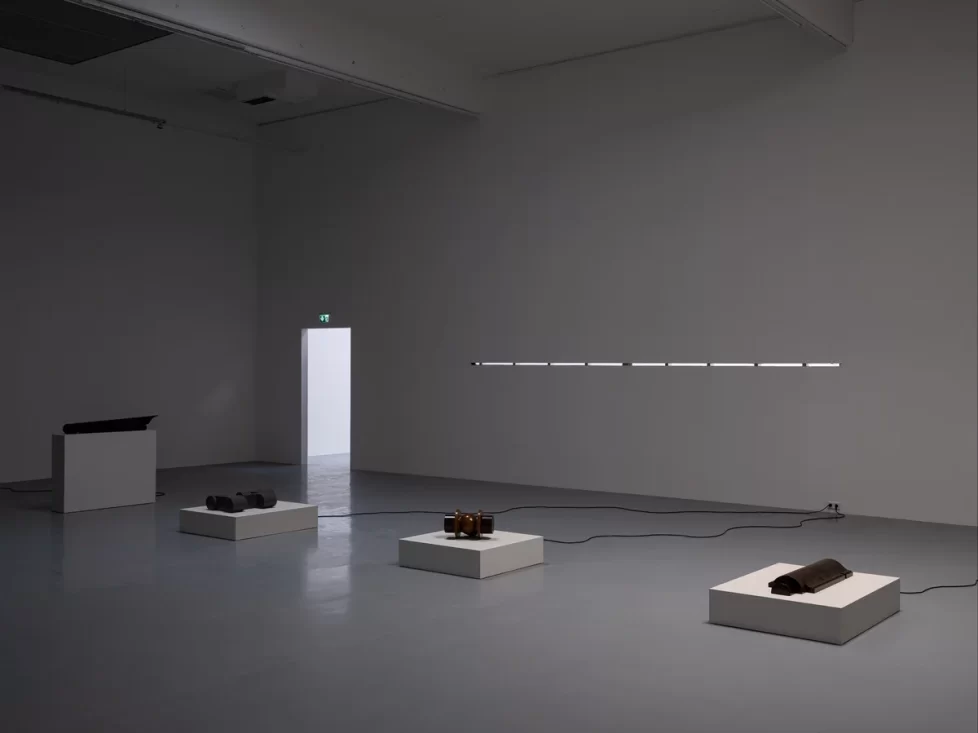
The room also contains five works from the series Autophone (2022–ongoing). Beautifully carved Constructivist sculptures made from woods used for musical instruments are presented on white pedestals. From inside them comes the rhythmic vibration of sex toys. By hiding the toys away, Budor allows attention to move alongside their primary function and form, focusing instead on their sound – an inherently worthless by-product of the vibration intended to produce pleasure.
So: Budor looks alongside. It is the same gesture in the holes in the heels of the shoes, the Kunstverein’s storage room, the café bar, the sawn-out wall, the undercarriages of cars, and the sound of sex toys. Of course, moving a wall and marking where it once stood risks being experienced as a one-dimensional repetition of gestures already performed historically. But Budor avoids the cliché by allowing artistic form-making to take place alongside her more austere conceptual approach. In filming the undercarriages of cars, in designing the Autophones, she makes room for something that could be described as a search for beauty. In other words, she does not merely reveal the structures that construct relations of value; she also demonstrates her own – the artist’s – power to make something attractive through form.
This means that the exhibition creates value at the same time as it undresses value. In this way, Budor’s work unfolds within the tension or ambivalence that constitutes one of contemporary art’s fundamental problems: being an artist who is part of the very structures that they are simultaneously scrutinising. With this exhibition Budor argues that the contemporary artistic subject must do both: create something beautiful while continually interrogating the material conditions of its production – and be bold enough to regard this compromised position as an artistic opportunity
All of this is done in a very polished way, probably too polished. Anyone who has ever found themselves in an algorithmic feed knows that whatever receives attention is what subsequently creates one’s world. Yet when Budor directs the viewer’s gaze to create small moments of tenderness – such as the songs tentatively emerging from the sound of the sex toys – a presence arises within the exhibition that cannot help but move you.
– Elmer Blåvarg (b. 1996) is an artist and writer based in Stockholm. He holds an MFA from the Royal Institute of Art, Stockholm, where he graduated in 2025.