My first encounter with Arthur Köpcke dates back to 2008, when I saw the exhibition Action and Remains at Kunsthal Charlottenborg. I was 21 at the time and not yet making art myself. As I recall, I didn’t understand him at all. The works seemed a little dated. The collages smelled old and musty. And then there was that performative layer, dripping with dad jokes. Yet something stuck in my mind. Perhaps a sense of the avant-garde. At any rate, the whole thing represented a way of actually living your art that stayed with me.
The German-born Köpcke (known to his friends as Addi) moved to Copenhagen in 1953 with his Danish wife, Aase (nicknamed Tut). In 1958, they opened Galerie Köpcke in Læderstræde – a small venue that, within a few years, became one of the most important galleries for experimental art in Europe. Here the Danish art scene encountered new movements such as Fluxus and Le Nouveau Réalisme, represented by artists such as Daniel Spoerri, Niki de Saint Phalle, George Maciunas, and Piero Manzoni. At the time, Copenhagen was a peripheral place within the art world, but the couple helped bring a small part of that world to Denmark.
Köpcke’s Reading-Work-Pieces (1958–64) is regarded as one of his major works. It comprises 129 short text fragments consisting of instructions, puzzles, and puns. The work serves as a manual for thought, each page inviting the reader to complete the piece through action or imagination. Köpcke believed in art as an open, participatory process where the work is not mainly an object but a meeting between artist, language, and audience. Essentially, this was the principles of Fluxus translated onto paper: art as thought and action rather than image.
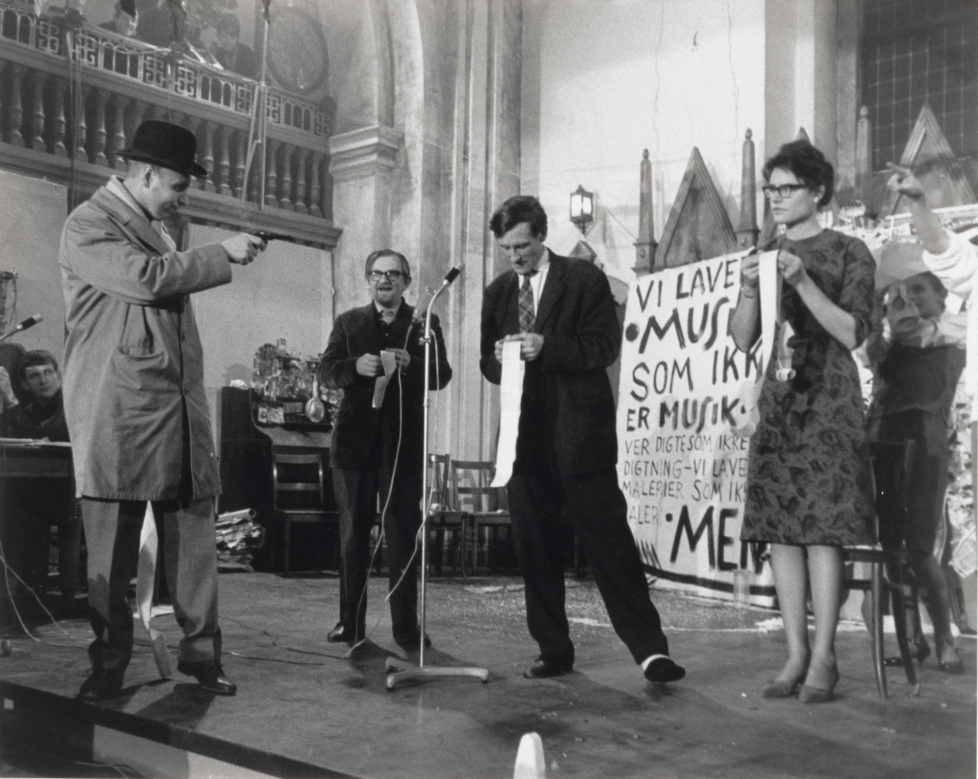
In 1962, he co-organised the festival Festum Fluxorum Fluxus. Over the course of six evenings in Nikolaj Church, all sorts of things were set in motion: sound, objects, chance, the audience. Copenhagen, somewhat startled and scandalised, was drawn into the Fluxus movement and the avant-garde of the 1960s. A Danish text on the backdrop of the stage read:“We make music that is not music. We make poems that are not poetry. We make paintings that are not painting … but we make paintings that give us the chance to cultivate a happy, unspecified fantasy.”
Since then, the Danish art scene has rarely seen such vitality.
Let our happy, unspecified fantasy for the day be that someone from the south might soon arrive to breathe a bit of art back into our lives.
Mathias Toubro is an artist living in Brussels. From 2017 to 2020 he ran the exhibition space Éclair in Berlin, together with Sigurd Kjeldgaard and Milan Ther. From 2020 to 2023 he ran the exhibition space Cucina in Copenhagen, together with Sigurd Kjeldgaard and Lasse Dam Valentin.