I’ve ordered an apricot juice and an espresso. Arrived far too early at the airport. From the table where I’m sitting, I can see the mountains and the exit from the small airport in Pisa. Tourists spill out of the building and into taxis. Lots of Americans. Italy is full of Americans these days. Europe is so cheap for them now – everything’s half price. Europe has become one vast, beautiful duty-free store.
For the past few months, I’ve been on a residency in Pietrasanta. I’ve been making bronze sculptures at a workshop that has produced artworks for artists since the Renaissance. Now I’m on my way to Paris, like so many others from the art world. Art Basel Paris opens in a few days. My phone is already pinging constantly: “Are you in Paris? What are you doing on Tuesday? Want to go to the VIP preview together?” Everything is buzzing. The favours, the exchanges: “If you can get me in there, I’ll get you in here.” Tit for tat. “Please come to my opening on Wednesday – free drinks!”
“Kiss and fly,” says a sign near my table. You’ll see that sign in every airport in the world. It’s universal. Kiss and go. A quick kiss in passing. No more than ten minutes of parking allowed. Not a heartfelt kiss, but a kiss as an act. The way an air kiss is also a gesture. A greeting. For a long time, I thought you were meant to actually kiss the person on the cheek when giving an air kiss. Lips on skin, you know, which was often awkward. Far too intimate. It took me far too long to realise that the kiss should, in fact, land in the air, as quick precise pecks on either side of the face.
An event like Art Basel Paris inevitably brings with it a load of associated exhibitions, performances, parties. That’s how it works. A big stone produces a big splash, making waves when it hits the water. So what happens in the wider landscape?
At the Bourse de Commerce, yet another historical exhibition fills the building, this time devoted to Minimalism. Which makes sense. There are Minimalist tendencies everywhere in contemporary art these days. I’d been looking forward to seeing Anne Truitt’s works. Her style and palette have been referenced by many young artists in recent years, so revisiting her practice seems an obvious choice. However, the works have been placed up against the walls and are never really allowed to become architecture within the space, which feels symptomatic of the exhibition as a whole. The works wither and die when they’re not given sufficient space. Once you cram too many objects into a single room, it’s not Minimalism anymore.
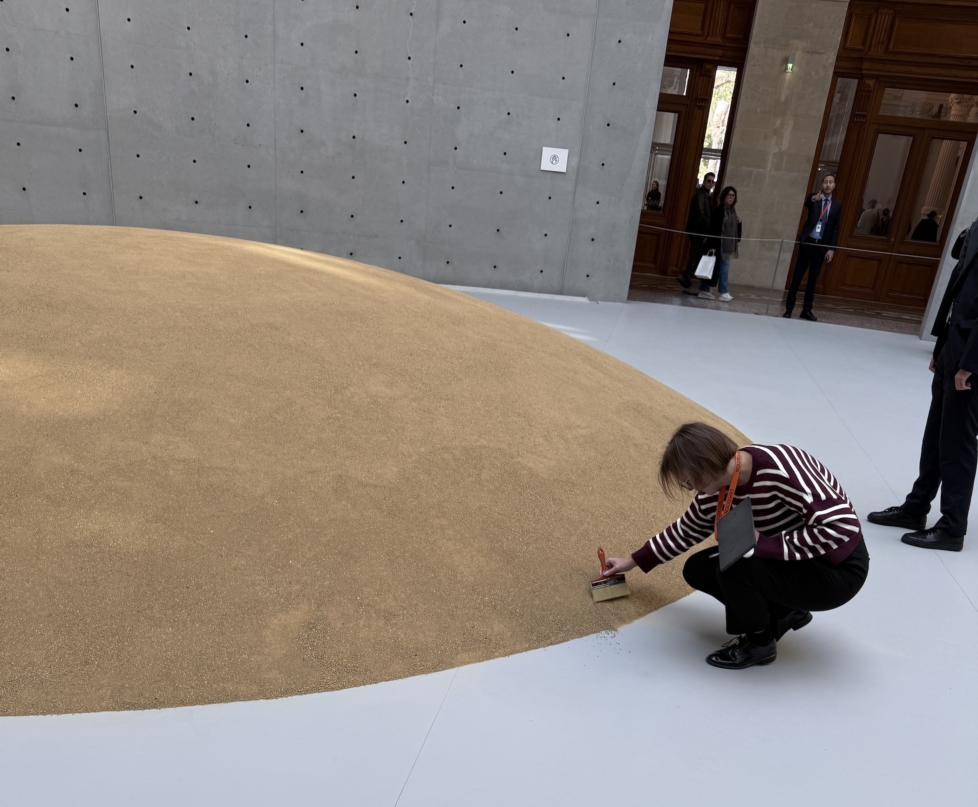
It was great, however, to see – for once – On Kawara’s date paintings displayed alongside their boxes, each famously lined with a clipping from a local newspaper from the day and place in the world where the painting was made. I study a German weather forecast from 1999 and an advert in The New York Times for a film that premiered in 1975. Events and media define their time and what we remember of it. Down in the great rotunda of the former stock exchange, some visitors have stepped into one of Meg Webster’s large earth mounds, Mound (1988). A gallery attendant rushes over with a brush and broom, quickly restoring Minimalist precision. Everything is under control.
The new Fondation Cartier just opened. Fondation Louis Vuitton has launched the most extensive Gerhard Richter exhibition to date, and has done so in a way that’s hard to imagine any public institution being able to pull off. The Bourse and Lafayette Anticipations have both become major institutions in relatively short time. The private sector increasingly dominates the scene, and I can’t help but worry about the direction things are taking: public institutions faltering for lack of political will to fund art and culture while private and commercial interests gradually take over the agenda.
A few days before the fairs open, I wake up to the news of a theft at the Louvre: nine pieces of jewellery from the Napoleonic era have been stolen. A brooch, a tiara. The heist took place during opening hours and has all the hallmarks of a commissioned job. There are plenty of wealthy, historically-minded people out there who would pay handsomely to secretly own Napoleon’s bling. After all, if you’re robbing one of the most heavily guarded museums in the world, I can’t imagine those jewels being the most valuable items on offer, so it doesn’t seem as though the thieves are looking to sell them on.
Everyone’s talking about the art market stagnating. Mega-galleries are closing branches. It’s also said that collectors are buying fewer works by living artists. Because of war, recession, and general anxiety about the future, people are turning to safe assets: gold, property, and artists whose names have long since been given the seal of approval by art history. As a result, galleries are selling classics like never before. Others claim the opposite: that collectors have never bought more young art than they do now. They don’t want the ultra-expensive pieces but prefer to invest in the stars of tomorrow. As always, there are probably more truths.
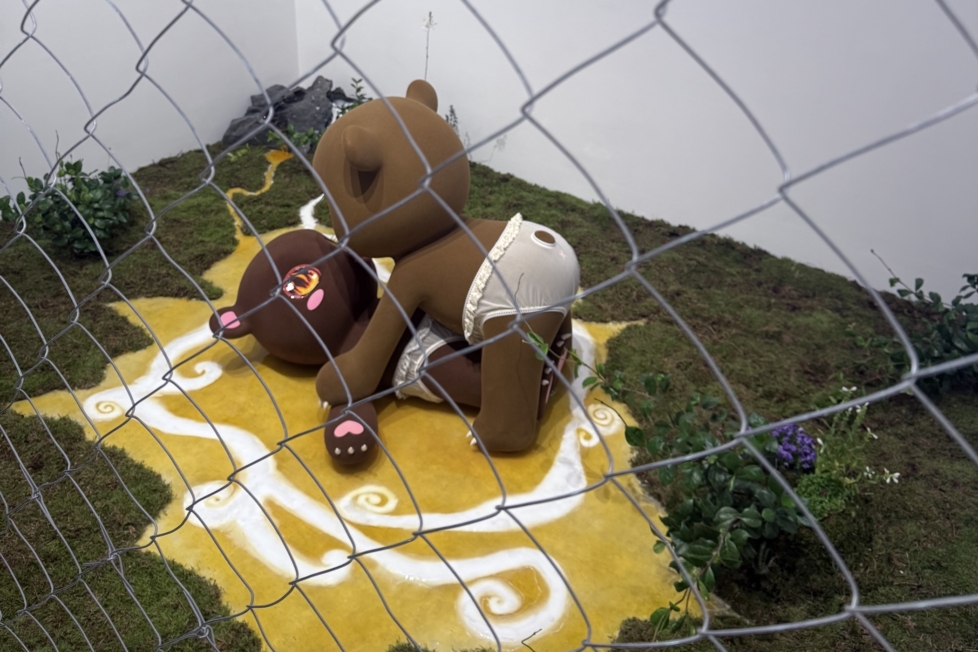
There’s an infectiously upbeat atmosphere at the opening of Precious Okoyomon’s exhibition at Mendes Wood’s Paris branch. Cute bears in lace lingerie, eyes aflame, pose erotically with sharp claws extended. Paintings on glass are set into the walls and lit from within, making the colours sparkle and gleam. Motifs from the sculptures reappear in the drawings and paintings, this time framed by flames and nature. The image of the exhibition’s first bear, showing its arsehole, recurs several times.
In all its brutality and dirty pop energy, Okoyomon’s show is strangely alluring, like a portal to a reality where our culture’s infantile sexualisation of everything points towards another logic, another hierarchy. The bears don’t appear as victims but rather as utopian figures liberated from human norms and surrounded by a world on the verge of collapse. The exhibition is accompanied by a small, free, pink, heart-shaped publication featuring a text by Okoyomon. It includes the following passage:
So
I let go
Of the fear that eats the soul
To release
Into
In the burning world
Humble child
legs spread apart
EXPOSED
hole to the sun
BANISH THE PREMORDIAL FEAR
BANISH THE DARKNESS THAT BLINDS LIGHT
The fire is here now
Burning
And
the flowers still dancing
In love the love of the sun
I carry the fire of that exhibition with me into the rest of the week, through the crowds drifting across the city from one event to the next. From the opening of Reena Spaulings’s very Reena Spaulings-like group show at Galerie Hussenot to Meriem Bennani’s exhibition at Lafayette Anticipations featuring two hundred flip-flops performing a kind of mechanical stomp concert, to the New York project space Jenny’s “one-night-only gay group show … in a cave.” I feel as if I’m at the opening of a biennial. Exhibitions turn into parties. Everywhere is packed. Always with a faint hangover, always on the move.
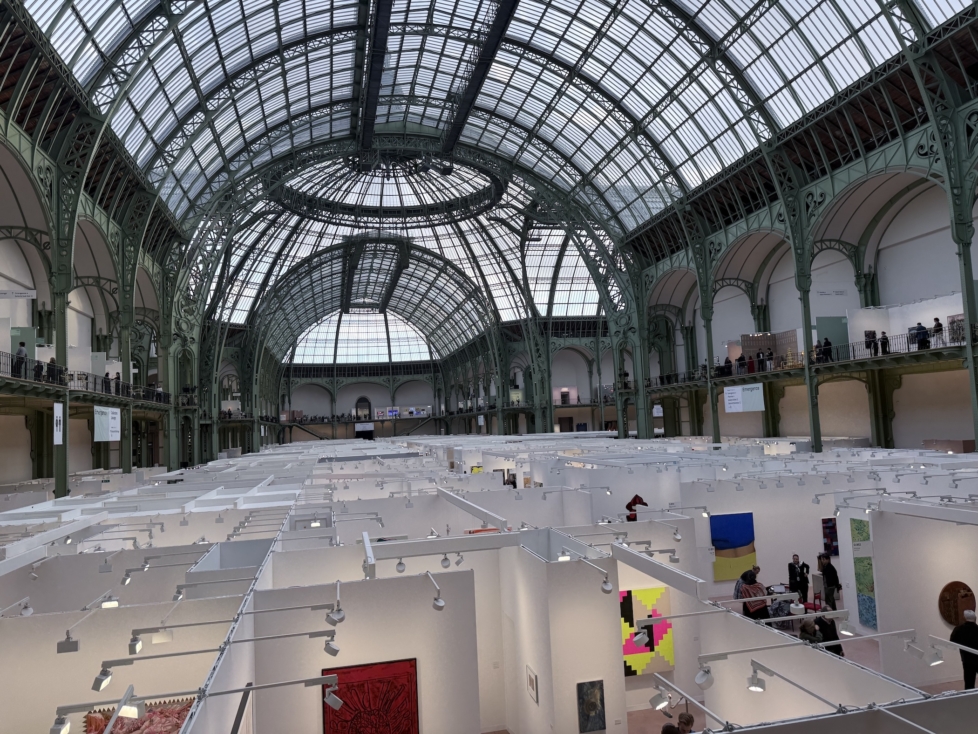
When I finally make it to the main fair, Art Basel Paris, it’s my first time back in the vast, beautiful space at Grand Palais since its renovation. The mood is light. There may be a bit more Picasso than usual, and perhaps not a huge number of younger artists. And there are only three galleries from the Nordic countries: Christian Andersen from Copenhagen, Standard (Oslo), and Andréhn-Schiptjenko (Paris/Stockholm). And, yes, perhaps the fair as a whole feels a little more conservative, a little safer, but then again, it’s felt that way for a few years now.
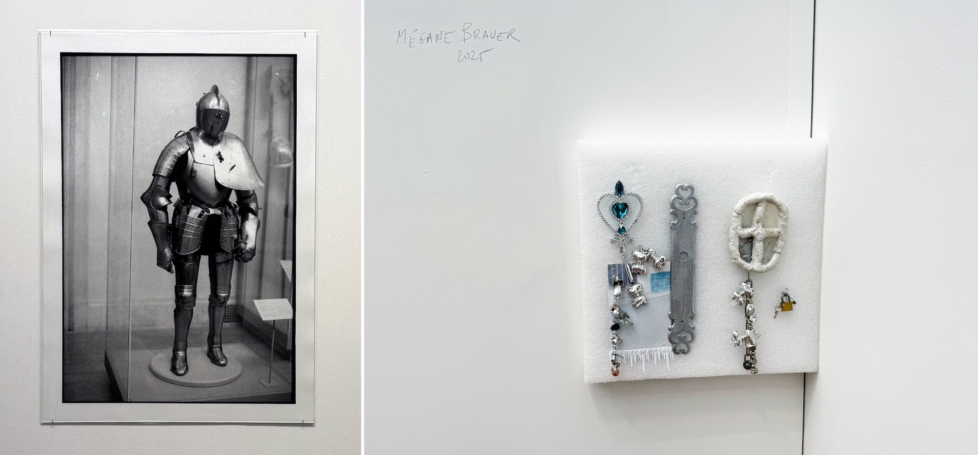
I stop to look at Megane Brauer’s beautiful collages of glittering things mounted on foam boards at Air de Paris. I walk through the aisles of the younger galleries. Maxwell Graham from New York has a great-looking stand with only three works, one of which is a fascinating gelatin silver print by Zoe Leonard depicting a suit of armour inside a display case.
Louis Vuitton’s long-standing collaboration with Takashi Murakami is also represented here, including in the form of an enormous brightly coloured octopus with long tentacles that makes me think of various brand–artist collaborations over the years. A personal favourite remains Louise Bourgeois’s project with Absolut Vodka from 1998: a spider sculpture designed so that a vodka bottle could hang perfectly in the centre. It was delightfully bizarre. As if the vodka-spider might come scuttling after you, forcing you to take a drink.
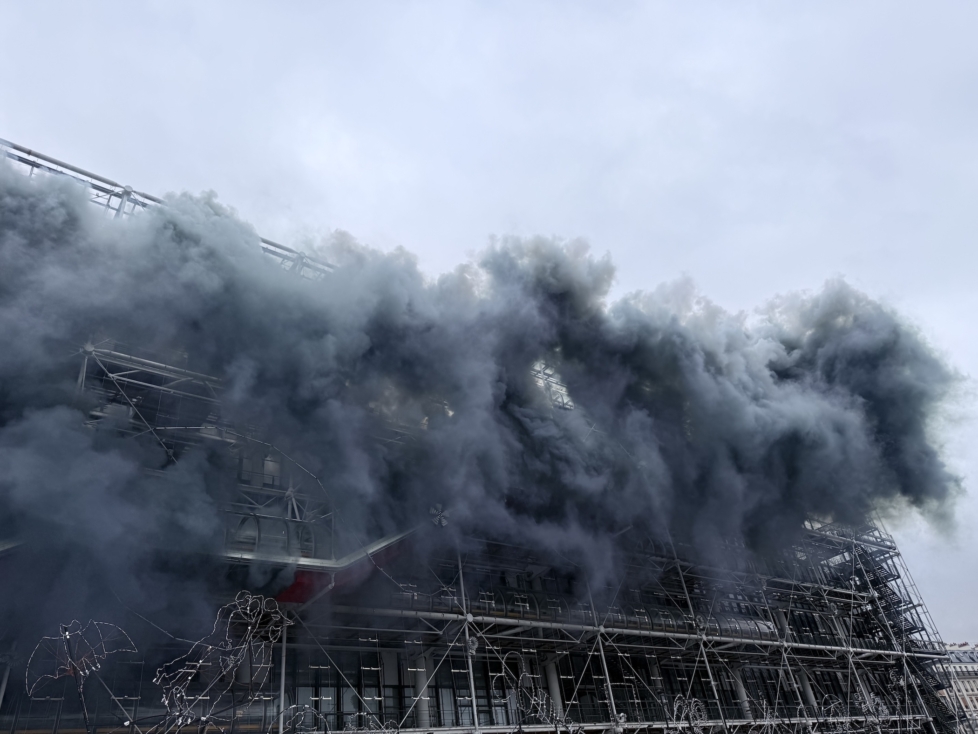
On my last day in Paris, I’m off to the opening party for the Pompidou’s four-day festival, marking the start of the iconic museum’s five-year closure for renovation. I meet up with some friends, and we check in on the square in front of the museum. We’re assigned into the red category, indicating where we are to stand during Cai Guo-Qiang’s commissioned firework piece The Last Carnival, staged across the entire façade of the building.
It begins with fiery writing inspired by The Last Supper and featuring motifs from the museum’s collection: a flickering portrait of Frida Kahlo, Duchamp’s urinal spinning in mid-air. Then the façade erupts in successive acts. The first is black. It’s eerie. Vast black clouds of smoke fill the sky and the air around us. Sharp flashes of white light break through, ending in a massive explosion of colour. It’s so vast, so all-encompassing that I struggle to grasp it. The opening segment, with its art-historical imagery, felt almost too didactic, but the second part was both terrifying and beautiful. It genuinely looked as if the building were blowing up, which felt like a brave move, given the times we live in. I appreciate the museum’s courage in doing that.
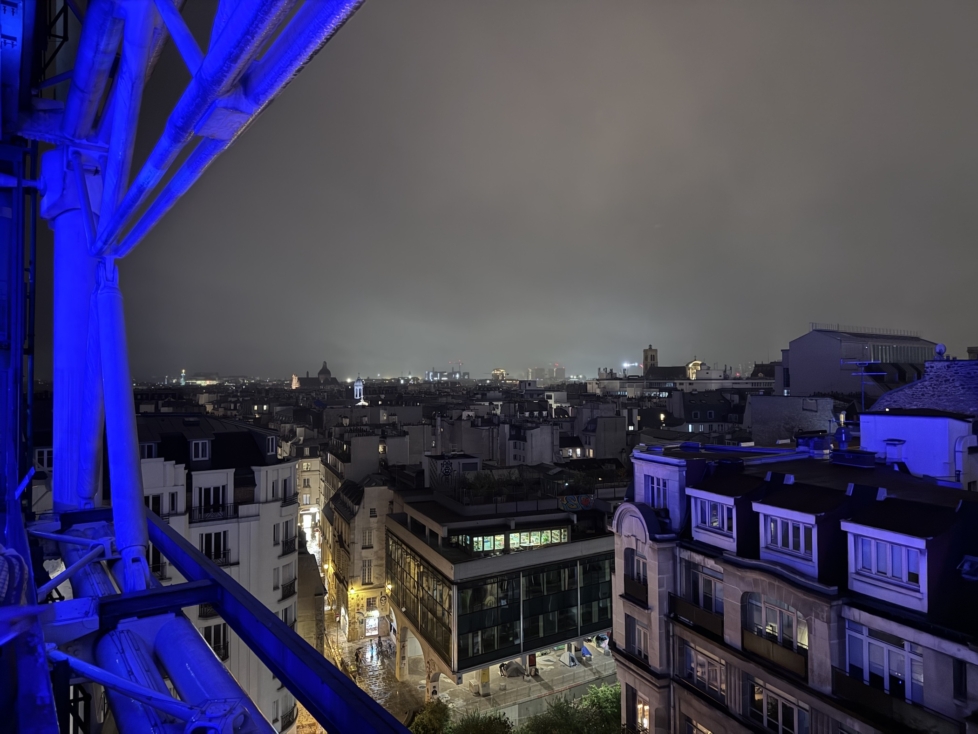
When we enter the museum, we find French pop star Christine and the Queens performing in his trademark crimson suit. The entire building has been transformed into a club. I wander up to the fifth floor and look out across Paris shimmering in the night. The Eiffel Tower stands there like an echo of a World’s Fair that once was. On the other side is the rebuilt Notre Dame. It’s hard to imagine a Scandinavian museum celebrating itself like this. It’s also hard not to fall in love with Paris.
I don’t know how the hardcore art scene keeps up the pace. Last week was Frieze Art Week in London; next week it’s Artissima in Turin. Many of the same galleries and collectors are dashing around the world while expensive objects are marketed and exchanged. It’s an extreme sport, an endurance contest. And it’s all very entertaining and problematic and fun.
I truly didn’t find this art week depressing, quite the opposite. Nor do I fully believe the crisis is as clear-cut as it’s being described. There’s a paradox in the fact that the market is struggling while interest in contemporary art has never been greater. In Paris, I sense a certain optimism. The scene is heaving. Perhaps because Paris is the only place I can think of so perfectly built for these kinds of spectacles, with its glamorous infrastructure, endless fashion weeks and art weeks. It doesn’t feel forced or artificial here. This city feels most alive when it invites the spectacle in.
Translated from Danish.