Whenever works of art, artists, or exhibitions are classified as operating somewhere at the intersection of art and activism, as system-critical or socially responsible, I feel a flicker of default scepticism. Not because activist ambitions are, as such, incompatible with artistic practices, but because practising activism, doing the actual actions, often struggles to find favourable conditions in an art world that, with few exceptions, always pursues hype, exposure, sales, and object-fixated artwork statuses.
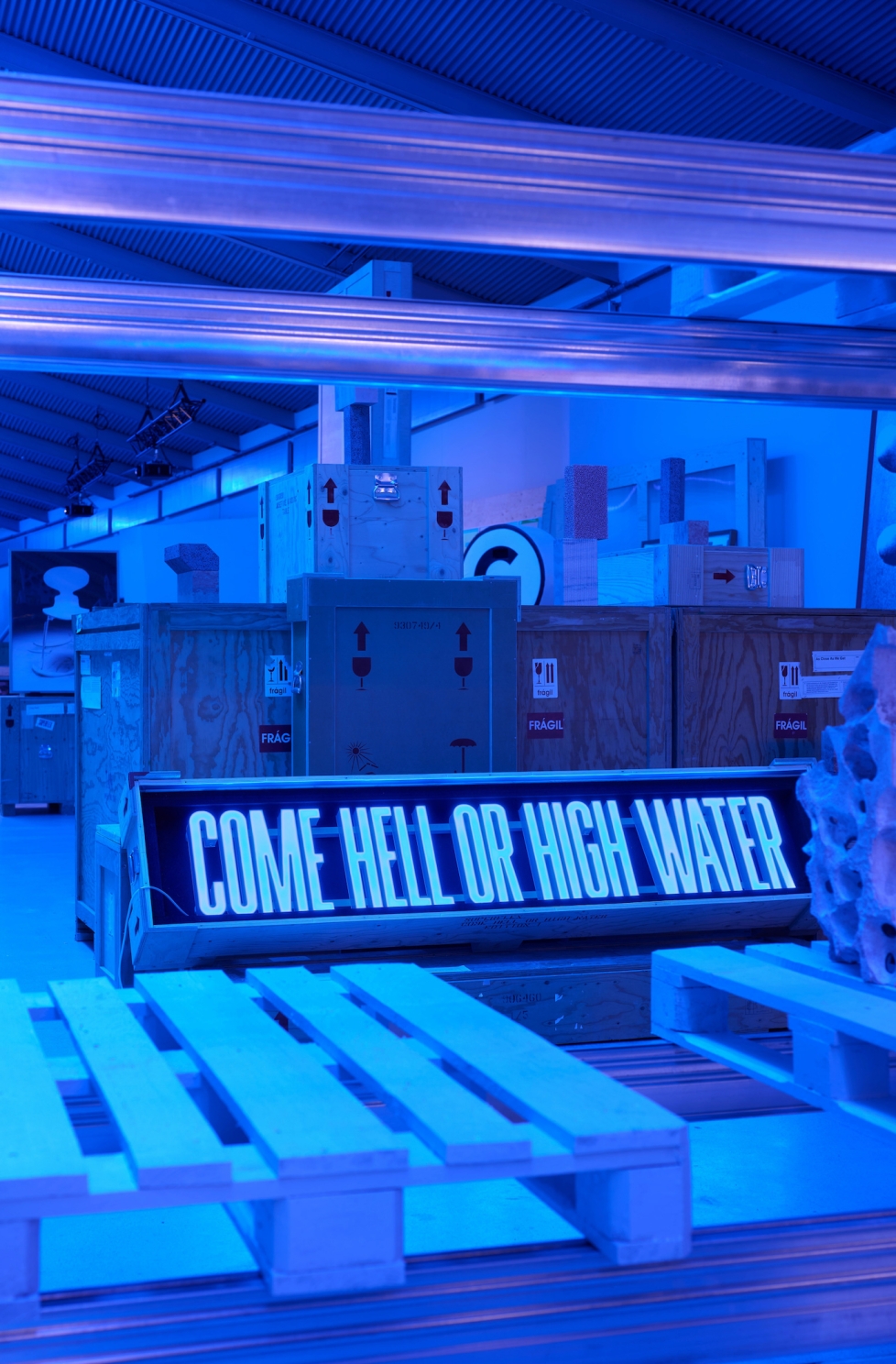
The artist collective SUPERFLEX (Bjørnstjerne Reuter Christiansen, Jakob Fenger, and Rasmus Rosengren Nielsen) explicitly and emphatically occupies this intersection, and with a succession of social projects in its signature-orange back catalogue, it has now taken over ARKEN with a kind of mid-career exhibition. The idea of that combination sparks genuine interest: how will activist foundations blend and fuse with Greater Copenhagen’s mothership for flashy blue-chip art? Come Hell or High Water is the title of the exhibition, and the rising seas, both global and local, form its scenographic and thematic framework: ARKEN is situated in Køge Bay Beach Park, practically in the sea, and rogue water levels are one of several threads running through SUPERFLEX’s work.
The museum and the collective are almost of an age, turning thirty and thirty-three respectively this year. We are dealing, in other words, with two significant parts of the Danish art scene that have grown up together, nurtured first by the blithe irony of the 1990s followed by unbridled graphically designed years of economic prosperity before the disillusioning financial crash, a growing awareness of the climate crisis and, with it, attempts at political awakening and a critique of capitalism within the framework of comfortable Scandinavian wealth (I hope I will never forget the Danish media personality Anders Morgenthaler brandishing a megaphone like he did at a 2018 climate march, rallying thousands of momentarily riled-up Copenhageners around in combat-ready protests demanding “non-iron linen clothing” and “electric planes now”).
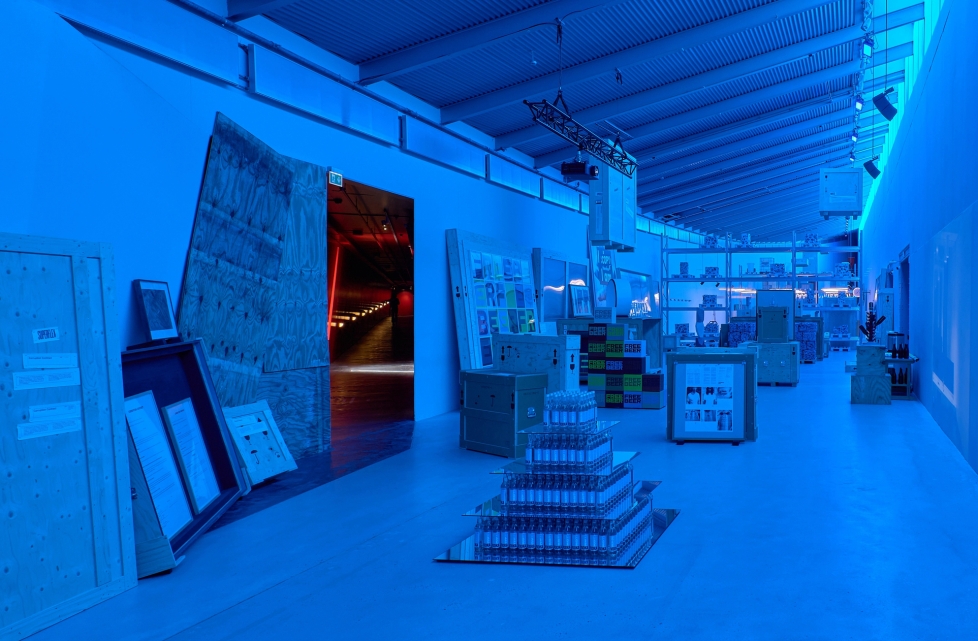
These shifts and changes in the zeitgeist are palpably present in the exhibition, which unfolds in near-chronological order through the museum’s Art Axis, transformed here into an ersatz marine environment. SUPERFLEX has made an ark for Arken: the exhibition is meant to appear as if it were set underwater in a flooded future, and the ship-shaped axis gallery is awash with blue light and a deep-sea soundtrack to support the effect. Besides blueness and pervasive ambience, the new ark is crammed with political art, emphatically staged among prominently featured transport crates. The cargo of the next millennium, then, is a critique of capitalism clad in one of capitalism’s favourite attires: global trade.
As noted before, SUPERFLEX first arose in the heyday of wry irony, and its earliest projects smack of conceptual, deadpan critique. Photographic works such as The Campaign (1994) and The Tube (1993) document the beginnings of the group’s tendency to mimic what it criticises: business meetings, industry, mass production – in terms of aesthetics as well as dramaturgy – at the arm’s-length remove so typical of the visual artist. A degree of staging is evident when the three young Superflexers dress up as businessmen and invite unsuspecting companies in southern Jutland to act as unwitting extras in fictional product pitches for nothing at all. Funny.
Towards the end of the decade, projects such as Supergas/Share (1998) and Supercopy/Biogas PH5 Lamp (2002) introduce a more directly participatory direction in the collective’s work: development initiatives facilitating sustainable biogas solutions for local communities and households in the Global South. Later came Guarana Power (2003/2004), perhaps SUPERFLEX’s best-known project, which assisted Brazilian guaraná farmers with resources for self-organisation, enabling them to become independent of the unutterably capitalist soft-drinks monopoly in whose pockets they were firmly stuck.
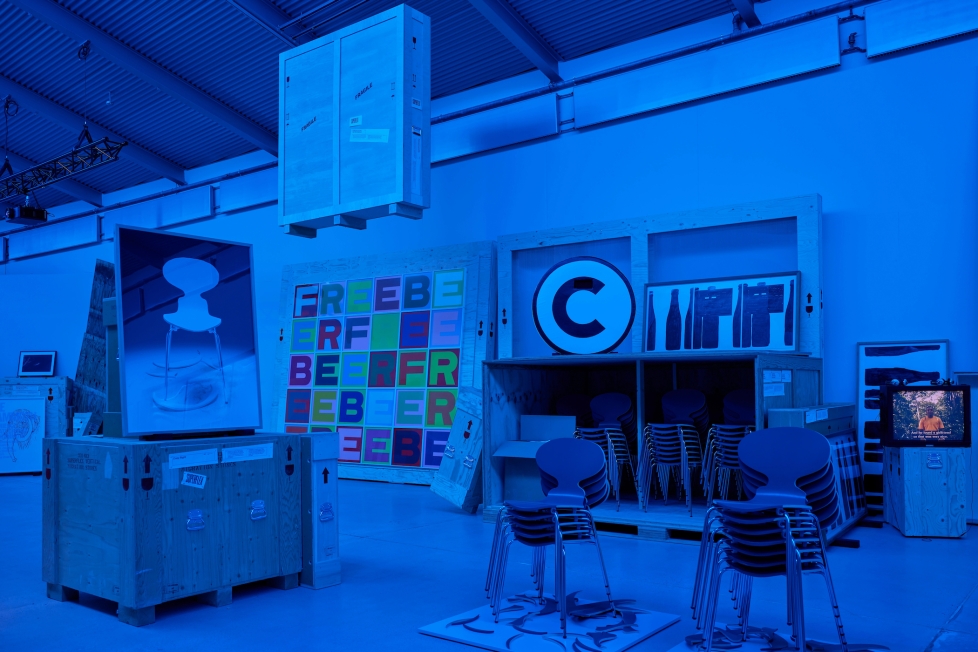
Continuing on through the exhibition and through this millennium, the more overtly social work seems to recede into the background in favour of video works, photographic works, prints, even a couple of outright paintings and sculptures, as well as hybrid happenings with tongue-in-cheek catchy slogans, and, relatively recently, a dedication to interspecies activism. Faced with the climate crisis, it is as though the group has given up on saving human beings and instead turned towards the sea.
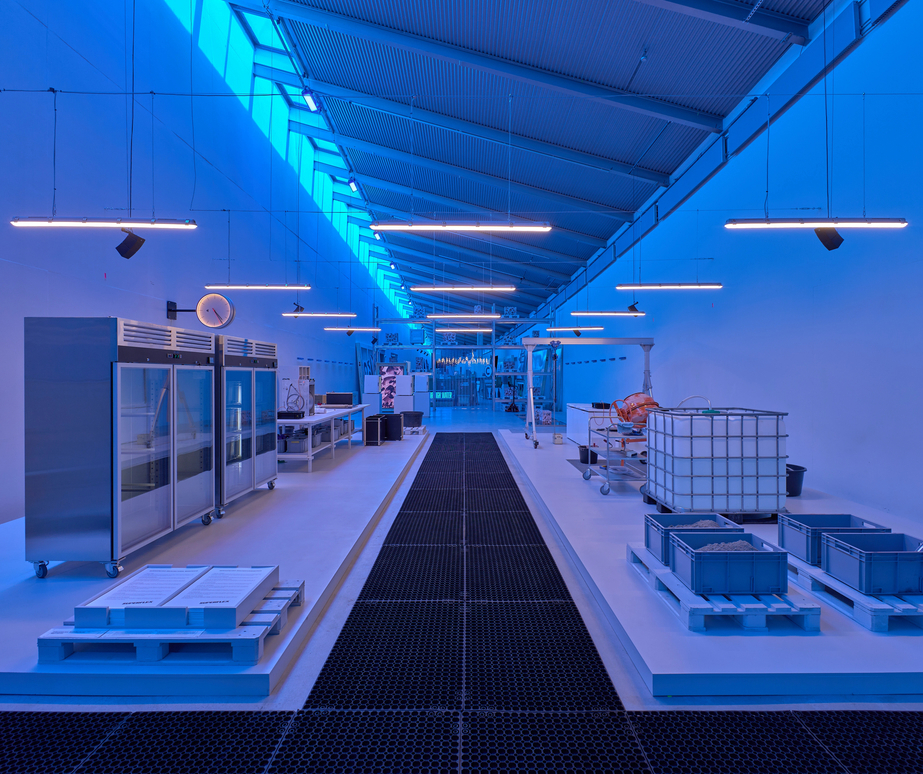
The installation The Ark Factory (2026) is clearly the exhibition’s darling, an artificial-looking factory erected at the heart of the space, complete with all the trimmings: lab coats and working drawings, plastic tanks and tubes, fluorescent lights, an industrial freezer and heavy butcher’s strip curtains galore. From ice and cement, this factory produces pink building blocks for marine organisms, based on the idea that since a shamelessly over-producing humanity has destroyed the marine environment, it is only right to give back some regenerative architecture to the sea’s inhabitants. A lovely sentiment, but also illustrative of what feels like the exhibition’s problem: theatricality; the air of smoke and mirrors, set designs and staging. Note, for example, the transport crates that make up the exhibition design while suspiciously looking newly produced, the spotlessly clinical factory scenography and the pervasive blueness of the whole space which, with all due respect, is a rather childish way of introducing an ocean theme.
You can spot plenty of amusing, well-meaning, eye-catching ideas throughout the wildly extensive exhibition, and lots of work that has undoubtedly had a significant and positive impact on the people, communities, companies, and underwater species at which it was directed. Yet it is often difficult to shake the sense of fiction over reality, aesthetics over critique. Which are, of course, entirely legitimate priorities for any artist, but grate here because these artists take such an explicitly political approach.
There is a pervasive sense that often it is the artwork – the production and sale of an object – that governs and conditions the activism. A series of photographic works were created with charity for victims of natural disasters in Miami and New Orleans in mind – provided the works are sold. A fully functioning operating table is to be sent to a conflict hotspot and save human lives – once the exhibition is over. I harbour no naive expectation that activist artists should act as Doctors Without Borders in order to qualify their claims to political engagement, but with, for example, the bombed hospitals of Khan Younis rattling around in the back of my mind, there is something almost distasteful about an operating table standing in Ishøj, waiting to become immortalised as a photographic work in some collector’s treasure trove before it can be sent out into the world and fulfil its practical function.
And so, we have circled back to the point of changing times and zeitgeists. SUPERFLEX was born in a decade when ideas of a world in crisis were treated rather more flippantly, presumably because it felt, and perhaps was, less acute, and because there was a consensus that gestural social interventions wrapped up in sleek logos and signature aesthetics actually had an effect – which, no doubt, they did. Today, the globe as a home to humanity is lost. We kill one another with our eyes wide open, we scorch the earth or drown in unruly water, and if there is one thing visual art certainly cannot do, it is counteracting that development.
Whether SUPERFLEX shares this conviction I do not know; I don’t really think so. But the journey through ARKEN carries with it a sense of giving in and giving up. At first, the work is marked by a cheekily finance-baiting and genuinely involved sense of hopefulness. Gradually, that mood is replaced by a more soberly serious feel, for instance in the works preoccupied with flooding. And then the whole thing culminates in theatre, with overly immaculate industrial scenography and a bombastically dramatic marine narrative.
I believe in the good intentions: that water levels, interspecies considerations, and global inequality truly matter to SUPERFLEX. But I also take in the exhibition with a feeling that being an artist brand matters more. And these dual aspects of the collective’s ambitions, the SUPERFLEX brand and the political commitment, have a somewhat unfavourable effect on one another at ARKEN. The all-dominating blue light makes it difficult to look at the art as art; the many, many objects become props in the main story. In turn, the main story, the dedication to the ravaged deep sea, comes across as slightly phoney precisely because the works look like props, and because an ever-pertinent, annoyingly delicate question intrudes: what is the potential of critique if, to a large extent, it mimics and repeats the very thing it criticises? In this case, for example, mass production, value creation, and the art market.
Questions like that defy easy answers – and that holds true of SUPERFLEX’s work too – but pondering them is always useful. It is perfectly all right not to believe that activist art can change the world, partly because, unfortunately, it can’t. But if activist ambitions are the entire raison d’être of an artistic practice, I do not think it unreasonable to wish for a little less design, a little less theatre, a little more unconditional activism.