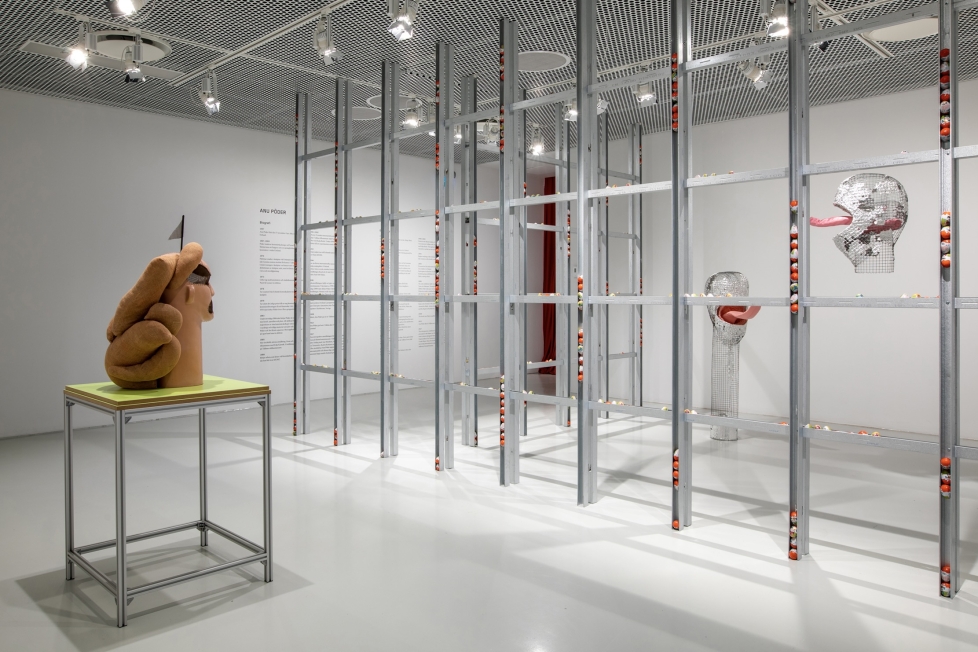
There was a time when the Copenhagen art scene liked to hail Malmö as Denmark’s most important city for art. This had nothing to do with an imperial mindset or any desire to take over the city across the Sound; the sentiment sprang from sheer admiration. For years, Malmö served up one experimental, well-curated exhibition after another. The Øresund trains were packed with Copenhageners heading for every opening. Malmö Konsthall and Rooseum were the main draws, later joined by Moderna Museet. Things have changed since then. Copenhagen’s art venues have caught up, and Malmö’s institutions no longer play the same role in the region – except in one important respect.
Moderna Museet’s current exhibition of work by the Estonian artist Anu Põder (1947–2013) is a case in point: Malmö’s art scene is still far more outward-looking than Copenhagen’s. This probably has a lot to do with Sweden being a more ‘international’, more culturally literate country, with everything that entails – for better or worse – from the inclusive folkhemmet, or ‘people’s home’, to a more clear-cut class system with greater extremes. Quite simply, the level of curiosity about art from outside the well-worn Western art capitals appears to be greater in Sweden than in Denmark.
Estonia is not far from either Sweden or Denmark, though perhaps it still is psychologically. Especially in Denmark. Somehow, I can’t imagine an institution in the Copenhagen area taking on a solo exhibition of an artist like Põder. Her oeuvre is also relatively small (which rules out Louisiana, for instance). Of the sixty works attributed to Põder, forty survive today. The Malmö retrospective includes twenty.
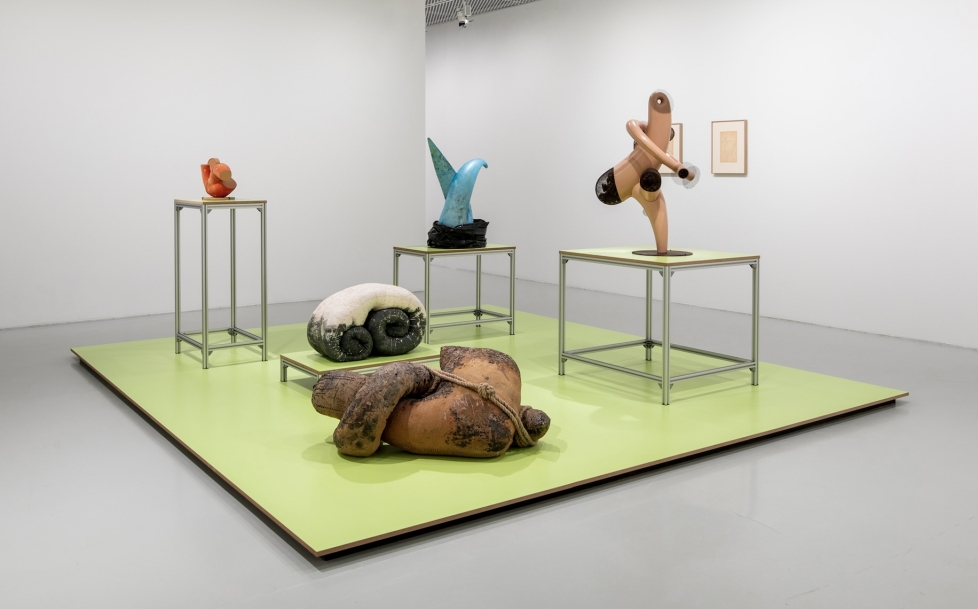
The show starts low and creeps up on you – quite literally, in the case of the staging on a lime-green platform with an aluminium frame that suits Põder’s sculptures surprisingly well. As it happens, the exhibition design acts almost like an extension of the late-modernist housing-estate atmosphere that has always characterised Malmö for me. The platform struck me of something that could have been part of a kitchen unit in a flat in one of those housing blocks. Perhaps in Tallinn, too, where this Estonian artist spent most of her working life and where she died in 2013, at the age of 65.
I love it when exhibitions do that. When the story is sparked by just the right work or, as here, by a simple exhibition design that gives you the sense that someone has done their homework and that the museum knows precisely why it’s showing the work this way. All the tension drains from your body, and you’re free to dive in.
Most of Põder’s works are a manageable size. A single person can easily move them. Her materials, too, tend to be whatever is at hand: wood, fabric, plastic, rope, and thread. In the middle of the first green platform lies Ihoprullad figur (Rolled-up Figure, 1992): a half-rolled mattress that, seen from above, looks like a back, with long stitches suggesting a spine.
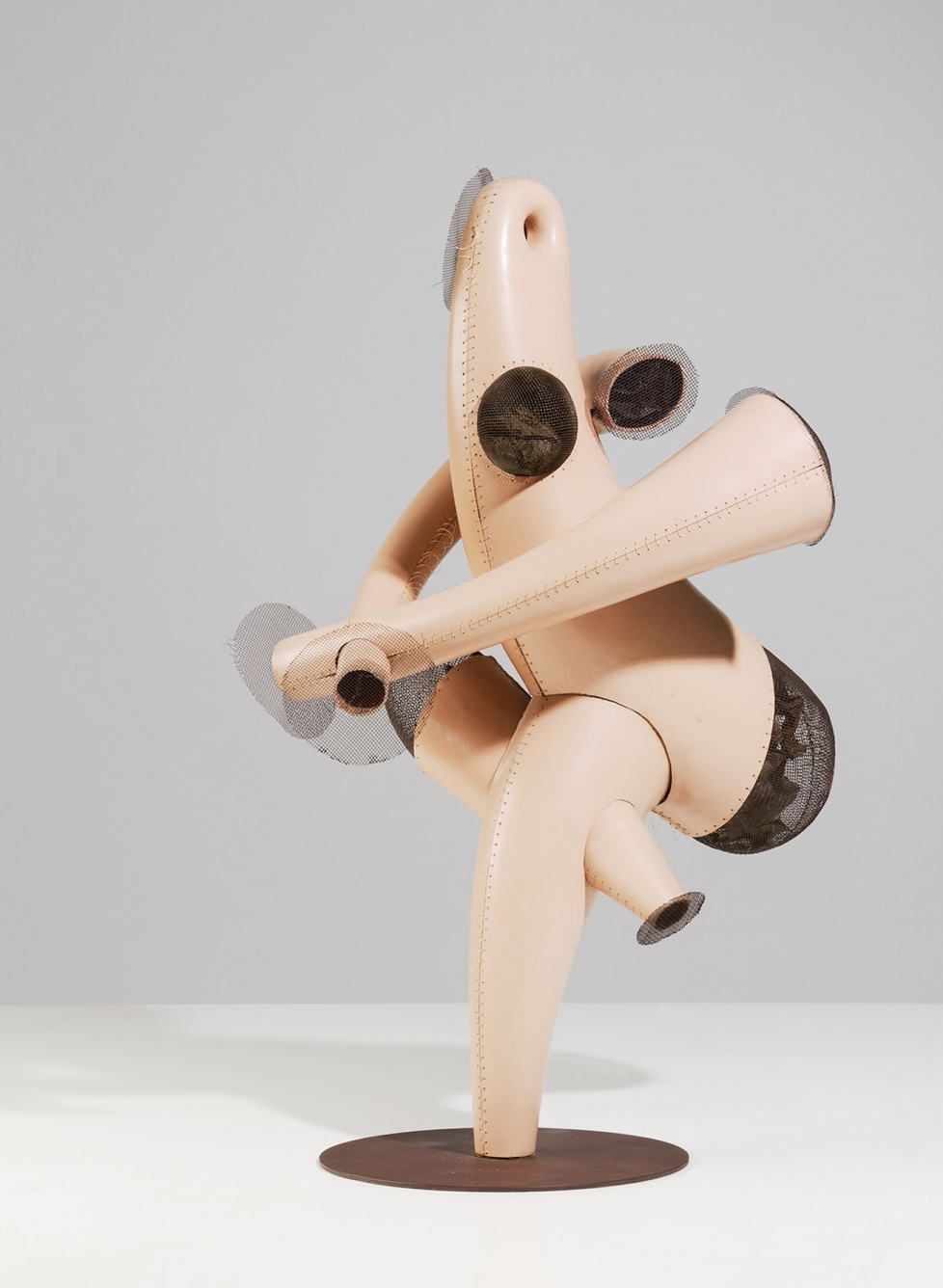
In fact, the human body is present in most of Põder’s works, though rarely in full or intact. It often appears in fragments, a bit cut up, but not in a perverse Hans Bellmer sort of way, even if there is something surreal about Põder’s disjecta membra. Take the peculiar, pork-pink, balloon-like figure Med en trumpet från Lasnamäe (Rosa fågel) (With a Trumpet from Lasnamäe [Pink Bird], 1988), shown in The Milk of Dreams at the 2022 Venice Biennale – an appearance that helped give her oeuvre a boost.
Made of taut plastic, the glossy limbs stick out in several directions. Through holes covered with wire mesh, you can see into the sculpture. It is empty, apart from a few balls of scrunched-up paper. I find it hard not seeing it as a quiet, humorous comment on sculpture’s core (or lack of one), a debate that goes back practically all the way to Michelangelo. This is especially true as the sculpture dates from 1988, a few years before Estonia’s independence from the Soviet Union, when art was still subject to demands for monumentality, executed in durable materials such as bronze or stone – not stray body parts, and certainly not balls of scrunched-up paper.
Põder was at her most productive in the 1980s and 90s, the years leading up to and just after the change of regime in 1991. I have a feeling that this helps make the works both unfamiliar and enigmatic. At the same time, it all feels close to home. I whizz back and forth through art history, between Surrealism and post-Minimalism, sometimes a little Arte Povera, too, or something else entirely – all of which, of course, stems from my own limited knowledge of Estonian art history. That only makes it more exciting.
In the catalogue foreword – written by the directors of the three institutions behind the exhibition (Moderna Museet in Malmö and Stockholm, and EMMA, the Espoo Museum of Modern Art outside Helsinki) – the interest in Põder is linked to Moderna Museet’s early presentations of American Pop Art. One can hardly blame the museum for highlighting that proud legacy and a moment in art history when Moderna was a pioneer on the European art scene. Yet how much Põder actually has to do with Pop Art is up for debate.
Perhaps the directors are thinking of Skärm (Screen, 2007), a pieces that carefully wedges hundreds of Kinder Surprise eggs into the hollow channels of industrial metal sections stretching from floor to ceiling. So yes, we’re talking readymades and the visual language of commercialism, just as in Pop Art, but also just as in so much other art made in 2007, and in the decades prior. Either way, Screen is a pretty lively work that gets you thinking.
For yours truly – having been brought up amid rampant Western European capitalism (which has only ever gone in one direction in my lifetime) – it’s almost impossible to imagine what it must have been like to encounter capitalism for the first time as an adult. Põder was in her forties when Estonia regained its independence.
Perhaps the scenario is comparable to the delirious, apocalyptic mood surrounding the prospect of life with artificial intelligence, now hurtling towards us, with consequences no one can really get their head around? And perhaps the idea of a wrapped chocolate egg with a toy inside is actually the perfect image of it – presented, moreover, within an open metal structure that pretends there’s an overarching plan to it all. It’s a false nirvana of plastic crap in a plastic container hidden inside chocolate that’s never seen a cocoa bean.
It might almost have been better with some scrunched-up paper inside.