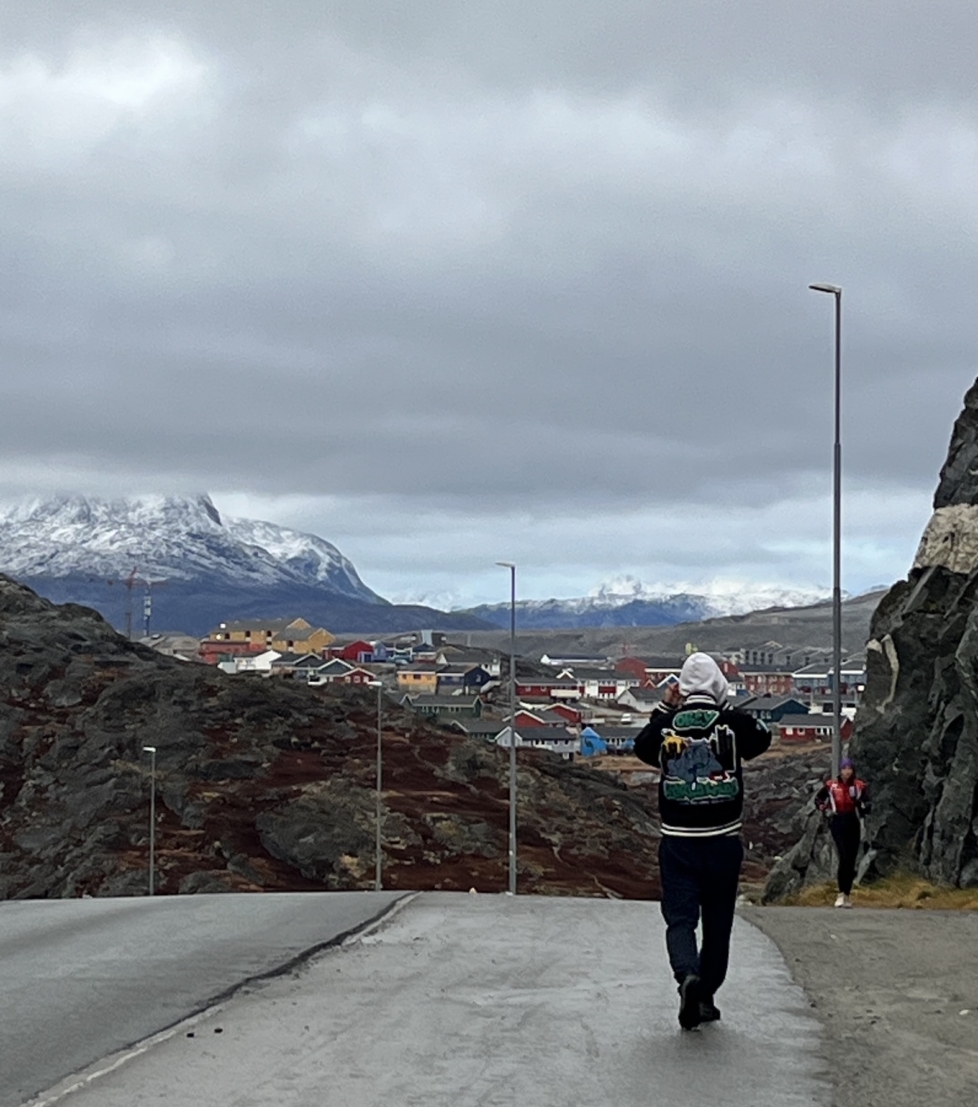
“Keep an eye on the birds. When the ravens fly high, there’s a storm coming,” my cousin says with a smile when I ask, slightly worried, about the weather. I’ve arrived in Nuuk just as a storm warning was issued, and because the weather in Greenland can change very suddenly, I’m not entirely comfortable walking from the district of Nuussuaq through the mountain pass into the city centre. My cousin laughs indulgently: “This is nothing. Just you wait.”
I’m in Nuuk to attend the Suialaa Arts Festival, Greenland’s largest cultural event, held every other year. Until this year it was known as “Nuuk Nordisk,” but for its fifth edition it has adopted a new name, Suialaa, meaning “a gentle breeze” in Greenlandic. The phrase is taken from poet Frederik Kristensen Kunngi’s collection Ippassaq Ullumeqarani Aqagu (Yesterday Is Not Tomorrow, 2007).
The name change is the outcome of a debate at a previous instalment of the festival where the idea of referring to Greenland as part of the Nordic region was challenged. Geographically speaking, Scandinavia is far from Greenland, and, looking at the world from an Indigenous perspective, both Greenland and Sápmi regard their connection to the Nordic countries as a result of colonial ties. In addition to Greenlandic artists, this year’s festival features many participants from Sápmi, and Canadian Inuit artists are also featured in the programme. So the ‘Nordic’ aspect occupies less space, and Suialaa is now a festival dedicated to the cultures of Indigenous Peoples from across the Arctic region.
I follow the main road as it cuts through the mountains down to Nuuk Art Museum, which is housed in a former church, a green wooden building with a spire. Winding up one side of the façade, beside a tall window, is a series of reindeer antlers; this is a work by Sámi superstar Máret Ánne Sara, who is currently exhibiting in Tate Modern’s Turbine Hall in London. To the untrained eye, the antlers look like hunting trophies of the sort you’d expect to see above the fireplace in a log cabin, but apparently those who know about reindeer husbandry can tell that these animals were well cared for and lived full lives before they died. In reindeer farming, the antlers are typically sawn off the animals before slaughter, and the fact that these remain attached to the skulls shows that they came from a Sámi herd.
The museum’s festival exhibition, Inuussutigut // Ealát (What we live by // Livelihood), brings together Greenlandic and Sámi artists exploring the heritage of Indigenous culture. Here I learn my first lesson about a conception of art that differs markedly from the European one in several respects. The Sámi and Greenlandic traditions never made any meaningful distinction between fine art and what Europeans would term applied art, craft, design or decoration. And although the festival programme attempts to classify the individual contributions as visual art, performance, theatre, or something else entirely, it turns out that most of what is shown is hybrid in form, embracing several genres.
Many of the works in the exhibition were created in collaboration with the Sámi artist collective Dáiddadállu. Ann-Sofie Kallok, for example, has produced a series of wearable pieces poised somewhere between jewellery and armour, constructed mainly from the neon-coloured rubber cords used in reindeer husbandry. The results are funky and almost futuristic, which is likely to be the point. Here, traditional craftsmanship is fused with contemporary materials, reflecting how traditional Sámi life, revolving around animal herding, is not just a thing of the past.
The works created by Greenlandic artist Arnajaraq Støvlbæk focus on the glass beads used in the collars of the traditional national costumes of Greenlandic women. Støvlbæk has unravelled her grandmother’s beadwork and reassembled the beads into long chains hanging from the museum ceiling, cascading down into a pile on the floor. The beaded collars of Greenlandic national dress do not follow a single, fixed pattern; rather, they form individual visual narratives detailing their wearer’s lineage. In the long bead chains, differences in colour were clearly evident from one chain to the next. A simple yet striking metaphor for how Greenlandic culture exists somewhere between tradition and the present moment.
The art of survival
“Like Albertslund, except with mountains,” a friend commented on my first Instagram post from Nuuk, which showed the listed 1960s housing blocks that still make up a large part of the city’s residential stock. The observation isn’t far off. To Danes, the hastily built apartment blocks look strikingly familiar, incongruously so here among mountains and icebergs. The Danish presence is still strongly felt in Nuuk, where you can buy Dancake sponges and Arla milk at the Danish supermarket chain Brugseni, and although many place names have now been restored to Greenlandic, I, for instance, am staying on Børnehjemsvej – “Orphanage Street” – a name that inevitably stirs up unpleasant colonial associations.
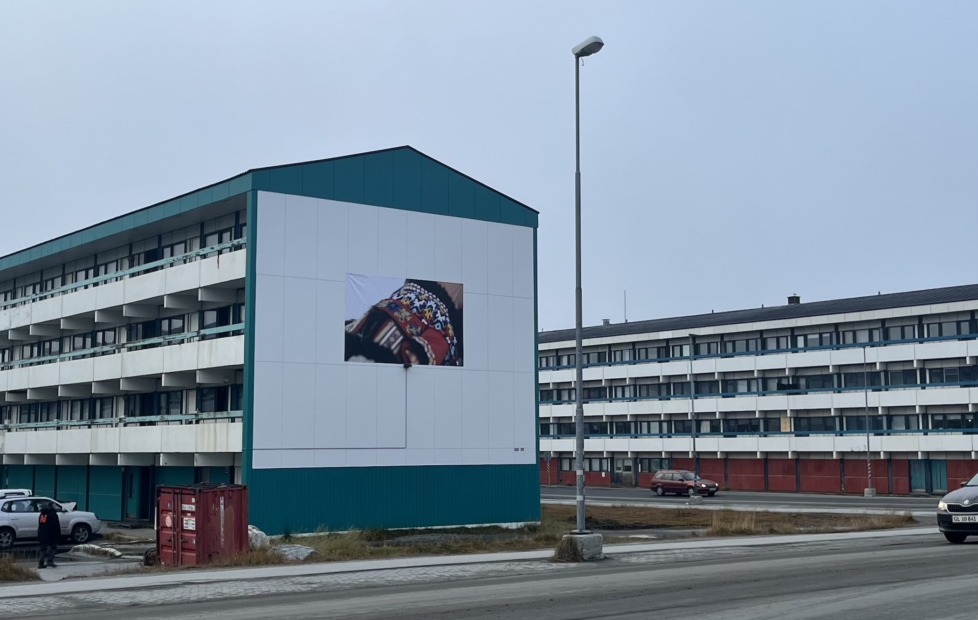
To mark the festival, the large gable walls of these blocks have been adorned with banners by Arnajaraq Støvlbæk and Canadian artist Julie Grenier, both of whom have photographed jewellery, beads, and other small personal effects of the kind found in the drawers of deceased relatives. Something funny and curious happens when the photographic medium comes between us and these beads. How, I wonder, will future generations be impacted by the fact that we now digitise our memories instead of keeping them tucked away in drawers?
If the housing blocks recall the suburban estates of Copenhagen’s western outskirts, then the cultural centre Katuaq brings us smack-bang back to the kind of flamboyantly show-offy architecture familiar from the gentrified harbourfronts of larger Danish cities. Clad in timber, the building undulates like a wave on the outside while its interior is white and high-ceilinged like a typical modern Western museum. Yet at one end of this vast space, something quite different is afoot.
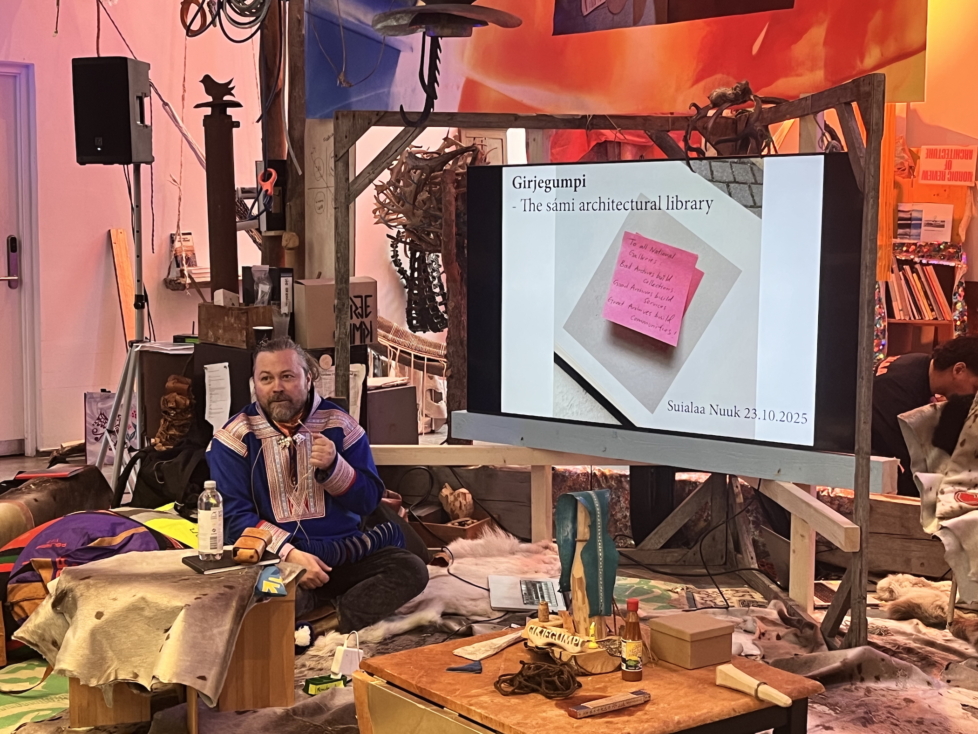
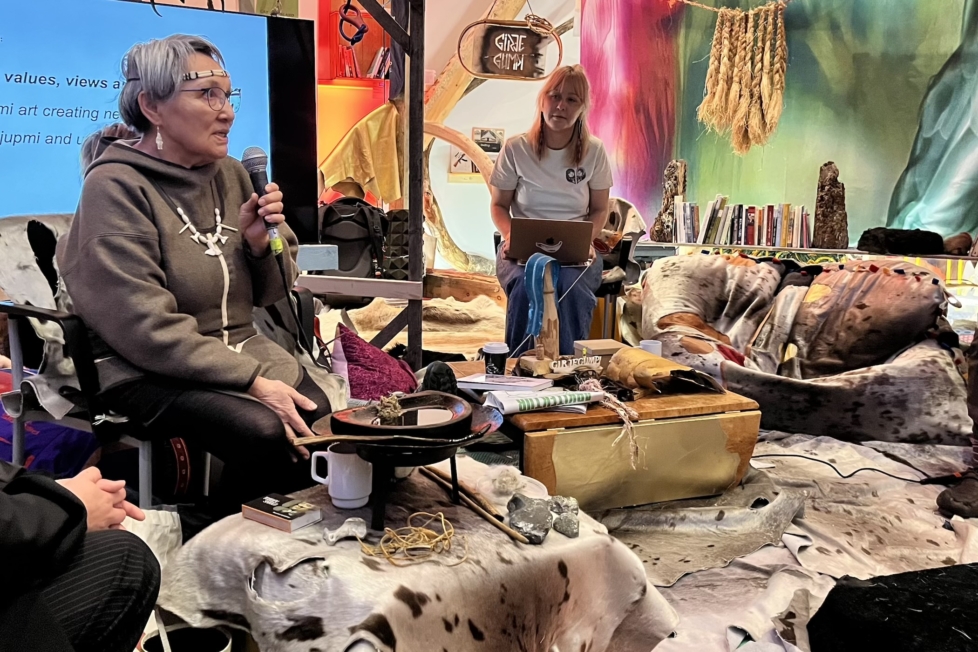
Forming a small, defiant intervention amid all this neatly well-behaved European whiteness, the Sámi artist and architect Joar Nango has created a Greenlandic version of his mobile library on Sámi architecture, the Girjegumpi (2018–ongoing), previously shown in the Nordic Pavilion at the 18th Venice Architecture Biennale and elsewhere. The library, a soft and tactile space filled with reindeer hides and floor cushions, serves as the festival’s venue for talks. Its cosy and slightly chaotic construction stands as a tribute to the distinctive ingenuity that enables Sámi and Inuit alike to survive in environments where resources are scarce.
The highlight of the festival was undoubtedly the talks programme at Katuaq. Most of the conversations revolved around bringing together Greenlandic, Canadian, and Sámi artists and cultural workers, sparking dialogue between kindred spirits about Indigenous culture past and present. In a conversation between Nivi Christensen (Nuuk Art Museum), Dine Arnannguaq Fenger Lynge (NANU – Sámi Arts International), and Lindsay McIntyre (Inuit Art Foundation), one of the points raised was that Arctic Indigenous cultures share a distinctly collective mindset and a holistic approach to knowledge.
For example, Fenger Lynge observed that in the Arctic, people live off the land they hunt or herd on. Which means that sustainability is not a choice but a necessity, and art becomes a driving force for social justice. “Art is research on survival,” she said, “on creating knowledge, remembering, connecting, and healing. It isn’t some abstract concept. It’s what we do every day.”
Several of the networks and organisations participating in the talks programme were born out of conversations conducted at earlier instalments of the festival. Because the art scenes across the Arctic are small and relatively isolated, having a meeting place like Suialaa is essential for exchanging experiences of life as Indigenous Peoples across colonial borders. Here, participants can create flexible, self-defined structures grounded in Indigenous worldviews instead of waiting to be “included” in contexts and settings that do not truly consider minority needs anyway. As one participant noted, “inclusion implies that it’s not the structures that must change, but the person being included.”
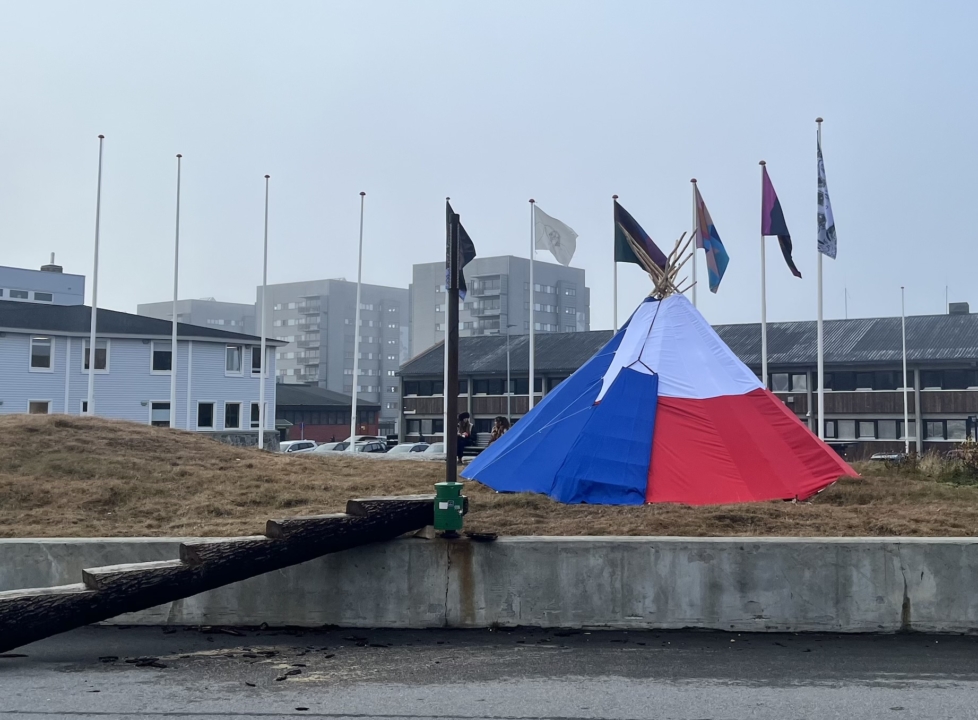
Whereas Europeans tend to build architecture, structures, and systems that are, broadly speaking, intended to last forever, Indigenous cultures carry an implicit understanding that you need to be adaptable, mobile, and ready to change what no longer works. For that reason, and due to limited resources, Indigenous artworks are often modest in scale and take the form of interventions within already existing structures.
A collaborative work by Sámi artist Susanne Hætta and Greenlandic artist Lisbeth Karline Poulsen at the art museum embodies precisely this kind of intervention. In a small room, they have created another soft space using reindeer and seal hides, filling the space with cushions and stuffed objects that can be cuddled, hugged, petted, or leaned against. The work takes as its point of departure the 2023 report of Norway’s Truth and Reconciliation Commission, which sought to map the consequences of the so-called “Norwegianisation” imposed on the Sámi people and to outline possible steps in a future process of reconciliation.
Only a few of the recommendations from the report have been implemented, explained Hætta during one of the talks, where she also remarked that “reconciliation” is an awkward term. “Reconciliation makes it sound as if the Norwegian state and the Sámi minority are two equal parties, but this isn’t a matter of some disagreement or dispute. It’s a colonial violation,” she said. Like the Sámi minority in Norway, the Greenlandic people are still waiting for reconciliation, after a proposal for a similar commission was rejected in 2014 by then Danish Prime Minister Helle Thorning-Schmidt.
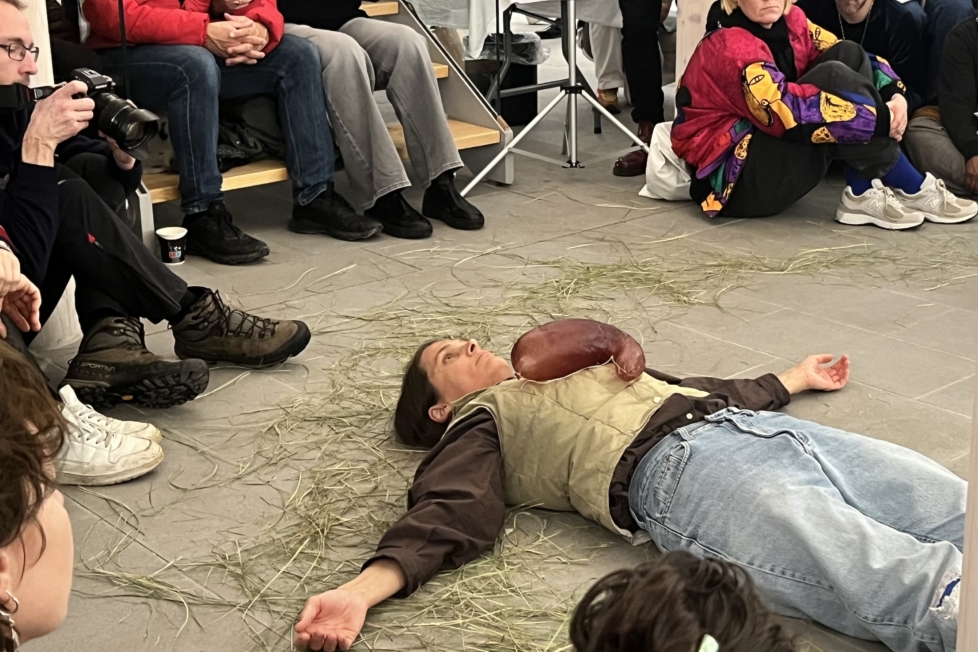
In Lisbeth Karline Poulsen’s Inunngorsimanngitsut (The Unborn) (2025), a work addressing the so-called “coil scandal,” each blood-red bead represents a child who was never born as a consequence of Danish state policy. From 1966 to 1970, up to 4,500 women – roughly half of all fertile women in Greenland at the time – had intrauterine devices (IUDs) inserted without their consent. It is estimated that without this campaign, Greenland’s current population would be around 100,000 people, meaning 43,000 more than it actually is.
For that reason, it rings hollow to Greenlandic ears when the dream of independence is dismissed on the grounds that the Greenlandic population is too small to sustain a functional society. The fact that the Danish Prime Minister recently visited Nuuk to apologise for the campaign offers little more than a symbolic salve. At first glance, Poulsen’s work might appear to be a straightforward political statement, but when I spoke with her, she described how the ritual act of threading the incredible number of beads, the sheer physical presence of the material, had been vital to her grasping both the enormity of the number and the depth of the sorrow this violation stirred in her.
Over the course of the festival, that approach to materiality and ritual slowly seeped into me. In an extraordinarily moving performance at the art museum, Máret Ánne Sara invited a group of performing artists to interact with her works. Through breath and movement, two dancers explored materials such as grass and seal bellies, and it felt as if their bodies merged with the organic matter in a dance that felt like a fusion of ballet and drum dance. I don’t know if it was the abundance of community feeling and soft reindeer hides that gradually wore down my European cynicism, but I found myself brushing away a tear when Saturday’s talk programme opened with the lighting of the traditional qulliq oil lamp to the sound of a Sámi joik.
In their own voices
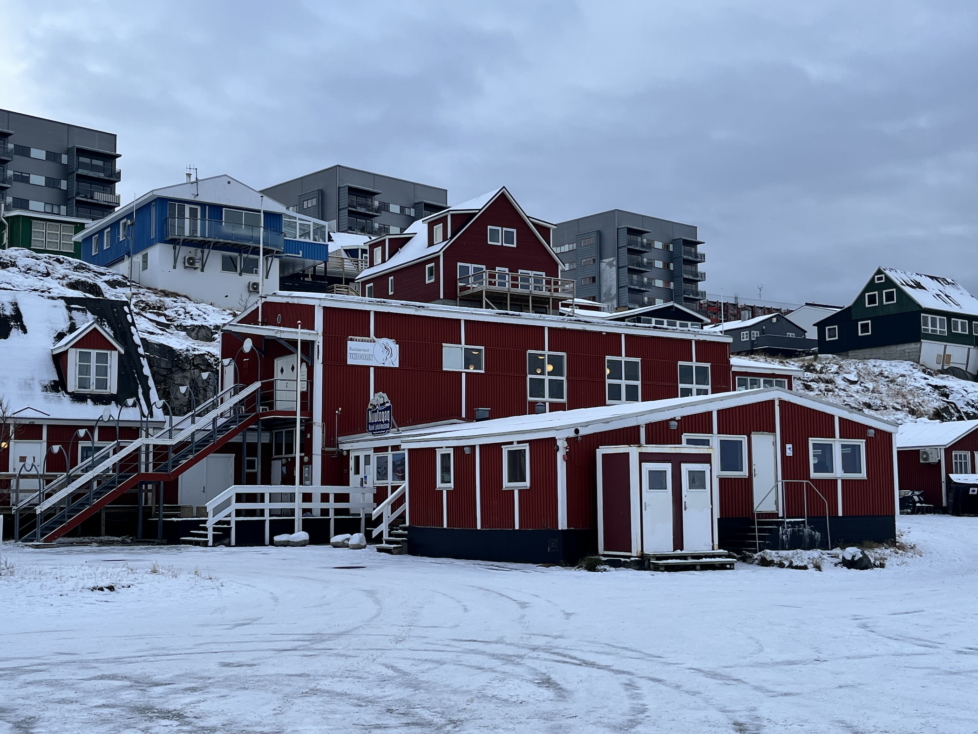
The Nuuk Local Museum, Nuutoqaq, is situated in the old colonial harbour where warehouses and historic buildings such as Danish-Norwegian missionary Hans Egede’s house still speak of a time when ships carrying goods from Denmark provided Nuuk’s only connection to the outside world. Entering the museum feels like stepping into a 1950s classroom, with creaking wooden floors, black-and-white photographs, and informative panels about the city’s history.
I have come to attend a screening of the documentary Grønlands hvide guld (The White Gold of Greenland, 2025), directed by Claus Pilehave and Otto Rosing, a film that was, as is well known in Denmark, removed from the Danish broadcasting corporation DR’s streaming platform following a heated public debate about colonial economics and disputed calculations. This is only its third screening in Nuuk, and many are obviously seeing it for the first time. A young woman beside me bursts into tears at the film’s conclusion and is immediately drawn into a hug by the person next to her.
During the subsequent discussion, it becomes clear that the film carries a very different significance in Greenland than in Denmark. According to co-producer Michael Rosing, the film tells a story that everyone in Greenland already knows, yet has been taboo for so long that seeing it projected on a cinema screen evokes powerful emotions. This is not, he says, primarily a question of financial calculations but about being able to tell one’s own story. In his view, the Danish reaction to the film makes it evident that we have not yet entered a postcolonial era; rather, colonisation is, in fact, ongoing.
Filmmaker Vivi Vold shared that, for the first time in her life, she feared for her safety when travelling to Copenhagen shortly after the film’s premiere. Another Greenlandic director, David Heilmann Ottosen, described the Danish media’s focus on figures – and the subsequent accusation that DR had timed the film’s release to coincide with Greenland’s election – as “deliberate distractions.” The debate ended in agreement that the entire affair highlights the urgent need for stronger support of Greenland’s film industry. “We cannot rely on DR,” was the common sentiment.
In Denmark, Greenlandic rapper and local superstar Tarrak is known from another DR documentary, the less controversial Kampen om Grønland (The Fight for Greenland, 2020), in which he speaks about being among the first of his generation to reclaim traditional Inuit tattoos. Performing on the stage of Nuuk’s old high school, he mixed samples of Danish racist comments with a compelling demonstration of how perfectly the Greenlandic language lends itself to rap. By that point in the festival, I had fully surrendered, melting at the sight of Greenlandic teenagers singing along to the hit song ‘Tupilak’ at the top of their lungs, arms around each other, jumping up and down in unison.
And so, this year’s Suialaa Arts Festival came to an end as it had begun: warm as a reindeer hide, arm in arm with kindred spirits from across the Arctic. And the storm? It delayed a few artists who were stranded in Reykjavik; a handful never made it at all. The rest of us managed with a little adaptability and flexibility – as one does in the Arctic.
Translated from Danish.