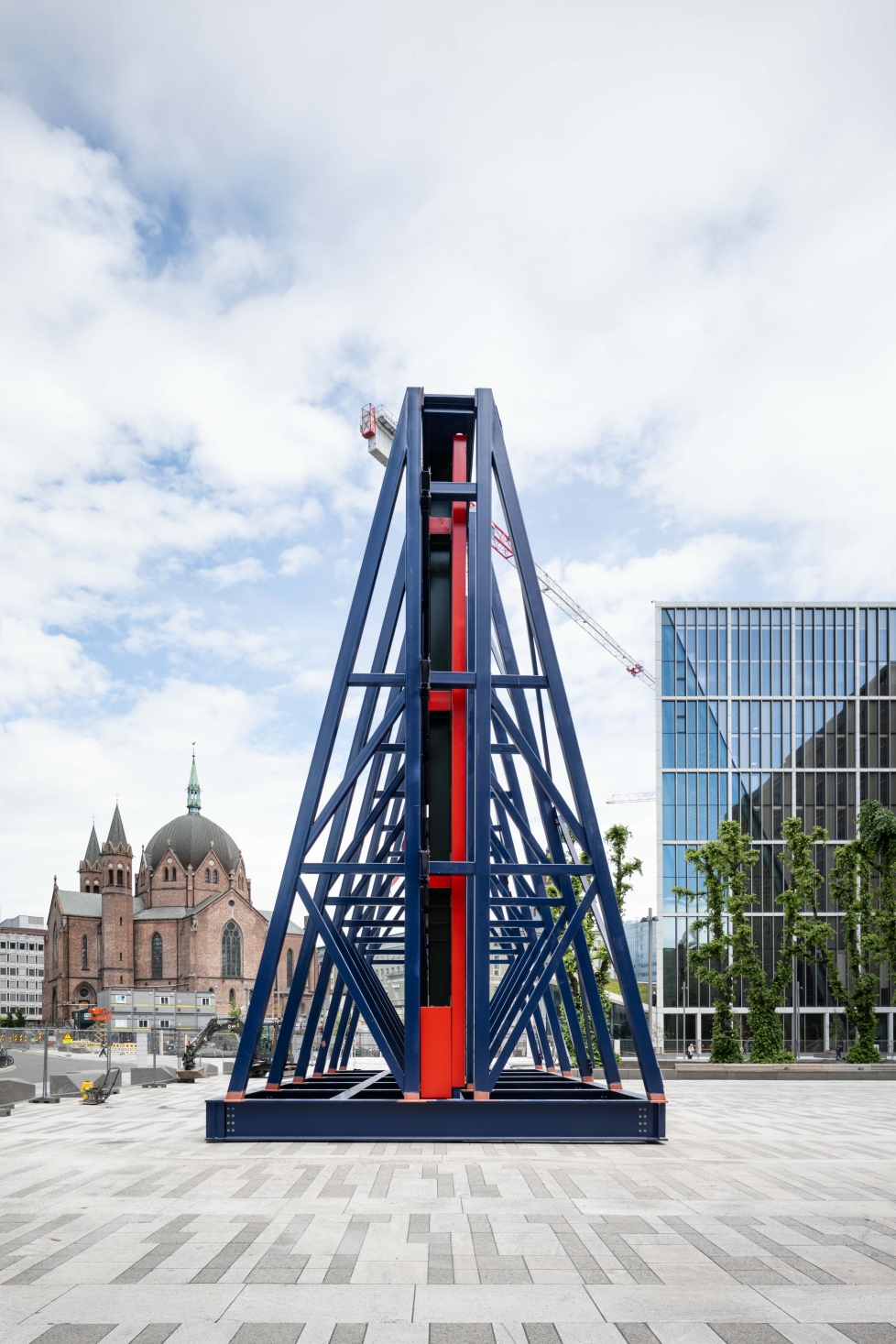
As is always the case with art in public space, the work addressed here has to negotiate the surrounding architecture and a context that is anything but neutral. This is probably not the preferred territory of neo-Conceptualist Matias Faldbakken, although the monumental stone mosaic Upholding (2026) unveiled earlier this summer in Oslo’s new Government Quarter is not his first venture beyond the white walls of the gallery. It is, however, the first time his work has had to fit into a context as hyper-charged as that surrounding a memorial to the victims of the far-right terrorist attacks in Oslo and on Utøya in 2011 – exactly fifteen years ago – when seventy-seven people, many of them young participants at the AUF (Workers’ Youth League) political summer camp, were gunned down and killed. Faldbakken’s Upholding was selected by a jury following a concerted effort by KORO (Public Art Norway) to make the process leading up to the decision as public and transparent as possible. Ten groups of artists and architects presented their proposals for a new national memorial at an open seminar at the National Museum of Norway in June 2024.
KORO can be said to have owed the public a more orderly process after Memory Wound, Jonas Dahlberg’s KORO-selected proposal, was eventually shelved in 2017 following public protests. Sadly, art critics tend to stick to the galleries and are less inclined to plunge into debates and reviews of art in public space. This was one of several weak points that made the process surrounding Dahlberg’s work so messy: the necessary public discussion, including with survivors and relatives of those killed in the terrorist attacks, did not properly take place before a winner was chosen. The fact that the usually sphinxlike Faldbakken must now explain his work in emotionally charged situations under intense media scrutiny seems like fitting payback for all those early years of silence about his own art.
To be honest, I was among those who assumed that his work would not be seriously considered, since it is not a place, an environment capable of embracing people in mourning, but a monumental object that certainly does not reach out and hug you when you stand beside it. At the first presentation in 2024, Faldbakken began by saying that when he had walked past the remains of the government building known as the “Y-block” and saw Pablo Picasso and Carl Nesjar’s mural The Fishermen (1969), which was damaged in the attack, encased in blue scaffolding, it reminded him of a work that he himself could have made. This initially seemed an embarrassingly self-absorbed and strangely misconceived starting point. Were we supposed to want a monument that foregrounded Faldbakken’s own genius and placed him on a par with Picasso? The artist sees it differently, as becomes clear in interviews in which he describes Upholding as a kind of readymade that he simply spotted and recreated. Even so, the artist’s identity, his imprint, has an odd way of getting in the way, inserting itself between us and the emotions that ought to be at the centre of the work.
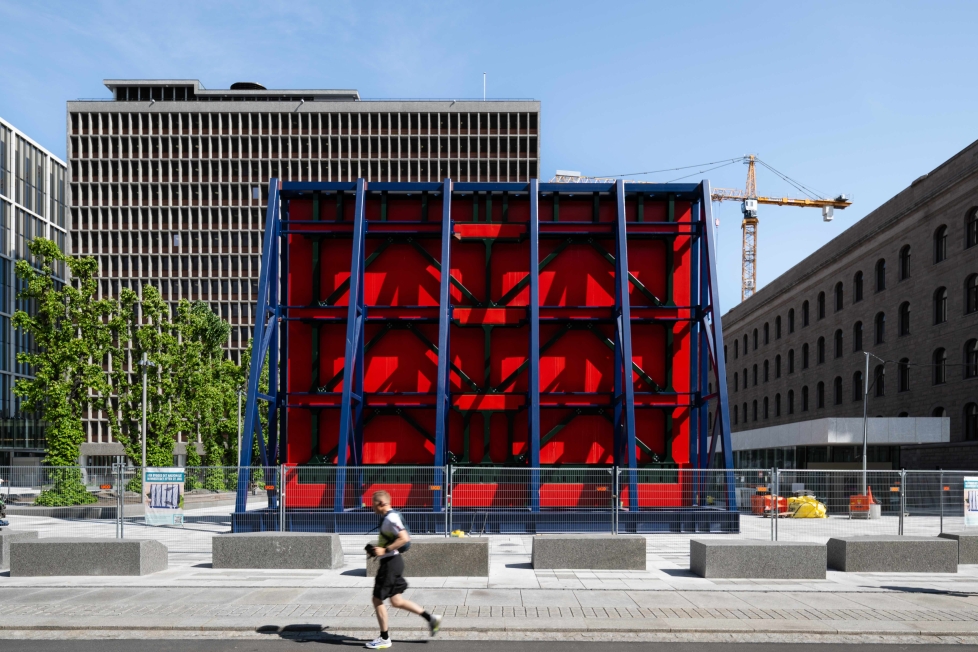
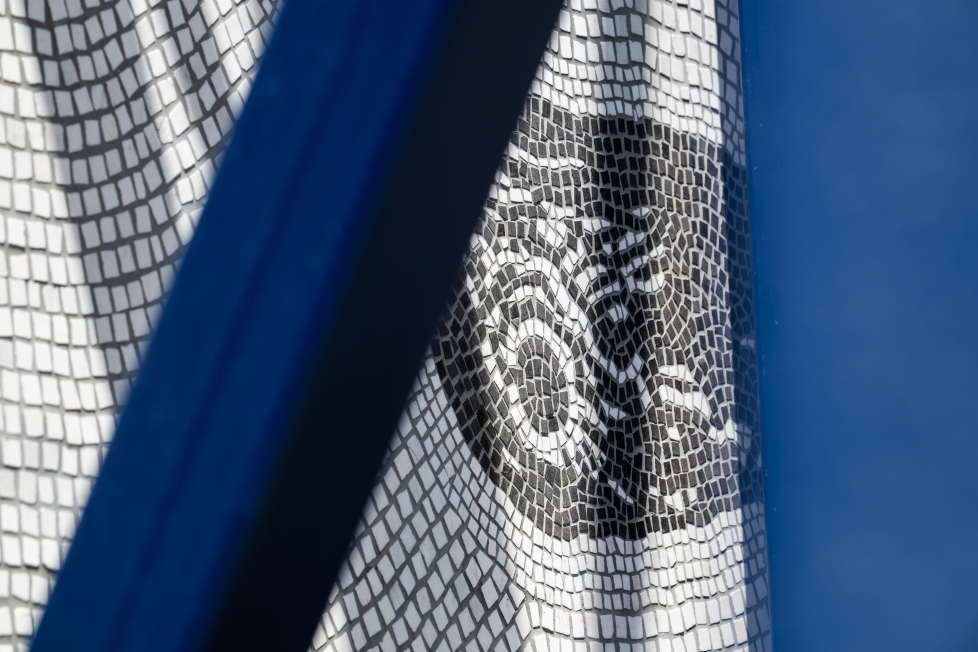
The completed work may be described as having two faces. Its front faces the newly restored Høyblokken. Like a gigantic road barrier, it blazes furiously red – ¡No pasarán! – at anyone intent on causing harm. The inside is softer: a mosaic made of around 300,000 stones produced in collaboration with the Milan-based firm Fantini Mosaici and everyone who took part in the various workshops, including many people directly affected by the terrorist attacks. It feels almost obligatory for a work of this kind to include some element from Utøya, and here that element is the delicate greenshank, a bird found around Tyrifjorden, where the island lies. But, we might well ask, what does a bird have to do with any of this?
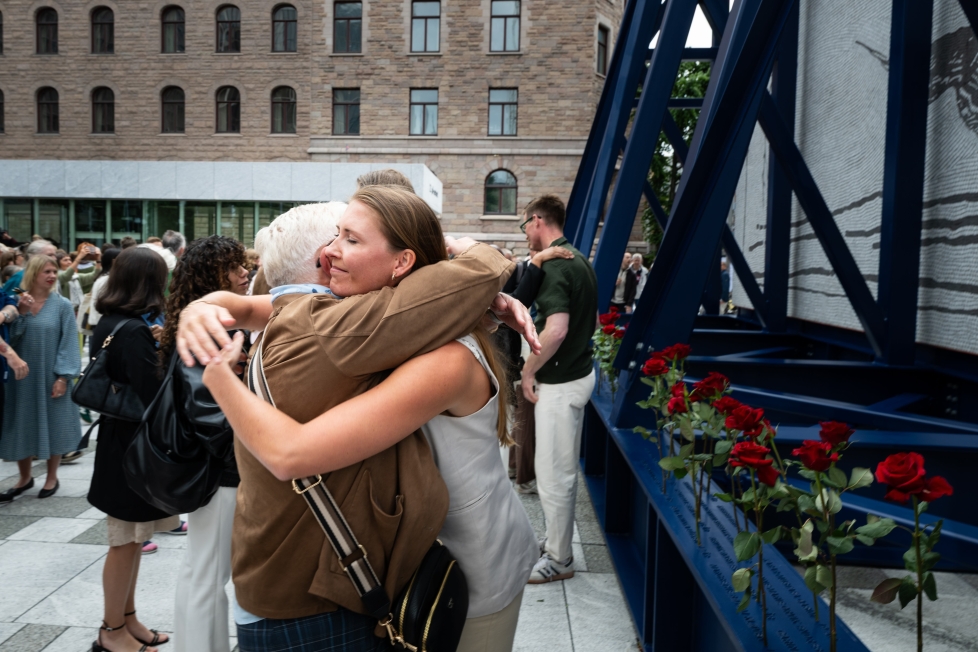
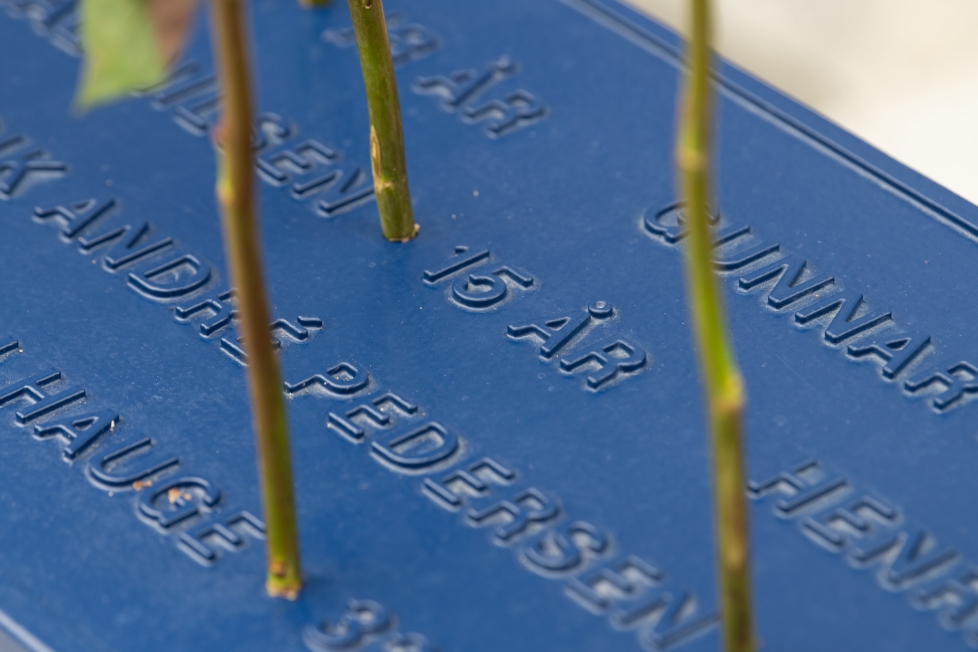
The greenshank is naturally mosaic-like in appearance, speckled black and white. Its bill curves slightly upwards; ornithologists like to say that it ‘smiles’. In the human imagination, birds will always rhyme with flight, and it is easy enough to see the slender greenshank as a dream of, and a longing for, escape, quick-wittedness, and resistance. The weak shall become the strong. Beneath this image the names of those who were killed are cast into the metal in raised lettering so that they can be read both with the eyes and with the hands. Small, discreet flower holders give the memorial a practical function without ‘disturbing’ Faldbakken’s pared-back aesthetic.
If we continue to pursue the idea that the work has two faces, we might say that the delicately vulnerable bird and its reflection in the surface of the water are perhaps intended to speak to those whose lives have been directly affected by the attacks. A far more abstract form of address is at work on the side of the mosaic facing the street, where the blue-painted steel meets the mosaic’s boldly red reverse. What does it mean for us collectively to uphold a reflection? Red and blue are not complementary colours, but they are highly charged colours associated with the political spectrum. Are we upholding a political system in which red and blue mutually mirror and affirm one another through negation?
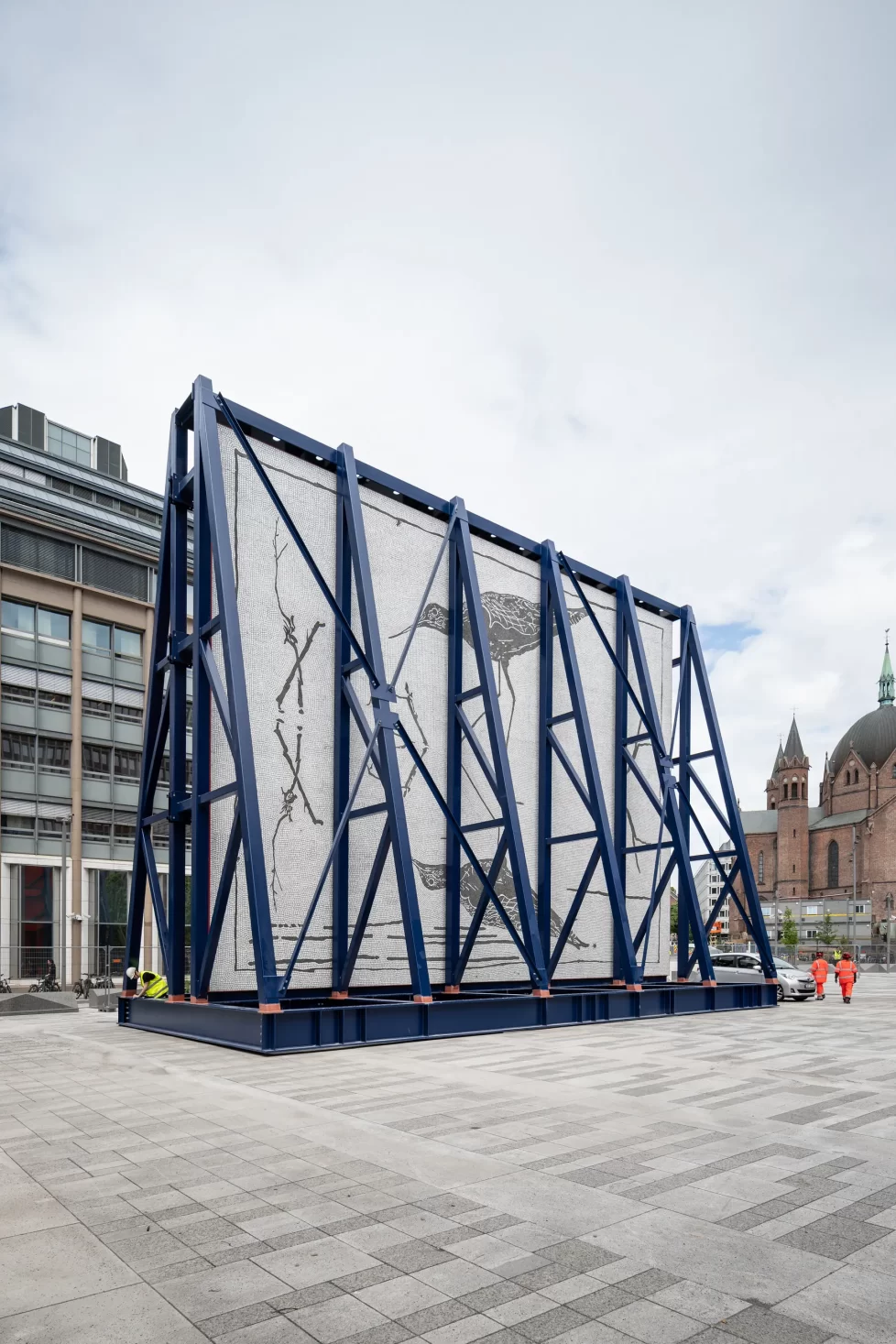
By chance, I happened to be in the area on the evening when Norway’s World Cup football team received a hero’s welcome from Crown Prince Haakon and 900,000 ecstatic people gathered in front of the Royal Palace. The rest of the city was deserted, yet there were still plenty of eyes on the Government Quarter. I became acutely aware that I was being watched, and that an art critic strolling about taking notes could just as easily have been a terrorist planning an attack.
Looking back on the ten works presented in 2024, many of them appear to have been conceived without much thought for security. Are we living in such peaceful times that we can wander safely through garden and sculpture environments as though it were the summer of 1969? Can we just swan around remembering the days when the world was wicked? Clearly not, and perhaps Faldbakken’s was the only proposal to distinguish itself through its bleak view of the future. We need to remember and mourn, but we also have to prepare ourselves for what lies ahead. Sadly, the threat of terrorism has not diminished since 2011; if anything, it has grown. Faldbakken’s concept is more or less the only one of the ten that truly takes this reality on board. It may boast a cute bird motif, yet it is a sombre and clear-eyed work.
Throughout his career, Faldbakken has spent a great deal of time speculating on the avant-garde tendency towards vandalism, negation, and so forth. In retrospect, some of his early works can seem distinctly youthful, even juvenile, a reminder of a period when the security provided by the social-democratic welfare state appeared so solid that unrest almost had to be invented by the maladjusted in the form of imaginary scenarios. Faldbakken’s novel trilogy Skandinavisk misantropi (Scandinavian Misanthropy, 2001, 2003, 2008) clearly manifests this: a restless yearning for trouble and conflict, however abstract and theoretical. A kind of performative fetishisation of negation, expressing the spoilt teenager’s dissatisfaction with all the love and welfare surrounding him.
The adult Faldbakken has, admittedly, observed that the urge to troll the politically correct, so ubiquitous through his novel trilogy, now seems to have helped create fertile soil for an extreme rightward turn. Reflecting on the alt-right, the Trump regime, and the connections between ironic troll forums such as the online bulletin board 4chan, he notes in an interview with the journal Paragone: “Now, in a way, it is the troll-like impulse to rebel that is sitting on the throne.” So how funny is vandalism now, exactly? Faldbakken has created a work that will be almost impossible to vandalise.
Think again of the beautiful, mournful sculpture gardens against which Upholding was competing. And think of the risk they presented of an endless series of re-traumatising incidents and media stories about graffiti and vandalism involving unwanted symbols and distasteful glorifications of violence. My point is that the jury was not alone in giving Faldbakken the thumbs-up – those responsible for assessing the work’s security in the years ahead did too. However firmly the jury’s remit may officially have been confined to purely aesthetic considerations, I imagine that the security briefing was the tipping point. Good art is also art that cannot easily be mown down by terrorists seeking to create the political conditions for a further shift towards extremist positions.
The Rhodes Must Fall phenomenon is another useful example in this context. The protest movement began in South Africa and from 2015 onwards prompted a wave of statue-toppling actions around the world as part of a reckoning with the colonial past. It is easy to understand young people’s desire and urge to eradicate monuments glorifying assorted colonial masters, but what kind of materiality, what kind of physical resistance, should we ourselves leave behind in public space? Politically correct flower gardens daubed with swastikas? Seen in that light, I think I understand more clearly what Faldbakken’s work is trying to do, and why what we need is a monument made of steel and stone rather than a melancholy garden.