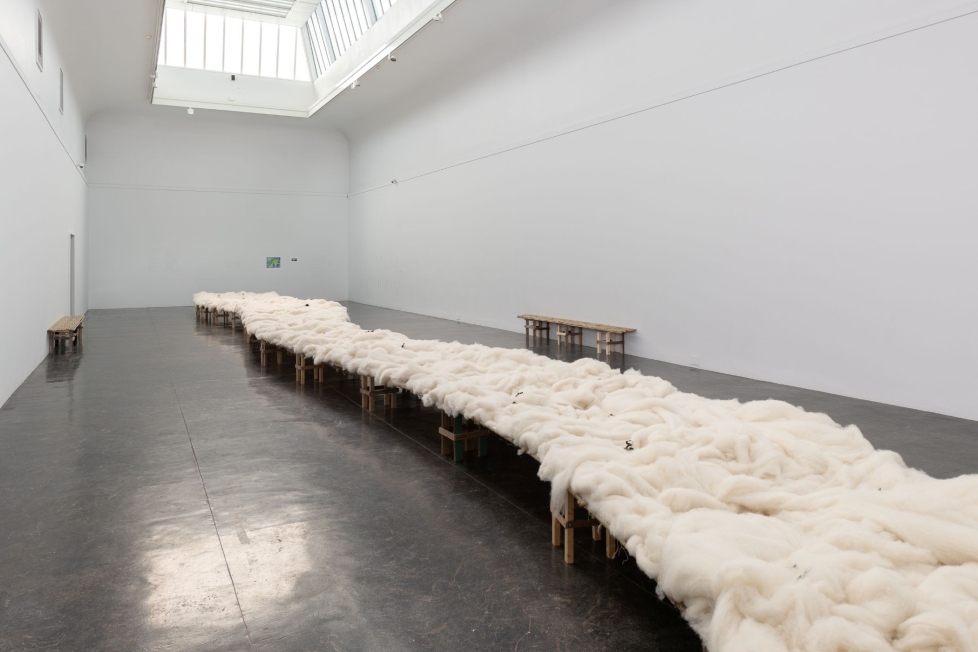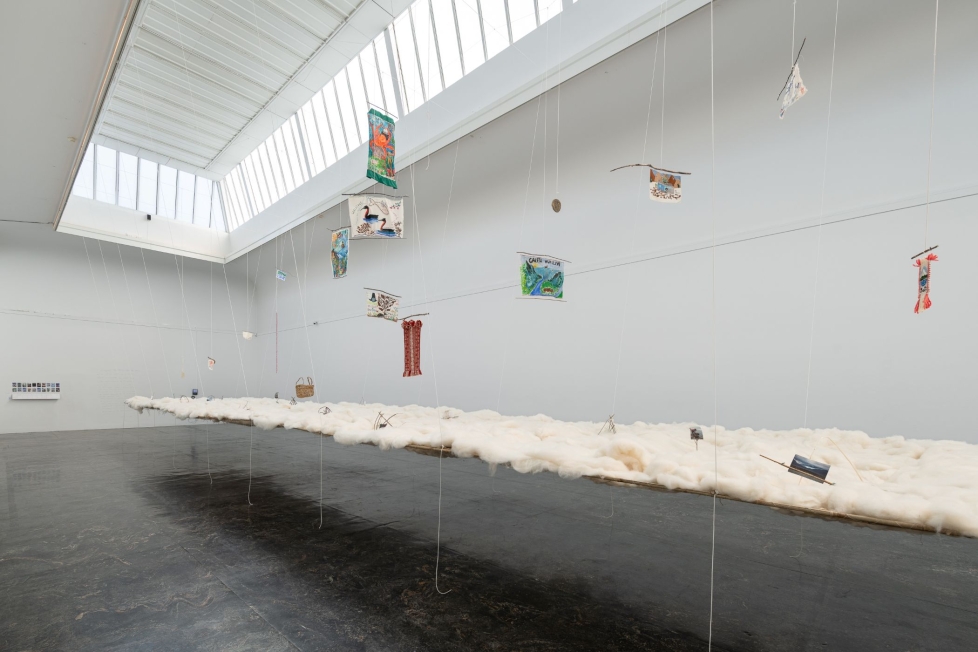
While strolling along the large carpet of wool floating above the floor of one of two long skylight halls in Kunstnernes Hus in Oslo, I feel a sudden urge to rest there, elongated and weightless. It is reminiscent of the impulse I sometimes get when sitting in a plane looking down at a compact carpet of white clouds resembling a comfy material to sit or lie down on. In one sense, I felt carried by this soft, furry carpet hanging from the ceiling at elbow hight. Although illusory, it is a sensation that I would argue is not irrelevant for understanding this exhibition by Chilean artist, poet, and activist Cecilia Vicuña.
To Vicuña, this thick carpet of wool, held by a network of threads, represents a quipu – or “knot” in the Indigenous language Quechua – a pre-Columbian communication system in which knowledge was coded through knots on threads. It is a tradition that was lost because of colonial repression, but for over fifty years, Vicuña has worked on reviving it by making her own quipus. One example is her eight-meter-high installation Quipu Womb (The Story of the Red Thread), consisting of thick clusters of crimson wool with knots, hanging in a circular shape, which was exhibited during Documenta 14 in Athens in 2017.
In the second skylight hall, another version of the quipu is on show: a narrower carpet made of the same naturally white wool, winding through the room like a serpent or a river, closer to the floor. Here, the wool is supported by low wooden stools. Vicuña’s monumental quipu sculptures establish a connection to another time and a lost language, and in this sense they can be seen as representing both incomprehensibility and a surplus of meaning. But although the meaning of these quipus can’t be reduced to a simple message, they carry some messages that can’t be misunderstood.
In what is presented as her first major solo exhibition in the Nordics, Vicuña grabs the opportunity to criticise Norwegian exploitation of natural resources, and to connect with artists and activists in Norway. In Minga for the Sea, she focuses on the stories of two geographically distant yet closely related struggles for marine life – in Chile and Norway, respectively – against Norwegian industrial interests. In both countries, Indigenous People are leading a struggle that is not only about the environmental crisis, but also about a cultural and spiritual connection to the sea.
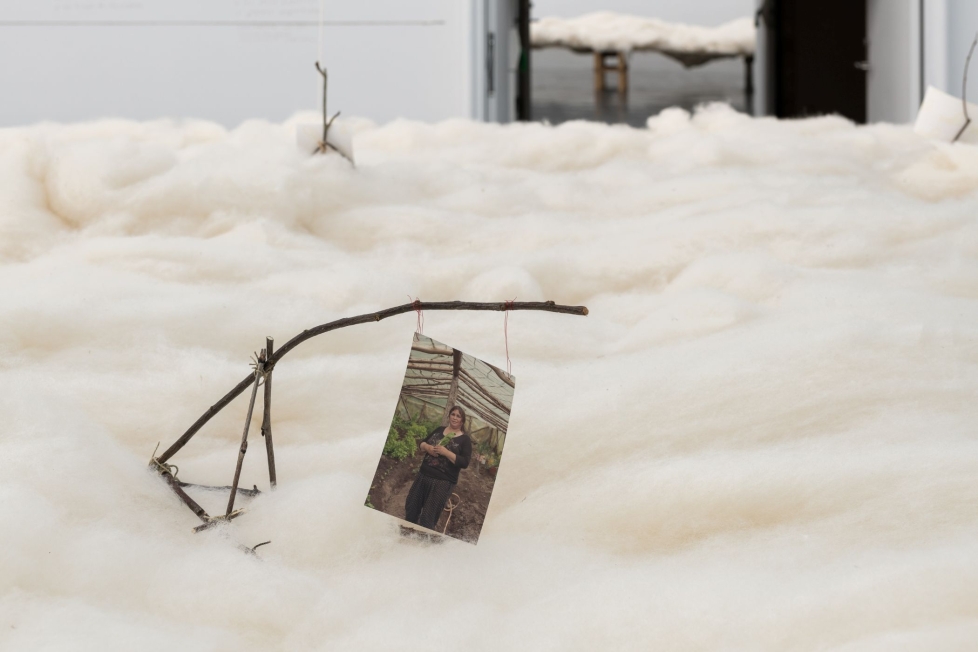
Around the quipu hanging from the ceiling in the ʻsouthernʼ room, Vicuña highlights the Chilean women’s collective Red de Mujeres Originarias por la Defensa del Mar (Network of Indigenous Women for the Defence of the Sea), which is standing up against the Norwegian salmon farms that have been established along the Chilean coastline. The women have contributed small handmade objects, drawings, and photos – some of which hang like small sails over the quipu, some of which are spread out on the wool. Sounding from within the wool in the middle of the quipu is a recording of a woman singing a traditional song. Visitors can also sit down on a bench made of bamboo and listen to a song in headphones.
In particular, Vicuña is concerned with the effect that salmon farming has on the whales in the area. “Whales are not singing anymore,” she writes in one of the many texts scribbled directly on the walls. The text goes on to explain that the whales are starving because krill, their main source or food, is being used to feed the farmed salmon. It is a harrowing and ominous piece of information, and some of the short texts lining one of the long walls of the room elaborate on the deep relationship that Chile’s Indigenous population has with the whales. In Norway, the problematic sides of the salmon industry are widely known, but Vicuña’s presentation of the Chilean situation is nevertheless a brutal wake-up call.
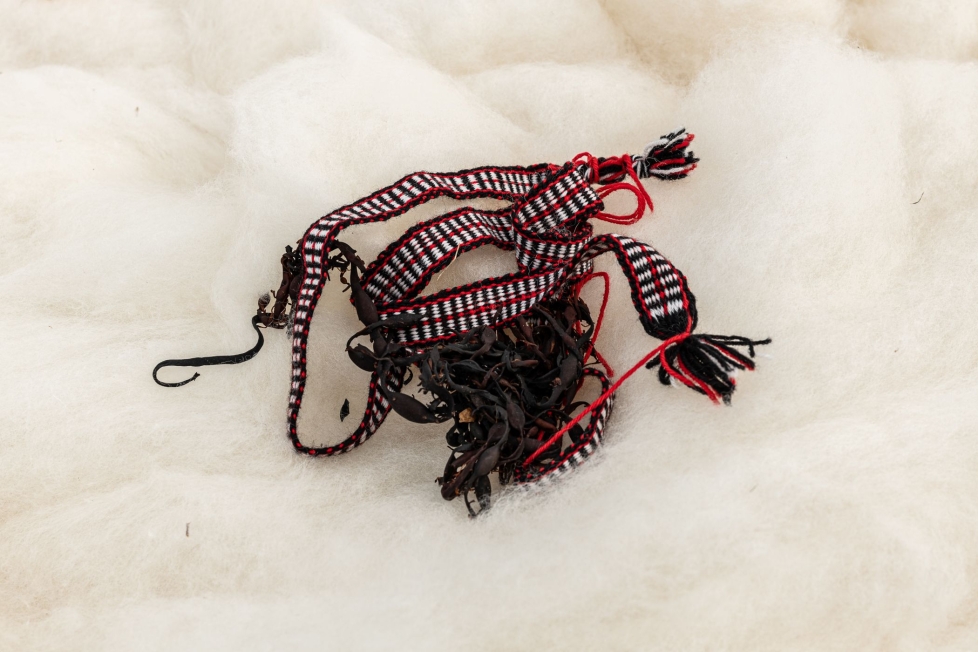
The ʻnorthernʼ quipu presents the Sámi-led action group Redd Repparfjord (Save Repparfjord), which should be familiar to most Norwegians. The group is fighting the dumping of toxic waste from a copper mine into Repparfjord, a fjord in the far-north region of Finnmark, where wild salmon can still be found. Spread across the wool are natural materials like seaweed and shells, duodji (Sámi handcraft), drawings, a poem, and a small screen showing a black-and-white video of a landscape covered in snow. The walls also feature poems, short texts, and a poster version of one of artist Hans Ragnar Mathisen’s maps of Sápmi. Additionally, short informational videos from the activist groups’ social media accounts play on small, vertical screens in both rooms.
From a purely aesthetic point of view, it was a stronger experience to see Vicuña’s contribution to The Milk of Dreams at the Venice Biennale in 2022, where she showed a series of imaginative paintings of women and animal figures, followed by an installation of anti-monumental sculptural elements made with found materials, which she labels precarios. Visitors to Kunstnernes Hus expecting something similar may be a little disappointed.
The Quechua word “minga” in the exhibition title finds an equivalent in the Norwegian “dugnad,” and Vicuña translates it to “collaborative work for a common purpose” in English. The collective exhibition Minga for the Sea is characterised by a slightly shaky and folksy DIY aesthetics. It demands a certain amount of goodwill and investment from its visitors in the sense that understanding it fully requires taking time to watch the videos, read the writing on the walls, sit or lie down, listen to the songs, breathe in the heavy scent of wool, and to take to heart what it means if it is indeed true that whales have stopped singing.