The last few editions of the Baltic Triennial, organised at the CAC Vilnius since 1979, have been preceded by a public event roughly one year before the main exhibition. The two curators of the 16th edition in 2027 – Kyiv-based artist Nikita Kadan and Chief Curator of the Museum of Modern Art in Warsaw Natalia Sielewicz – did not break the tradition.
On Friday, 19 June, a discursive and musical event played out to a curated assembly of around two hundred, unequally divided between the handsome young crowd that makes Vilnius Vilnius and seasoned art professionals like myself, everyone on their own trajectory towards what this part of the world calls “honourable age.”
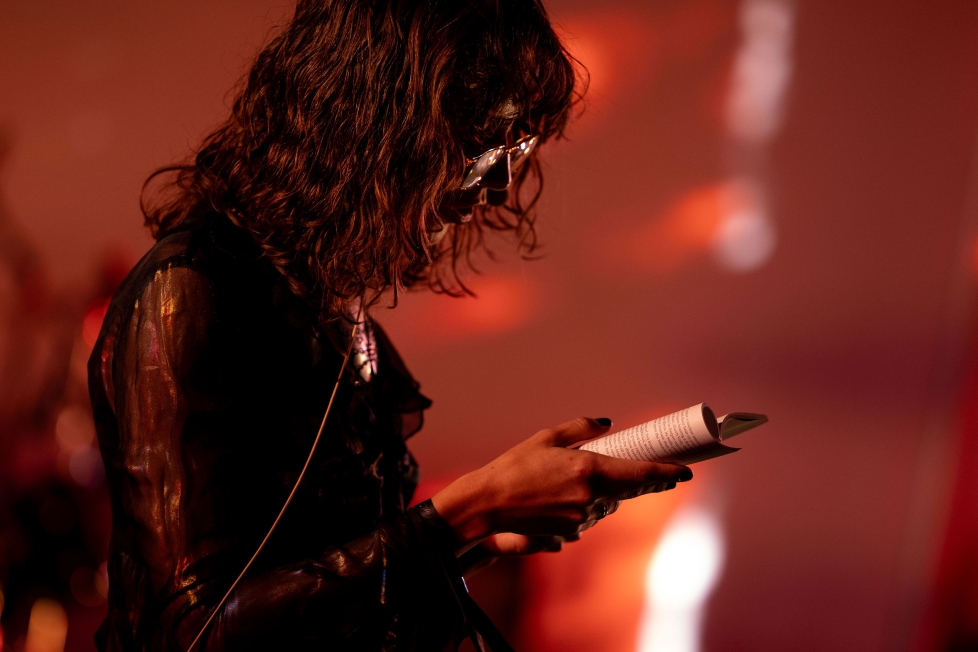
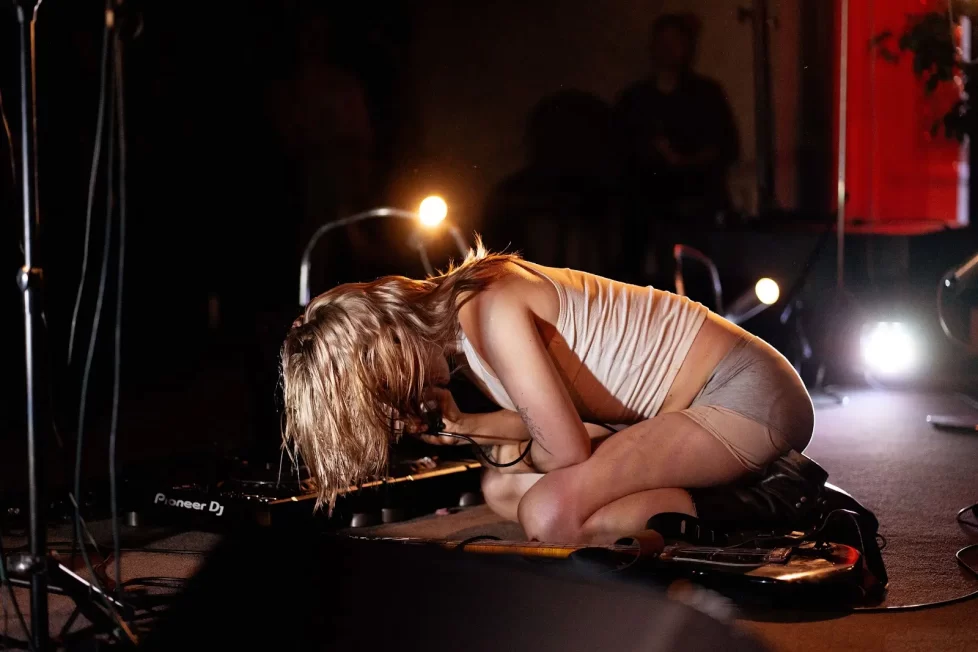
Any genre stands and falls with the quality of the content it promises to deliver, in this case words (read in English from phone screens by their authors, in what has become the accepted industry standard) mixed with sonic art. It would be dilettantish for someone who binge-listens to Haydn to review the DJ set performance by softchaos (Teresa Stout), who also gave a reading, and the purposely very loud Bastard Bath duo consisting of Kuba Stępień (guitar, synth and vocals) and Maja Gajewicz (drums). I shall just say that I appreciated them, in my own way. I also appreciated the seriousness, precision, and tone of the actual discourse our little congregation was fed.
As every event-maker knows, judgment will always be passed on the venue, the sound quality, and the drinks. The Composers’ House is a delightfully pocket-sized and rough-plastered Alvar Aalto-inspired auditorium in an elite suburb, designed by Vytautas Edmondas Čekanauskas and inaugurated in 1966. He was also the architect of the Art Exhibition Palace that opened one year later and is now the Contemporary Art Centre. Good sound is so important for a reading, and too rare. I found no fault with it this evening. To quote from artist Agnė Jokšė’s distinctly no-nonsense account of a breakdown catalysed by her activism during the Lithuanian cultural protests last autumn: “Technicians usually have the best ideas.”
Both Jokšė and Sielewicz, who also gave a similarly confessional but somewhat more constructed reading, floated, with self-deprecation of the honest Central European variety, the notion of “oversharing.” In all honesty, I (a Central European by choice) found the evening to be about something more delicate and, yes, urgent: sharing.
The words printed on the wristbands we received at registration paraphrased a question posed in a poem by American writer Alice Walker (best known for her 1982 novel The Color Purple): “How do we pull the arrow out of the heart rather than yelling at the archer?” In a 2017 talk at Stanford University, Walker elaborated on the metaphor: “If we don’t learn to take out the arrow it stays there. The wound becomes infected. We become like the people we hate. And what a fate that is.”
The stage was set for a meditation on anger and resentment in relation to grief and mourning, the prologue of an international exhibition that the curators have pre-sold to the organisers as “the saddest show in art history.” Their plan is, for now, to stage all public events in the various cemeteries of Vilnius, some of which are places of great beauty and historical significance. One focus will be Ukraine, the Middle East, and other war zones across the world. There will be an emphasis on non-travelling Ukrainian artists: men of draftable age prohibited from leaving the country who have, since the Russians launched their full-scale invasion in February 2022, become invisible to the outside world. The exhibition will also feature works by prominent Ukrainian artists, among them women, who have been killed at the front.
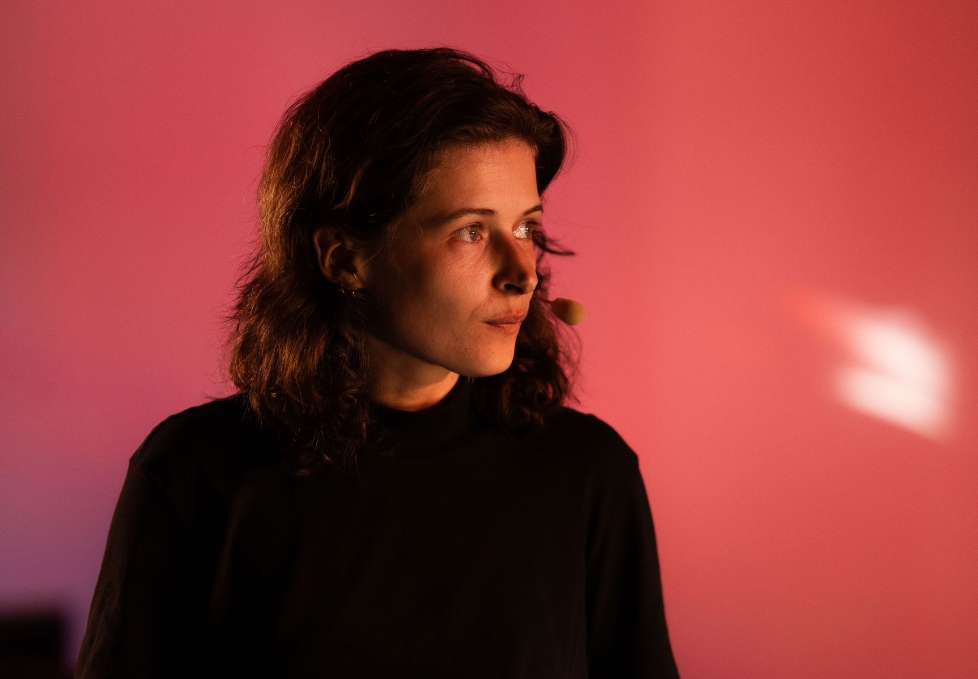
Kadan, whose discursive dexterity I have long admired, said to me just before the event at the Composers’ House that it would be a melancholic exhibition, “but not one that wallows in catastrophe.” Its aim is instead “to talk about how we can live when catastrophe becomes the new norm.” In his introductory address, co-written with Sielewicz, Kadan further noted that “to hate war doesn’t mean to deny its reality.” A likely scenario for the future, he held, is to be “fighting within the war yet contending against it.”
The event also included readings by two Ukrainian theoreticians in exile. Iryna Zamuruieva, of the University of Oxford, constructed her text around the ancient burial mounds of the Pontic steppe, the kurgans. Asya Bazdyrieva, of the University of Applied Arts in Vienna, made an essential point while explicating her concept of “the geopolitical mode of communication”: there is no space outside the war. Within its parameters, there can be degrees of kinetic and affective intensity, moments of quiet and distraction, but one is “never outside the statistical probability to receive a piece of artillery while casually walking, and never outside the air, which one has to learn how to listen to. It is pierced with information.”
The radical difference between being claimed by war and claiming detachment from it is absolutely insurmountable, but we will only realise this once war has been inflicted on us and others still continue to live as if it never happened. This appears to be at the at core of the upcoming Triennial. It is also at the very core of our current historical period, which may or may not already be the Third World War.