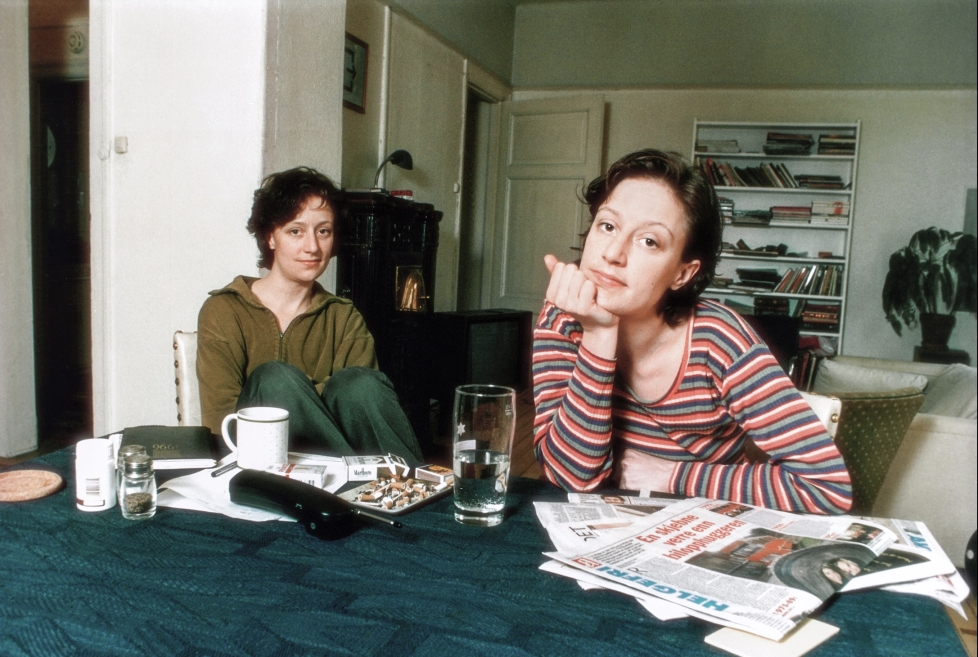
Vibeke Tandberg’s two iconic works from the 1990s, both on view in the exhibition They Live at Kode in Bergen, are also works that essentially sum up the YOLO spirit of that decade. Bride (1993) and Living Together (1996) represent important moments when new currents on the international art scene found a Norwegian voice. The works constituted avant-garde breaks with the prevailing order, and the young artist Tandberg presented herself as an incarnation of this rupture – as a brud (Danish for both “rupture” and “bride”). Oh, dear.
During the mid-1970s, when the media landscape was more static, photography still served as a kind of document of truth. It appeared in newspapers as documentary records of war zones and major events and stepped forth with deep black-and-white conviction in the modernist art tradition. It was not to be fucked with, to put it differently. This, of course, was virtually an invitation for someone to take it upon themselves to do just that. I think of postmodern staged photography as a feminist wave in art, with Cindy Sherman at the forefront. A generation of artists such as Richard Prince, Barbara Kruger, and Sherrie Levine used conceptual approaches, media intervention, and appropriation in their work. Today they are all in their seventies, but their art still feels fresh, ironically reactivated by our present media situation in which documentary credibility has foundered in a storm of ceaseless staging and media manipulation.
In Bride, Tandberg had herself photographed in a wedding dress with ten men – friends from the legendary Bergen bar Garage – after which the images were published as marriage announcements in various local newspapers in Norway. At the time, Tandberg was a student in the first cohort at the Institute of Photography at what was then called Statens Høgskole for Kunsthåndverk og Design (today KMD) in Bergen. All this makes it entirely suitable that Kode should now open its doors to a near-retrospective of Tandberg as part of its series on Norwegian artists with ties to Bergen.
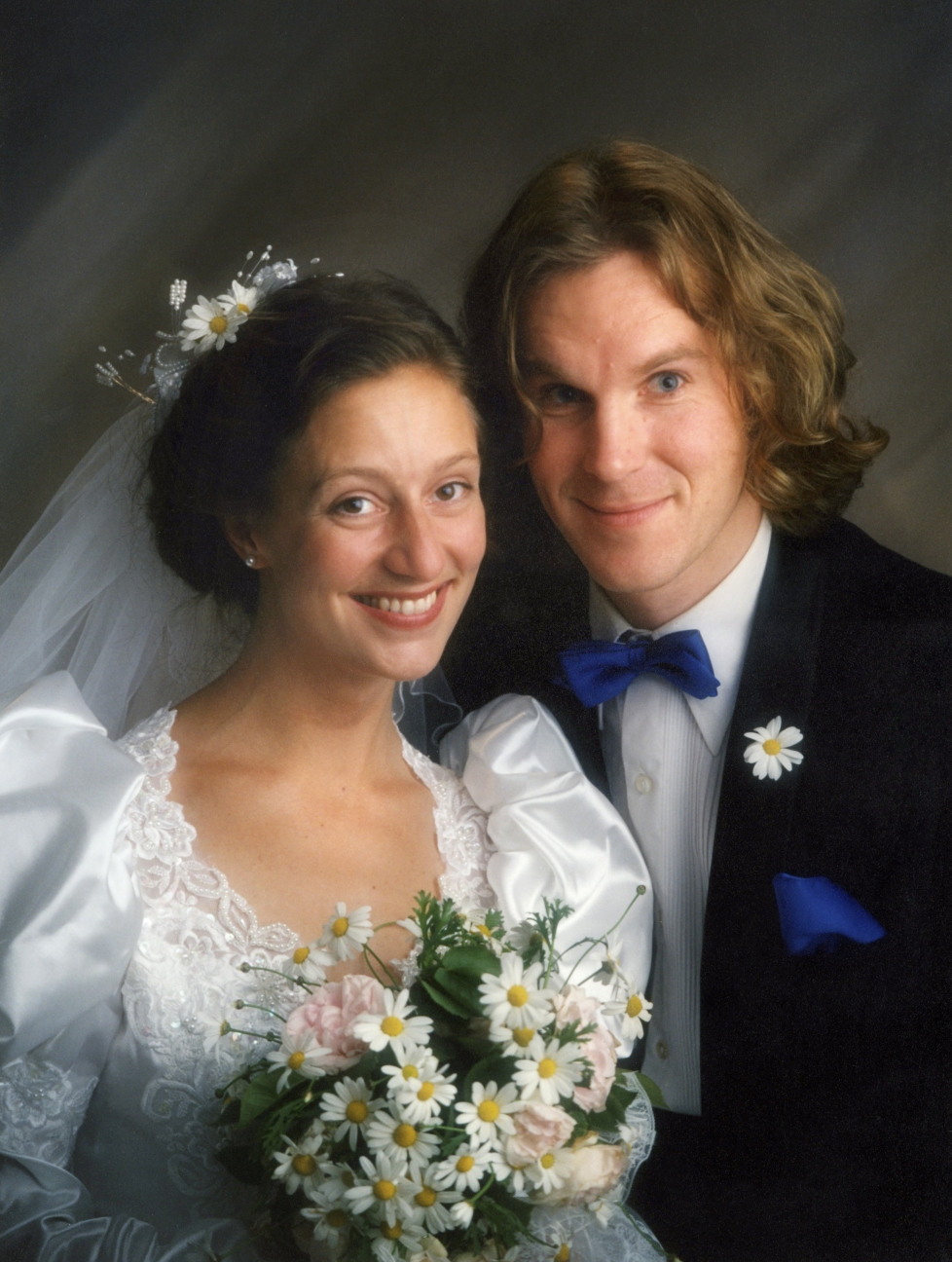
Tandberg embodied every aspect of the Danish term “brud” – bride, break, burst, rupture – but from the very beginning she was also multiple. Looking at the doubled Tandberg in the series Living Together, we may well think of it as a mode of self-presentation rich in promise. Her name is Legion, for she is many. If the artist manages to inhabit this split, branches may shoot out in every direction. Many variations on Tandberg might grow from this seed, and this prophecy (as it were) has come true, for she is not the kind of artist who has stopped experimenting with age.
Living Together plays on aspects of the homely and the uncanny as we gaze, dreamily and half-absently, at these intimate photographs from the cosy everyday life of two women together. When the work first appeared, the audience’s realisation that these photographs had been manipulated, and that the artist had doubled herself, must have crept slowly into consciousness like some alien spider. We probably see it differently today, when self-staging has become a favourite pastime and image manipulation contributes to an ever-growing sense of disorientation.
The former “wow” effect has mutated into a feeling that this is something we must defend ourselves against if we are to preserve our last shreds of sanity. It is as though the experimental distortion pedal has been copied, rebuilt and rebooted, and is now sitting beneath the desks in the Kremlin and the White House. A creepy thought. Perhaps this also makes these artists (Tandberg and her American sources of inspiration) heralds or seers, though they originally saw themselves as tricksters.
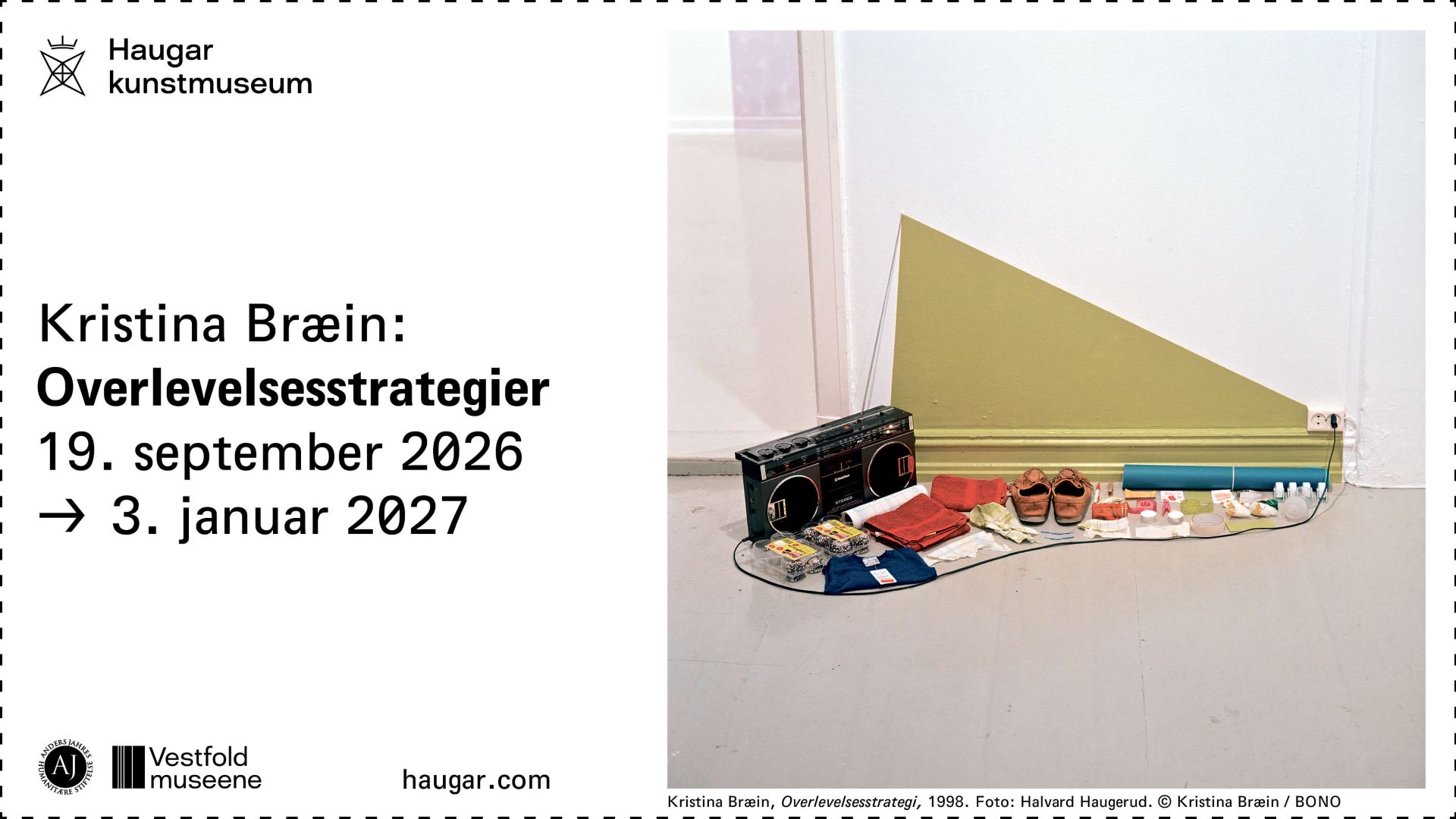
They Live is a narrative about Tandberg’s oeuvre created in collaboration with curator Lars Bang Larsen. It is one of many possible narratives about an artistic practice as it has unfolded over the past thirty-something years. Tandberg appears here as remarkably faithful to her starting point (her theory-informed mode of thinking and experimental attitude) and impressively dedicated to a handful of props, specifically theatrical ones such as the old-man mask and, most recently, the stuffed horse. Since the pandemic, the latter has moved into the artist’s studio and continues to generate meaning. This is the case in two films (Post Americana and They Live, both 2026) which are the newest works in the exhibition, and in which the mask and the horse once again take on new lives.
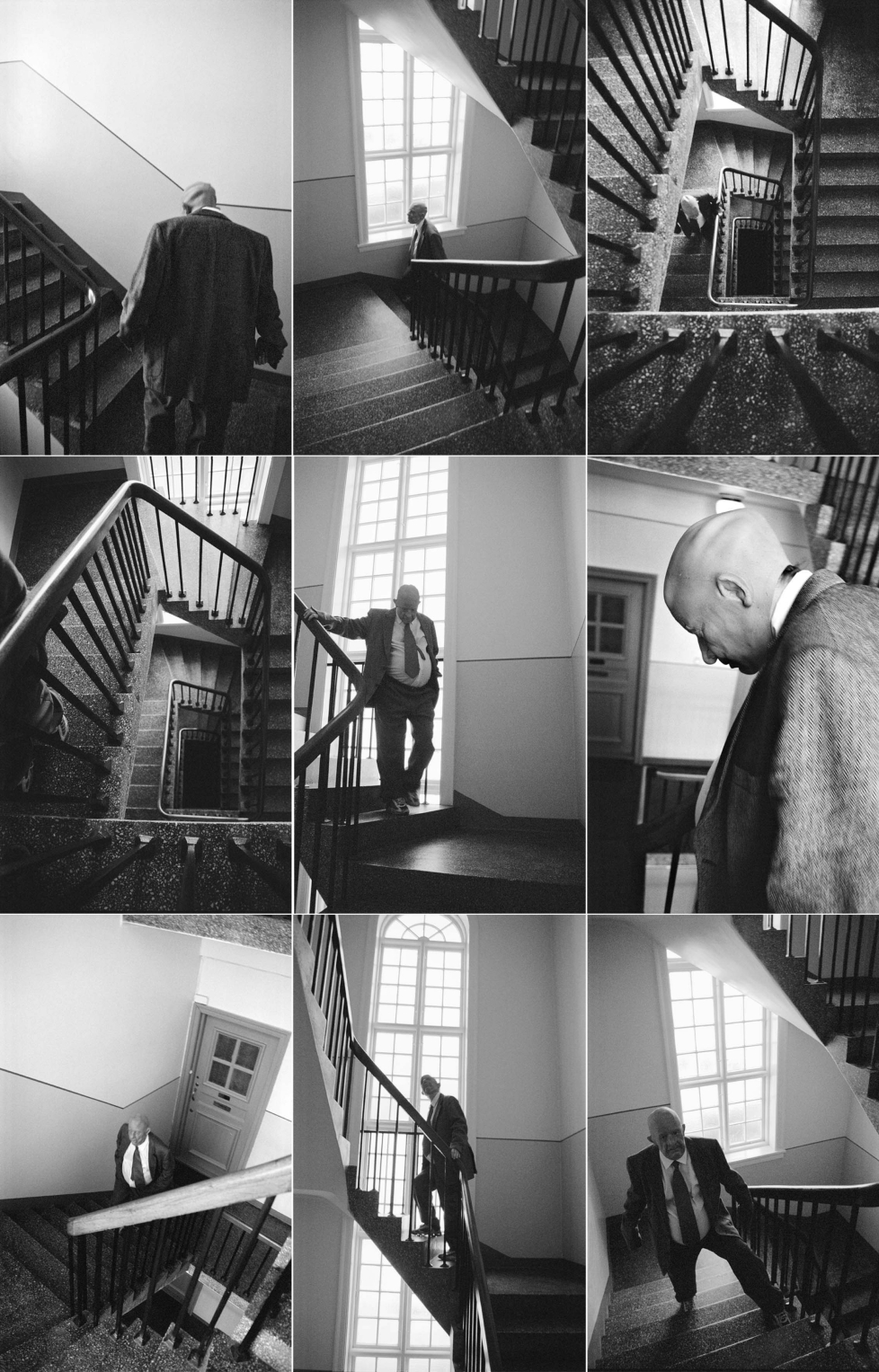
Tandberg first used the mask in the photographic series Old Man Going Up and Down a Staircase (2003), where she wrapped her heavily pregnant belly in the kind of suit you would expect an old man to wear. In doing so, she transformed herself into one of those old-fashioned authority figures that we Gen Xers saw on television as children. Boris Yeltsin comes to mind, perhaps because he acquired a tragic aura as the first Russian president after the fall of the Soviet Union. Yeltsin, with his shrinking empire, offered up scenes of drunken dancing that at the time seemed wildly shocking.
Back then, suppressing the urge to dance was crucial to the credibility of power. Today, dancing is almost compulsory. If a president does not generate memes and a stream of shocking tweets, who is going to care? We have left behind a rational order in which bodily control was imperative in favour of a funfair world in which everything is about provoking emotional reactions. That is why Elon Musk’s arms flail around in what may or may not be intended as a Nazi salute.
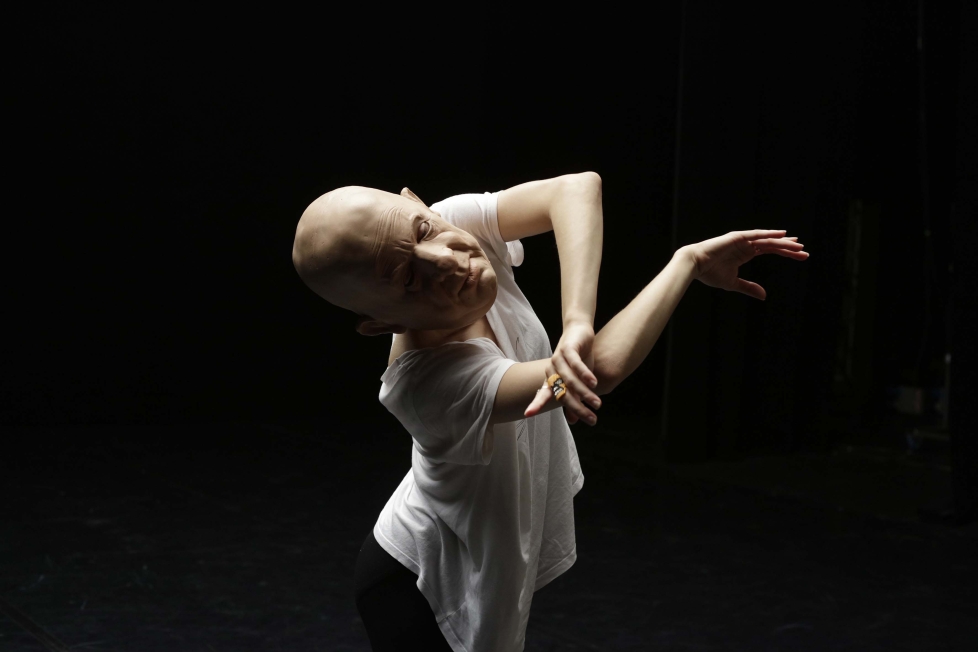
The old-man mask reappears in the film Old Man Dancing (2021). By that point, it was close to celebrating its twentieth anniversary as a prop in Tandberg’s inventory. In the film, the artist once again makes things teeter between the immediate, the mimetically recognisable (the Russian ballet dancer Maria Kochetkova’s gaze, looking out from the mask, out through the screen and straight at the viewer) and the strange, the uncanny. Seen in profile, Kochetkova’s delicate body with the grotesque old-man mask appears almost abject; body and head do not fit together. It is obvious that this is a construct, a staging, for the mask flaps loosely against her neck. Yet dancer and mask become one in brief flashes when we suddenly see her from the front, and she looks directly at us. It’s real, it’s a construction, it’s real, etc.
The same kind of relation exists between the two films mentioned above, one of which (Post Americana) is the work, while the other (They Live) is the work about the work: the behind-the-scenes feature, the making-of. The fact is that the entire exhibition design tries to remind us that we can see behind the constructions depending on where we position ourselves. For the exhibition, walls from Kode’s recent Georg Baselitz exhibition have been reused, but the backing has been torn away. We get the pristine front side, where the works hang, but also the complicated reverse, which reveals how they are built.
Rarely has Kode’s Stenersen building felt so airy, with such long, open sight lines from one end of the gallery to the other. Something magical has also happened to the heavy concrete ceiling, which every other exhibition has seemed determined to fight and hide by chopping up the space according to architectural cues. Not here, though. Someone actually liked these raw concrete beams (I imagine the artist looking up laughing and saying: “Oh, great, Brutalism!”). Set the walls slightly askew beneath them and presto! They play along with the exhibition instead of crushing it.
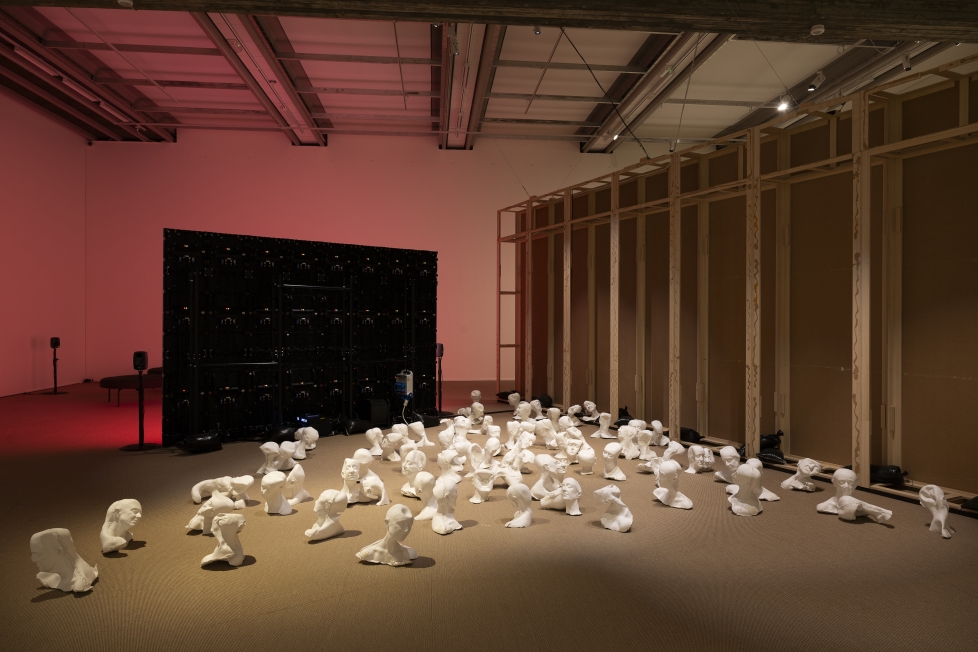
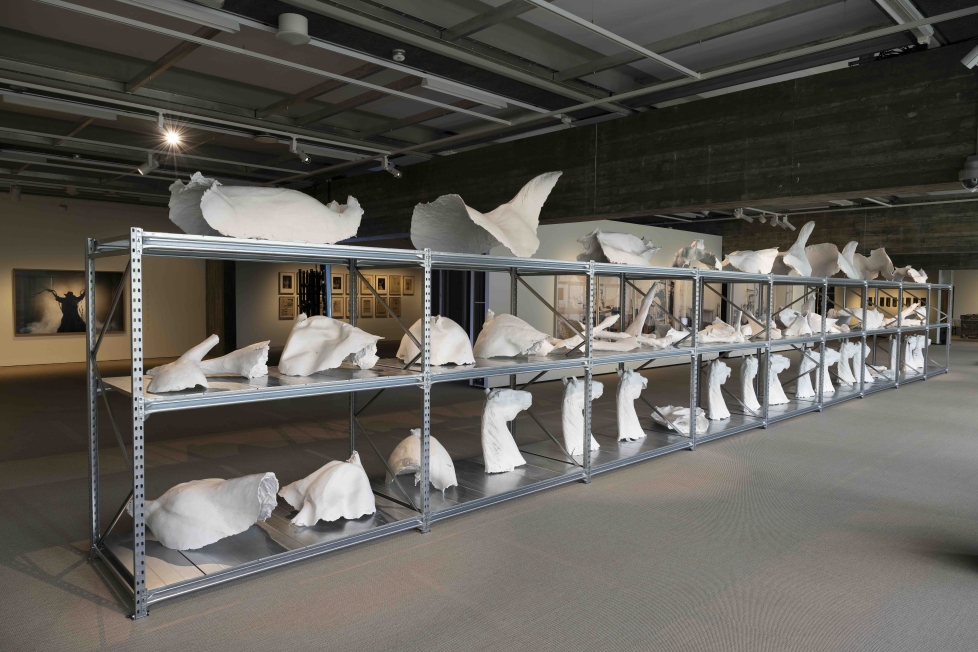
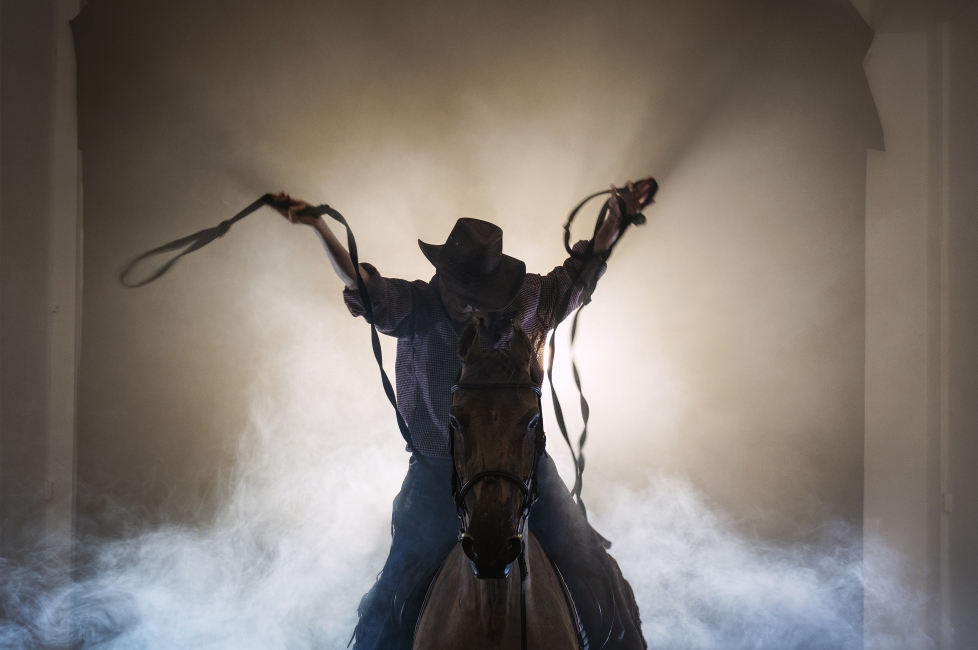
The artist bought a stuffed horse online (comic relief) and used it as the basis for a series of plaster casts (The Horse Archive, 2023), which fills a long shelving unit in the exhibition space. I cannot help thinking of broken eggshells. Considering the furious cowboy in the background (the photographic series Old Man Cowboy, 2022/23), who appears to be whipping his horse onwards, it is easy to start thinking about the horse, the subordinate creature, being ridden to pieces by power.
In the 1990s, theoretically informed art criticism held sway, and for that reason critics of the past may have been cautious about calling Tandberg a political artist. Her commitment is even clearer now, when her oeuvre has seen a gradual movement from a politics centred on the body to a more pronounced interest in geopolitical questions. Post Americana is a meditation on a cowboy being shot in slow motion and falling dead into a pile of hay to the strains of elegiac choral music. All sorts of meanings are set in motion: I see an individual, then, a moment later, an icon; it is a father, my father, the Father, authority, America, and back again.
Before he dies, the cowboy staggers along with his horse behind him. The horse stands rigid and still while the cowboy walks on a treadmill. It all takes place at the centre of a so-called dolly track, where the camera can move round and round. This speaks volumes about Tandberg’s way of telling stories, an approach also found in her novels. Here, stuttering repetitions and endless loops are the order of the day. In the film, however, she grabs hold of the great loop between life and death. Slowly, the scene is invaded by non-human actors. Cute chickens and rabbits from Old MacDonald’s farm? Perhaps they are there to explain why the cowboy disappears in a drift of white feathers that float down from above? However, they also seem rather like stand-ins for aliens. The turkey is not as innocent as it might appear. Are the birds scavengers, eaters of carrion, a nod from the dinosaurs telling us that our time is over?
In the catalogue, Tandberg has a conversation with the American writer and art critic Chris Kraus. The conversation ends abruptly with Tandberg exclaiming: “I hate chickens!” The outburst makes me think of the cowboy-like quality of Tandberg’s own way of making art. It comes across as a grand gesture within a masculine art history, one that is perhaps best captured through parody. “I hate chickens!” is parodic cowboy talk, human hubris pushed to its limit. But it is no use. Slowly, the subordinate creatures we thought we could control will force their way in and gobble us up.
Translated from Danish