The Swedish artist Lap-See Lam’s body of work is unusually coherent. For just over a decade she has made art about the most recognisable cultural expression of the Cantonese diaspora in the West: the Chinese restaurant. The restaurant can be seen as an offshoot of chinoiserie – the European fantasy of the Chinese, a conception built up over centuries of imitation and translation, long since established as a style in its own right, independent of authenticity. It is above all the dragon boat Sea Palace, a floating restaurant shaped like a dragon, that has preoccupied her practice. The boat sailed from Shanghai to Gothenburg in the early 1990s and was later converted into a haunted house at the Gröna Lund amusement park. It now lies at a shipyard in Stockholm.
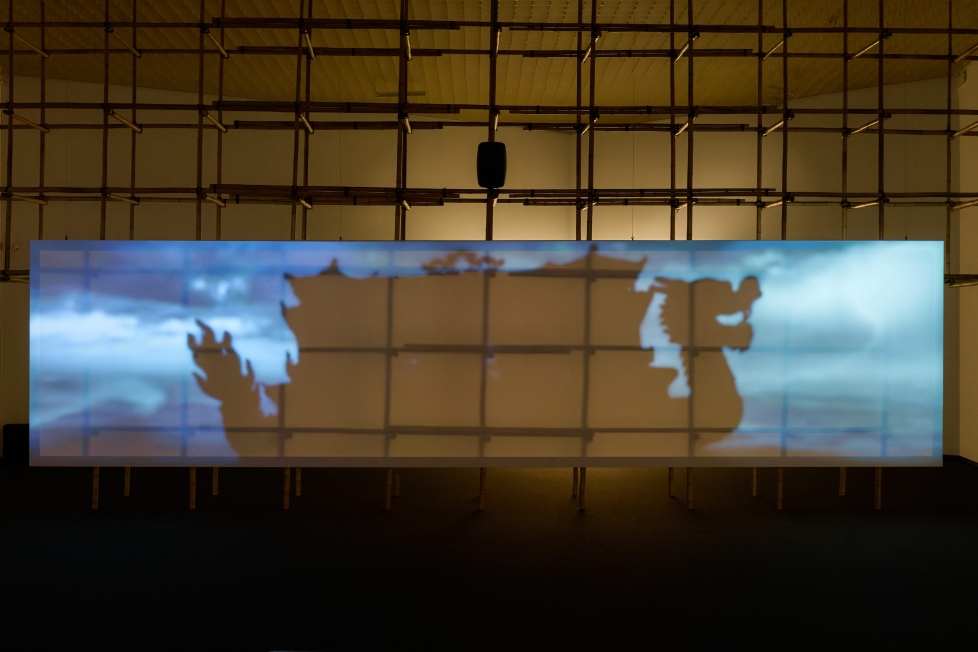
Ombres, the exhibition currently filling the prisma galleries at Henie Onstad Kunstsenter, consists of three videos and a series of sculptural works, with the floating restaurant as a centre of gravity. Floating Sea Palace (2024) is a stripped-down version of Lam’s exhibition in the Nordic Pavilion in Venice two years ago. There she recreated the dragon boat with its head and tail placed outside the building, while a bamboo scaffolding filled the interior and traced the outline of the hull. At its centre was a filmed Cantonese opera about the merman Lo Ting, regarded as an origin myth of the people of Hong Kong. In the opera, Lo Ting is split into two halves, and human and fish drift apart. When Lam places this myth aboard a restaurant boat bound for Europe, it is as if she wants to say that hybridity was there from the beginning – both in the myth of the people and in the culture that travels on.
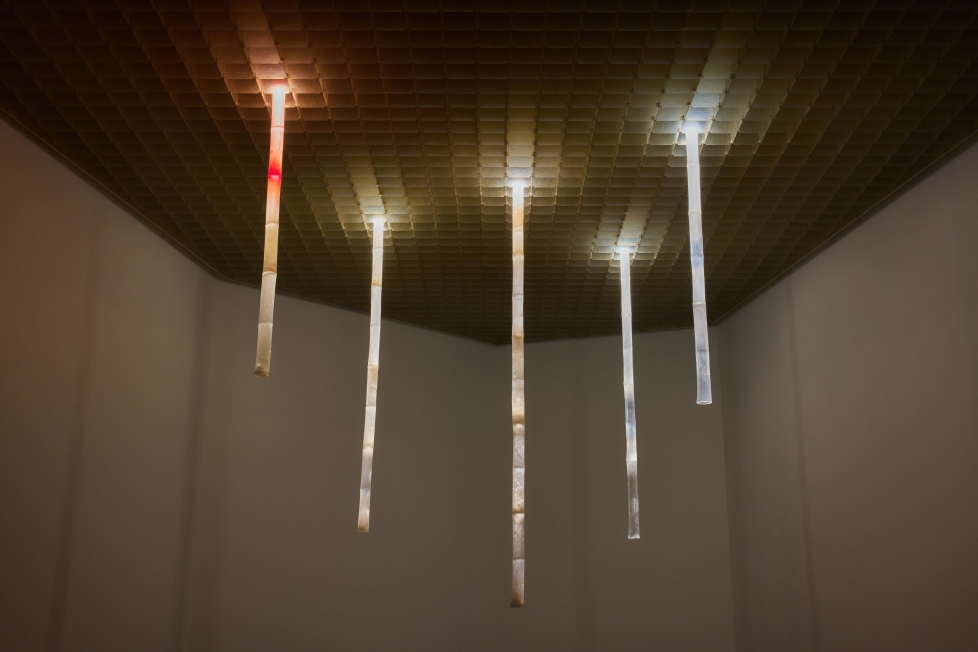
The bamboo scaffolding to which the screen is fixed is raised in the tradition of travelling opera stages. Occupying the same room is the work Bamboo (Vertical II) (2026), five glass bamboo tubes falling from the ceiling like icicles or stalactites. They glow faintly and warmly, almost like the lamps in a restaurant, giving a subtle nod to the other works in the exhibition. Where the scaffolding is rooted and rises upward, thus presenting itself as a symbol of construction and anchorage, the glass bamboos point downward, like memories from another life, from the ancestors.
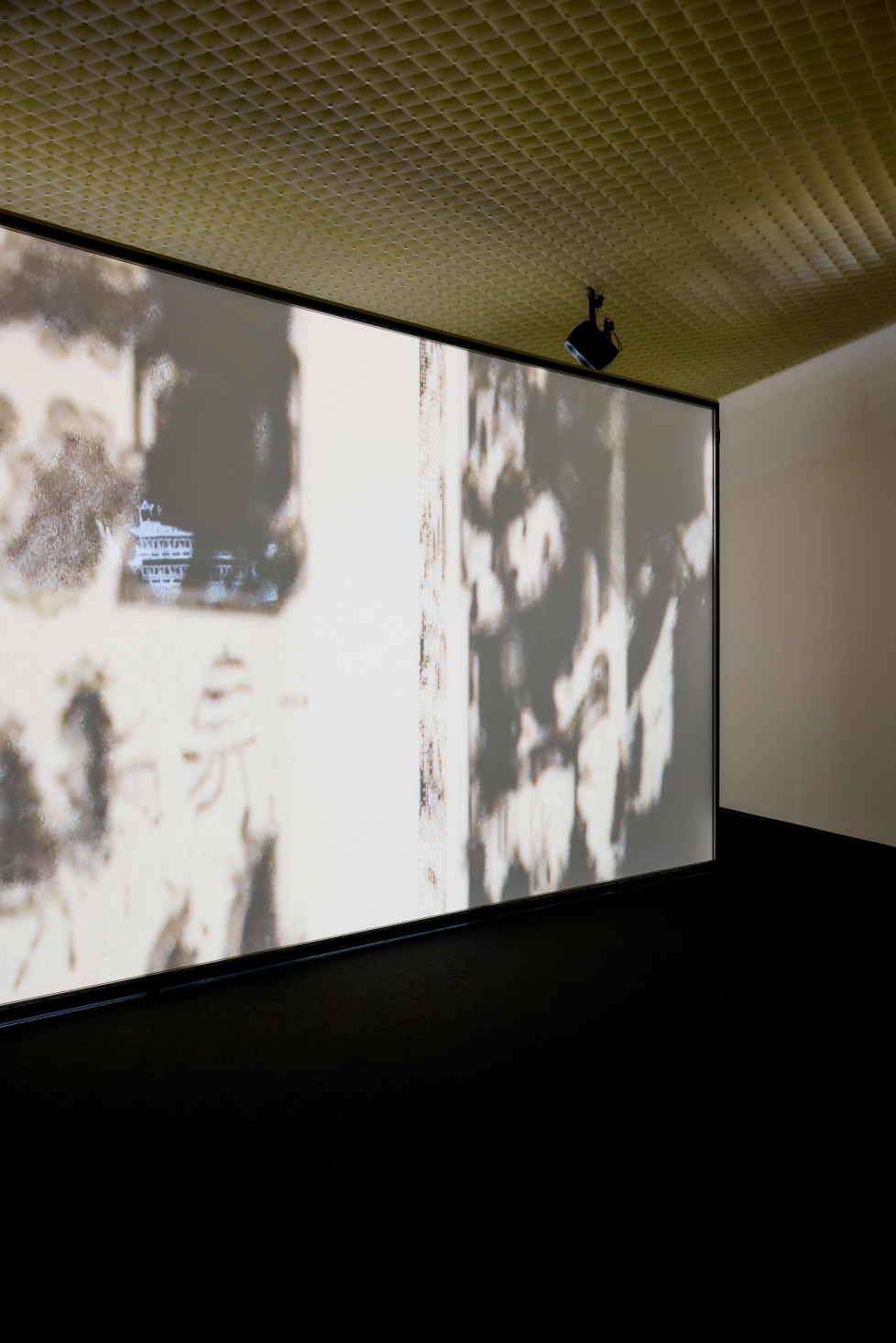
Dreamers’ Quay (2022) is the exhibition’s centrepiece and a large-scale shadow play. It consists of a multi-channel video installation in which Lam combines the ancient tradition of shadow play with advanced projection mapping, a technique that fits the projected image precisely to surfaces and objects in the room. The narrative carries us from the 1970s, where a teenage girl enters a time portal in her mother’s Chinese restaurant, back to the 1700s, when the first connections between Canton and Sweden were established. Along the way, she meets characters from this entangled history, among them a singing cook and the first registered Chinese person in Sweden. They are rendered as shadows of smoke clouds that drift off and dissolve, lending the work a phantasmagoric quality. The light sources shift while you stand surrounded by screens, immersed in a multi-channel soundtrack that mixes music, radio recordings, and voices in several languages.
The installation is technologically advanced, yet an object placed between a light source and a screen unavoidably gives the impression of standing before an older medium, like a magic lantern. Just as she folds different eras and generations into one another, so Lam does with traditional craft and new technology. This is akin to the approach that Siegfried Zielinski calls for when he argues that, rather than reading the history of technology linearly, as a development from the primitive to the advanced, we should dig downward through the layers, like geologists. Then we find traces of the oldest techniques in the very newest.
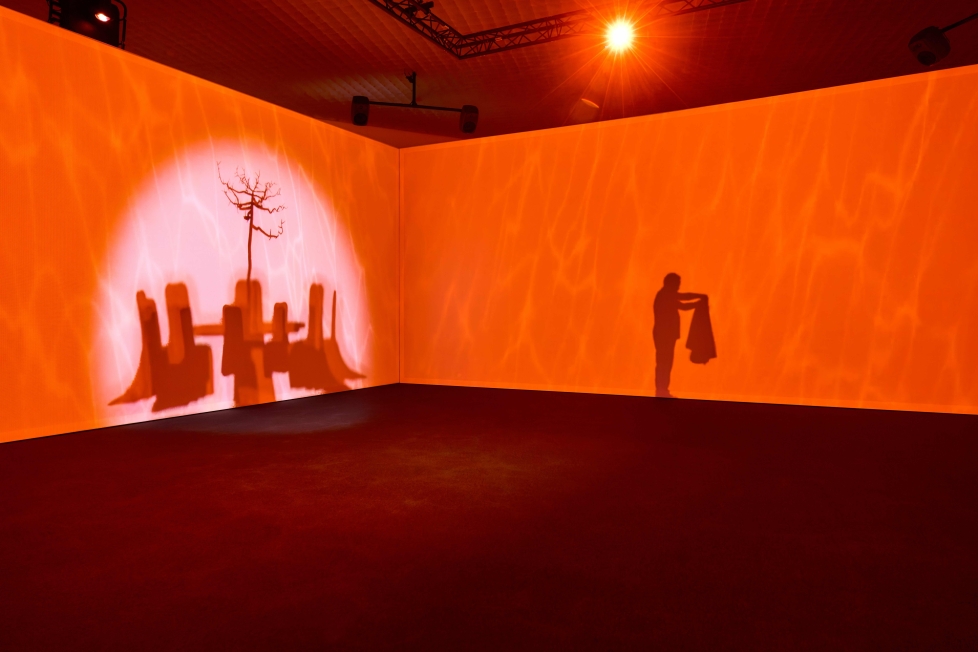
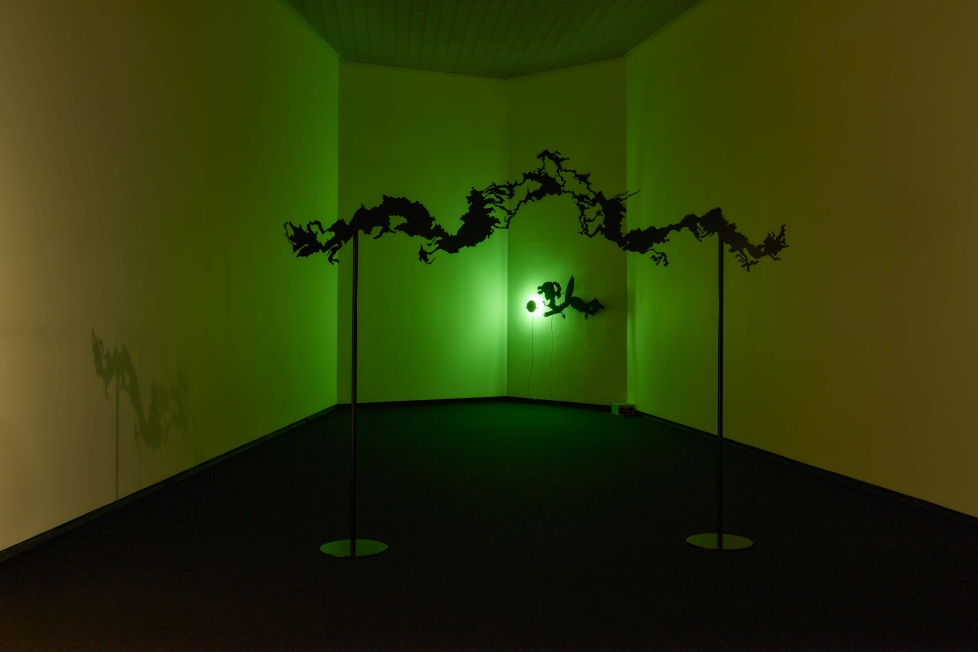
For someone who grows up as part of a diaspora, the culture you inherit can feel like a time capsule. Emigration all but seals the culture one leaves behind, as it was at the moment of departure. Lam gives sensory form to this union of past and present, and it is fitting that she lets it play out through shadows. When her characters appear as literal shadows of smoke, it underscores that they are traces of bodies that no longer exist. The same was the case with phantasmagoria, the ghost projections of the 18th century, which were used to conjure up the dead, the ancestors. The past’s haunting of the present lies not only in the motifs but in the very apparatus that produces them.
Lam’s works are closely linked. The exhibition’s eight pieces come together in a way that emphasise their unity. Both bamboo and the restaurant recur as motifs in nearly all of Lam’s work. The videos feel somewhat oversized relative to the space, and image and sound bleed into one another. The effect is admittedly powerful and clearly intended. However, it is also the exhibition’s weakness. Lam has built a system in which all traces lead back to Floating Sea Palace. It is impressively tight, but I miss ruptures in this totalising logic, aesthetic deviations that refuse to fall in line with the carefully choreographed whole. Such ruptures would correspond to the diasporic experience of split origins and untranslatability that smoulders beneath the surface of Lam’s narratives.