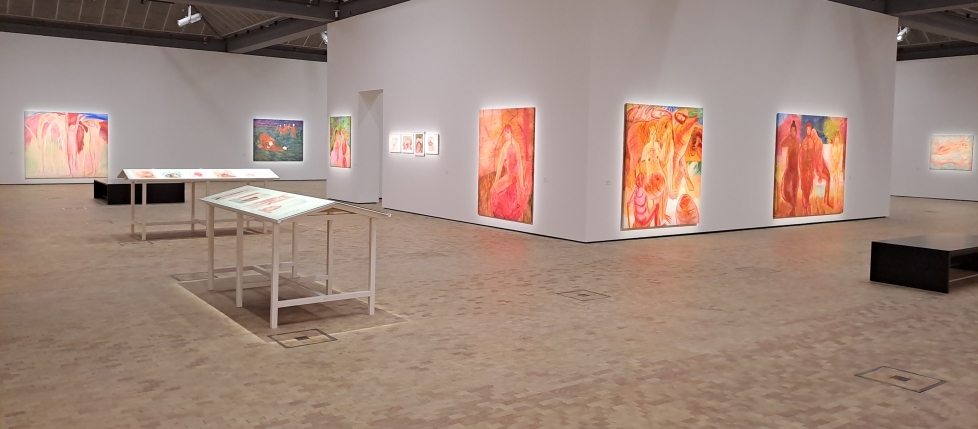
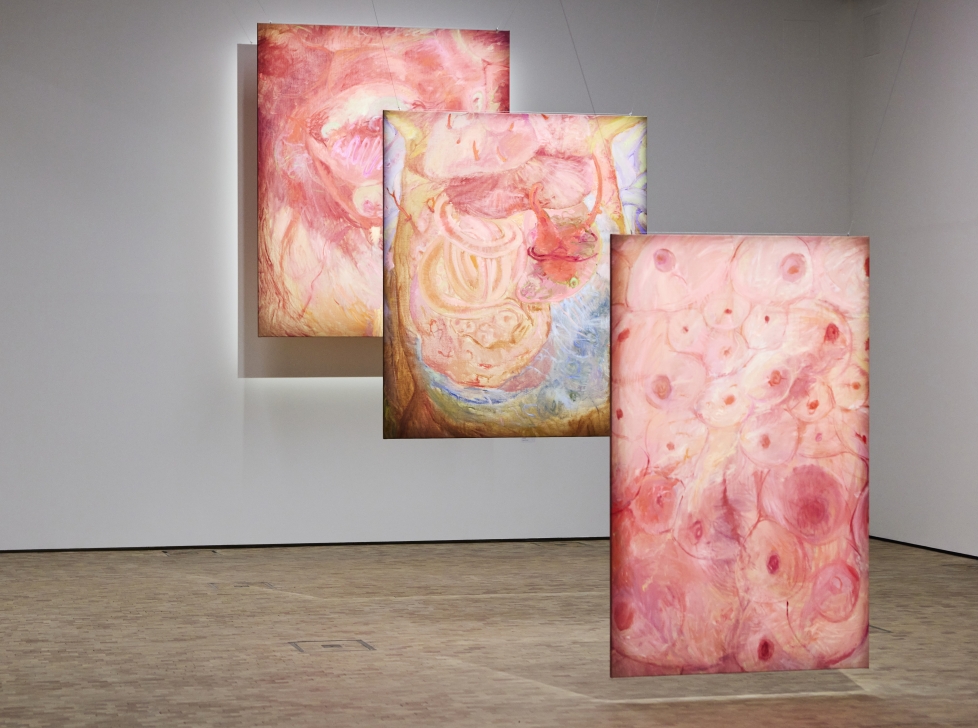
Where does the light come from, I wonder, as my gaze is caught by the red and pink canvases at Helsingborg Konsthall. The exhibition room is stripped down, almost ascetic, and without daylight. Yet, the Ukrainian artist Kateryna Lysovenko’s paintings seem to glow like stained-glass windows, with an inner light source, giving them sculptural qualities. Furthermore, the first three paintings are suspended from the ceiling, like a staircase rising upwards: the one at the front hangs lowest, followed by the others, one and two steps higher in the air, respectively.
At the very front hangs The Milky Way (2024), a large, warm-pink canvas resembling a group of round breasts with small, dark nipples – or perhaps they are oversized frog eggs? The painting sets the tone for the entire exhibition: it is about a universe permeated by warmth and life, yet forced to observe humanity’s senseless violence.
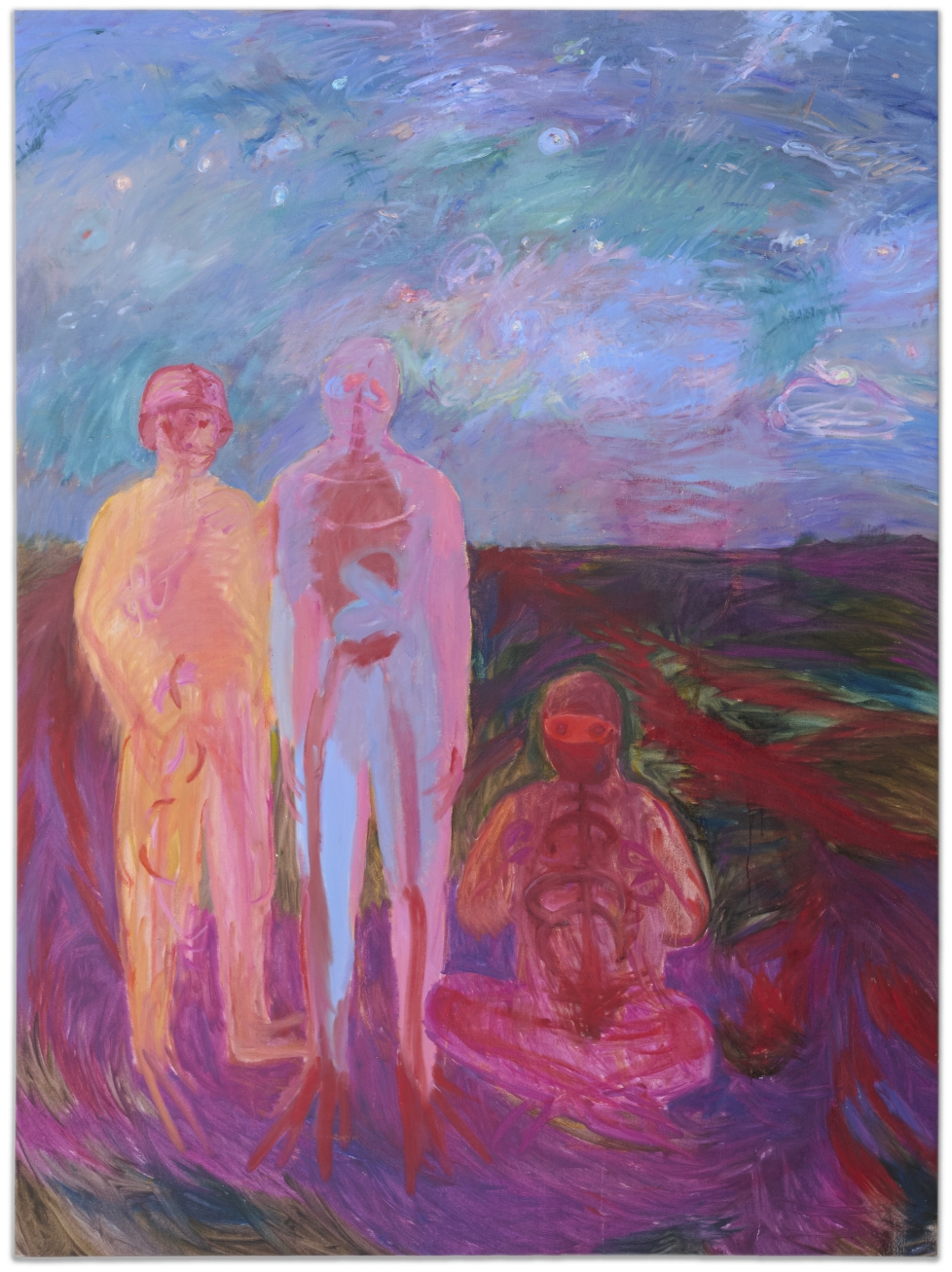
Lysovenko left her hometown of Odesa after Russia’s invasion of Ukraine and is now based in Vienna. The exhibition at Helsingborg Konsthall is her first major presentation in the Nordic countries, and it is easy to trace how her imagery has changed from 24 February 2022 until now. In Political Animal (2023), a predator has killed a creature resembling a llama with a human head, and is chewing its flesh while the rest of the herd watches, paralysed by the violence. The brushstrokes here are short, as if she were in a hurry to fill in the blue-green background and finish the painting. A few years later, the brushstrokes appear instead long and calm, and in Die junge Wienerinnen und ich (2026) we find the artist herself sitting on a bench in Vienna, beside three new female friends. The painting is characterised by the same round forms as The Milky Way, and she paints the people’s eyes as round dots, corresponding to the stars – or nipples – that appear in other motifs.
But the path to the bench in Vienna is fraught with anxiety and pain. In the middle of the room is a smaller interior space constructed like a chamber of horrors, containing a kind of symbolic testimony to the war. Here there are bloody traces of sexual violence and images of torture. Lysovenko has deliberately placed these images somewhat out of the way, to make it possible for any children who might visit the exhibition to avoid the motifs. I appreciate that, and also as an adult visitor, I get the chance to take a breath before entering.
What about the light, then? It turns out that the paintings are individually illuminated by theatre spotlights, making them come alive in the room. But that does not entirely explain it; the warm hues of the oil paint also create movement within the images. I am reminded of Marc Chagall’s imagery, which is likewise permeated by love and longing, and whose figures similarly move weightlessly between heaven and earth. For although Lysovenko begins in the Milky Way and paints both stars and hosts of angels into her pictures, she simultaneously emphasises how people want to root themselves in the earth, or crawl into it for protection. Mother Earth may seem safe, but her depths can very easily become a grave.
Lysovenko draws strongly on Symbolism, and works with motifs from Greek mythology, particularly the princess Europa, whom the god Zeus abducts after disguising himself as a bull. In Lysovenko’s work, Europa has sometimes been given horns herself, as in the magnificent painting The End of Imperialism (2023), where she stands victoriously with one foot on the oversized palm of the hand of power. The background is deep blue, and rising from the defeated enemy’s hand is a floating red sphere, like a liberated spirit. The painting radiates the stubbornness that is life itself, and at the same time the pride of someone who knows that they have already achieved an ethical victory, regardless of all other circumstances.
Helsingborg Konsthall was inaugurated in the spring of 2026 as an independent venue for contemporary art, following a redevelopment of the city’s cultural centre, Dunkers Kulturhus. With its presentation of Lysovenko, the medium-sized city on the Öresund is placed within a broader contemporary art context through an artistic practice that already holds clear international standing. The new museum thus demonstrates that it can hold its own alongside the country’s leading art institutions, while simultaneously turning its gaze towards a European audience.
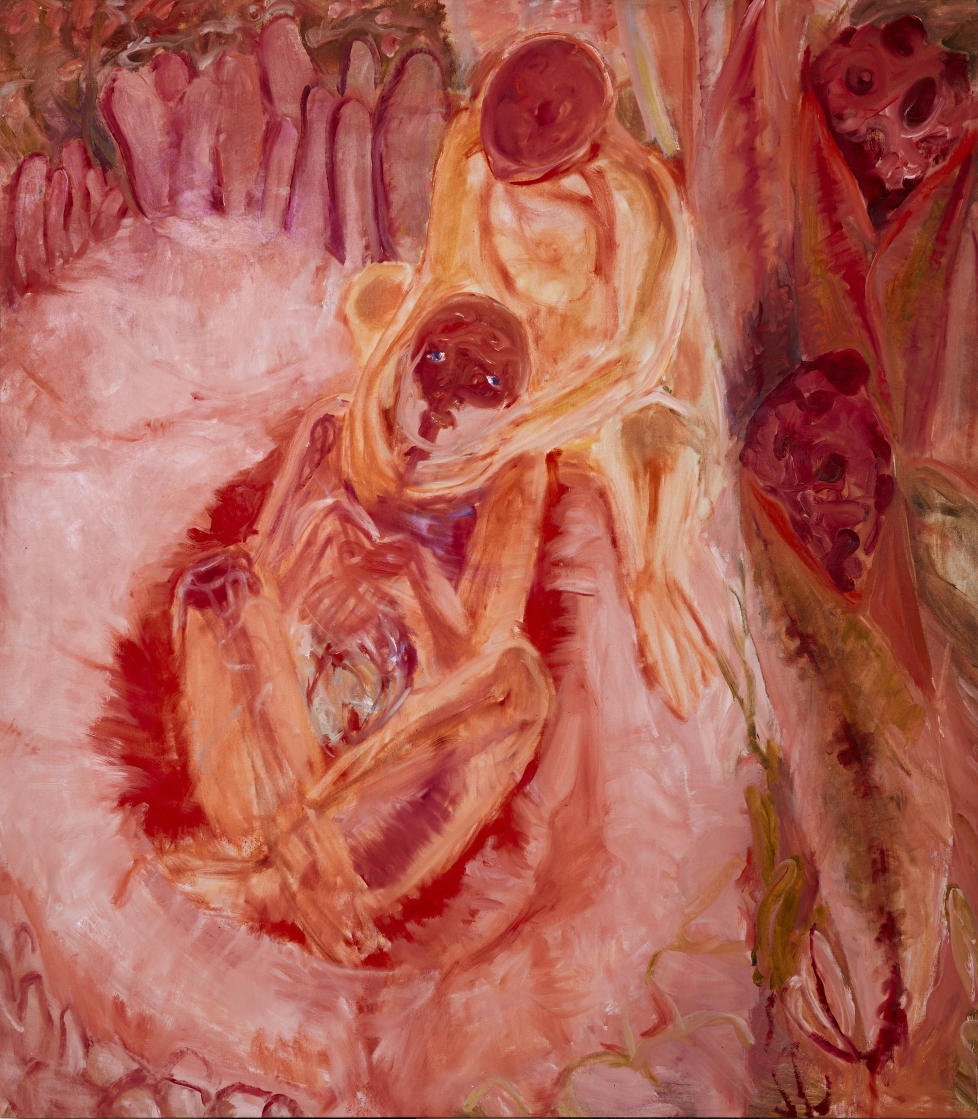
Despite the differences between Lysovenko’s motifs, there is nevertheless an enveloping warmth in her handling of colour that leads the viewer from one image to the next. She takes the war as her point of departure, but counters violence with a powerful tenderness. Her project is best summed up by Propaganda of the Fragile Living World (2024), depicting a woman lying on the ground, almost transparent, with a belly full of something growing. Beside the woman lies a smaller figure, and the two hold hands. Around them grow large purple and pale-green plants, painted with gentle movements, but the ground on which they lie appears restless and unpredictable.
The only valid propaganda, Lysovenko seems to argue, is one advocating for the frailty of life: for what happens in a mutual, timeless gaze between all of us who are part of it.