After two years of closure, the New Museum in New York has finally reopened, now with a new extension designed by the Office for Metropolitan Architecture (OMA), led by Shohei Shigematsu and Rem Koolhaas. A fractal-like, angular façade and surprisingly steep staircases convey a sense of institutional ambition. Compared to another recently renovated New York institution, the Studio Museum in Harlem – which aspires to a luxurious aesthetic that makes it resemble a high-end hotel lobby – the New Museum’s expansion signals an experimental drive that suits the institution. Since its founding in 1977, the non-collecting museum has cultivated the “new” in the strictest sense: new art, new voices, the rigorously contemporary.
According to the press release, the opening exhibition, New Humans: Memories of the Future, explores art’s engagement with what it means to be human in the face of sweeping technological changes. This might lead you to expect immersive installations, AI-generated works, VR world-building, or at least a general high-tech sensibility. Instead, the curatorial team led by Massimiliano Gioni has put together a historically oriented exhibition grounded in the premise that contemporary art’s preoccupation with the human/machine relationship – from techno-utopian visions to darker scenarios of alienation from vision, language, and subjectivity – has a long prehistory.
When an institution like the New Museum turns to modernism and art history in its inaugural exhibition, it marks a shift that has prompted critic Ben Davis to suggest that the very project of “contemporary art,” as we know it, may be nearing its end. Davis offers this as an observation rather than a judgment. Still, the logic of radical inclusivity clearly places increasing pressure on curators to make precise selections, establish coherence, and, crucially, to delimit.
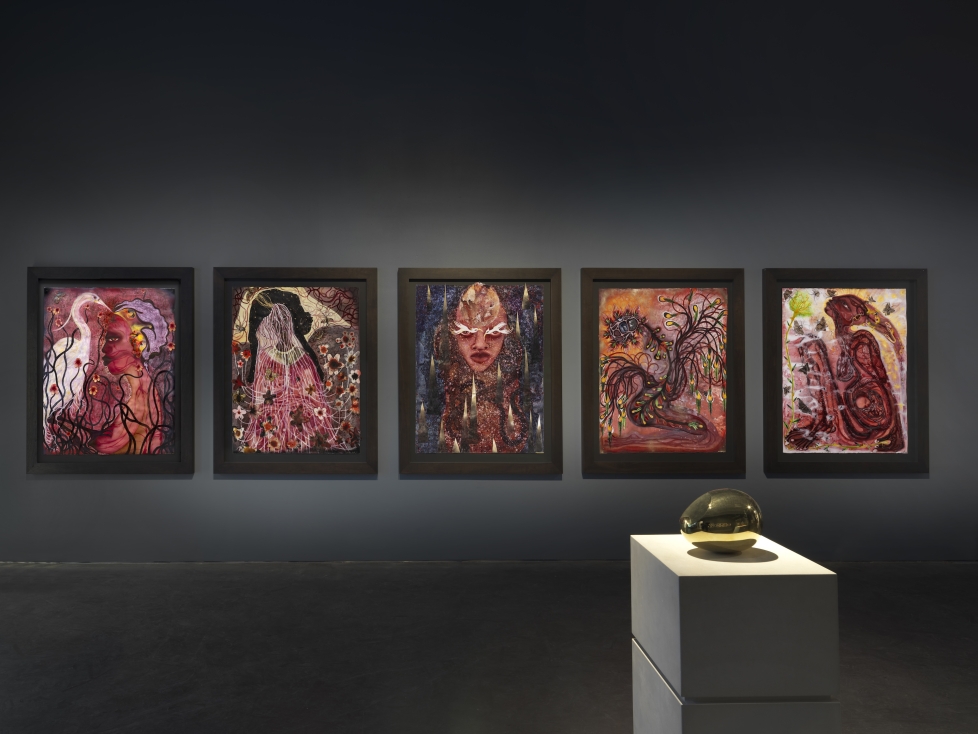
Spanning more than 150 artists, 700 objects, and over a century of art, the exhibition unfolds across three floors of the gallery’s newly doubled space. It opens with the section “Reproductive Futures,” which includes photographs by Lennart Nilsson, a Swedish pioneer of foetal imaging. His intimate technique renders nerves, tissue, and veins with striking clarity. The foetus appears almost luminous, taking on an eerily extraterrestrial quality. The high-contrast images recall the Star Child from Stanley Kubrick’s 2001: A Space Odyssey (1968) and resonate with the similarly astral series of paintings Heroned (2026) by Kenyan artist Wangechi Mutu on the opposite wall. They depict female bodies that open into plant matter or sprout insect wings – hybrid figures suspended in metamorphosis.
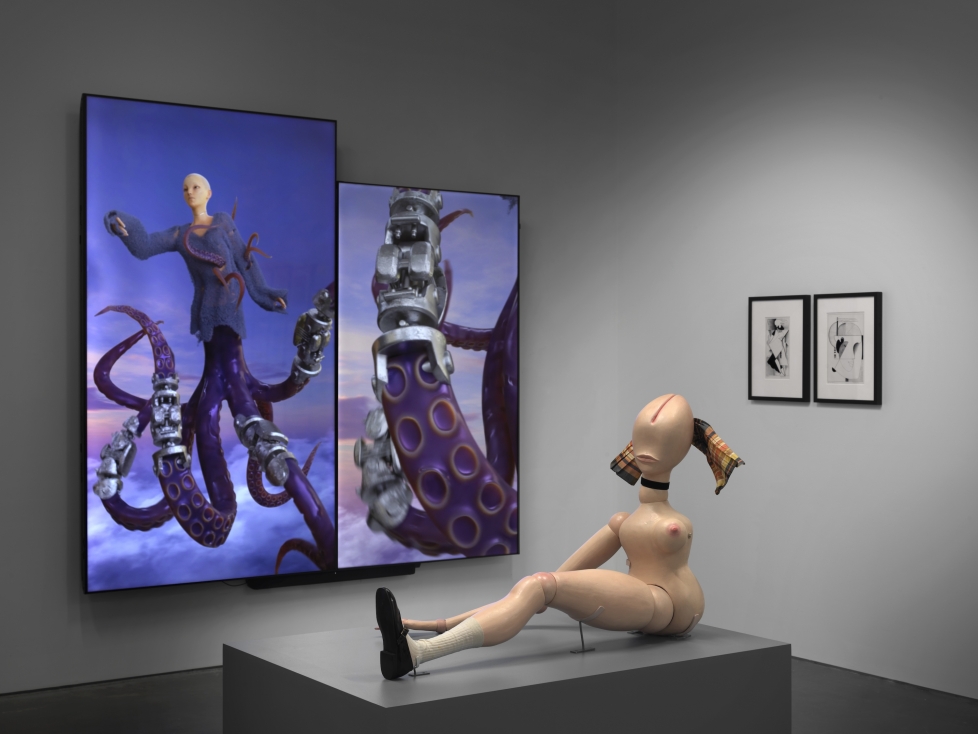
In the adjacent room, Hans Bellmer’s La Demie-Poupée (1972) – a dismembered doll with a single leg, arm, and breast – is placed directly in front of Cao Fei’s animated video Meta-Mentary (2022), in which a bald avatar, half human and half mechanical octopus, floats over a pastel sky. Both works present the body as fragmented and modular, heightening the unease surrounding hybrid and manipulable anatomies. Also included is Harun Farocki’s Auge/Maschine III (2003), composed of images produced by machines for machines, effectively removing the human from the technological loop. Hito Steyerl’s Mechanical Kurds (2025) documents Kurdish refugees in Iraq earning meagre wages tagging and classifying drone imagery for Amazon. Steyerl underscores how the supposedly autonomous machine gaze remains dependent on human labour – labour that must in turn adapt to machine logic.
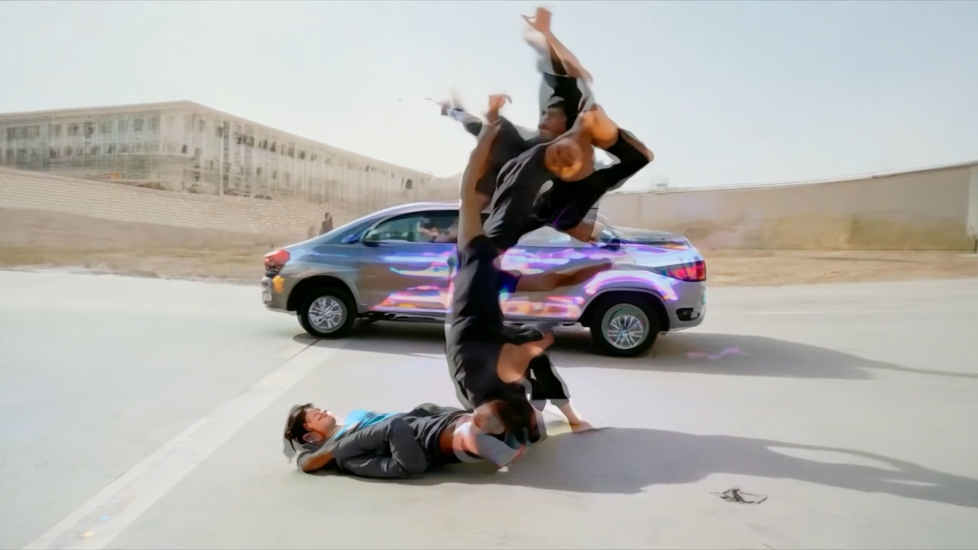
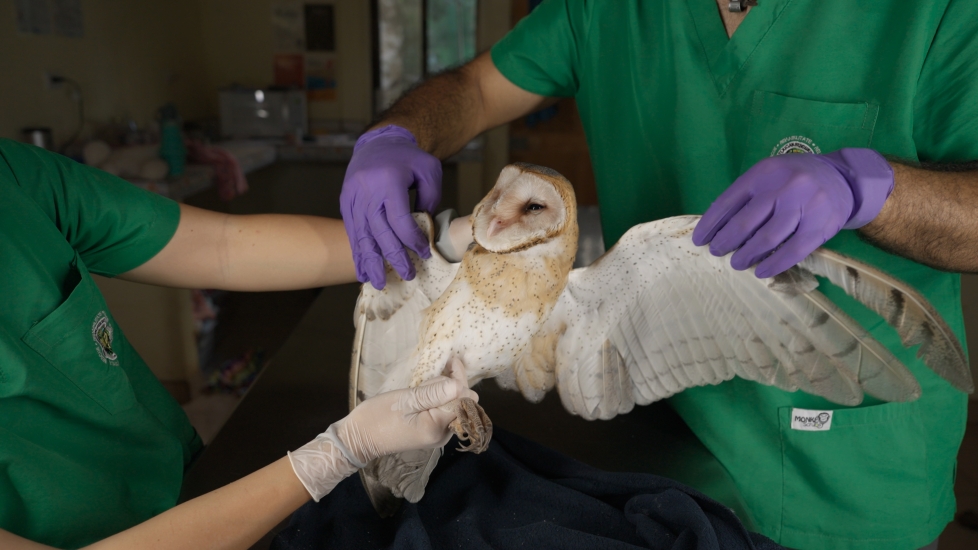
Mechanical Kurds is among the few works to explicitly address a dystopian present. Another is Camille Henrot’s In the Veins (2026), a kind of sequel to her Grosse Fatigue (2013). Through rapid montage, the film alternates between footage from a wildlife rehabilitation centre – an otter pup being bottle-fed, veterinarians performing surgery – and scenes with the artist’s own son. Animated animal stickers appear superimposed onto the imagery, visually linking generations. A child’s voice narrates a text about the climate crisis and the future, embodying the anxiety – and the implicit accusation – of the coming generation, a theme the exhibition otherwise approaches more obliquely.
This kind of thesis-driven, encyclopaedic constellation is Gioni’s curatorial signature. Since at least The Encyclopedic Palace at the Venice Biennale in 2013, he has staged large-scale exhibitions that juxtapose canonical artists with marginal figures, often incorporating non-art objects such as scientific documents and models. At its best, this method offers a productive reframing of the exhibited materials that is especially valuable for canonical works burdened with a long reception history.
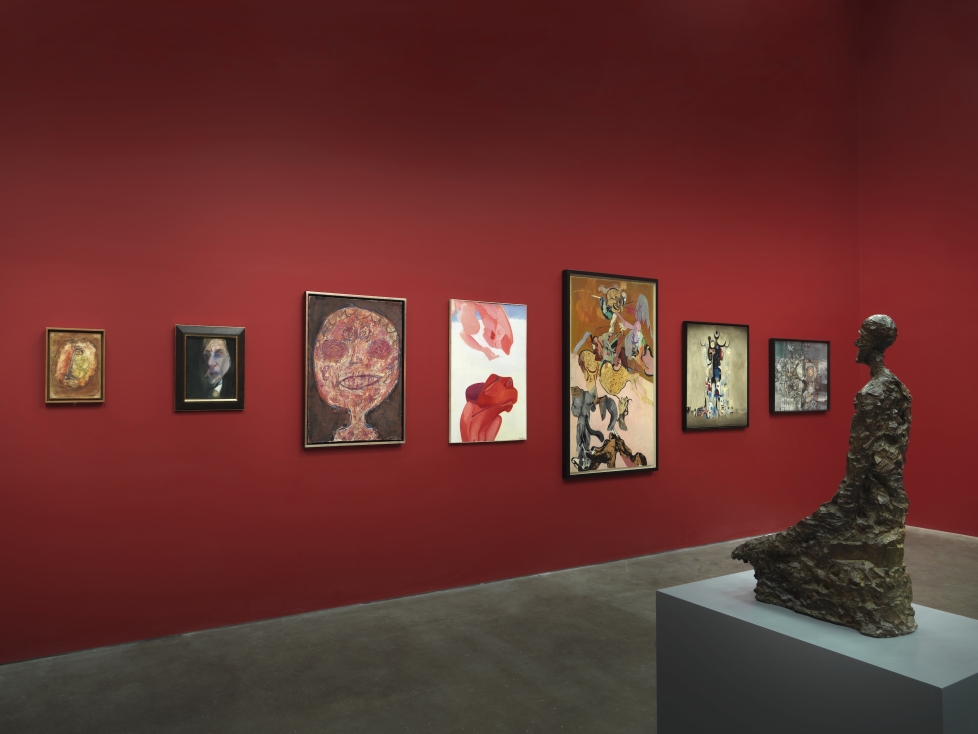
In New Humans, however, the breadth of the theme becomes a liability as it allows almost anything to be fitted in. This becomes increasingly apparent on the upper floors. The section “New Images of Man” – borrowing its title from MoMA’s 1959 exhibition – brings together a dozen works hung salon-style on a red wall and organised around the idea that postwar art sought to reinvent the human figure. It includes works from the original exhibition, such as sculptures by Alberto Giacometti and a self-portrait by Francis Bacon, alongside new additions by Ibrahim El-Salahi, Maria Lassnig, and Asger Jorn. The result feels less like a meaningful expansion on the topic than an arbitrary art-historical digression.
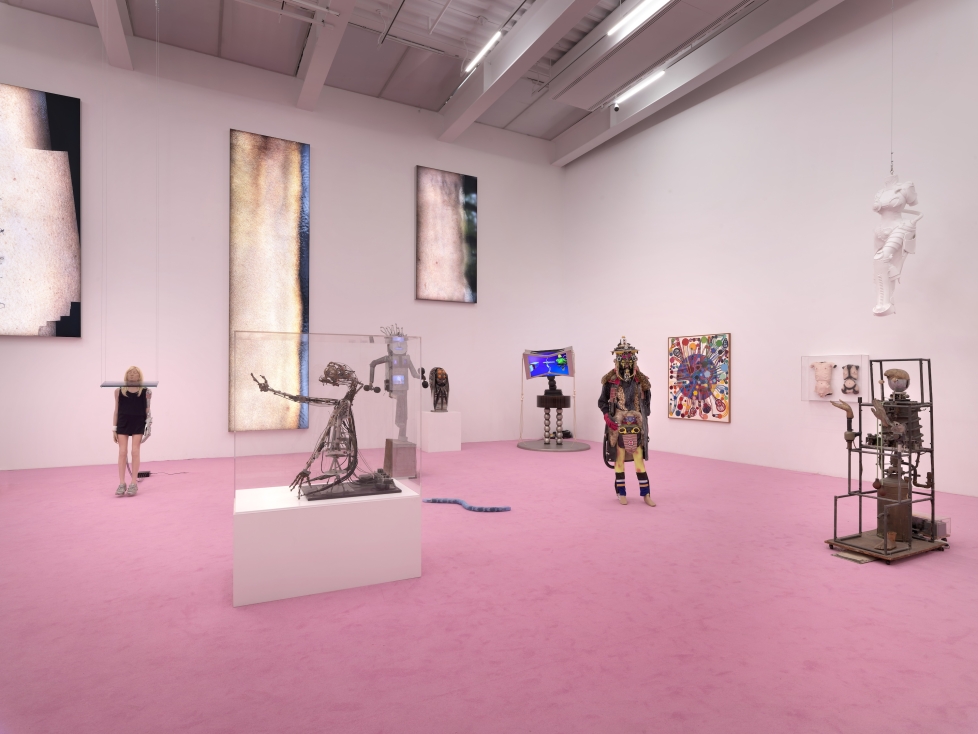
On the top floor, in the “Hall of Robots,” the already tenuous continuity collapses altogether. The space, carpeted in pink and filled with a menagerie of androids, mechanical creatures, and whimsical hybrids – including the actual model of E.T. from Steven Spielberg’s film and H.R. Giger’s sculpture that inspired the creature in Ridley Scott’s Alien (1979) – resembles a film museum or theme park more than an art exhibition. It provides a distracting setting for one of the show’s highlights: Seth Price’s three vertical lightboxes (Bob, Danny, and Untitled, all 2015), which present enlarged, digitally processed sections of human skin. Shifting between organic and synthetic, the skin becomes landscape, screen, and material – a quiet reminder that the body is always already mediated, inevitably perceived through filters and algorithms.
The exhibition’s central thesis – that the relationship between humans and machines in art has a long prehistory – is compelling but ultimately overwhelmed by its encyclopaedic ambition. In an age of limitless information access, Gioni’s curatorial strategy, once a means of expanding the canon, risks tipping into a kind of compulsive and unbounded inclusivity. The exhibition loses definition and, perhaps unintentionally, becomes symptomatic of our era’s insatiable appetite for information and diminished capacity to process it.
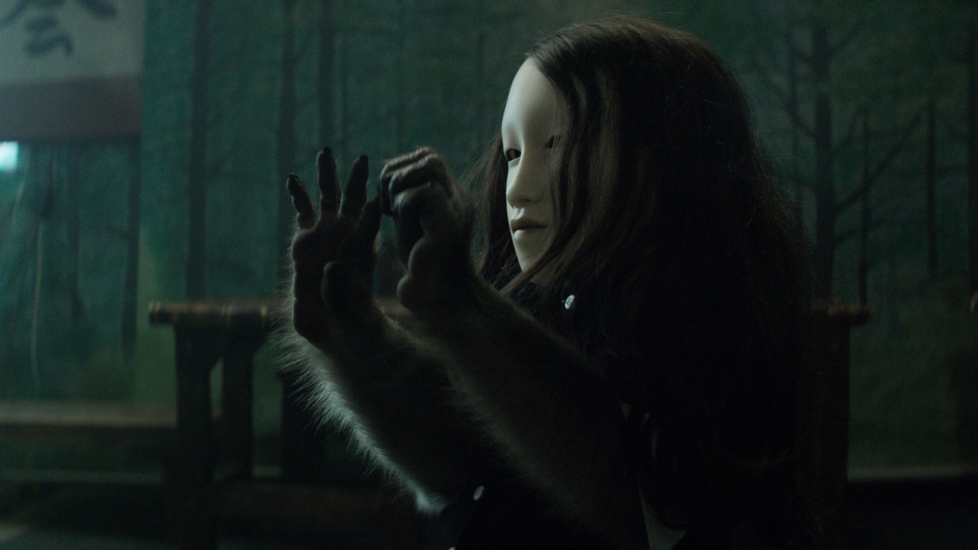
Tucked away at the back of the third floor is Pierre Huyghe’s widely exhibited video Untitled (Human Mask) (2014), in which a monkey wearing a white mask and girls’ clothing performs repetitive tasks in an abandoned restaurant in Fukushima, Japan. Its unsettling, almost childlike quality stems from the animal’s apparent imitation of human behaviour without comprehension. It serves as an apt metaphor for the political paralysis that arises when information technologies we neither fully understand nor control begin to shape our lives.
Translated from Norwegian