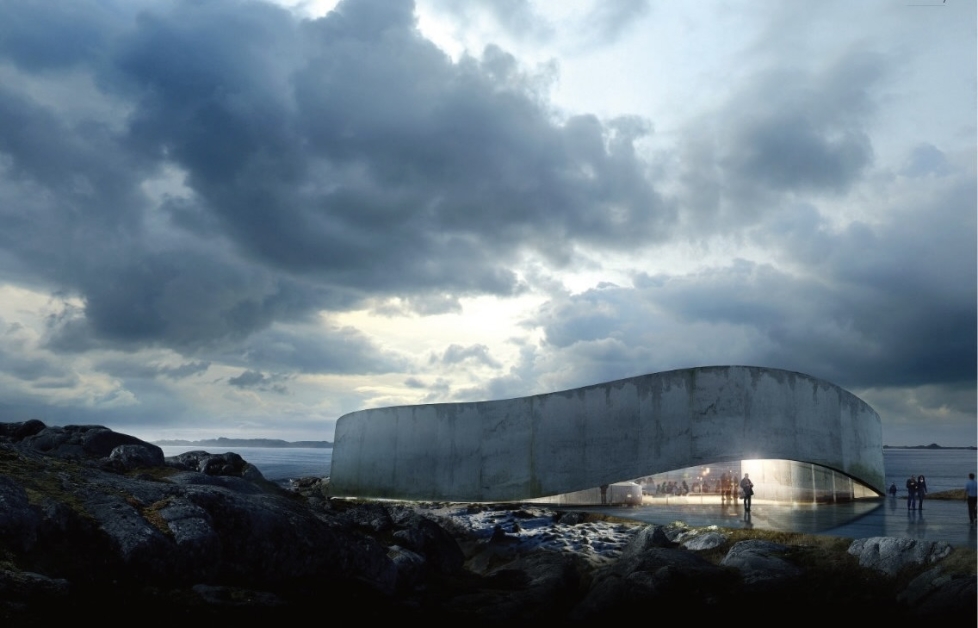
It seemed like the perfect match when, in December 2025, the Foundation for the Establishment of a Greenland National Gallery of Art appointed Nivi Christensen as the project manager responsible for securing funding for the construction of a museum designed by Danish architecture practice Bjarke Ingels Group (BIG). Having headed Nuuk Art Museum for the past eleven years, Christensen is not only a central voice on Greenland’s art scene, she is also one of the few people to have delved deeply into what a new museum of this kind might be like. In fact, her master’s thesis in art history at the University of Copenhagen was devoted precisely to the establishment of a national gallery in Greenland.
But after just four months on the job, Christensen resigned and has now returned to her position at Nuuk Art Museum. She describes the plans for the future national gallery as “poorly thought through.”
“They have approved a building without reflecting on what it should represent or what works it should contain,” says Christensen. “Greenland’s national gallery will be the first national gallery in the world devoted to the art of an Indigenous people. That means we need to think carefully rather than simply adopt a traditional European model designed to underpin the nation state which, at the time when most of these institutions were founded, was often a colonial power with a fairly complicated collection.”
According to a 2024 prospectus, the future museum’s collection will range from older Greenlandic artefacts to contemporary Greenlandic art, art from the Arctic beyond Greenland, and international art. The existing collection comprises around thirty works, most of them private donations. The museum is also due to receive artefacts from the Greenland National Museum, intended to provide a representative picture of the period from the Saqqaq culture (beginning around 2300 BCE) up through the 1950s. There will also be a substantial donation of works by the Greenlandic artist Hans Lynge (1906-88), as well as works from Nuuk Art Museum and the archive of the Greenland Art School.
“I wouldn’t call it a collection as such,” Christensen says. “It’s an accumulation of miscellaneous works donated by generous people, but there is no real strategy connecting them.”
The future national gallery has been a long time in the making. In 2004, a group of Greenlandic artists formed a committee with the aim of establishing an art museum in Greenland. Since 2006, a foundation has been working to finance the building itself, and in December 2025 the foundation’s chair, Kristine Spore Kreutzmann, told Kunstkritikk that it was roughly halfway towards raising the necessary funds.
An architectural competition involving one Greenlandic and four Nordic practices was held in 2011. The winner was the Danish firm BIG, whose circular building is to be constructed on rocky terrain by the sea in northern Nuuk. Construction is expected to take around two years and can begin as soon as funding is fully secured. According to Christensen, however, BIG’s building is far from ideal.
“When I started at Nuuk Art Museum, I too dreamed of one of those big white museums with high ceilings, like the major international art museums. But a lot of Greenlandic art is quite small in scale; it differs from European art in that sense, having been made with a different kind of intimacy in mind. The renderings of the new building show works by Aron of Kangeq [ed.: 1822–69, regarded by many as a forefather of modern art in Greenland]. However, these are works measuring only 15 by 10 centimetres, so in the drawings they have been enlarged in order to make them fit the building. That is a good example of the problems with the building and with the overall thinking behind the project.”
More specifically, Christensen criticises the planned building for its lack of flexibility. At just over 2,000 square metres of floor space, it will be only twice the size of Nuuk Art Museum, and its circular form makes future extensions difficult. The building has also been conceived as a single continuous sequence of spaces, with areas that can be screened off for different activities, but with the same ceiling height and natural lighting throughout. Christensen believes this will make it difficult to experiment with exhibition formats.
“The Greenland art scene is currently seeing ongoing negotiations over the boundaries between visual art and the images produced by traditional Inuit culture – in other words, between fields that have conventionally belonged to the national museum on the one hand and art museums on the other,” she explains. “I think those boundaries need to remain fluid and open to negotiation, and that places certain demands on the building. You need, for example, to be able to make small changes regularly without having to rehang the entire collection, which is what a single continuous exhibition space tends to require. I think we need to research, communicate, and think slowly, over time. Partly because we also need to build up the expertise required to engage with that negotiation and with the connections between contemporary art and older artefacts. It’s not as if there are twenty Greenlandic art historians just hanging around with nothing to do, and I don’t think the solution is to hire Danish art historians to do the job.”
BIG’s museum building is intended to interact with the surrounding landscape. Its circular, curving structure echoes the contours of the rocks on which it sits, while a large glass façade opens onto nature through an inner courtyard. Over time, the concrete exterior is intended to weather and gradually become covered with algae and salt deposits, while the circular form refers to the rings of Inuit tents, igloos, and circular stone structures. Even so, Christensen believes the architecture is not sufficiently specific to the place or its culture.
“Of course, there ought to have been Greenlandic architects involved in designing the building, but the conversation about what characterises Inuit architecture has only just begun,” she says, pointing to the National Theatre in Kautokeino in Sápmi as one example of how institutional architecture can take Indigenous building traditions as its point of departure. The theatre was designed by the Norwegian practice Snøhetta in collaboration with Sámi architect and visual artist Joar Nango and takes the form of a three-legged structure inspired by reindeer antlers.
Over the years, a number of proposals have been put forward, suggesting how a future national gallery might be conceived. Christensen is particularly enthusiastic about the idea of converting one of Nuuk’s old apartment blocks into a museum: “The blocks are sometimes described as ‘the elephant in the urban room’: they loom large in Nuuk, both physically and historically, and parts of their history is painful and difficult to talk about.”
Most of the blocks were built in the 1960s to house the many Greenlanders who were moved from smaller settlements into the towns as part of Denmark’s centralisation and modernisation of Greenlandic society. In recent years, they have repeatedly been the subject of debate. Some want them demolished, while others favour renovation, but because the issue is so sensitive, for now they have simply been left to deteriorate.
“If one of them were turned into a museum, you could actively use the history it embodies in the conversation about the colonial period that’s already addressed in so much Greenlandic contemporary art. It would create an interplay between the building, the history, and the national narrative,” Christensen says.
Another proposal, first put forward by artist Gukki Nuka, is to create a mobile museum aboard a ship that could sail along Greenland’s coast. The national gallery could then quite literally travel out to meet its visitors in a country where vast geographical distances and limited infrastructure mean that Nuuk can be a very long way away.
“We shouldn’t simply reproduce a structure that Europe itself is already beginning to move away from. The National Gallery of Denmark’s new branch in Thy is a good example of a major national institution also attempting to establish a presence beyond the capital. We need to be careful that a national gallery does not become too monumental, especially in Greenland, where you don’t have a lot smaller museums scattered around the country to provide balance. We mustn’t end up with having a single board at a single institution in Nuuk defining what Greenlandic art is. A national gallery ought, after all, to belong to the whole population,” Christensen says.
Kunstkritikk has put Nivi Christensen’s criticism to the board of the Foundation for the Establishment of Greenland National Gallery of Art. In an email, chair Kristine Spore Kreutzmann states that the board’s task is not to acquire works for the future museum, but solely to raise the funds required to construct the building. Beyond that, the board has no comment at present.
Translated from Danish.