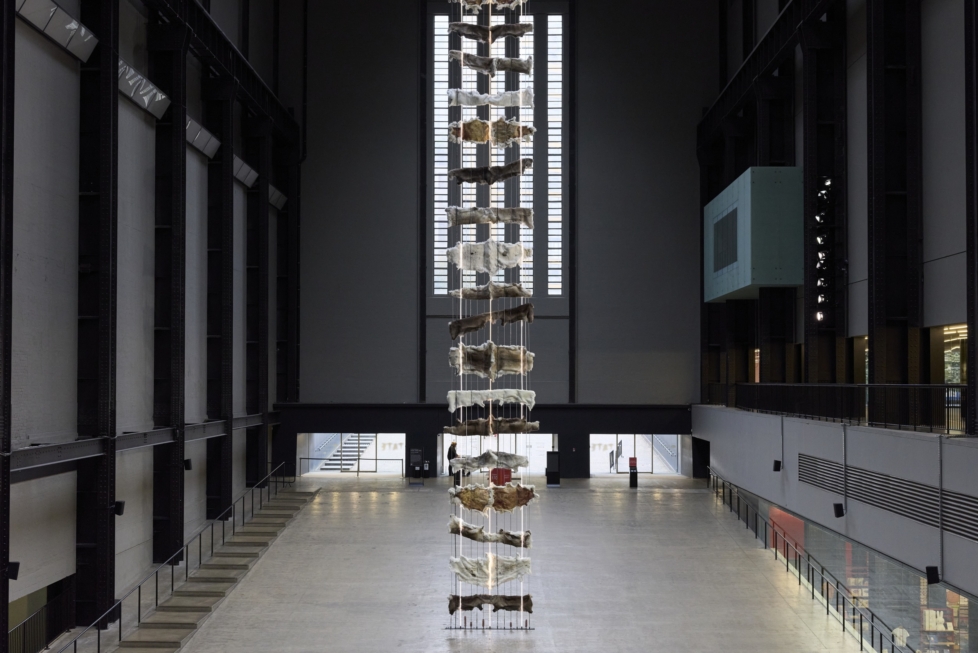
The first work you encounter in Máret Ánne Sara’s Tate commission consists of LED lights and reindeer hides (Goavve, 2025). Already here it becomes clear that, in an exhibition space that invites monumental one-liners, Sara has chosen a different strategy. The hides are interwoven with wires and chains that stretch up towards the ceiling. Despite its dimensions – twenty-eight metres high and a couple of metres wide – Goavve does not come across as overwhelming. This is partly due to the materials used, which I will return to. The impression is reinforced by the fact that, at first glance, there appears to be no more works. From the vantage point of Goavve, the Turbine Hall seems otherwise empty.
Reindeer herding has been a reference point in Sara’s practice ever since she placed two hundred severed reindeer heads outside a courthouse in the far-northern municipality of Tana in 2016, when her brother sued the Norwegian government over its decision to enforce reindeer culling. (He lost the case in the Norwegian Supreme Court, but last year the UN Human Rights Committee concluded that Norway had violated his rights.) An updated version of the Tana intervention, composed of reindeer skulls, became Sara’s most well-known work, Pile o’Sapmi (A Pile of Sápmi), exhibited at Documenta 14. With participation in the Venice Biennale and now the Tate commission, the Sámi artist finds herself deep within the international art establishment. The uncompromising attitude that her action testified to a decade ago has, however, seemingly been replaced by a more polished and accommodating approach.
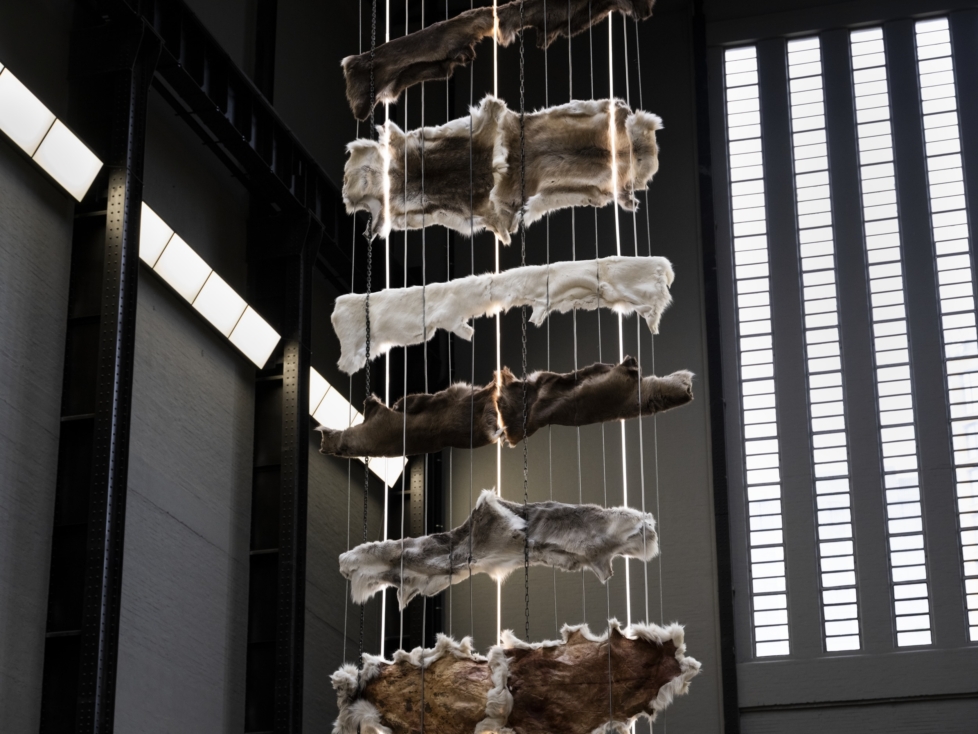
Goavve forms the first part of Sara’s two-part installation, which, according to the press release, invites a new and alternative understanding of power as “life force.” Goavve is integrated into the architecture of the Turbine Hall and thus relates site-specifically to Tate’s former use as a power station. By establishing a vertical, ascending line, Goavve evokes ideas of growth and expansion, while the industrial materials and reindeer hides connect reindeer herding to modern industrial processes. The fact that the industrial exploitation of natural resources so often also entails colonisation – and thus is an expression of the same underlying logic – is well known in both Sápmi and British history, albeit, of course, from the diametrically opposed perspectives of the colonised and the coloniser, respectively.
The Northern Sámi term goavvi translates as “lost pasture” and refers to grazing land that has become “locked” beneath a layer of hard ice, a phenomenon caused by abnormal temperature fluctuations. A sound piece composed of field recordings and fragments of joik (a traditional form of song in Sámi music) sets the affective tone for your encounter with the sculpture. As the soundscape competes with the ambient noise of the hall, the piece functions more as a mood-setting background element than as a work in its own right. In Goavve, the combination of materials – artificial, bluish light on noticeably clean reindeer pelts – also produces a somewhat slick impression, causing the work to slip away. The objects presented are less arresting than the ideas they are intended to convey. The withdrawn character of the piece seems related to the way the curatorial framing overshadows the work itself, rather than allowing the ideas to emerge through it.
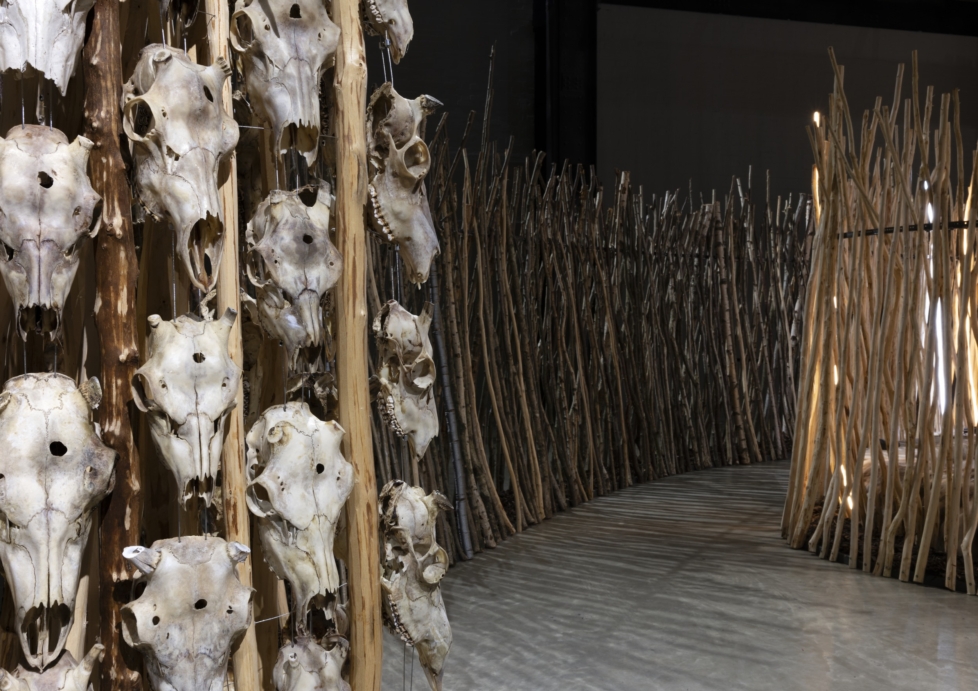
Geabbil (Flexible), the second work, invites a reorientation. In contrast to the linear, ascending Goavve, Geabbil consists of several circular wooden structures that visitors can enter. Seen from above, Geabbil resembles a fragile, makeshift Richard Serra piece that has been left exposed to the elements. Some of the branches and sticks forming the enclosures are adorned with duodji made from reindeer skulls and jawbones, in keeping with the Sámi tradition of honouring the slaughtered animal by making use of every part of its body. Inside the circles, attention is directed towards the cyclical. Visitors can sit down and listen to Sámi history through headphones. At times, you catch traces of a faint, alluring scent, which turns out to be based on breast milk and sweetgrass. Sara has also distilled the scent of fear in reindeer, váivahuvvon hádja, though I am unable to locate it. The scents seem to mark a boundary between a home and a hostile outside world.
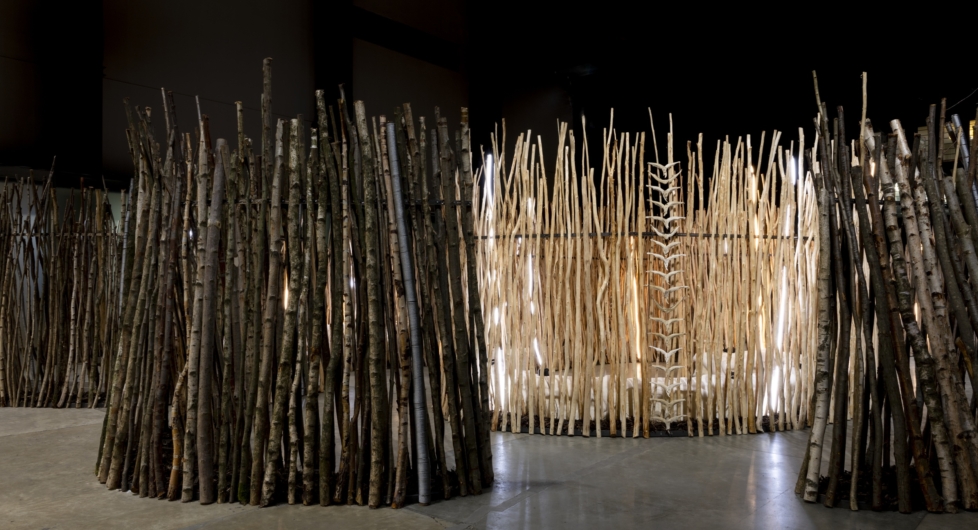
With Geabbil – in many ways constructed as a place in which you might seek shelter from the Turbine Hall – it almost seems as if Sara would rather be anywhere else than at the Tate. And can you really blame her? Whether the vast, cold Turbine Hall has ever been an ideal place to exhibit or experience art is a question worth asking. Monumentality has always been part of the brief, which artists have addressed with varying success. Sara has chosen to avoid the spectacular, which, on reflection, is clearly at odds with a worldview grounded in the notion of never taking more than you need. The works of the Sámi artist Britta Marakatt-Labba, by comparison, often depict groups of small figures inhabiting large, open white expanses – there, too, humanity is not at the centre. There is, however, a difference between an exhibition space that feels deliberately emptied, where absence is experienced as charged, and one that simply feels empty because the artist or curators have failed to fill it. Sara’s exhibition tends towards the latter.
The exhibition texts do their utmost to convey a Sámi worldview in a transparent language. Terms such as “Sámi science” and “Indigenous science” suggest a strong, perhaps overly strong, desire to gain acceptance within a Western frame of understanding. I wonder what might happen if Sara were freed from some of this pressure to mediate, allowing the audience to test their narrow Western minds against unfamiliar forms.
As the art world has both championed and criticised identity-driven and morally grounded curating – where exhibitions are often presented with predetermined interpretations – forces on the far right have gained ground, seeking to reverse recent progress in matters of inclusion and diversity. Such circumstances call for new strategies in art. You might imagine inclusion being treated as a baseline for an exhibition programme rather than as an explicit theme. With the Turbine Hall commission, however, Tate’s curators still seem bound to these now familiar strategies, where pedagogy and contextual framing around the artist’s identity are emphasised to such an extent that the artworks’ capacity to operate on their own terms is, to some extent, undermined.
Translated from Norwegian