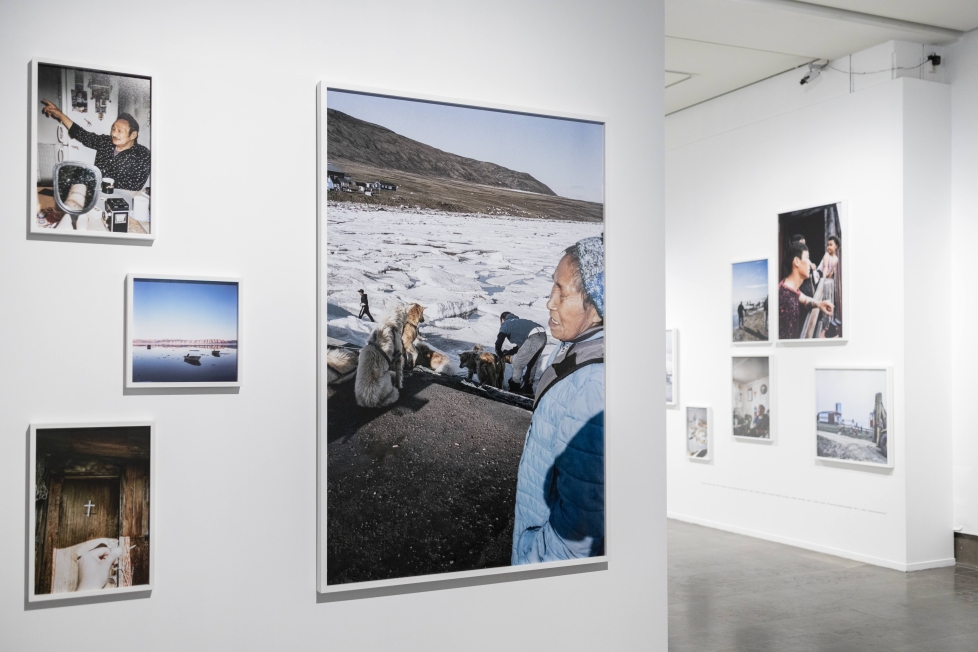
I happened to drop in on Innuteq Storch’s exhibition Rise of the Sunken Sun at the Hasselblad Center in Gothenburg during the opening, as a guided tour with the curator, Louise Wolthers, and the artist was under way. Storch had just been asked about the cameras he uses, and seemed more intent on recounting where they came from than on discussing technical specifics. He hadn’t acquired the cameras himself, he said, but had been given them – by his father and his ex, among others. The detail underscores a relational dimension in Storch’s photography; in a sense, these are images commissioned by a collective, a family even, to which he belongs. The curator’s reading of the exhibition title in the handout gives voice to a related motif: the phonetic proximity of the words sun and son points to a postcolonial condition in which the metaphorical child – historically suppressed and rendered invisible – now steps forward, claims space, and raises its voice.
But alongside its function as a vehicle for an emerging Kalaallit (Greenlandic) self-consciousness and a loosening from the colonial gaze, Storch’s photography is also clearly shaped by the snapshot idiom that defined the art and fashion worlds of the 1990s and 2000s. Reviewing his exhibition currently on view at MoMA PS1, New York Times critic Jason Farago names Wolfgang Tillmans and Larry Clark. Dawn Chan, in The New Yorker, adds Ryan McGinley. Like these photographers, Storch has a feel for the rawness of the moment, and for how to turn the camera into a natural extension of a body that is as much participant as observer. So, on the one hand, his work advances a postcolonial project of identity that foregrounds place-based and ethnic belonging, along with a preservation og culture-specific traditions; on the other, it draws on an aesthetic associated with a rootless cosmopolitan subject drifting through interchangeable urban settings and style registers. This tension is, productively, unresolved.
Storch works predominantly with analogue photography and in series, which are often pretty expansive. The Hasselblad iteration of Sunken Sun is an “edited” version of the material he presented in the Danish Pavilion in Venice in 2024 and comprises six series spread across two rooms: a white gallery space with framed prints and a sequence mounted on transparent plastic, and a darkened room where the images appear in lightboxes or projected onto the wall. A few “scenographic” elements are also included: on the wall immediately to the left of the entrance hangs a sign reading Kalaallit Nunaat (the Inuit name for Greenland, clearly less charged here than when it replaced “Denmark” above the entrance in Venice), and in the dark room there is a large replica of the semicircle from the Greenlandic flag, symbolising a sunrise over the ice, its surface covered in mirrors.
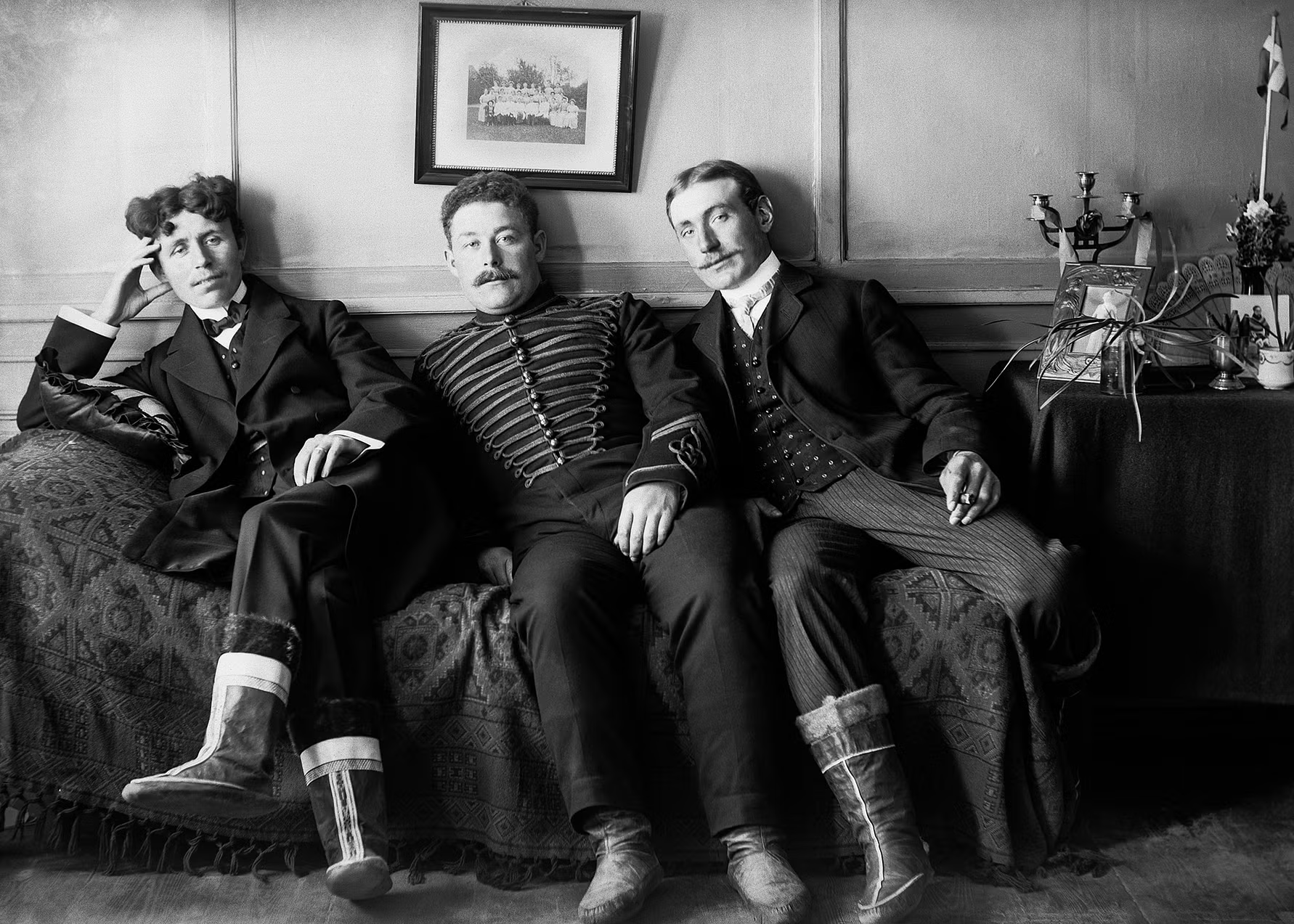
The series Mirrored (2021) occupies most of one long wall in the darkened room, juxtaposing photographs from Keepers of the Ocean (2019) with a selection from the archive of the Kalaallit photographer John Møller (1867–1935). Møller made his living by photographing Danes and other Europeans visiting Greenland. In that sense, as the handout notes, his work turns the ethnographic gaze on its head: it views the colonisers through Kalaallit eyes. Each of Møller’s images is paired with one of Storch’s in a symmetrical arrangement. Keepers consists mostly of informal snapshots of family and friends from the artist’s home town of Sisimiut, forming a dynamic counterweight to Møller’s more conventional register. The dialogue is multilayered, but most striking is how it brings into view two distinct ways of interacting with the camera. Where the poses assumed by Møller’s sitters have a staged quality that interrupts the flow of everyday life, Keepers is marked by a spontaneous, relaxed rapport with the camera. The contrast points to a historical shift in the social character of the photographic event. The camera has moved closer, become an appendage of the body, and our dealings with it are casual and intimate. It is hardly an original observation, but it is a necessary condition for Storch’s participatory gaze.
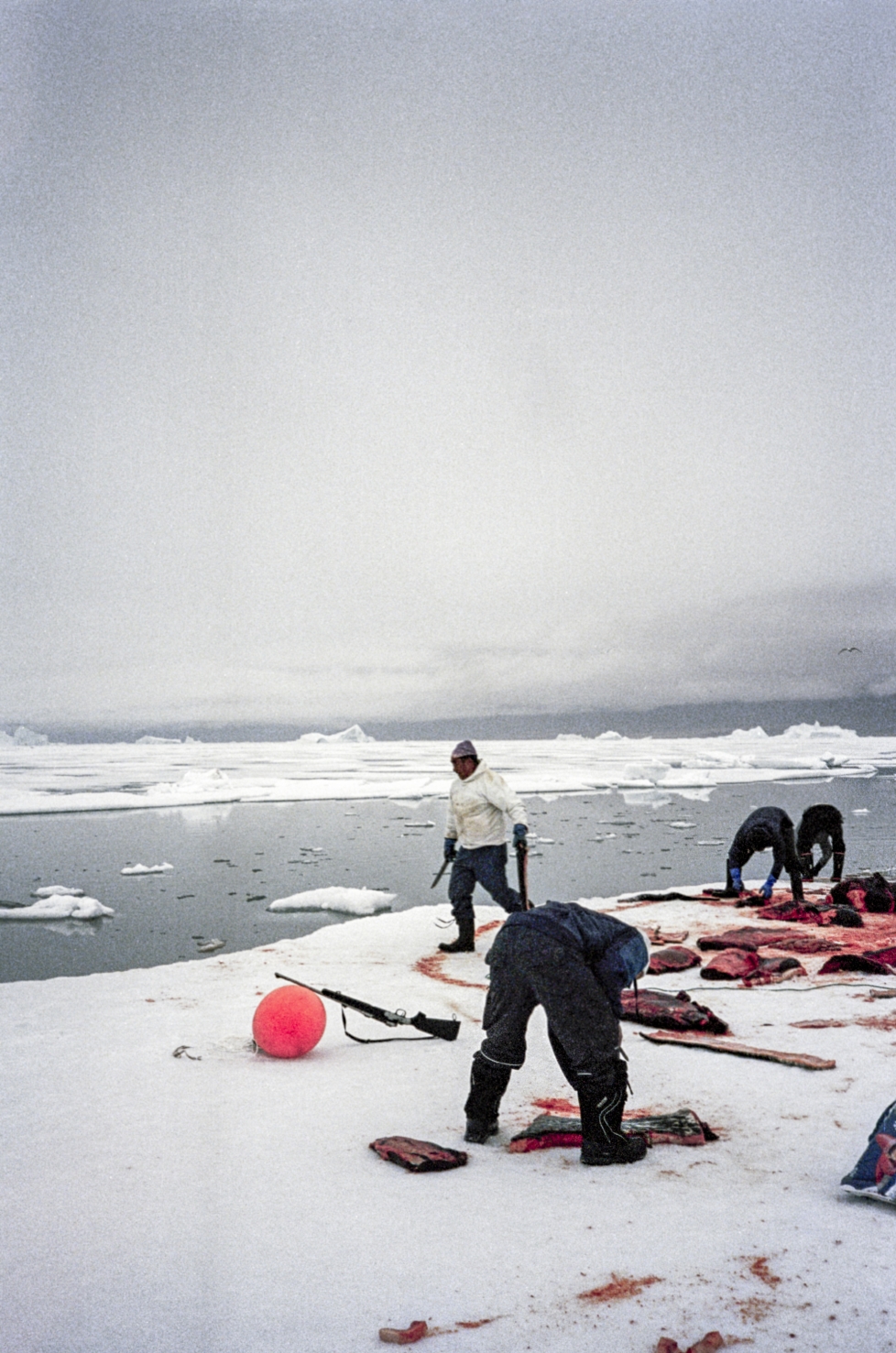
The production and consumption of photography have become a seamless part of social reality – presumably in Sisimiut and Qaanaaq too. It is hard to think of the medium separate from the technologies that distribute it. In concert with them, it has turned into a colonial power in its own right: it penetrates ever deeper into our lives, wrenching our attention from the immediate physical and social environment we inhabit in order to commoditise it. What is colonising about photography, then, is not only its historical ties to a racist-scientific mapping of Indigenous peoples and cultures. Storch’s photography – although distributed largely through slow, analogue channels such as photobooks and exhibitions – is marked by an ambivalence towards its representational mission, one that seems to arise from an attentiveness to this more cognitive form of extraction and to how it threatens the connection between identity and place.
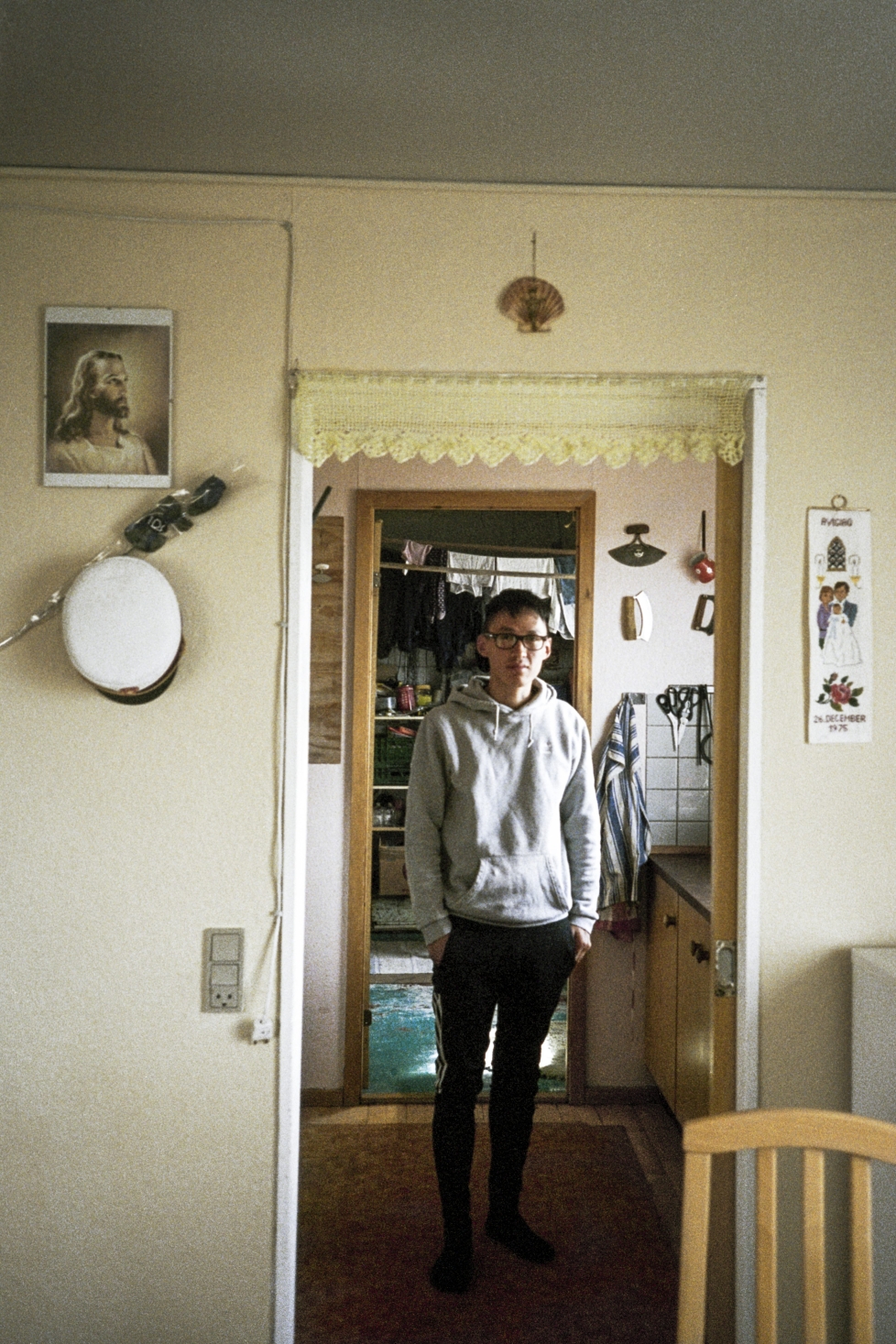
The images in the white room are freed from the dialogue with historical material, allowing Storch’s prosthetic camera to come into its own. Many could tentatively be classed as portraits, though a strict application of the genre feels misplaced here. Almost invariably, the bodies seem to sink into their surroundings. A mise en abyme composition from the series Soon Will Summer Be Over (2023), made in Qaanaaq, Greenland’s northernmost town, is indicative: a young man in glasses stands in a room between two other rooms, framed by two sets of doorways. It reads like an interior photograph with a portrait inset at its centre. In the foreground, the back of a chair juts awkwardly into the frame; on the wall around the doorway hang a number of obscure objects, including an image of Christ – an object that reads here as a lingering trace of the colonial legacy. The interior is an information-dense frame pressing forward, while the body recedes. Another picture shows two children lying on their backs outdoors. Here it is the identification with the landscape that is central: the sun obscures their features in a high-contrast play of light and shadow, while the folds of their jumpers echo the furrowed terrain stretching towards the horizon.
In two of the photos, Storch places his hand in front of the camera. The most iconic of the two has been widely circulated, showing the artist making the horns gesture towards an iceberg. The other is in black and white, with an out-of-focus bouquet held right up against the lens in front of a characteristic landscape. The liberation of the photographer’s hand underscores that photography is, above all, something we see with rather than something we hold. The gesture casts photography, symbolically, as a technology without an object, attesting to the intimacy of its pact with the body. In two other images Storch does something similar with mirrors, throwing fragments of his own body into the frame. Simple tricks, but they effectively scramble the traditional axis that positions the camera between photographer and subject.
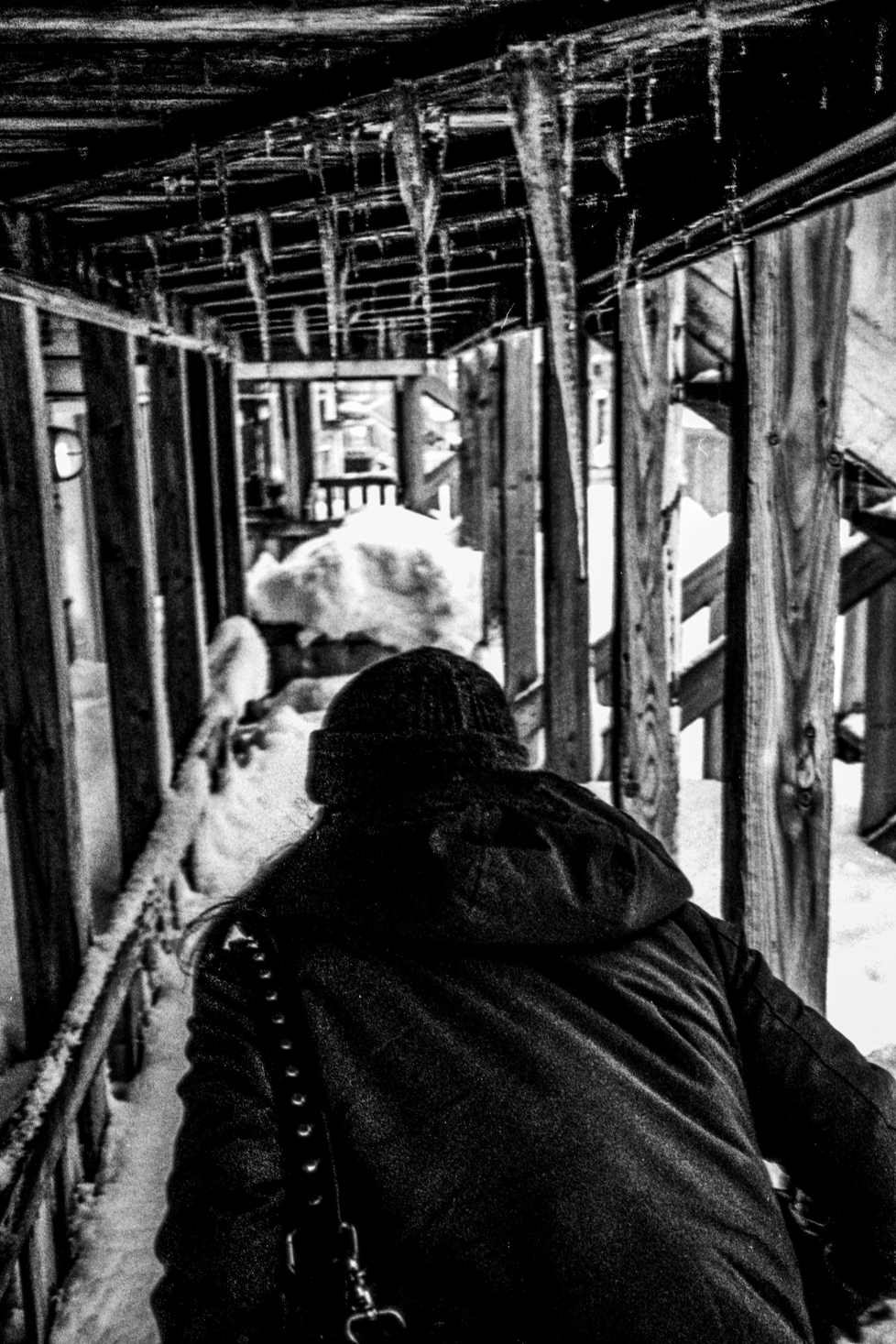
Necromancer (2023) is the series that stands out the most: a sequence of small, grainy black-and-white images on acrylic plastic that could have served as the storyboard for a low-budget horror film. The contrast is extremely high, and the transparent support makes the images seem to float above crude projections of themselves. The idiom is stylised, the compositions are dramatic and excessively atmospheric. Infrastructure proliferates – masts, buildings, cars – but nature is just as present: bare trees against the night sky and ominously empty landscapes, all buried under thick snow. When people do appear, they are usually shadowy, fleeting figures. Shot during Covid, the series is not site-specific in the way Storch’s other series are. Yet the images still cohere into a self-contained universe. In place of a geographic-cultural frame, the work is held together by their uniform, suggestive tone, achieved by sharpening the image as a communicative device along the templates of genre entertainment.
Storch’s photographs, then, are not naïve documents of a moment of liberation for an Indigenous Kalaallit culture. They also also speak to how mediation itself threatens the very identity it is meant to affirm. As with the chroniclers of fashion and subculture mentioned earlier, the subject’s charisma is a factor in Storch’s work too: his images are nourished by an attraction towards the environments and the people he captures. Sublime nature and precarious lives carry their own appeal, independent from the region’s current geopolitical charge. Storch’s insider gaze does not mean he escapes the role of intermediary between Kalaallit culture and the networks through which it circulates and is consumed as image. Running low along the wall in the white room is a personal text by Storch, in which he expresses a sense of lacking access to the spiritual world of experience that, generations ago, gave meaning to the language and customs of Kalaallit culture. The risk is that the culture’s outward markers begin to function as props in the staging of a kind of neo-Indigenous subjectivity addressed to a global public presently ravenous for this sort of content. This is an outcome Storch would naturally resist, and it gives his work an undeniable dramatic pull.
Translated from Norwegian