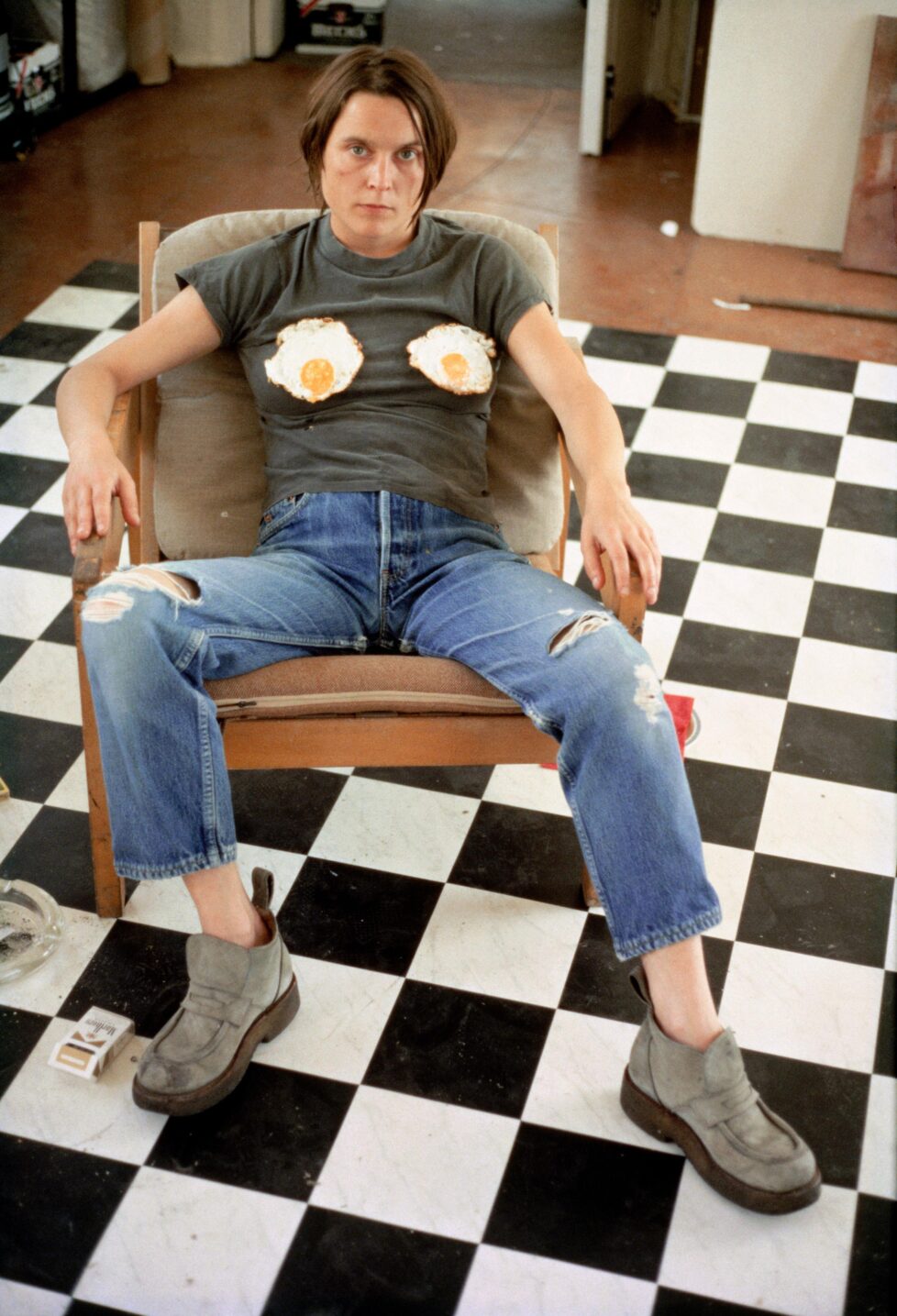
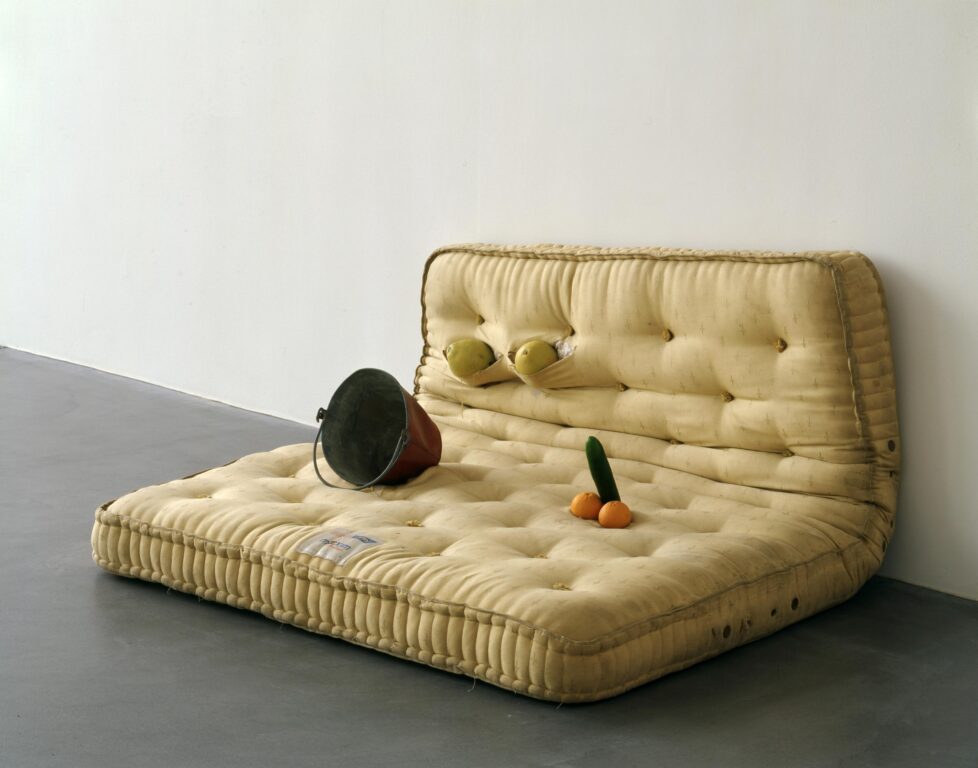
Navigating Sarah Lucas: Naked Eye at Kiasma in Helsinki, I was acutely reminded of the fact that the Swedish language lacks a natural facility for puns. The show assumes that the British artist’s coarse humour will land simply by filling the museum with hefty breasts and rock-hard penises. Yet, most discussions of Lucas’s work hinge on her deliberately unsophisticated sexual wordplay; on the tension between the comically vulgar objects and their sharply witty titles: a table, a T-shirt, two melons, and a vacuum-packed smoked fish become Bitch (1995); a grotesque headless female textile sculpture with two pairs of breasts becomes Honey Bunny (2025). Neither refined nor sophisticated, these works are nonetheless striking and associative.
Of course, as a state museum, Kiasma is obligated to communicate in Finnish and Swedish, besides English. Yet, strip Lucas of her charged words – ignore the fact that she emerges from Britain’s proud tradition of refined puns and bawdy humour – and the impact diminishes. Encountering her work through Swedish titles – Kärring instead of Bitch, Honungskanin instead of Honey Bunny – made the pieces sag, as though their lifeblood had drained away.
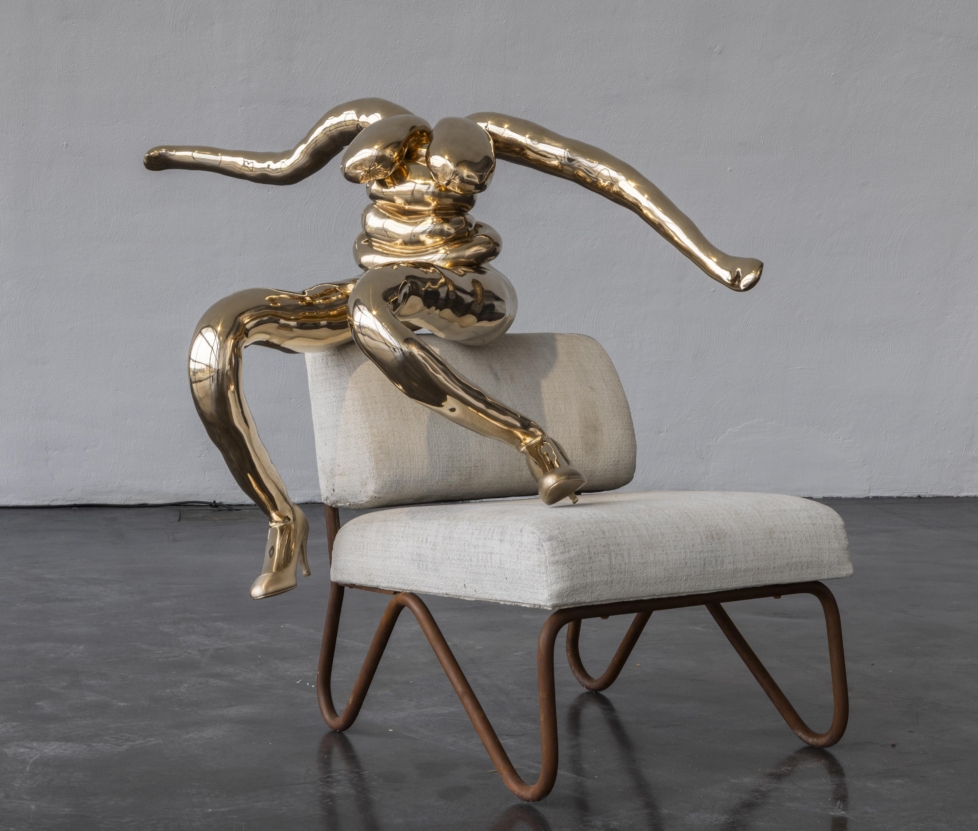
Another example: two black bronze sculptures resembling cats. From a distance, they break the monotony of the exhibition, which is overly focused on Lucas’s grotesque portrayals of sagging, sausage-like bodies. Up close, their forms are shrivelled, their plump legs gleaming as if sheathed in latex fetish gear. They belong in a nightmare, yet Lucas curtails any emotional reading by naming them Tit Tom 1 and 2 (2023). The reference to lustful tomcats renders them ridiculous, even pathetic – mutilated, like Samson bereft of his mane.
Translated into Swedish, the Tit Tom cats become Tuttgubbe 1 and 2 (“tit-man”), stripping away both the feline reference and the nod to the voyeuristic Peeping Tom. What remains is less an exploration of lust than a cousin to Jeff Koons’s Balloon Dog series. The difference is subtle, yet Lucas’s stripped-back practice means that every detail matters.
The artist’s most minimal gesture is Sod You Gits (1991), a blown-up page from the sex-obsessed Sunday Sport. The facsimile deftly captures British tabloids’ brazen linguistic excess. Kiasma, however, hesitates to foreground Lucas’s British identity, and the term YBA (Young British Artists, the generation that gained international acclaim in the 90s) is absent from the show. Perhaps the museum deems it unnecessary for understanding her work today? Yet, ignoring the hyper-British, working-class context that informs a work like Sod You Gits is a loss; much of Lucas’s work resonates specifically against post-Thatcherist Britain.
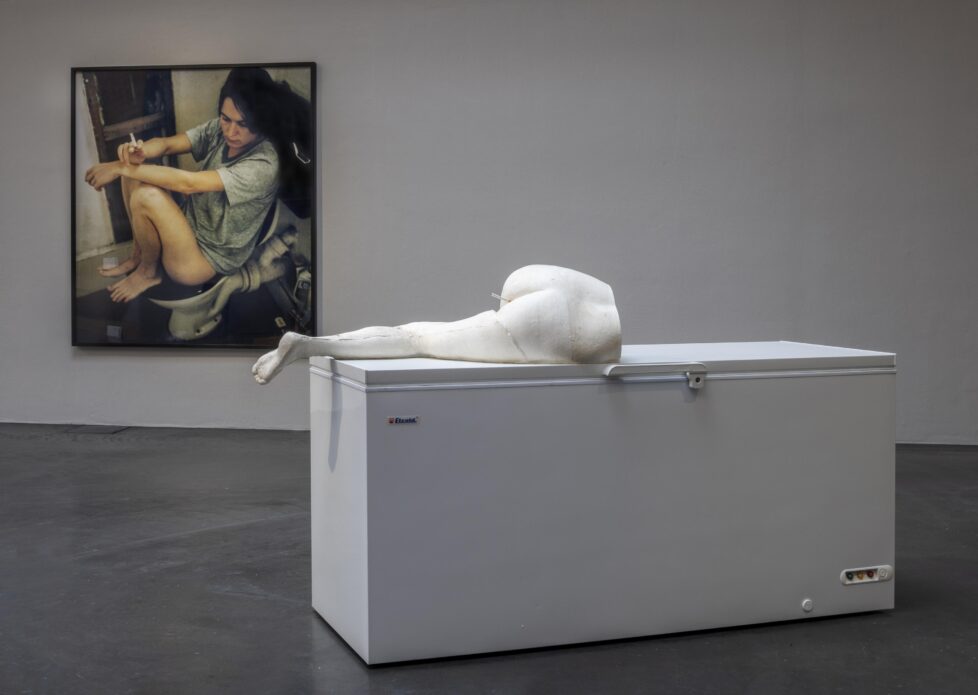
Instead, Kiasma presents Lucas as a purveyor of gendered humour. Her puerile use of melons, fried eggs, stuffed tights, cucumbers, and fluorescent tubes as stand-ins for breasts and penises feels trivial, like some kind of sex-positive army, in the museum’s sterile institutional gallery. Cigarettes – another visual hallmark, which in previous works draped luxury cars and a motorcycle helmet – appear here in plaster casts of women’s naked lower bodies (Margot, Michele, 2015). The works have a certain shock value, Lucas claims in an interview with the newspaper Helsingin Sanomat. In practice, they feel parodic, reminiscent of props in a fictional TV-exhibition, like the vulva paintings in Sex and the City or penis reliefs in Fleabag, presented as trivial art-nonsense.
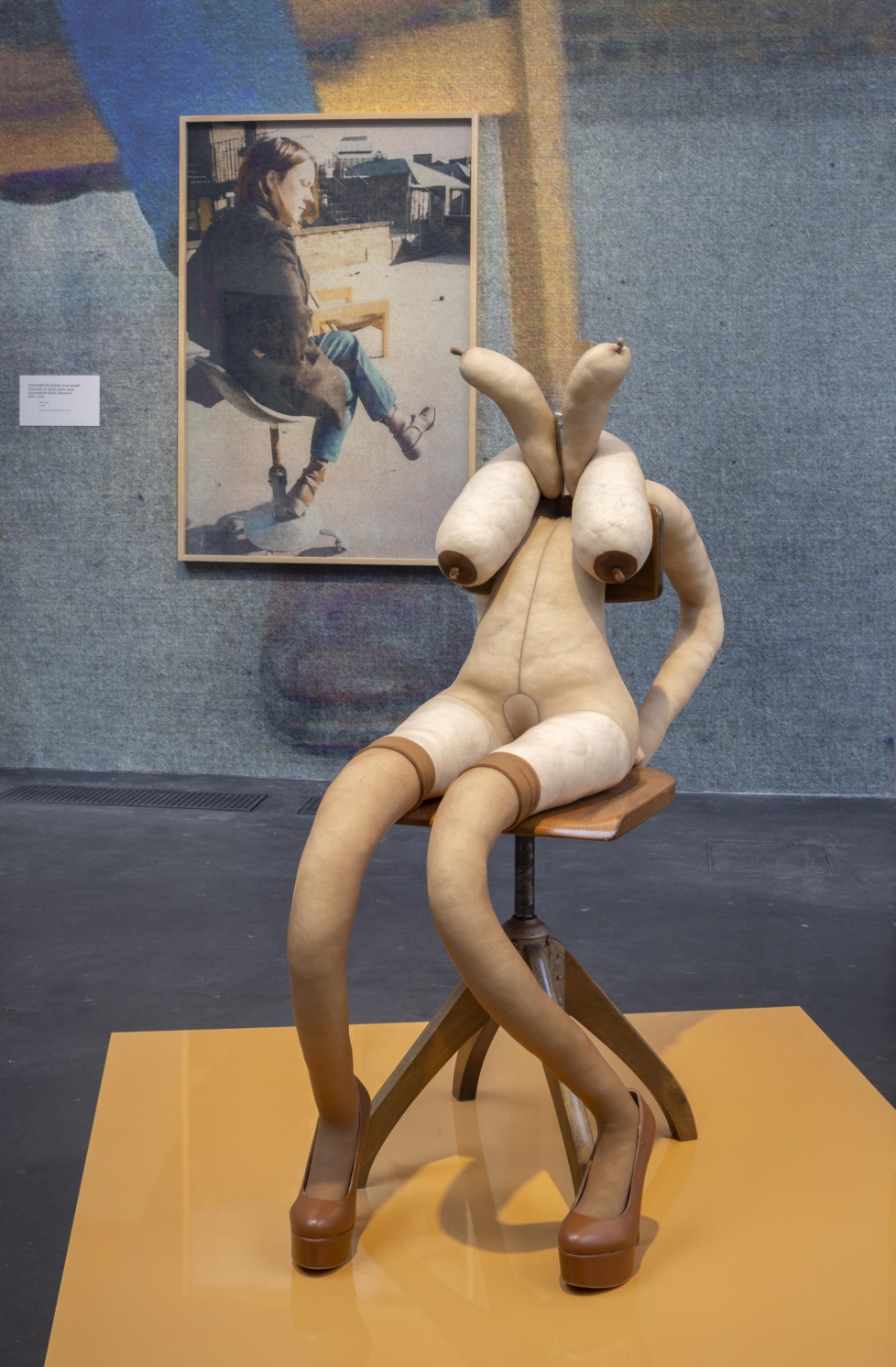
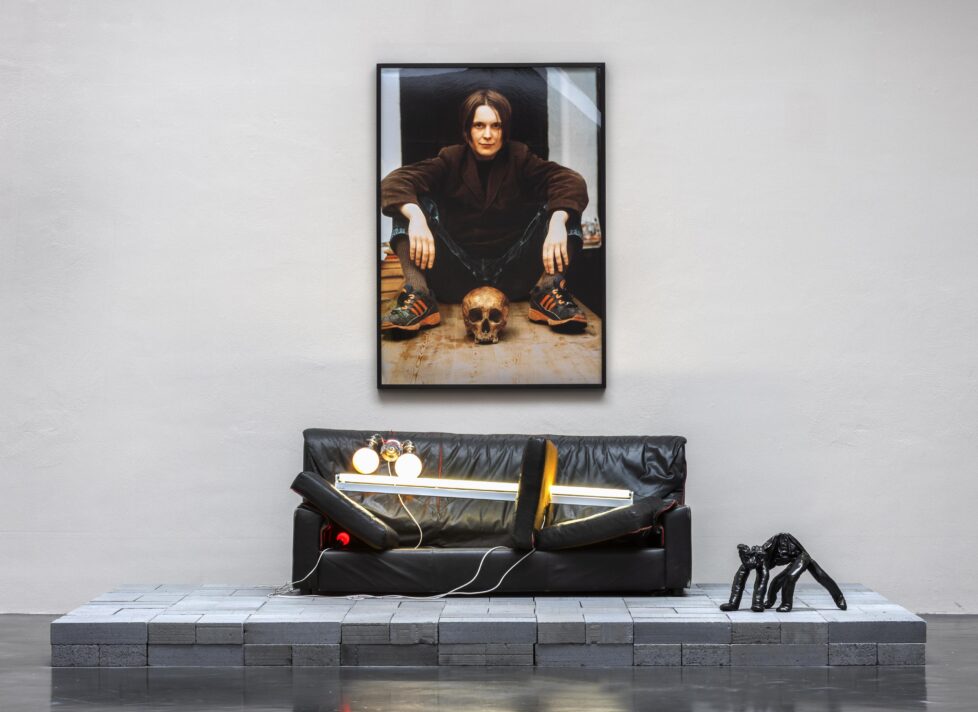
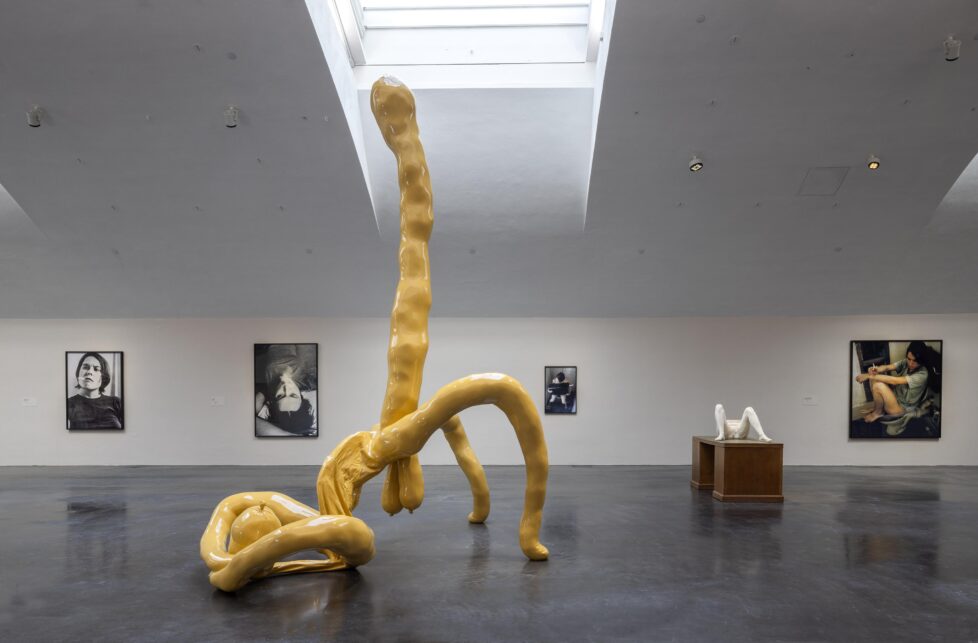
Kiasma’s exhibition disappoints precisely because it mirrors the monotony often attributed to contemporary art. Surrounded by sculptures of slumped bodies, flabby breasts, and sexy shoes, I felt little engagement with femininity – my own or anyone else’s. Presumably, I am meant to feel provoked, to smile at the grotesque, and perhaps reflect on heteronormative codes. Even my attempts to be shocked by Lucas’s visual aggression fail. The show is oddly sterile; nothing seems at stake. The most uncomfortable moment was when I caught a glimpse of myself in the polished surface of the bronze sculpture Goddess (2022), my reflection distorted as in a funhouse mirror, making me look like a melting human candle.
Yet, the show’s failure is hardly inevitable. Looking back at Lucas’s 2015 Venice Biennale exhibition, or her 2023–24 Tate Modern show, I see vibrancy and delight. In Venice, she painted the austere British Pavilion in a screaming yellow; at Tate, her sculptures occupied idiosyncratic podiums with a DIY aesthetic. Photographs reveal enormous sandwiches, pink puddles, burned-out armchairs, washing machines, and toilets – objects that communicate far more about gender than high heels and erections. You cannot help but marvel at how Kiasma strips Lucas of all edginess, shaving away too much in the effort to crystallise her oeuvre.
Translated from Swedish.