I notice the coyote pricking up its ears when I mention the cheap hidden-city flight ticket I found when I suddenly had to return home early from Venice. The term refers to a ticket where you get off at the stopover, in this case Copenhagen. And of course the idea of a hidden city would appeal to an artist collective like coyote, whose work revolves around urban spaces and different ways of navigating the city.
I meet two members of the Danish-Swedish group at a café in Copenhagen’s Christianshavn district, not far from O–Overgaden, where coyote are currently installing an exhibition. Among other things, this involves tearing down an end wall so that the beautiful factory windows hidden behind it are revealed, opening up a view of a picturesque Copenhagen courtyard with colourful façades – and beyond it, the city. It is almost closing time at the café, and we try to figure out how the interview might best be conducted. After all, the collective approach is part of coyote’s DNA. All members take part in everything the group does. So it would make no sense if they were not all part of the interview too.
Upstairs is the group’s first institutional solo exhibition. Previously, coyote have participated in group exhibitions, engaged with off-spaces and artist-run initiatives, and staged interventions in urban spaces, for example, in Stockholm. I have the impression that the collective, active since 2017, have made more of a mark on the Swedish art scene than the Danish one. Interestingly, my Swedish editor colleague at Kunstkritikkhas the exact opposite impression. Perhaps our disagreement says more about the elusive nature of the group than anything else.
In 2025, coyote served as jury and curator for the annual Spring Exhibition at Charlottenborg in Copenhagen. The group approached this juried exhibition the same way they approach any exhibition: curious about what making an exhibition actually means, and intent on investigating the possibilities hidden within this traditional exhibition format. They encouraged more applications from groups, collectives and communities, and introduced new categories into the application process, such as ‘unfinished works’. Entirely in keeping with the group’s own idiom and way of working.
coyote often use understated gestures, as seen in the exhibition at O–Overgaden, which features expressions linked to legendary tales from Copenhagen. Among them is footage recorded with an endoscopic camera of cracks in the asphalt on Korsgade, which may derive from the underground tunnel used as an escape route by squatters in 1983 during a confrontation with police over the occupied house Allotria. This story is one of the most legendary narratives about Copenhagen’s squatter movement and naturally appeals to a group that calls itself ‘coyote’ – a prairie wolf known for its ability to adapt to different environments, including human-made ones, which is why it can be found in a number of cities, primarily in North America. A cunning creature, good at adapting, and good at hiding. Much like the members of coyote, who are in no hurry to reveal who is actually behind the group. Several of them also work as artists under their own names.
The café closes, and we find ourselves out on the street. We agree that having a real conversation around a table would be the most fun, but also that things would probably become too unwieldy if I had to wait for the group to arrive collectively at each answer. We settle on a hybrid format: I will send my thoughts and questions by email, and the group will respond whenever they take a break from installing. I’ll write in Danish, and the answers I receive from the group will be in Swedish. In the Scandinavian spirit – which is also Kunstkritikk’s – I choose not to translate them in the original version of this article. Instead, I try to do as coyote does: adapt to the situation.
I know the names of a couple of coyote’s members and imagine that coyote consists of five or six people – a mix of Swedish and Danish artists, aged between 34 and 39. Is that right? Is there anything else we ought to know? Anything important for understanding who coyote are?
In relation to the public, coyote is just coyote.
We live in an age obsessed with celebrity, and this has also affected the so-called art world. Over the past five to seven years, it has become customary for press releases to be accompanied by an artist portrait. Sometimes there are pictures of the art too, but I no longer expect it. I imagine that a group of artists working collectively in the 2020s, one whose members’ identities are not necessarily publicly known, must have had to consider this. How do coyote operate in this field?
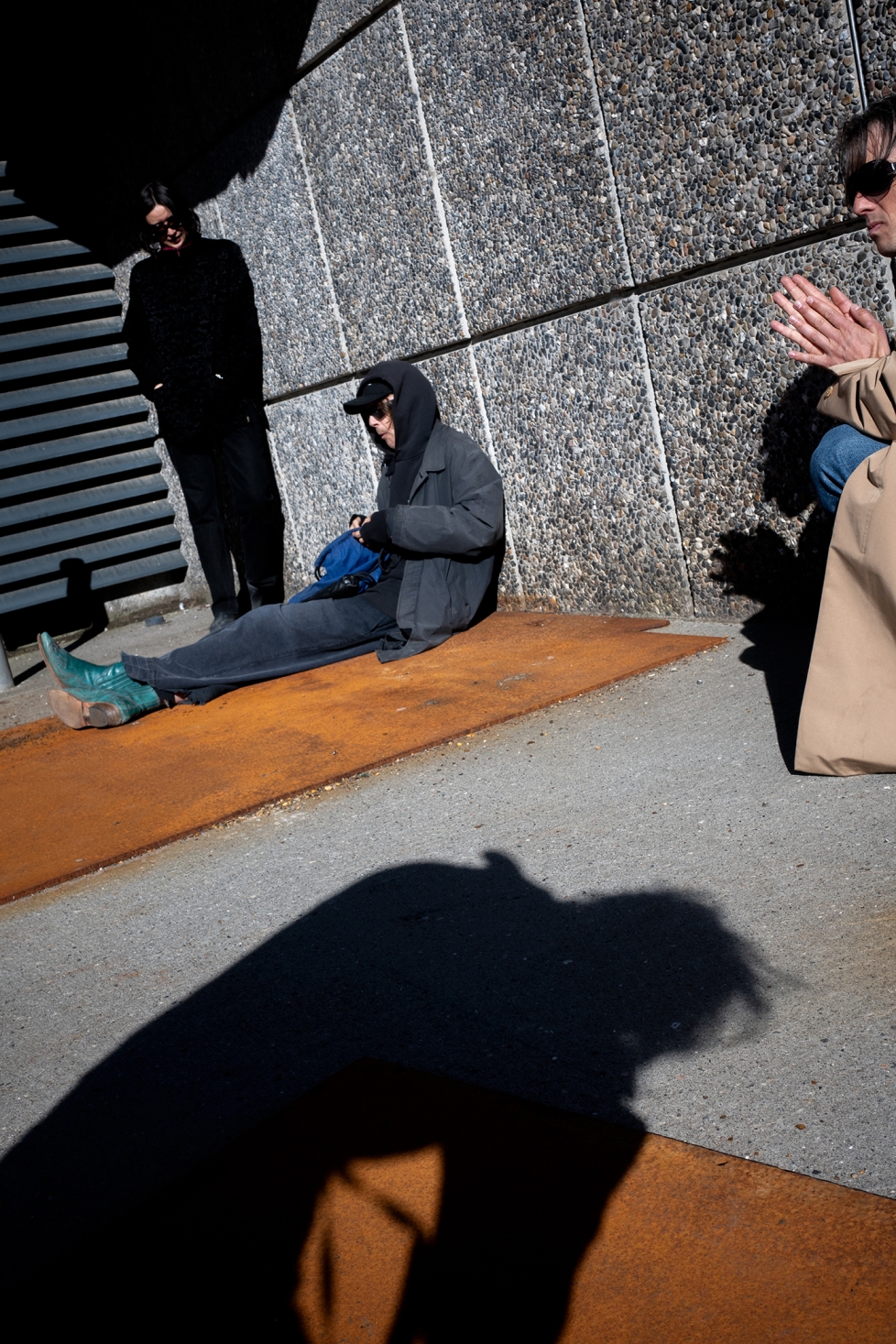
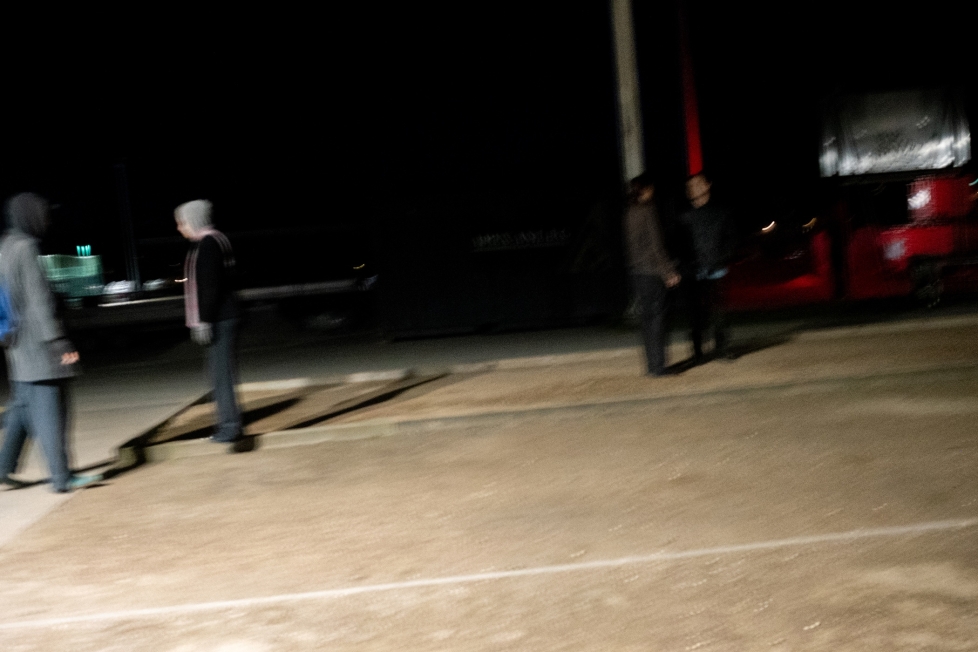
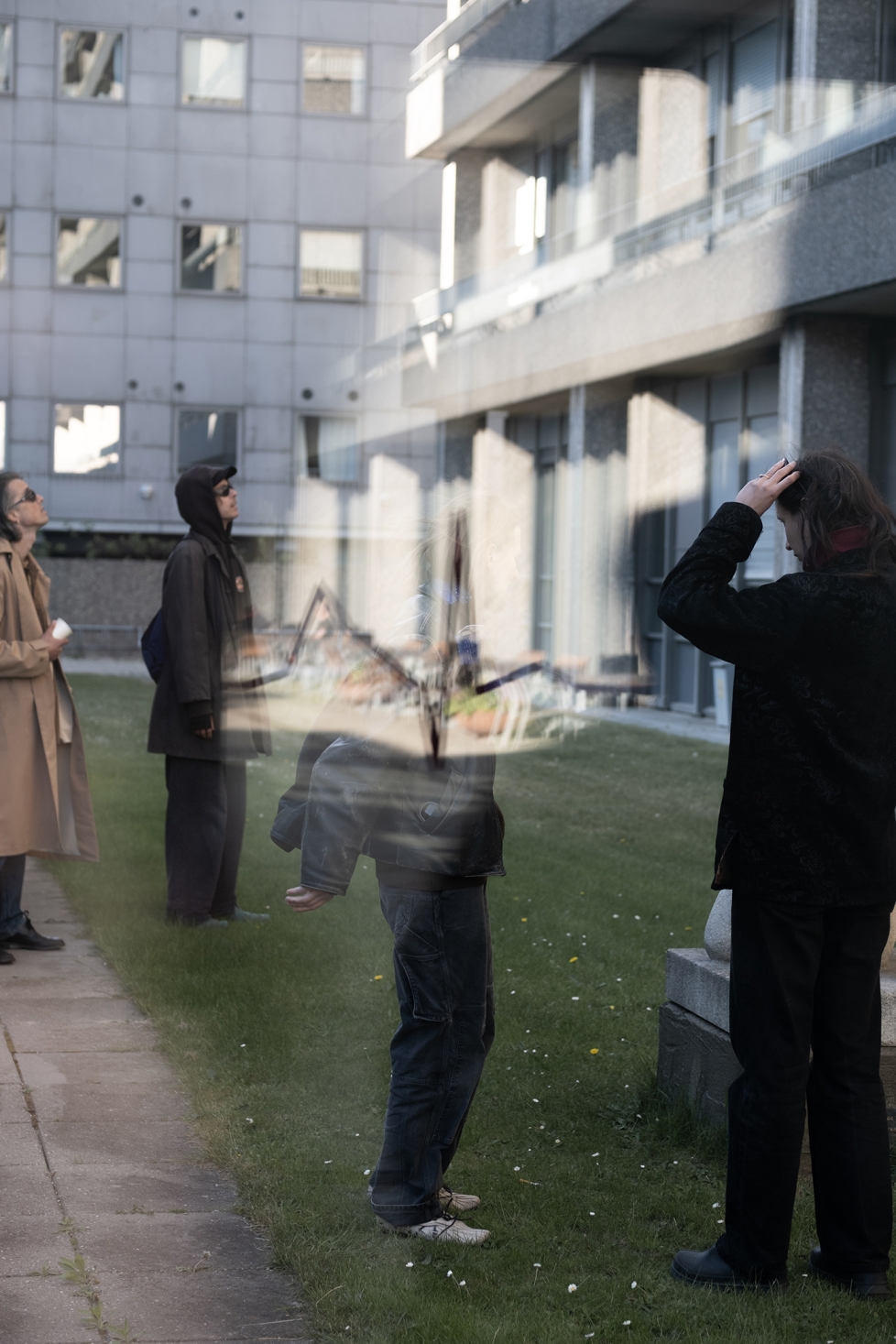
We try to take a constructive approach to this, and in practical terms we probably see it more as a kind of framework that we operate within. We have worked on our artist portrait in relation to various institutional commitments, using the format to visually represent coyote. For our press images, we have invited a local photographer to take an artist portrait inspired by fashion editorials. In Stockholm, it was the iconic photographer and filmmaker Anders Edström, and now in Copenhagen, with the exhibition at Overgaden, it is the legendary photographer Absalon Kirkeby.
The people who ‘embody’ the group in the photograph are not necessarily ourselves, but may be artists, curators or gallerists with whom we have collaborated since 2017. The photographs function both as conventional artist portraits and as artworks. For us, the age you suggest we are living in, and the structural frameworks a contemporary artist operates within, are not something we react against directly, but rather something we can use as artistic material.
You have torn down part of the venue’s end wall and uncovered the windows hidden behind it. It feels almost like a liberation of the building. But perhaps it is also a comment on a particular understanding of institutions that we have gradually grown used to, specifically the formatting of exhibitions that has become the default over the past ten to fifteen years – new walls, new spatial sequences, blocked-up windows and doors, every time. Sometimes the format asserts itself so insistently that you have to work hard to sense the art, or the artistic gestures. But do you actually see the demolition of this wall as a form of institutional critique?
Knocking down the wall was the first step in taking on the exhibition as a whole. For us, it was essential that the wall covering was not simply stripped away and removed, but that the actual panelling from which the wall was constructed became the very foundation of the exhibition. It was transformed into long tables and three-dimensional sculptural elements used to present the other parts of the exhibition.
It took six months of discussions to reach a decision – but just one day to tear it down. As you say, the back room now evokes a past era. In doing this, we are affirming the institution’s history and the building’s location in Christianshavn. The demolition of the wall becomes a time capsule that helps us to see and treat the exhibition space with care. Taking down the wall was also a way of opening up the space and making the city outside more visible.
The ‘formatting’ of art institutions and exhibition spaces over the last 10–15 years, that you mention, has also gone hand in hand with a general institutionalisation and professionalisation of the visual arts, which has actually been taking place over an even longer period. It is within this contemporary context that we operate, and it is a structural reality that we cannot avoid addressing. The exhibition has sparked discussions about how the art scene in Scandinavia has followed along with this professionalisation and conceptualisation. In this context, Copenhagen has almost become synonymous with the concept of ‘concept’, a sort of Concept City Deluxe, where everything is conceptualised: restaurants, shops, and institutions.
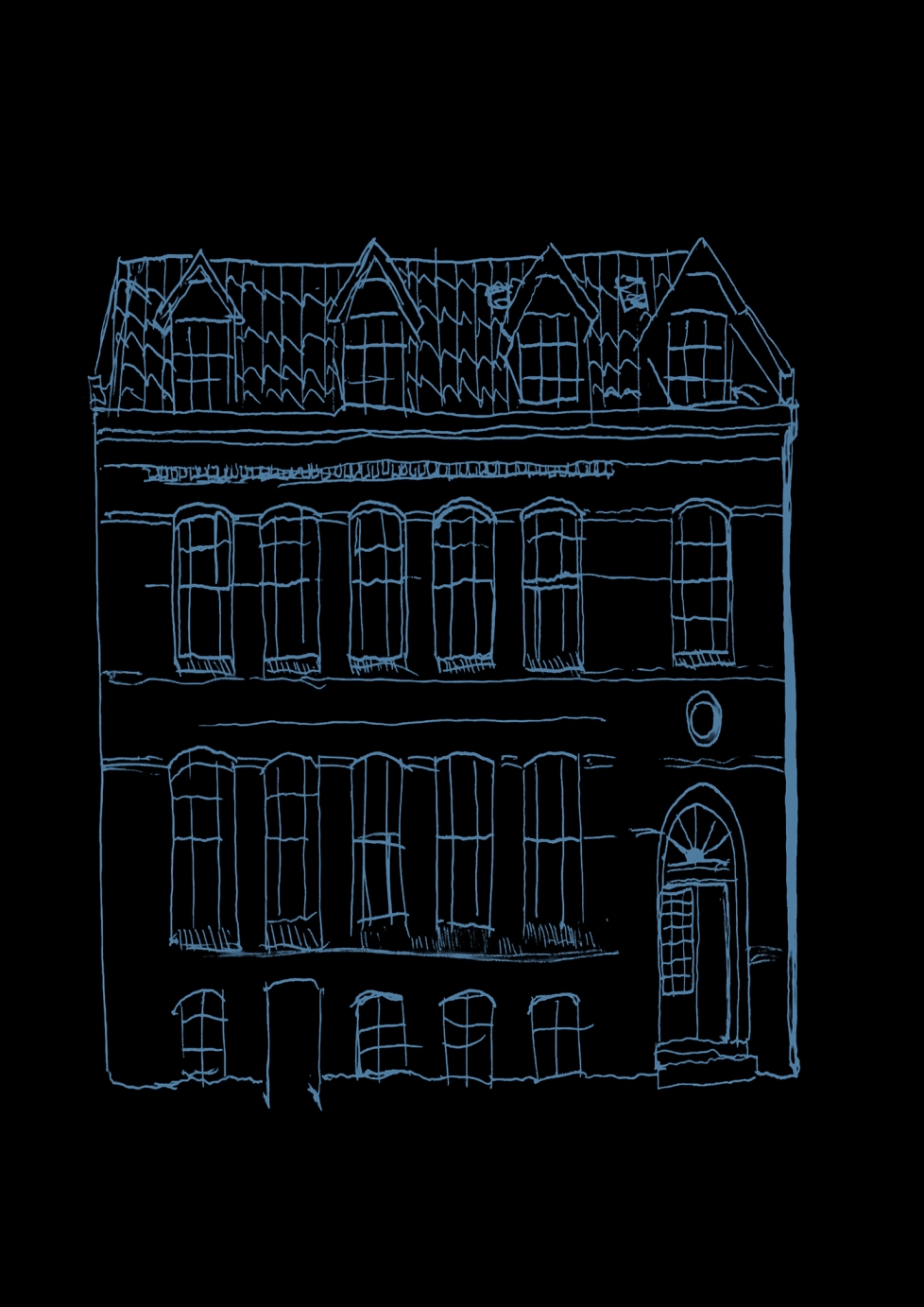
Speaking of the city outside, the drawing on the invitation is interesting. It depicts a building in the same style as Overgaden, but it isn’t Overgaden. It seems more like a fantasy of old Copenhagen, the kind we know from children’s-book illustrations or from the legendary 24-episode TV Christmas calendars of the 1970s, where the Christianshavn district in particular served as the model for puppet-theatre versions of miniature harbour towns. How important is the district to the exhibition?
For us, the institution’s history and the building’s location in Christianshavn are factors we need to take into account. The drawing is a direct reference to the opening sequence of the Danish TV series Huset på Christianshavn (1970–1977), but instead of the series’ setting on Amagergade, it depicts a different ‘house in Christianshavn’. A sort of hand-drawn blueprint for the exhibition.
Throughout the process, the TV classic has come to mind in various ways, primarily as a fictional and staged portrait of the neighbourhood. These fictional layers – where the sets and characters have become synonymous with an image of ‘Christianshavn’ – play a key role in how we have approached the site. Just as ‘the house in Christianshavn’ is right around the corner, there is also a local history of collective action, with Beboerhuset, Christiania, and the occupation of Sofiegården, which influences the exhibition.
The tension between these narratives is explored in an episode of Huset på Christianshavn, in which squatters move into the house next door, setting the dramatic stage for the plot. There is something very exciting about how the series was influenced by the contemporary squatters’ movement and allows this to be reflected in the fictional content, where the residents and squatters become caricatures of themselves. An interest in playing with and studying the space in which we exhibit is a recurring factor in our artistic work, as a method for constantly challenging our position and our own point of entry by engaging in dialogue with new places and contexts.
Could you say something more about what kind of institutional critique coyote actually represent?
It is important to consider the term from a contemporary perspective, given that institutional critique and the artistic approach it often entails are deeply rooted in art history. Perhaps, in some ways, institutional critique today should be redefined or understood in relation to different parameters. Julie Ault, who is a common point of reference in our work, conveys the importance of a form of institutional critique, or perhaps analysis, based on pausing and slowing down “the industry treadmill.” In her 2017 anthology In Part: Writings, she writes:
Perhaps the most important questions any institution, organization, or individual practitioner can periodically pose inward (as well as publicly) are, «Why do this? Is there need? Is there desire? Does my/our work fill a void? What is at stake beyond immediate pressures and deadlines? What would happen if we stopped and took stock? What if we closed our doors for a month? A year? Could it be productive? How would we do things differently if we didn’t do what we’re doing, if we threw the manual out the window?»
What Ault writes may not directly address the specific work we are engaged in, but there is something in it that we consider important and which we see as our shared responsibility to keep in mind.
Back in the old days, artists exhibiting at O-Overgaden were simply given the keys to the building. Then they got to work, made the exhibition, sent out invitations and press releases. Finally, they bought beer for the opening and opened the door. The artists were also in charge of the practicalities of the exhibition run itself. At the same time, O-Overgaden was an institution under the Danish Ministry of Culture, so it wasn’t an artist-run space as such. Might this be an interesting model for an institution today?
In the end, it’s all about self-organisation, just as in the example of Overgaden that you mention, and in many other places. Of course it works as a model, because that premise is a necessity for creating exhibitions, artistic practices, and institutions – where the exhibiting artists are, or are allowed to be, the basis for the whole thing.
In a way, the most professional thing an institution can do today is to engage in dialogue with the artist and work to support the premises of art. And conversely, the most professional thing an artist can do is not to adapt their practice to a predetermined, objective idea of what it means to work professionally.
At the opening, Swedish artist Annika Eriksson will restage Copenhagen Postmen’s Orchestra from 1996. In the original video work, you see a local postmen’s orchestra turn up and play a simple melody. Such orchestras often perform at professional conventions and trade-union meetings. What is it about this work that captures your interest?
We have invited Annika Eriksson to restage Copenhagen Postmen’s Orchestra, not as a video work but as a performative intervention during the opening. It is a new work and, just as in the original, it is the actual Copenhagen Post Orchestra that performs the melancholic pop song ‘Sour Times’ by Portishead.
Eriksson’s practice and her video works often recur as references in our conversations, where stagings of everyday and social interactions between groups and individuals are central. Annika is in a better position to talk about what the work means, but in relation to inviting her, it is beautiful that the work was already described as a time capsule in 1996. In the 30 years that have passed since then, the Danish postal service has stopped delivering all letter mail in the country. It is intriguing to imagine what the work will mean in another 30 years.
Annika Eriksson’s work reminds me of the Danish-Swedish art scene of the 1990s – among others, a few years at Louisiana when the Swedish director Lars Nittve created an atmosphere at the museum unlike anything seen there before or since. Eriksson’s work was made for the exhibition NowHere, which took over the entire museum and was curated by some of the brightest minds of the time. The list of artists was correspondingly urgent, full of cutting-edge Scandinavian and international contemporary art. There was a techno party in the park and skinny-dipping in the Øresund until sunrise and ahhhhh… I was twenty-five and thought that this was what the Scandinavian art scene was like. Forgive my nostalgic trip, but there is something about coyote that stirs echoes of that time. The critic Nora Arrhenius Hagdahl recently described coyote as a kind of representative of a dark neo-relational aesthetics. What are your thoughts on that?
Your description of being in your twenties is incredibly beautiful and exactly captures what we’re interested in. We don’t want to recreate that art, or really even have anything to do with it, but rather to create an understanding of history through that kind of memory. What you describe is, after all, a personal experience of a scene or a moment in time – an urgent and relevant cultural expression – which in turn reflects a context or a larger group of people within the same context.
In almost all our major works, we have processed memories of places or contexts through a kind of ‘experienced’ history, in image or text. In such processes, it is important to respect and understand what has happened (before us), but at the same time also to acknowledge that we live in a different time and allow that mash-up of time and space to be reflected in our works and exhibitions. That is why our works may evoke a feeling similar to what someone experienced 30 years ago, while someone else might think we are working with a ‘neo’ version of a particular art-historical concept.
There is something beautiful in the discrepancy between reality and fiction. Which collective memories do we preserve together, and which do we allow to fade into oblivion? It’s within that ambiguity that we want to exist.