There is a rag rug made from my father’s old shirts in my house. I know how it is woven. I have seen women weave rag rugs all my life; I know how it’s done. The rugs I have at home are made by my mother and grandmother, my cousins and aunts. Sometimes I recognise the fabrics. I know which garments are woven into the weft. The rugs are almost sacred objects. They carry a powerful symbolic value for me, and for us who come from Tornedalen, just as they do for so many others for whom reusing materials has been vital. I care for my rugs tenderly. When they start to wear out, I roll them up and store them like valuables in the attic.
The places where this text unfolds are meaningful: Tornedalen (Torne Valley) and Kiruna. Two places, one a region another a city, in the far-northern reaches of Sweden, which have historically been the home of speakers of the minority language meänkieli. My relationship to my own cultural heritage – the Tornedalian one – and all the traditions and knowledge that my 60-year-old body holds, I have had to reconsider through my encounter with Matilda Kenttä’s artistic practice.
Matilda, who is a generation younger than I am, unrolls our shared cultural history, interprets the present, and gives shape to that which has not been told, in both material and words. In her art, I can sense the invisible glue and the hidden knots, the things that keep our history and our present bound together in these places. She sees things I do not.
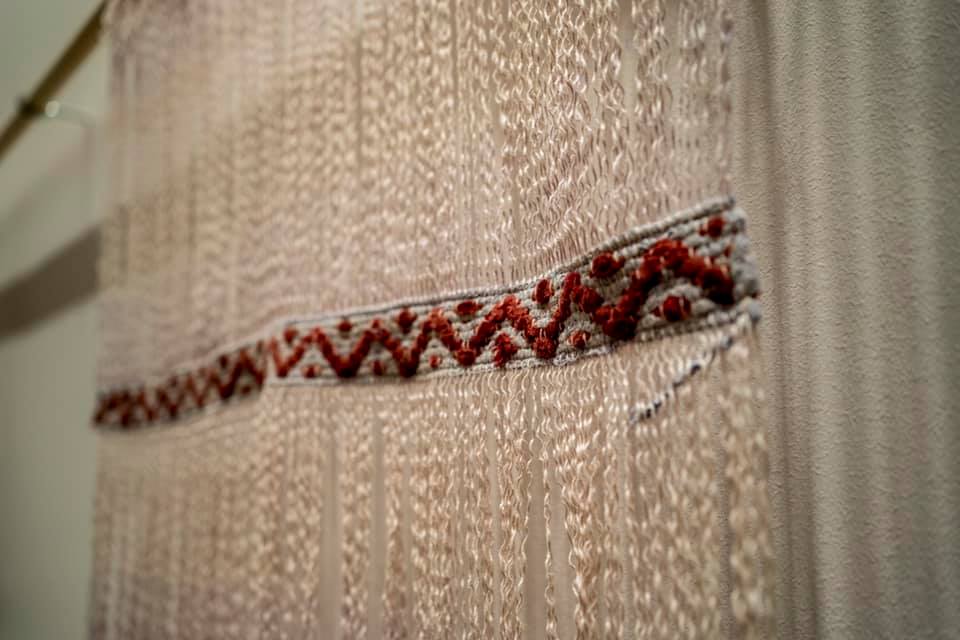
In the spring of 2024, Matilda exhibited her work Response in Reconstruction (2023) at Kin Museum of Contemporary Art in Kiruna. There, she had unravelled one of her grandmother’s rag rugs. The former rug occupied a large part of the room; from the ceiling hung strips of fabric that once formed the weft, and on the floor was a pile of gathered rags. Matilda has described the work as kilometres of tangles in which she searches for gossip in words or actions. What she finds includes, among other things, the strength of the hands that once tore the fabric strips.
I think of my grandmother’s rag strips and how she tore apart old worn-out clothes and textiles. Was there an outlet for emotions there – anger or frustration? Did she and her daughters sit together tearing fabric, and what did they talk about then? I can read the everyday and forgotten making in Matilda’s work – the doing that simply happens before something is considered finished. In this case, a completed rug meant to lie on the floor and do its job: to warm-up the room, soften sounds, give colour, and create homeliness.
Today, almost all of old Kiruna is being demolished because the state-owned company LKAB’s iron ore mine is expanding and causing the ground beneath the city to shake. In Sju omvävnader (Seven Re-weavings, 2022), an art project created in connection with Kiruna’s urban transformation, Matilda unravelled Kiruna residents’ rag rugs and rewove the strips according to the exact measurements of seven spaces in the city that have now disappeared.
Within the donated rugs lie the work, memories, and places of Kiruna’s inhabitants. In Matilda’s loom, the material from the original rugs becomes memories of rooms that can no longer be visited. The warp, which she preserves in its original state with only a few weft threads remaining, becomes images that breathe emptiness. Parts of the content – what makes a rug a complete rug – are missing. Just like parts of Kiruna that now lack their houses. There, only the ground remains, with scattered traces of the old buildings.
I am taken aback by Matilda’s way of using weaving to interpret events and places. She weaves in so many layers of life and ideas. The slowness of weaving can feel downright provocative, and in Matilda’s artistic practice it is a provocation conveyed with inspiring lightness and a sense of inevitability. I’ve also heard her speak about separatist spaces where only women meet, and how wonderful the conversations are that unfold there during the slow, repetitive work. I want to talk with Matilda in such a space, soon.
– Lena Ylipää (b. 1965) is an artist living in Lainio, Kiruna municipality, Norrbotten (North Bothnia). After graduating from Konstfack in Stockholm in 1996, she moved back to Norrbotten, and has worked in the county ever since. Recent exhibitions include To Meet Aili – Lena Ylipää and Aili Kangas at KIN Museum of Contemporary Art in Kiruna, and Eight Degrees – Contemporary Art on the Forest at Bildmuseet in Umeå.
Translated from Swedish.