Through icy winds and snow, I climb the hill at Høvikodden outside Oslo to reach Henie Onstad Art Center. With its space-age armchairs and curved walls of natural stone and raw concrete, the building stands as a monument to Scandinavian modernism’s belief in cultural progress. I am here for Ann Lislegaard, the Norwegian-born artist who came to prominence in the 1990s with installations featuring electrified fences and barking dogs. In the 2000s she gained attention for digital animations inspired by science fiction writers like Ursula Le Guin and J.G. Ballard.
I am therefore surprised when I step into the lobby and hear tranquil birdsong. From snarling mutts and sleek futurism to pastoral chirping? As I am lulled toward an emotional reconciliation with nature that seems almost planted in my Nordic DNA, I realise that the recordings are of extinct or endangered species – a calculated sentimentality that keeps me on guard.
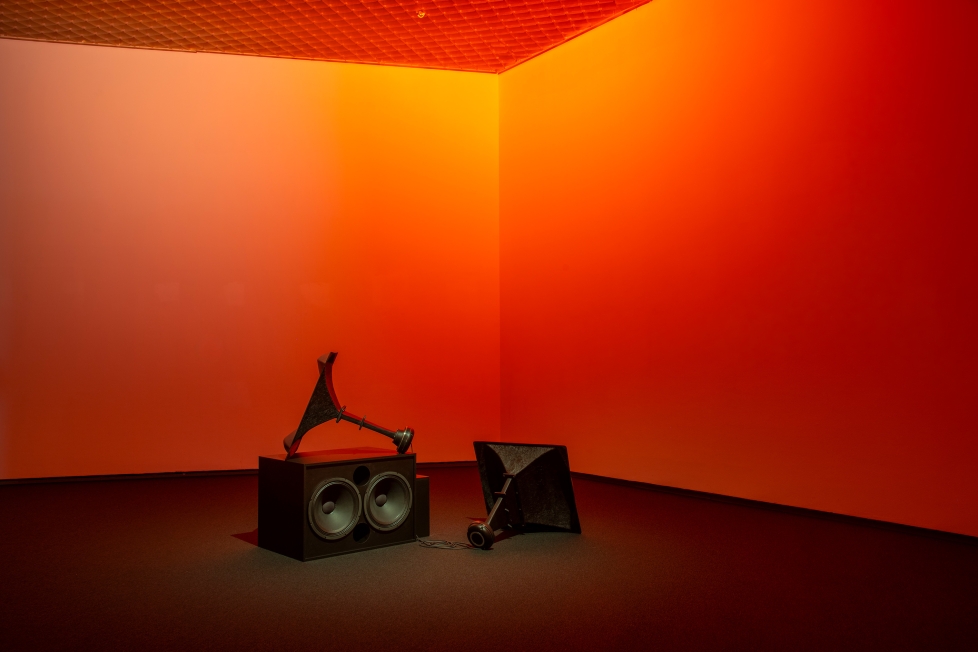
The show is the Copenhagen-based artists first presentation in her country of birth in almost two decades. It is displayed in the so-called Prisma Galleries, in two darkened halls separated by a corridor. Once inside, the mood becomes foreboding: a red warning light beams from the left room, and a green glow spills from the right, while a synthetic voice repeats disjointed statements such as “future” and “time is no different than the other dimensions.” Have I stumbled into in a crashed space station from the future? A research laboratory where things have gone terribly wrong?

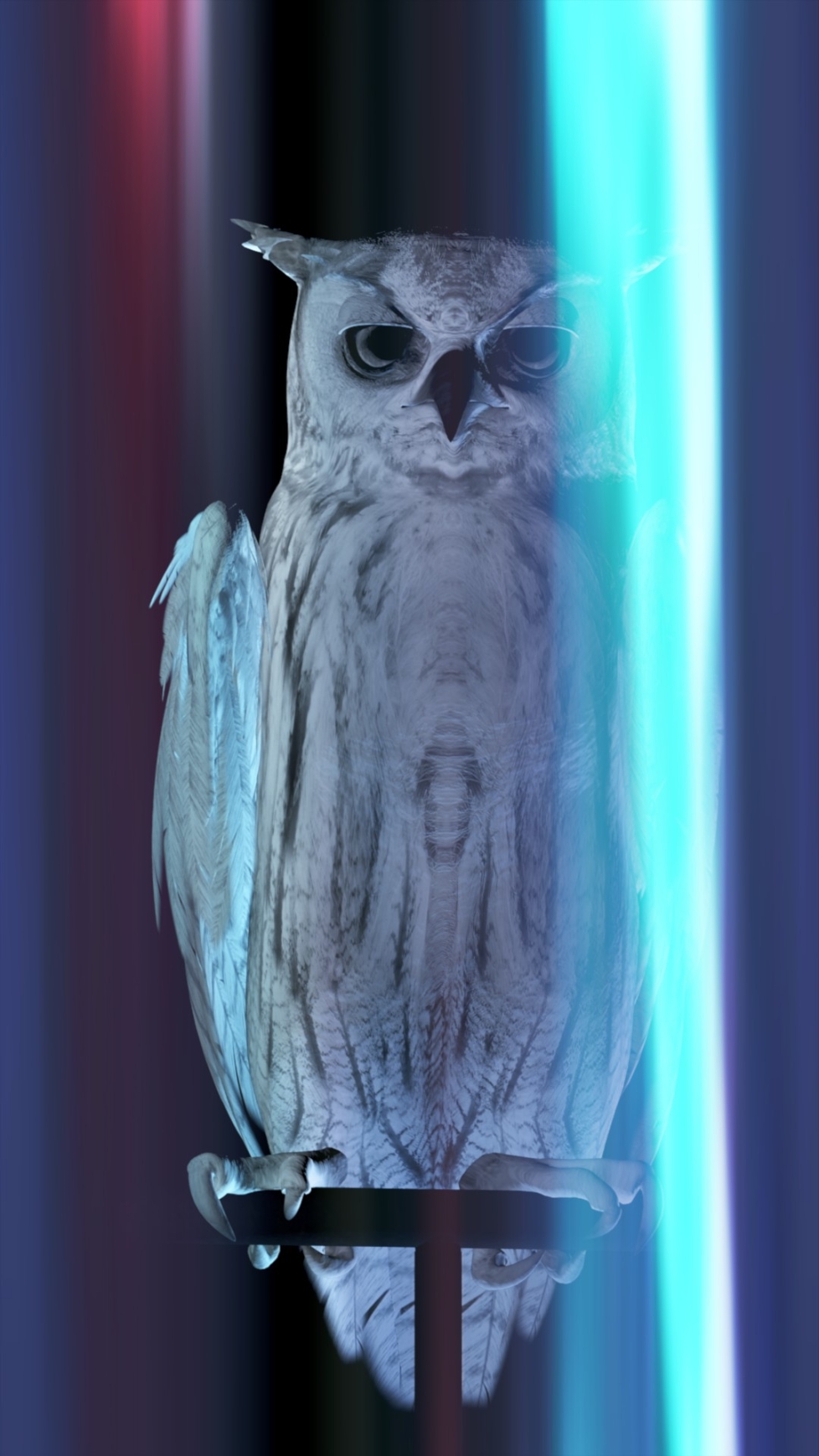
Twelve works spanning the past thirty years might sound extensive, but the presentation is actually more focused than comprehensive. It is neither a retrospective tracing the development of Lislegaard’s practice as whole, nor a survey of her different phases. Rather, the aim is to construct a total environment around the monumental digital animation Oracles, Owls… Some Animals Never Sleep (2022), recently acquired by Henie Onstad.
Most of the works are from the past ten years, and the few older pieces feel oddly out of context. A wall drawing executed under hypnosis (The Bell, 1992/2026), and an electrified metal net Untitled (Transmitter) (1993) emitting a low humming noise, are too minimal to function convincingly here. The claim that the net anticipates the mesh structure of the digital animations makes its inclusion seem strained rather than insightful.
Oracles, Owls is undoubtedly the exhibition’s pièce de résistance, shown on a several-meter-high LED screen, with the owl’s hyperreal yet spectral body occupying the entire vertical picture plane. Anyone hoping for action will be disappointed: during the half-hour loop the bird seems on the verge of dozing off, only to snap back to life, shake its head, and flap its wings a little. Occasionally it utters something cryptic in Danish or English. It’s an intriguing spectacle, tickling the imagination without spelling things out. Is the owl a ghost, or a digital avatar being rebooted because of some internal systems error? At the same time, it captures the paradox of an exhibition gesturing toward uncertainty while remaining ostensibly pre-programmed.
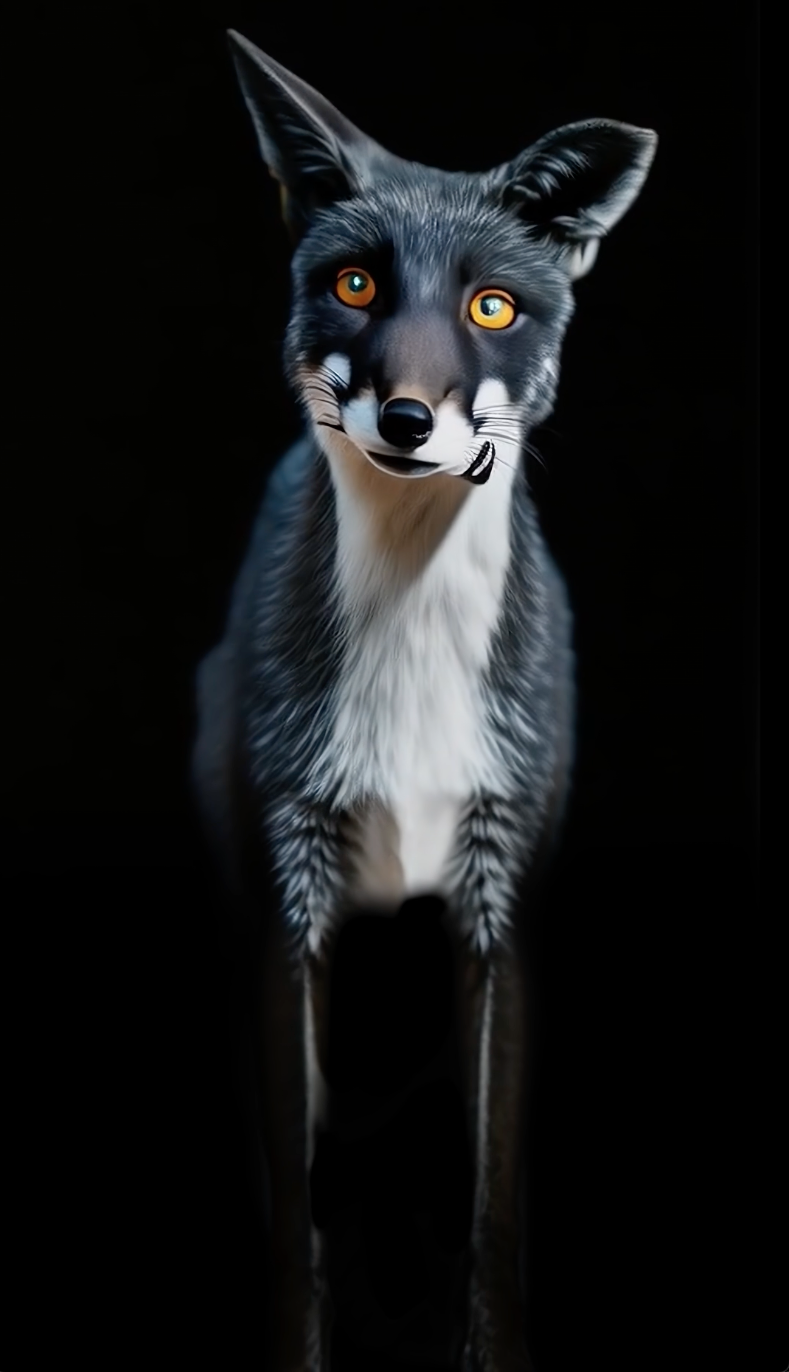
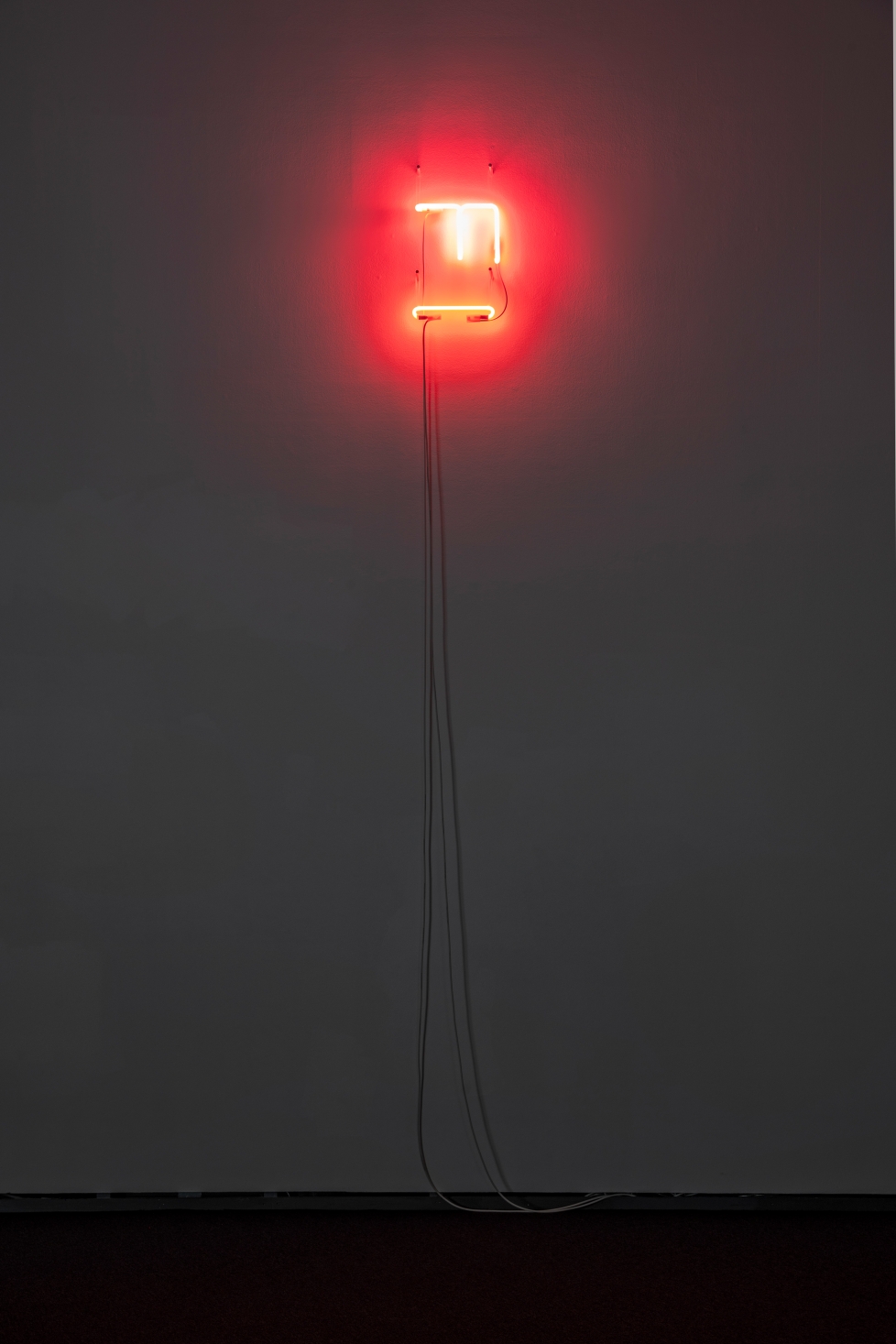
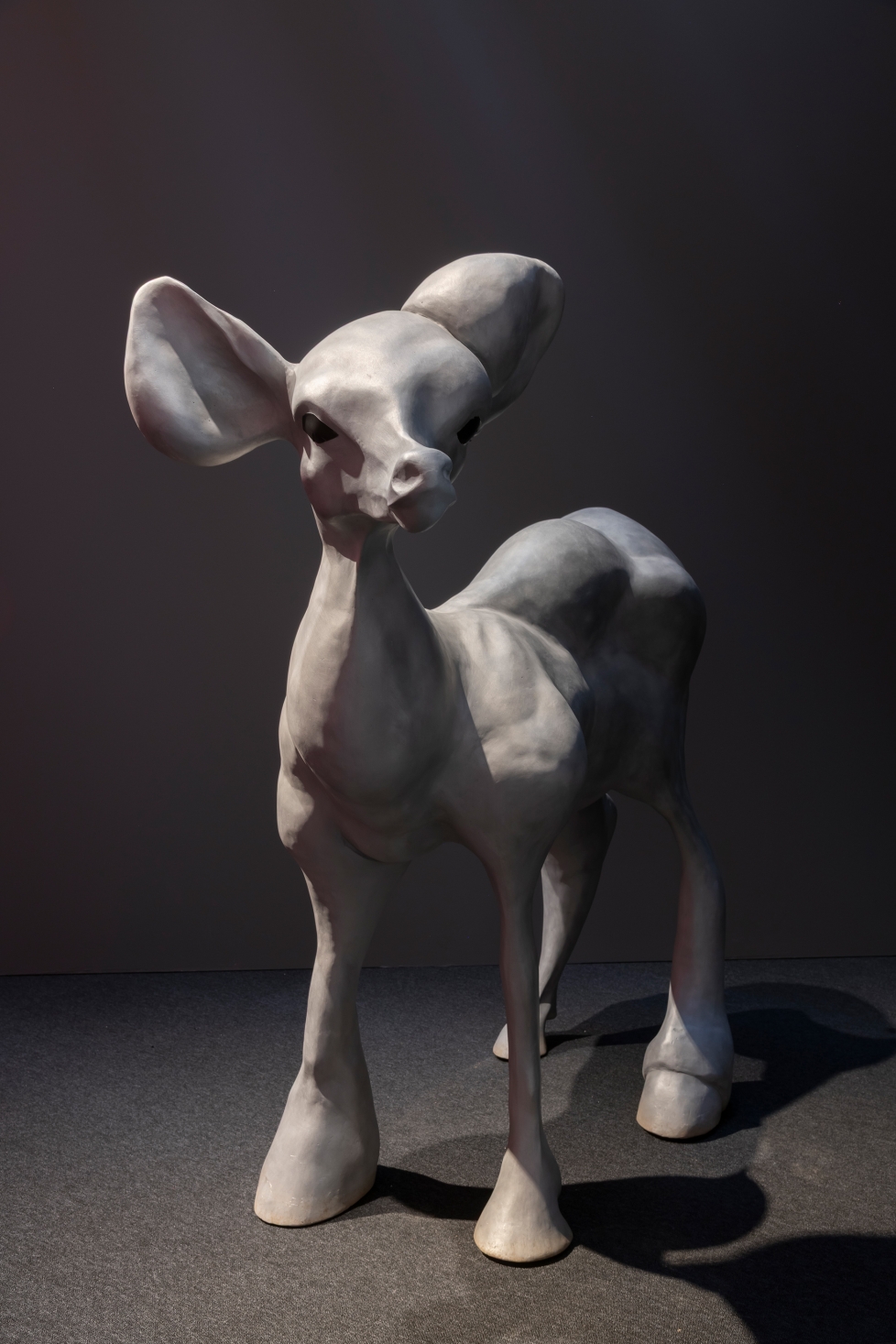
The other films similarly resemble corrupted digital files, though the animation in these earlier works is far less convincing. In Time Machine (2011–2025), a fox speaks to us from the future, and in The Malstrømmen (2017) a human avatar seems to transform into an octopus during a descent into a water vortex (although the narrative is deliberately opaque). Slanted neon signs reinforce the sense of unraveling. One reads “FI,” alluding to the French word for the end, la fin. A 3D-printed sculpture of a grotesque, mutated deer suggests an Island of Dr. Moreau scenario, where technological experiments have had devastating consequences.
Lislegaard’s obsession with “animoids,” as she calls her cyborg creatures with a reference to Bladerunner (1982), makes me think of her as an heir to Bruno Liljefors (1860–1938), the Swedish turn-of-the-century painter who used staged taxidermy to depict animals in their ‘wild state’. Both artists show nature as at once sublime and threatened, intimate yet estranged. And just like Liljefors’s tableaux, Lislegaard’s animoids function less as subjects than as screens for cultural anxieties. Indeed, the punch-drinking bourgeoisie of the previous century probably felt the same need as today’s natural-wine-sipping professional class to lament the decay of modern life, while seeking consolation in nature with similar moist-eyed sentimentality.
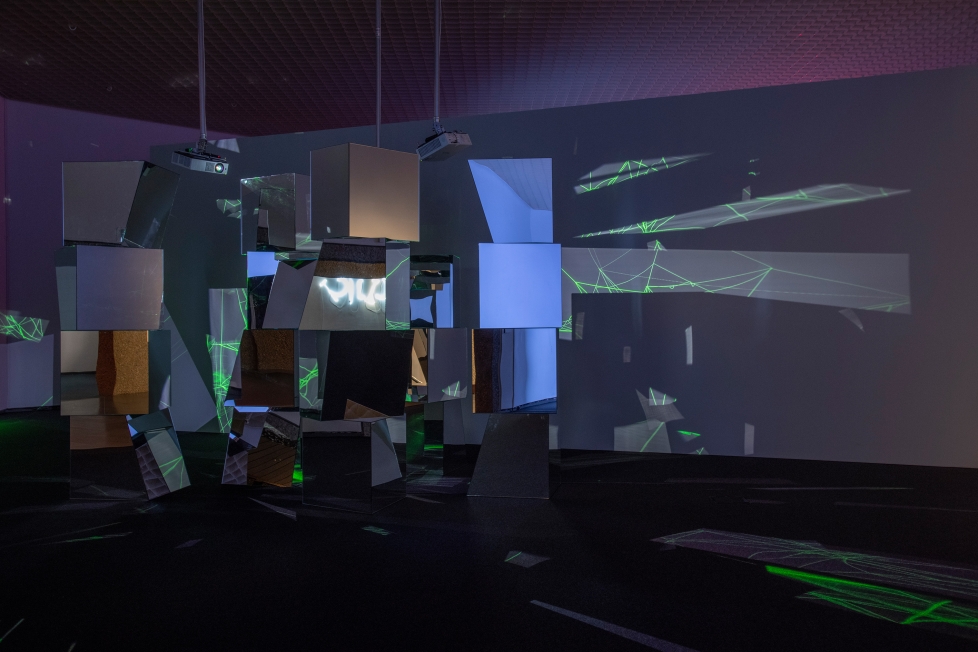
In the show’s most detached work, Spinning and Weaving Ada (2016), a spider is projected onto irregularly stacked mirror cubes, producing a kaleidoscopic effect that imitates the animal’s compound vision. The title refers to the mathematician Ada Lovelace (1815–1852), whose discoveries famously laid the groundwork for digital computer technology, evoking what the exhibition text describes as Lislegaard’s “feminist futurism.”
Yet, while seemingly attempting to dethrone the humanist subject’s dominion over nature, the installation, in practice, doesn’t generate a more inhuman perception than a funhouse’s hall of mirrors. The science fiction queen proves to be a National Romantic reborn, weaving obscure moods and dreamlike states in a muted critique of modernity. Still, what places Lislegaard in the present is how she insists on technology being humanity’s second nature, an inseparable part of how we think and act.
Unfortunately, this critical insight comes at an artistic cost, for her work overflows with stated intentions. There is a conspicuous absence of noise that might have introduced an objective or impersonal dimension into the artistic process. Every glitch is meant to be just that, every flaw designated and pre-scripted by digital animation software and reinforced by institutional framing. The result is a perfect rendering of an imperfect world, tediously moralistic in tone. I find myself almost longing for an accident not already anticipated, for a rupture that exceeds the script.
While ecological conscience has long been cast as a cornerstone of the Nordic welfare state, it has recently been exhausted by capitalist extraction and a lack of faith in societal progress. Yet, Lislegaard’s journey from the raw to the speculative to the brooding transforms this cultural lethargy into a hyperbolic cliché, mirroring how today’s professional class responds to pressure through a regime of emotional self-regulation (i.e. an ostensible concern with the suffering of the world). Luckily, waking up from fantasies of endless growth does not mean we are living through the Apocalypse. Melancholy has become a style, but that does not make it a destiny.