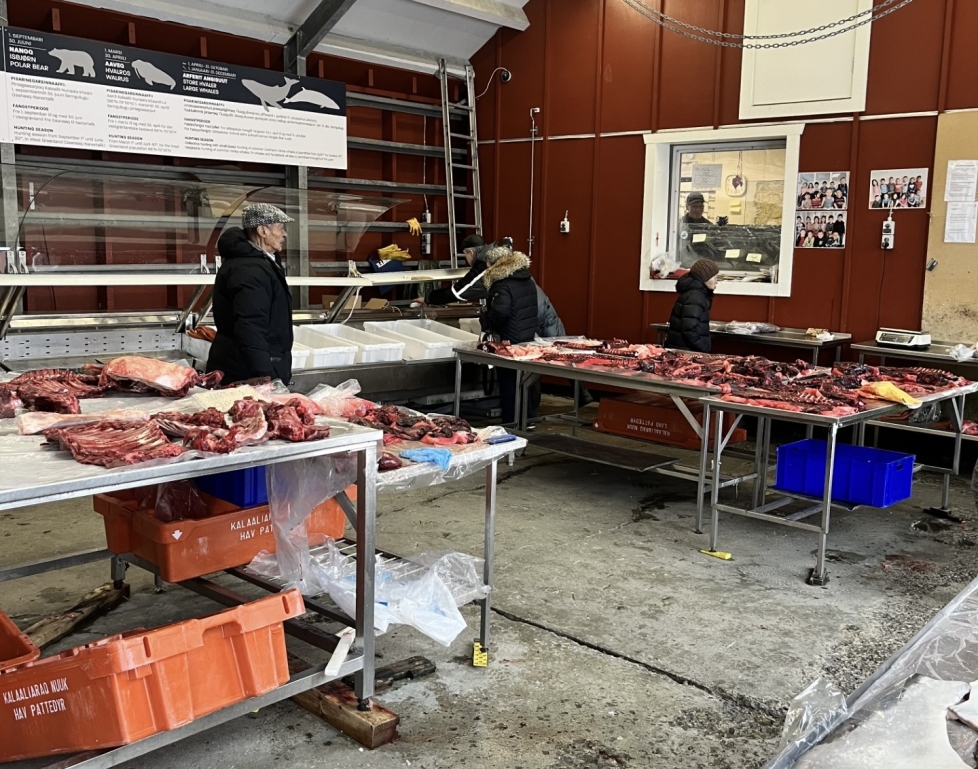
It snowed during the night, and I am half walking, half skating my way down towards the harbour in the oldest part of Nuuk, where I am due to visit the city’s art school. I keep my eyes on the ground to avoid falling, and then, suddenly, I see blood in the snow. Not just a few splashes, but a clear trail leading to a red wooden building with its doors wide open.
The place is the Kalaaliaraq Market, known in Danish as “Brættet” (The Board), a meat market where fishermen and hunters sell their catch directly to customers. The reindeer hunting season has just begun, and on the slabs lie large cuts of meat from animals recently shot in the mountains outside the town. A couple of men in thermal gear amble about aimlessly with cigarettes dangling from the corners of their mouths, waiting for customers to appear. It is late morning, which means the place is almost empty, but, they tell me, The Board is usually busy. Not only is the meat fresher than what you find in the refrigerated aisle at the supermarket, shopping at the fresh food market is also part of a renewed interest in traditional ways of life in the Arctic, where hunters, until just a few generations ago, were the lifeblood of society. And when I return to The Board later that day, it is packed with young, hip Greenlanders looking very stylish with their Inuit facial tattoos and jewellery made of bone and beads, pairing perfectly with hoodies from the local streetwear brand Bolt Lamar.
Something similar is happening on Greenland’s art scene at the moment. It is increasingly looking towards the Indigenous culture that was marginalised, and in some cases banned outright, by the Danish colonial authorities. This year the local culture festival changed its name from “Nuuk Nordisk” to the more Greenlandic-sounding “Suialaa Arts Festival,” and is increasingly focused on Indigenous cultures across the Arctic, particularly on traits and circumstances shared between Greenlandic and Canadian Inuit and the Sámi People of Scandinavia. And while Greenland’s visual arts scene has long been closely intertwined with Denmark’s, a reorientation is now palpable: being an Indigenous People means looking at the world differently from the West.
The shaman curates
“We don’t have the power to counteract and negotiate with the Western concept of art,” says Nivi Christensen, who greets me at the Nuuk Art Museum, where she has served as director for the past ten years. The museum has just completed a rehang of its collection in an effort to tell a new story about Greenlandic art. Christensen shows me around the permanent display which is housed in the oldest part of the building where the rooms are small, the walls painted in different colours, and the works hung close together.
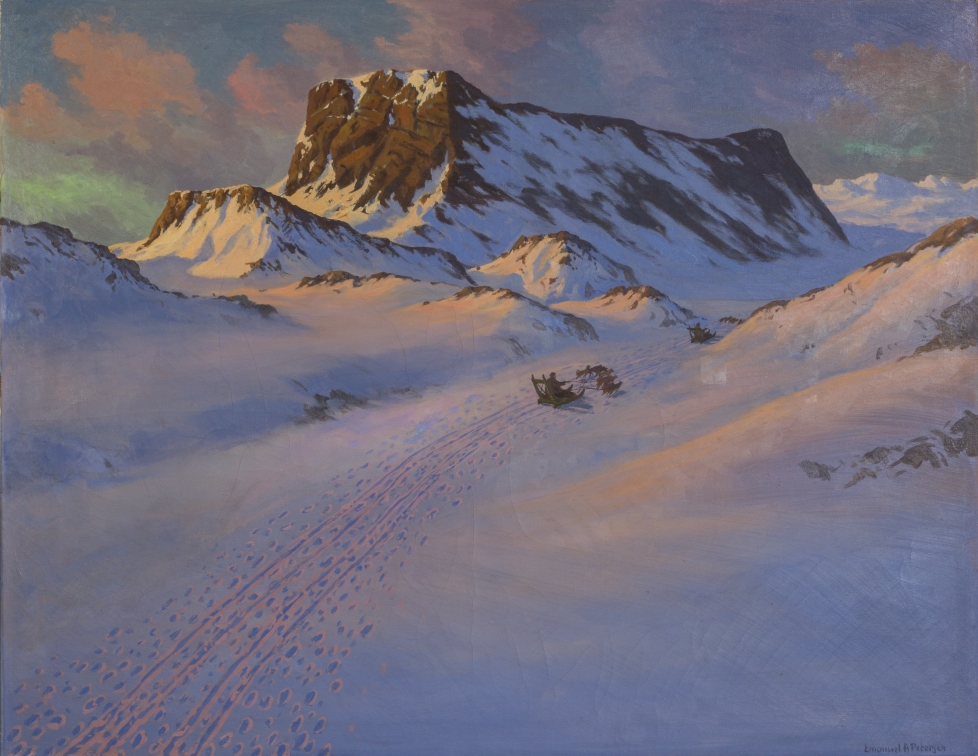
“Soon after I started working here, a middle-aged Danish woman came in and looked at the landscape paintings made by Danish artists who had visited Greenland. ‘Oh! This is exactly how I imagined Greenlandic art!’ she exclaimed, and no matter what I said, I couldn’t persuade her otherwise,” Christensen recalls, gesturing instead towards a work made up of small, pastel-coloured squares of paper mounted on a larger sheet.
“This piece by Ivalo Abelsen is an excellent example of how actual Greenlandic artists work with nature. It’s a kind of catalogue of plants she collected and embedded in the paper, and on the back there’s a list of the plants used. What she depicts is not primarily the beauty of these plants but their properties; almost all of them can be eaten or used as seasoning. When I look at this work, I can smell and taste nature,” Christensen says.
The museum’s collection is based on a donation from the businessman Svend Junge and his wife, Helene Junge Pedersen, a couple who arrived in Nuuk in 1959 to run a carpentry business. The original collection is shaped by their perspective, and so the Danish painters’ Romantic landscapes full of icebergs and sunlit, snow-covered mountains take up a great deal of space. It is that gaze, and the Danish understanding of Greenlandic art it has helped to entrench, that Nivi Christensen and her team aim to broaden in the rehang: the Danish painters have been given their own section on the museum’s first floor, while the ground floor is dominated by Greenlandic artists.
Christensen relates that telling the story of Greenlandic art history through a Greenlandic lens is a difficult task. What we, in the West, know and understand as art has a relatively short history in Greenland and is closely intertwined with those who came from elsewhere. The oldest works in the museum are a collection of prints from the 1850s, initiated by Christian missionaries from the Moravian Church.
“From the outset there was an idea of creating social cohesion – nation-building – through art. That’s why Greenlanders from across the country were asked to submit drawings and descriptions of local myths, and people were then taught printmaking,” Christensen explains.
Before the arrival of the Western concept of art, image-making in Greenland was often associated with practical and ritual practices. A harpoon, for instance, might be decorated with images of the animals a hunter hoped to kill, on the understanding that the image would attract the animal. It seems a radically different conception of the power of images from the one found in European art history. And yet, as Nivi Christensen notes:
“In Greenlandic we have two concepts: eqqumiitsuliorneq, which means ‘making something strange’, and kusanartuliorneq, which means ‘making something beautiful’ – used respectively for art and for craft. But art is often both: strange and beautiful. That’s why, at the museum, we use the two concepts to break down the boundaries between fine art and craft, enabling us to more closely define what it means to look at images through a Greenlandic lens.”
The rehang of the museum’s collection coincided with the tremendous media focus on Greenland after US President Donald Trump said in late 2024 that the United States needed Greenland for national security reasons. At Nuuk Art Museum, says Christensen, this meant that Danish journalists would suddenly call them all the time: “It felt rather as though someone had set an evil spirit on us. All we wanted was peace and quiet to hang the collection, but we were interrupted all the time. We felt we had to do something to protect the building from all the outside noise.”
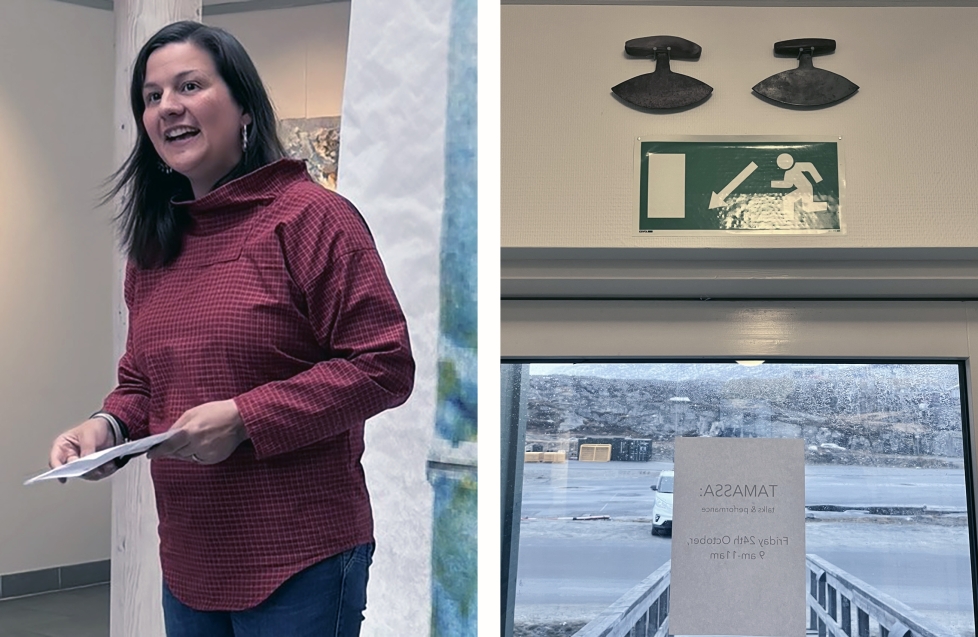
The solution was to invite an angakkoq, a Greenlandic shaman, to perform a ritual: a nocturnal drum journey. Afterwards the shaman said that, through the ritual, she had encountered two sisters who were willing to protect the building. That is why two ulus – traditional Greenlandic knives with curved blades – now hang above the museum entrance. “They’re not there for you to look at,” Christensen says with a wry smile, “they’re there to keep an eye on whether you enter the museum with malicious intent.”
The ulus are part of the collection, and Christensen has struggled with how they and similar pieces should be presented. “After all, you would never show a Viking-age knife in a Danish art collection. The reason the ulus are included in the museum’s collection is that Europeans viewed the objects made by people from Indigenous cultures differently from the way they viewed their own culture,” the museum director observes. The shaman’s drum journey became the beginning of a conversation about how the museum curates. “She told us that every object in our collection contains a small piece of everyone who has ever held it in their hands. They have an inner life and a spirit that wants to be seen. It’s a principle I now keep in mind when I curate,” Christensen said.
Myths on the curriculum
Five curious heads pop up behind easels as I enter the small room at Nunatsinni Eqqumiitsuiiornermik Ilinniarfik, the art school in Nuuk. The five students are currently working on an assignment in perspective drawing and their deadline is fast approaching. A young woman invites me behind her easel and shows me how she transfers the lines from a photograph of a small blue house onto the paper. She has turned the photograph upside down. ‘It makes it easier for me to see the subject in a more abstract way,’ she says.
The art school was founded in 1972 under the name Grafisk Værksted (Graphic Workshop) by the artists Hans Lynge and Bodil Kaalund, and its alumni include major Greenlandic artists such as Jessie Kleemann and Aka Høegh. Today, the large printing press still dominates the cramped premises. In 1981, the school changed its name and became the one-year foundation course in visual art that it remains today. Each year, five students from across Greenland are admitted and then undertake a series of modules on classic art disciplines — drawing, colour theory, modelling and printmaking — before the year concludes with the final exhibition at Katuaq, Nuuk’s cultural centre.
In recent years, several higher-education programmes in Greenland have begun rethinking their structure and content in order to be more firmly grounded in forms of knowledge that dominated the Arctic before colonisation and before the European concept of knowledge took hold. This holds true not only for the performing arts school Nunatta Isiginnaartitsinermik Ilinniarfia, where drum dance and mask dance have been added to the curriculum, but also for the biology programme at the University of Nuuk. Here, the degree course has been redesigned to take a more holistic approach to the natural world it studies. For example, students take part in hunting and in the subsequent preparation of the meat from the animals they sample; they also study the etymology of animal names and explore how the animal has been described and depicted over time. In this way they come to understand the animal from every angle in a manner not found in comparable European programmes. Might they imagine a similar approach at the art school?
“We are constrained by the fact that the programme is only one year long. The students learn the basics, the classical techniques they can use if they want to apply to an art academy abroad,” says the school’s head, Ivinguak’ Stork Høegh. “But over the next few years we plan to extend the building so that students can also work in soapstone, bone, and tooth.”
On a table, a student has left behind a sombre watercolour of an animal skull with what look like small figures dancing around its head. “That’s from the thematic assignment on myths,” Stork Høegh says as she shows me around the room, where several stuffed birds are waiting to be drawn.
The art school collaborates with the privately owned Aarhus Art Academy, where many students continue their studies. Many also go on to other schools in Europe and Canada. “The dream, of course, is to establish an art academy here in Nuuk, but resources are limited, so for now we’re pleased to be able to offer a high-quality foundation course,” Stork Høegh says.
Back to craft
Artist Lisbeth Karline Poulsen is among those who began by completing the one-year programme at the Nuuk art school and then went on to train at the Aarhus Art Academy. She does not share the dream of an art academy in Nuuk – not at this time: “I think it’s important for young artists to get out into the world because when you live in Nuuk you’re very isolated. You need one hand out in the world and one in your belly, as a teacher once said to me. The most important thing for us Greenlandic artists is to have faith in ourselves, in our abilities and our skills, rather than trying to squeeze into structures that weren’t made for us in the first place,” she says and goes on to describe an experience at the art fair Art Copenhagen six or seven years ago.
“There we were, a group of Greenlandic artists sharing a stand with The Greenlandic House in Copenhagen. I walked around the fair and spoke to so many people, but there was simply no interest in Greenlandic art; none at all. It was so frustrating to sense the way we were perceived; we were seen as these oddballs who made tupilaks,” Poulsen says.
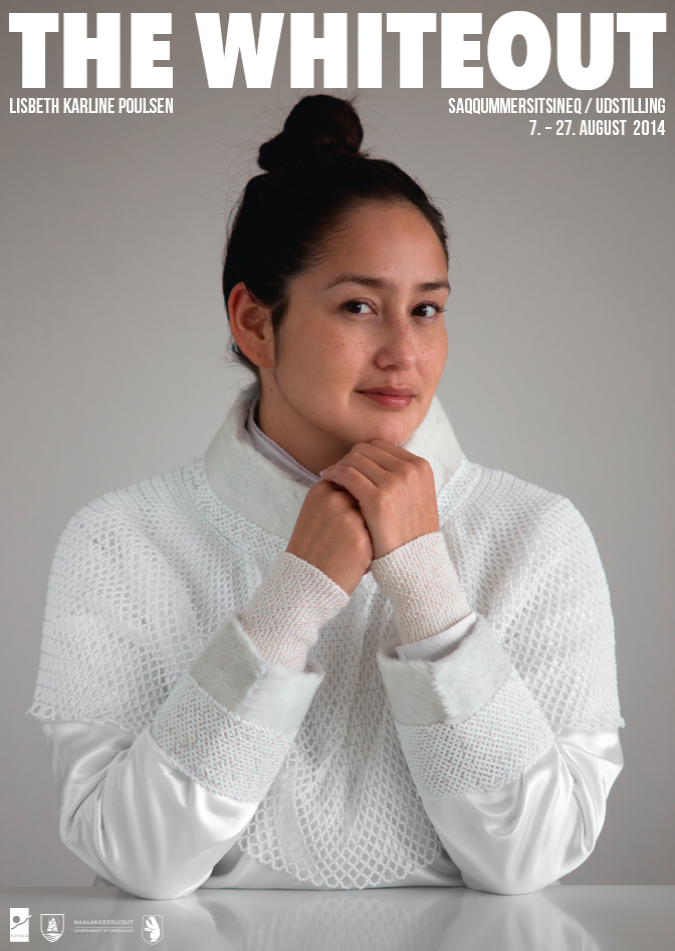
For Poulsen, immersing herself in traditional craft has been deeply meaningful. At the art museum, where I meet her, her work The White Out (2014) is on display: a traditional national costume, but snow-white. In Greenland, the national costume reflects a set of rules: the arrangement of beads and patterns reflects how old you are, which part of the country you come from, and which family you belong to. The white version of the costume suggests an erasure of the identity normally embedded in it.
“It tells the story of how Greenlandic self-esteem took a blow, how our entire history and culture were wiped away under colonisation. When I, and many other Greenlandic artists, return to traditional craft practices, that shift involves a postcolonial investigation of who we were then and who we have become today,” Poulsen says.
The dream of a national gallery
Over the past twenty years, efforts have been made to establish a national gallery in Greenland. In 2004, the Committee for the Establishment of Greenland’s Art Museum was initiated by a group of artists, and in 2006 a foundation was created to secure financing for the project. In 2011, the Danish architectural firm BIG created the winning design for the future museum building: an undulating circular structure to be sited by the sea in the northern part of Nuuk. Just before the turn of the year, Nivi Christensen was appointed to serve as the project director who will lead the work forward.
“It has taken a great deal of political work to reach this point,” says committee board chair Kristine Spore Kreuzmann, “today the foundation has a little over 100 million Danish kroner [EUR 13.4 million] at its disposal, which means we are halfway to securing the funding.”
Exactly when the museum can be realised remains uncertain. Even now, the future museum owns a collection of works by Greenlandic artists, most of which are being held at various institutions in Denmark. It also owns a number of older artefacts which will be exhibited alongside contemporary art. Thus, the new museum will spring from a very different premise than the Nuuk Art Museum, whose collection is based on a donation consisting largely of paintings of Greenland by Danish artists.
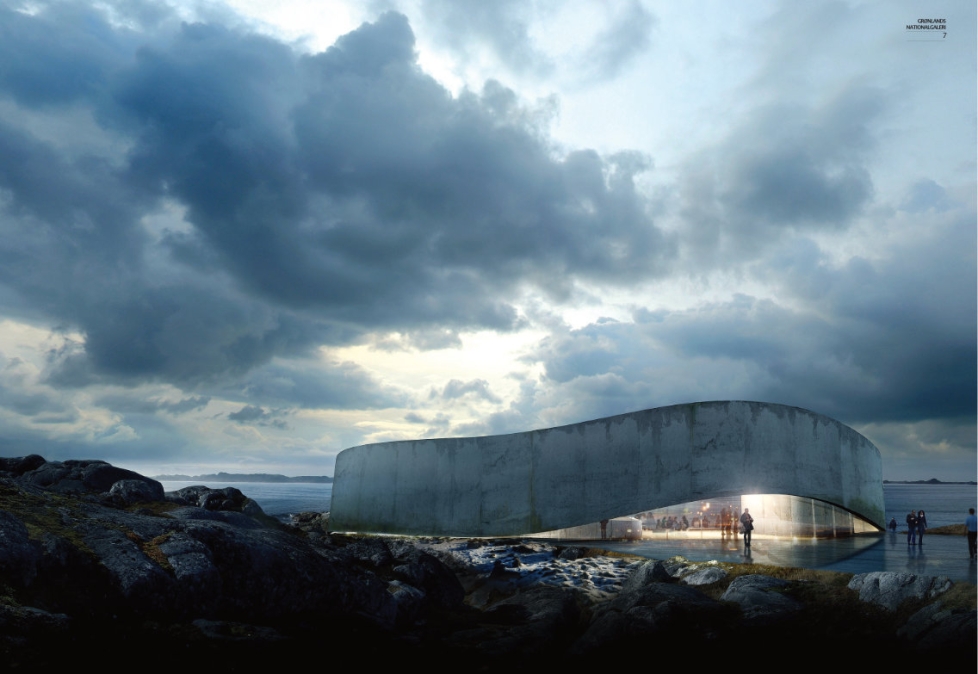

The art museum in Nuuk will be the world’s first national gallery dedicated to an Indigenous People’s art, giving it an entirely unique position. “With this museum we can create structures that fit our art. We don’t necessarily dream of a vast white cube because our artists have not traditionally worked on a vast scale. As an Indigenous People, we are used to scarce resources and to operating through smaller interventions within existing structures. Now we have the chance to create something from scratch and on our own terms,” says the newly appointed project leader Nivi Christensen.
An international outlook
I return to Nuuk Art Museum towards the end of my stay to attend a reception for the Canadian magazine Inuit Art Quarterly, whose latest issue focuses on the Greenlandic art scene. On the cover is Jessie Kleemann’s 2023 installation Kamiit, rows of kamik boots in psychedelic colours, which was shown that same year as part of her major solo show at the National Gallery of Denmark.
At a long table laid with canapés, I run into Kleemann. “So, have you become used to Greenlandic food yet?” she asks with a wry smile, nodding towards a bowl of mattak, a Greenlandic delicacy made of whale skin and blubber. With its greasy texture and almost rancid taste, mattak is probably what you might call an acquired taste, at least for Danish palates.
“When I was a child in the 1960s, people were ashamed of eating things like that because the Danes thought it was primitive. You were constantly being told you should be ashamed of being Greenlandic,” Kleemann adds. “The younger generation today feels entirely differently. They’re proud of their culture and their ethnicity.”
For Kleemann, the growing interest in older Greenlandic culture is a natural development. Indigenous Greenlanders have to look back to the time before colonisation to rediscover culture, traditions, spirituality, and craft in order to understand who they once were, and to be able to move forward. As older generations who master traditional craft practices pass away, it feels natural that a new generation should take them up again.
“I think it’s happening now because the Greenlandic contemporary art scene is finally ready to start asking questions about the colonial era,” she says. “At the same time, it’s important to understand that this isn’t about a return to traditional culture. For example, people use drum dance to create new music and dance forms. Tradition is tossed into a tumble dryer, given a good spin and re-emerges in new forms.”
Over the past decade, the international art world has truly begun to open its eyes to Greenlandic art. In 2024, the conceptual photographer Pia Arke was the subject of a solo exhibition at KW Institute for Contemporary Art in Berlin. Martin Brandt Hansen has just opened his second major solo show at the commercial gallery Andersen’s in Copenhagen. Inuuteq Storch represented the Danish Commonwealth in the Danish Pavilion at the Venice Biennial in 2024, and MoMA PS1 in New York is currently showing a large solo exhibition of his works. Kleemann’s calendar, too, is fully booked far into the future.
“The fact that Inuuteq [Storch] and I have had major international exhibitions means that more people have become aware of all the talented artists you’ll find in Greenland,” says Kleemann. She believes the interest is due partly to Greenland’s geopolitical importance and partly to a growing demand for Indigenous knowledge and expertise: “In Greenland you can find knowledge about how to maintain a sustainable natural environment, an issue which the rest of the world has begun to take an interest in. We know something about care and community because we have traditionally lived in small societies under difficult conditions,” she says.
In her now-famous 1995 essay ‘Ethno-Aesthetics’, Arke writes that, as a Greenlandic artist, you need to strike a balance between two opposing expectations: first, that what you make should have a particular “Greenlandic aesthetic”; second, that it should tally with the European understanding of what counts as art. Perhaps the Greenlandic art scene is beginning to shake off that set of expectations as the colonial period recedes into the distance and Greenlanders permit themselves to dive deep into the legacy of the culture that came before. From there grows a new understanding, a sense of being part of an Indigenous People making art on their own terms – with one hand in the belly and one out in the world.
Editor’s Note: This article was written on the basis of the author’s stay in Nuuk during October 2025, prior to the recent US threats to annex Greenland.
Translated from Danish.