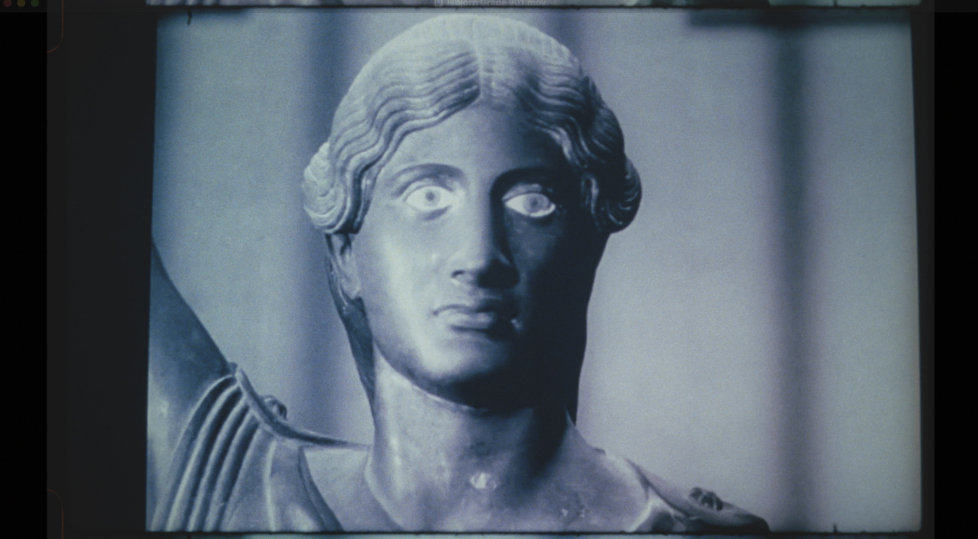
Lina Selander’s exhibition at Marabouparken resembles the interior of a camera or an inside-out labyrinth. The video works are projected onto the outer walls of the exhibition hall or onto thin screens that form rooms or corridors, allowing the images to pass through and layer over one another. In this transparent space, horror gleams and resounds beside beauty. There is no obscure mechanism here; everything is laid bare for the viewer to assemble for themselves.
Ten years ago, Selander represented Sweden at the Venice Biennale with Excavation of the Image. Since then, she has shown her work at Gothenburg Konsthall, Kunst Haus Wien, and Haus der Kulturen der Welt in Berlin. This is her first solo exhibition in Stockholm since her show at Moderna Museet in 2015, and consists of twelve new works from the past two years.
The broad staircase leading down to the exhibition hall is partly blocked by a large screen functioning as a membrane toward the outside world. The video The Eye Is the First Circle (2023) shows a circular section – the lens, or the symbolic eye of the camera – gliding over plant parts, perhaps tropical fungi and ferns, while the rest of the screen is black. Cut. The video now shows a circular section on a wall in a darkened studio. The circular view reveals a greenhouse; we hear water, tropical sounds, and shattering glass. Cut. The now-jerky eye moves across what the exhibition booklet describes as the East German Stasi’s surveillance devices in close-up. The work invites the viewer to step through the ‘lens’, and into the symbolically charged and shadowy body of the camera – Selander’s camera obscura.
At the foot of the stairs, the hall is crisscrossed by broken images and fragmentary sounds. There is not a single point from which you cannot see – and be seen from – all other points. The room contains no other objects, which reinforces the absorbing and destabilising effect of the images and makes it difficult to distinguish the singular from the multitude. Then a soft female voice breaks through: ”Jag ska berätta något. De skar ut bilderna ur mitt huvud först. Inte med händerna. Med tiden. Mycket långsamt.” (“I’ll tell you something. They cut the images out of my head first. Not with their hands. With time. Very slowly.”) These words – heard throughout the hall, added to all the films – accompany warm microscopic images trembling over biological material. In reality, the woman tells us very little. The coherent story, often invoked as a universal foundation, is always far away in Selander’s work.
What Selander does instead is create a sort of archive of fragments invoking modern and contemporary human conditions: the botanical garden, the prison, the research institute, and the nuclear power plant meet Christian, Muslim, and other religious and political symbols. Domesticated animals, romantic and destroyed nature; mass murder and mass destruction; the studio and the protest. Most of the images in different ways depict the past.
Selander presents this archive as the product of a camera with a lens, and thus as an imperfect, always flawed selection. These are powerful images that evoke strong sensations, but by repeatedly insisting on the camera’s narrow eye, Selander places the technical and historical conditions of video art in front of a direct encounter with her found material. In the end, her insistence on the deceptive nature of a frame and the technological premises of the image feels more like a defensive trope than a way of exposing fragility. That’s a pity.
What do we actually see through the layers and the camera’s eye? Three films installed in a T-shape form what I think of as a triptych. The stem of the T, On Its Own Ruins (2025), is filmed as if a negative were being pulled, frame by frame, in front of the camera: an ancient temple, a bombed-out black-and-white city with a coiling stylized snake, an inscription reading “to victory” in French and Arabic, and a mosaic fish. On either side of the screen showing this political and religious symbolism, the two arms of the T display If We Were to Die (2025) and One Is Equal to One (2025) on separate monitors.
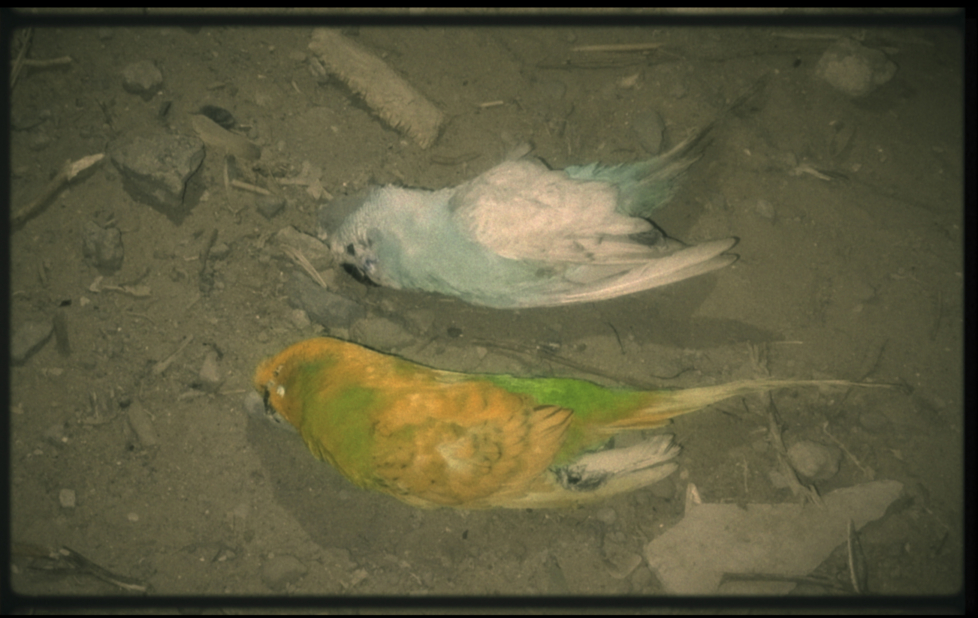
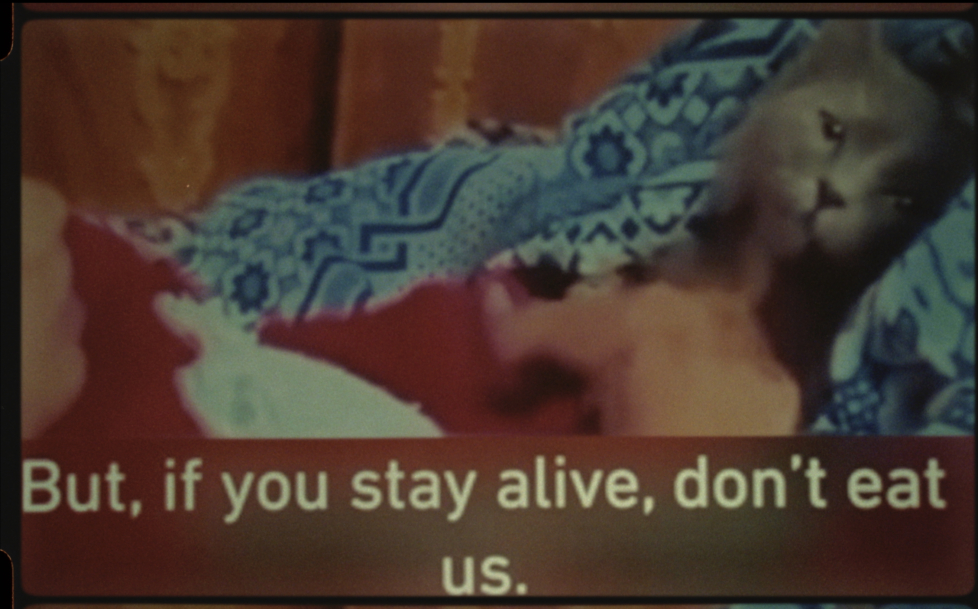
In If We Were to Die, Selander has re-filmed a social-media clip from Gaza using an analogue camera. The image alternates between a child petting a cat and the subtitle: “Hopefully, you will die with us. God willing, if we were to die. But if you stay alive, don’t eat us. Go eat other people.” It is a horrific snapshot of a child’s daily fear of death in Gaza, expressed through a recurring notion of cats eating humans. One is Equal to One shows brief clips of another child from Gaza holding two parakeets. Suddenly, they lie dead on a bombed-out street: “The two birds’ hearts stopped from the intensity of the explosion’s sound.” The safe play of home is abruptly broken. The images overlap so that none of the three works can be viewed without seeing at least one of the others simultaneously.
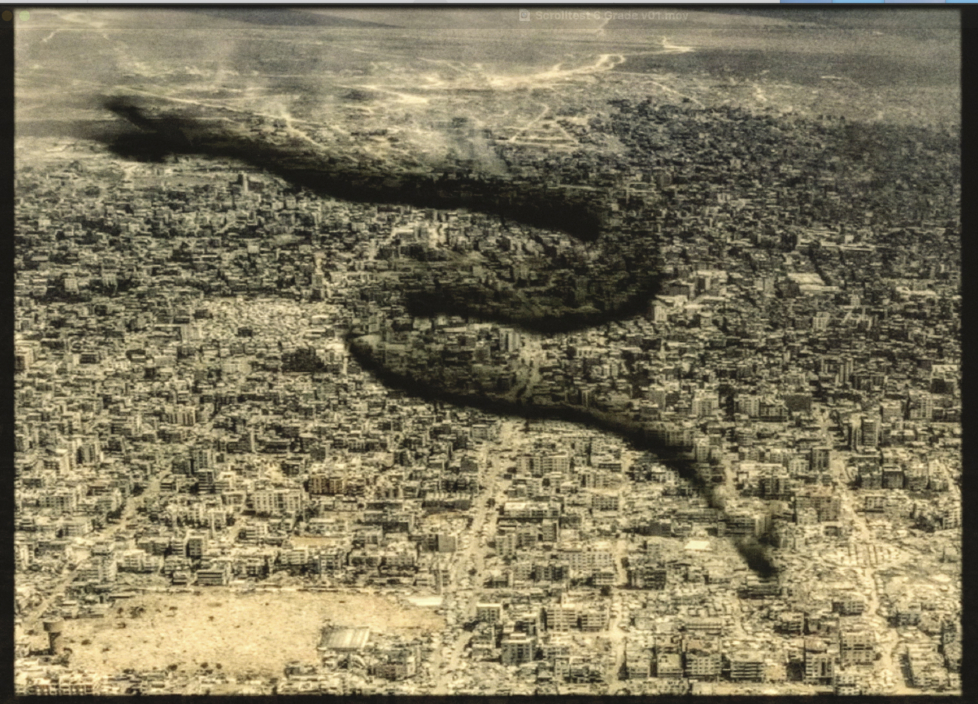
video, color, sound, 13:30 min, 2025.
If On Its Own Ruins is the symbolic archive, then the two Gaza films elevate the images of the present into found archival material through the analog camera. Selander may wish to lift these images out of the perverse flux of today’s media, but the effect is also the opposite: the outside world, life in the present, seems visible only through the camera’s deceptive lens.
From the nearby film Moon Tapestry (2024), a voice says: “I dug gold elsewhere and found gold everywhere.” This could be read as a comment on the artistic process – without discernment, everything appears as gold. In the three films, disparate realities, symbols, and histories collide with force, but what does it mean that the images and statements from Gaza are placed alongside older found material and left for the viewer to piece together?
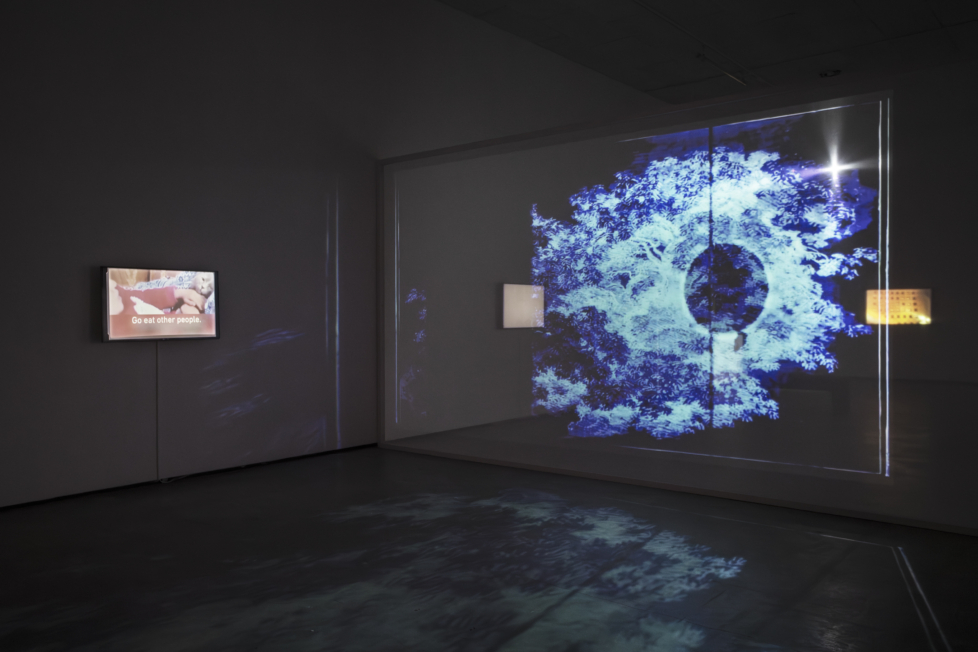
The exhibition appears transparent in the sense that it presents everything as if it were of the same kind – one is equal to one – with the camera’s technique displayed in front of the subject itself. In doing so, it risks erasing the distinctions between the horrors of history and those of the present. Between them lie both continuity and rupture, but without a clear distinction, the images easily fall back into the hyper-circulation of affective material that defines our time. That my vision is blurred and that the camera’s selection is deceptive is clear enough, but here I am left without a mechanism to discern or relate to what I see.
It is visually, emotionally, and cognitively powerful to absorb the exhibition’s images and layers – a process I have not finished even a week later. But one crucial question remains unanswered: what are we to do with this expression, with all these images? This is an ethical question. I left Marabouparken with a sense of being abandoned in a world of horrific images. In that loneliness, I wished that Selander would have had the courage to say: “this is how I see it,” instead of constructing a labyrinth and leaving it to the viewer to find his or her way out.
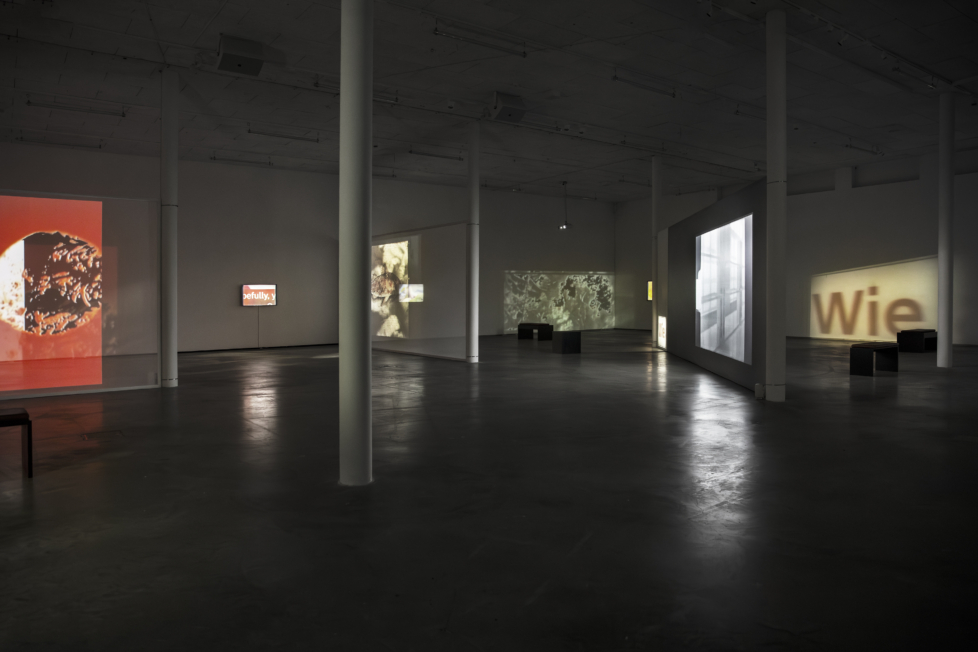
Translated from Swedish.