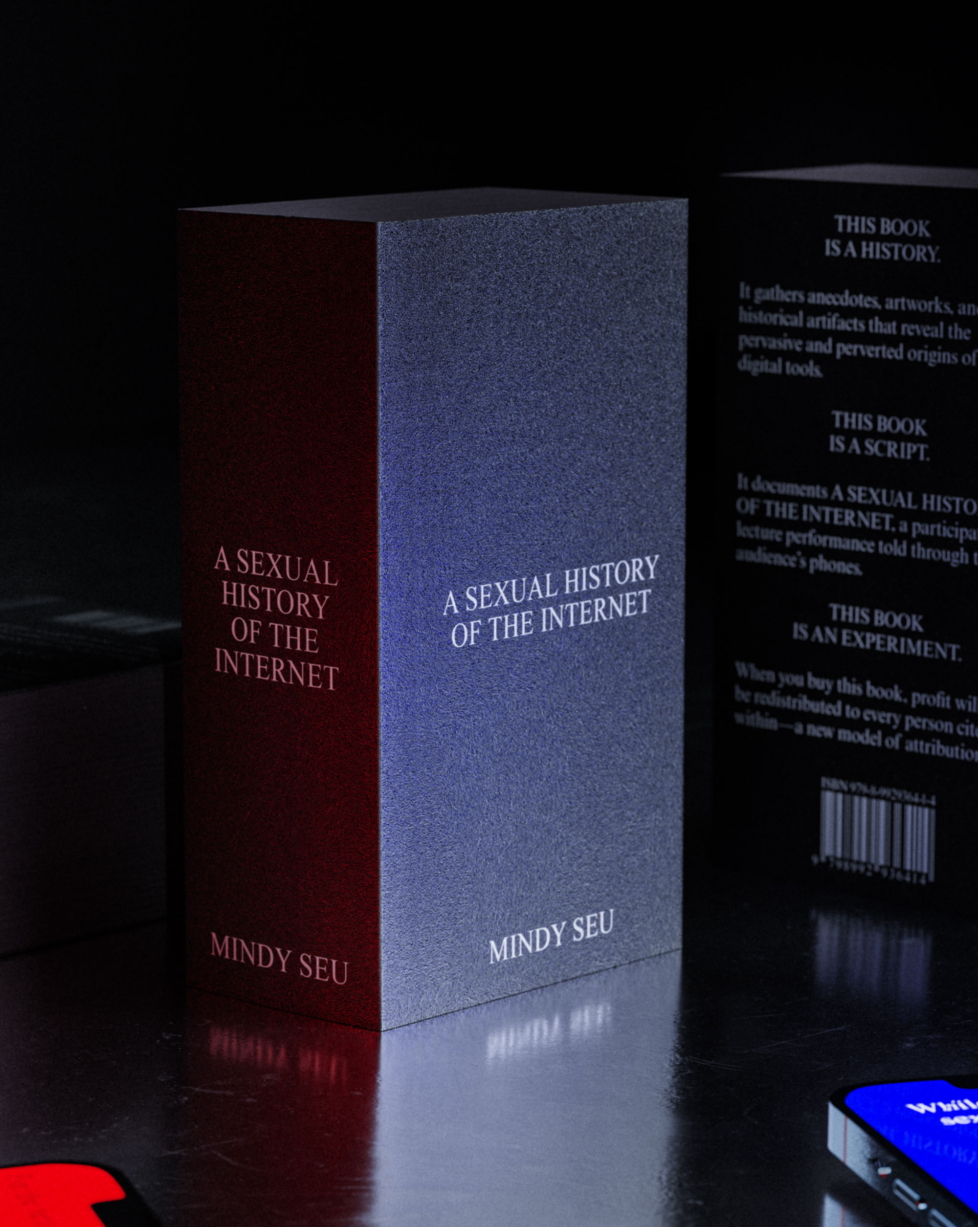
Artist and technologist Mindy Seu will be in Oslo this week to give a lecture performance at Office for Contemporary Art Norway (OCA). The work, which is also a book, is titled A Sexual History of the Internet (2024) and examines how sexuality has been fundamental to technological development while remaining systematically erased from official histories. I met up with Seu over Zoom while she was still in Berlin, preparing to embark on the European leg of her international tour. We discussed, among other things, the influence of sex work on early web innovation, publishing on Instagram, and the politics of citation.
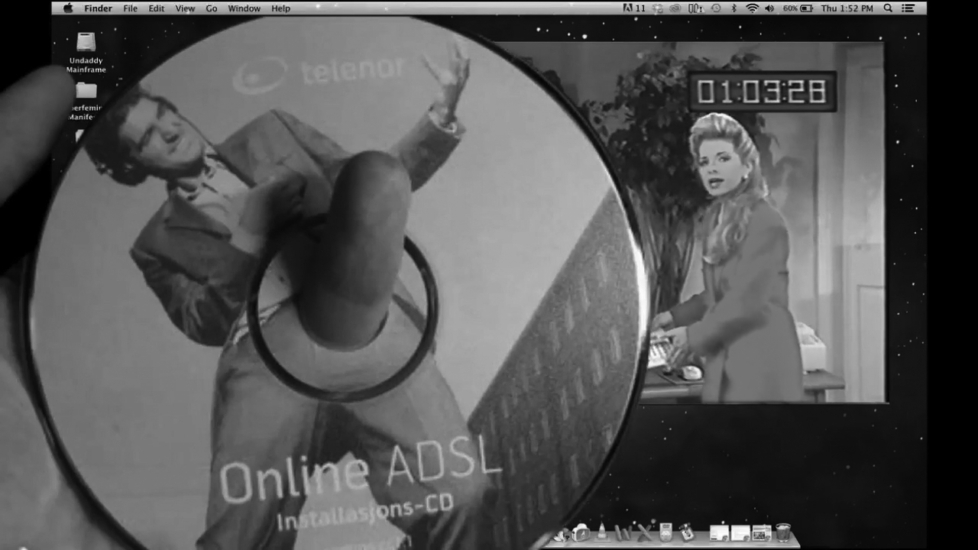
A Sexual History of the Internet begins by discussing the sexual qualities of technological devices that predate the internet itself: the tactile experience of using a mouse, the act of inserting a disc into a drive. Before you even get to the World Wide Web, you establish that our relationship to technology has always been physical and embodied. Why start there?
Tech history gets unwieldy quickly. Where does technology start and end? While the performance is titled A Sexual History of the Internet, everything that precedes the internet deals with computer appendages, which have a clear connection to it. I wanted to include proto-internets too – ARPANET, Xanadu, and early hypertext structures. So, it’s expansive in scope but stays focused on the World Wide Web as we know it.
You trace how the demand for sharing sexual content drove early internet innovation. You mention how, In 1973, researchers at USC developing image compression algorithms grabbed a Playboy magazine that happened to be in the lab and used a cropped portion of Lena Forsén’s centrefold as their test image. That image became the standard for JPEG development and was used in image processing research for decades without her consent. What does this origin story tell us about the power dynamics embedded from the start?

New technologies often have sexualised early use cases. The internet’s combination of fantasy and secrecy led to sexual exchanges that drove real innovation. It became an emancipatory moment where patrons and sex workers, in their desire to meet, developed higher bandwidth, chat services, online payment systems. But extraction was fundamental. The men building new technologies used them carelessly. I try to show the lineage between extractive acts, things they thought were just jokes but ended up being hurtful, and the technological innovations that came from all of this.
Early in the performance, which I saw recently at Performance Space New York, you ask the audience to consider how their body parts are already distributed across platforms – health data tracked by apps, faces captured by recognition systems, and other intimate information stored by tech companies. Why?
The performance isn’t just sex worker history, it maps how online environments have impacted our sexuality across a spectrum. That includes the metaphors we use and how we find ourselves online as both voyeur and observed, through our images and data. I quote Liara Roux, a technologist and sex worker, and her research on McKenzie Wark’s A Hacker Manifesto [2004] about data extraction. Sex and technology are ubiquitous, and surveillance connects them.
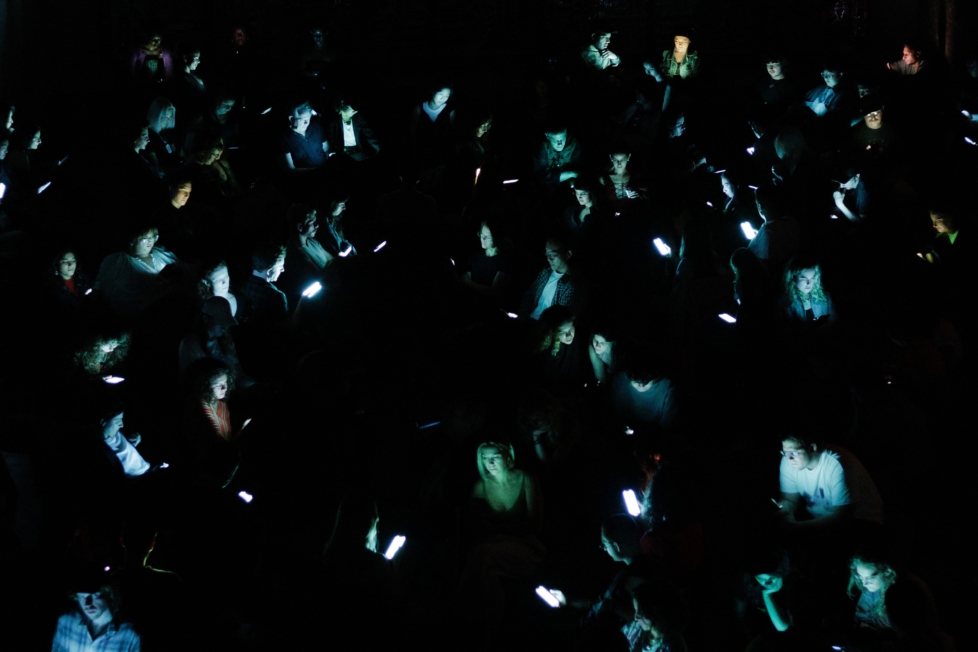
The performance transforms the typically private act of scrolling Instagram into something collective, with the audience following along on their own phones. How did you develop this format?
When I was beginning to write the script for this, my friend Melanie Hoff said our phone is a sex toy. I also remembered that years earlier, when I was teaching at Yale School of Art, my grad student Julio Correa had experimented with Instagram stories as a publishing format. Those two ideas paired together felt like the right way to tell this anecdotal history. Normally you click through Instagram stories quickly. But when you’re forced to let it autoplay, it becomes this tense, paced-out publishing experience – an automated slideshow. It’s impossible to have everyone click at the same time because of delays from reaction speeds, attention, or internet connection. This creates a beautiful asynchronous choral quality where the lights and sounds from everyone’s individual phones cascade through the room. It starts to feel like you’re in church.
Before the performance begins, you establish strict rules: everyone must use their phone at max volume and brightness, wait for your cue to click, and read certain passages aloud. Do people comply?
It surprises me a bit that people mostly follow the rules – there’s always opportunity to troll or click ahead. But it’s a performance, so people suspend disbelief and rely on me as narrator to lead the way. We’re also already conditioned to follow rules in these apps without questioning them. The performance makes that visible, which felt like an important connection.
It was important for me to have people read aloud. The project cites as many people as possible, and when you have people read those citations aloud, it becomes a recitation, an embodiment of someone else’s words. You get a queering effect: the room is expansive, and having men say “my clitoris” is a beautiful experience everyone should practice.
Your previous project, the Cyberfeminism Index, began as a viral spreadsheet in 2019 before evolving into a database, a 600-page book, and a lecture performance. How does A Sexual History of the Internet continue that work?
The Cyberfeminism Index was, indeed, an umbrella project with multiple outputs. It gathered three decades of online activism and net art, not only internationally but with many thematic through lines. Some focused on wetware, some on hacktivism, some on academic resources like syllabi. Another big through line was how sexuality impacted the internet and vice versa.
I really think all of cyberfeminism was about embodied technologies. When I was wrapping up that project, sexuality was one of the through lines that stayed with me because it felt so socially prescient. If you’re an adult in the internet age, you’re dealing with sexuality online in some way. I was trying to paint that history. A Sexual History of the Internet focuses on those initial threads from the Cyberfeminism Index.
The Cyberfeminism Index was built through crowdsourcing. This project cites many different people – from academic theorists to sex workers and artists. How did you decide whose voices to include?
My background is in media art, so I integrate art-historical knowledge with theoretical references like writings about technology and techno-criticism. But I also cite sex worker writings and oral histories, things transmitted through word of mouth. I wanted to get these on paper. If you only cite academic sources, you lose the anecdotal and oral historical information. Citations are political – who you choose to cite and omit. I’m always trying to be conscious of that.
Throughout the performance, you trace how sex workers have been essential to developing internet technologies, yet they face constant deplatforming and payment processor bans. How do these contradictory systems function?
Sex work is labour that requires compensation, but platforms profit from sexual content while making it nearly impossible for sex workers to earn. Every adult is implicated in the sex industry, just as we’re all implicated in tech. But if you’re classified as a sex worker, you’re suddenly unable to use major payment processors. This impacts everyone. We all experience algorithmic invisibility when platforms bury posts. The next step is shadow banning, then erasure, then breaking terms and conditions could one day be illegal and jailable. Sex workers are one step ahead of this. It’s important to see our role in changing these intensive forms of online policing.
You describe the book as a “financial experiment.” How so?
The Instagram story remains open access. But for the book, I wanted to test redistribution through MetaLabel’s splitting mechanism. I proposed citational splits – if you’re cited in the project, you split a percentage of profits. I have a longer essay about this on MetaLabel, but redistribution through citation is really important to me.
Have you changed anything in the Instagram story since printing the book based on responses to the performance?
Yes: certain citations, some reordered sections, modifications to the fifth chapter. The great thing about online publishing is that it’s dynamic and able to change. My practice of technology-driven performance and publication takes years to build. The process of developing the work, publishing it, then socially activating it is crucial because it allows the work to stay mutable. Even though the book is printed, we can continue changing the Instagram stories. I like this co-authoring, social cooperative format. It reflects the contemporary climate through collectivity.