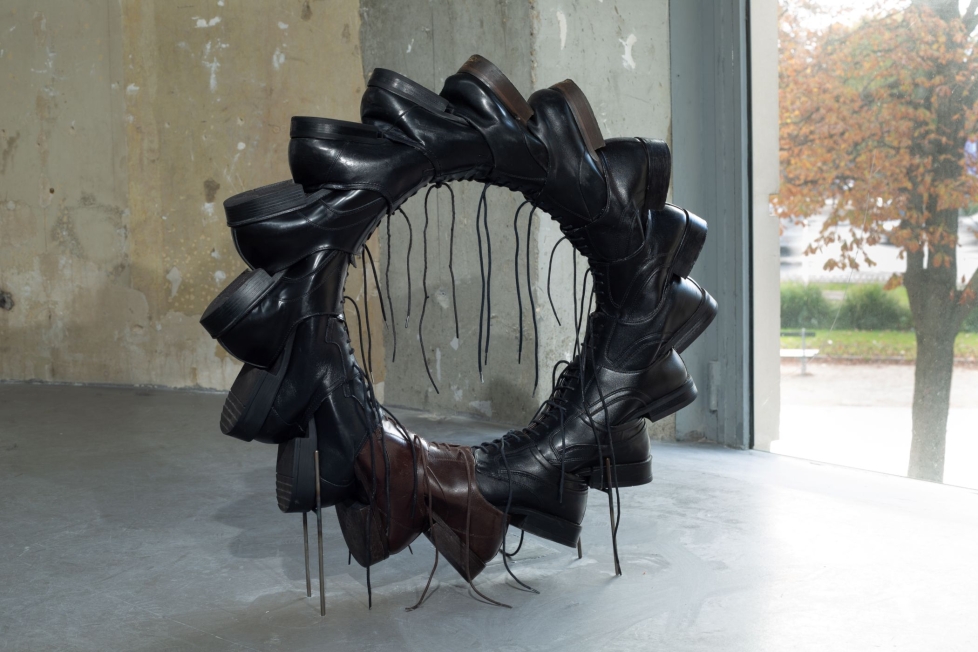
Between December and January, I read three books: Olga Tokarczuk’s The Books of Jacob (2021), Gunhild Øyehaug’s Her kjem sola (Here Comes the Sun, 2024) and the Danish artist Jakob Jakobsen’s Opphør opprør (roughly: Closure Rebellion, 2025). All three are good starts to a new year, but the last one gave me an impression or, more rightly, a kind of metaphor for what many of us working freelance in the art world are struggling with lately: a kind of numb dejectedness.
Opphør opprør came out in Danish in 2020 and is written in the form of a diary. Jakobsen describes daily life at an institution he checked into voluntarily for mental health reasons. The book lays out the life of a person suffering from illness, relating how medications affect memory and concentration, the relationship between illness and society, etc. It is an engaging book: sober, honest, and unflinching in a fundamentally beautiful way. Jakobsen does not sugar-coat or romanticise the art world, nor has he written an “I was sick, now I’m well” story. Jakobsen is not well; and yet, like most of us, he is well enough to go on living.
The following is translated from pages 127-128 of the Norwegian edition of the book (published by Torpedo Press):
The last time I was discharged, I also felt like I’d returned to a dead person’s estate when I got home. My things were a deceased person’s effects. Just stuff. All the books and magazines, the scribblings, printed matter, etc. were marked by a bunch of systems that had never worked, and everything floated in the big piles I found in my room. An estate. No soul, just a vast missing connection. Which is how I feel, generally, about my own personal history: it’s an estate. I know I need to revive it somewhat if I want to go on living.
History as an estate; that is what worked as a metaphor for me, a metaphor about the relationship between contemporary art and (art)history. If contemporary art cannot get out of the studios, the storage facilities, and the archives and be seen and understood, it loses its function in the here and now. Likewise, if history is not continually revived, studied, scrutinised, and debated, it, too, is just an estate – a sorry heap of yesterday’s costumes and conventions.
I have worked for many years as an independent researcher, author, critic, and sometime curator. The period from the last half of 1990 to the present day has seen enormous changes in views on history and contemporary art, and yet recently I have been filled with a growing sense of dejectedness, which is in fact more than a little irritating and paralysing. Dejectedness is not grief, but rather, equal parts sadness and resignation. It’s pretty lame stuff, actually, the exact opposite of sturm und drang.
The source of this disheartenment stems, I believe, from the shifting balance of power between the major art institutions and what is often referred to as “the independent art scene.” The independent art scene is an interesting umbrella term that in practice encompasses most individual artists, smaller exhibition venues, and artist-run projects and gallery spaces. There are many grey areas, but it is perhaps best summed up as the difference between having a steady income and not, between having institutional backing and not.
In Norway in recent years, funding for the arts has been channeled mainly toward infrastructure and the major museums. New museum buildings have been erected, including private ones. Attention and resources have gravitated towards acquisitions, research, and communication. Museums are required to generate revenue and are measured by their attendance records. Politicians from both Labour and parties on the right have invited private actors in on “cost-sharing” initiatives to finance the nation’s buffet of art and culture offerings. These monies by and large do not end up with the artists, however, but with the institutions.
It’s not all so negative though. There are bright spots, and I am not going to drag yet another story of decline up on the screen. I would just say pointedly that capitalism’s concept of freedom, which is also the right’s buzzword of choice, only has real value if you have money. Freedom nowadays – i.e. the freedom to buy everything you want – is, in essence, socioeconomically determined. My agenda here is to say something about the relative strength between history and the present. The major art institutions are consistently producing fewer exhibitions than before, and the number of exhibitions that feature artists living and working today is also sinking. Meanwhile, the number of events has increased significantly, and substantially greater institutional resources are going to communication, marketing, and outreach.
Communication as a professional activity often operates in the rather uncomfortable intersection between (self-)promotion and conveying relevant information. Because visibility has become one of communication’s most important criteria. Quite a lot of ‘communication’ therefore relies on the use of high-profile individuals and social media – famous people (preferably authors, actors, or influencers) talking or writing about exhibitions. Clickbait is the engine, and visitor numbers are more important than what is actually being shown. The art has to have the broadest reach possible.
Achieving broad appeal without compromising the professional, curatorial, and communicative aspects is an art in and of itself. The simplest and safest route is, of course, programming with names, like Pablo Picasso, that draw visitors regardless, as the new private museum Posten Moderne in Trondheim did in 2025. That exhibition alone accounted for over 80,000 visitors in a city with a little over 200,000 residents. The catch with this approach, however, is that bringing Picasso to a Norwegian city requires a great deal of money and contacts.
The current riff is that the museums’ exhibition programmes are dominated by art stars of the past (often working with figurative painting or sculpture), not art by artists living and working now. In addition, public discourse on art that is about anything other than monetary value or the personas associated with art has been more or less muted and relegated to journals such as Kunstkritikk, Kunstavisen, and Billedkunst.
The institutions’ attention is turned toward history, but what we are generally presented with is not living history but the most famous ‘costumes’ and artists. That is to say, their exhibitions seldom contribute new insight that actually challenges or alters established history and its hierarchies. Building community and traditions around retelling familiar history is all well and good, but if history is to be kept alive we cannot treat it like an estate or a costume warehouse. If the present is to exist in all its complexity, we need to acknowledge and discuss its presence and make being a practicing artist possible.
The absence of insightful conversation about contemporary art leaves me dejected. I also have to admit that I miss teaching at the Academy of Fine Art in Oslo. Because for better or worse students always keep their teachers alive, as Jakobsen stresses so laconically in Opphør opprør. I miss them even more when I read that the Conservative Party, in its alternative budget proposal, would allocate NOK 35 million (EUR 3.05 million) to establish a common national canon, and yet cut the number of stipends for artists and funding for Arts Council Norway. Talk about teaming up with dancing skeletons in times of crisis and putting on a little dance macabre around our borders, with eyes locked solidly on the past.
A canon can have many attributes, and ongoing discussion about quality is necessary. But a canon cannot be posted like a placard on a nation’s façade; that would undermine its legitimacy. A canon has to be in constant motion, the same way that art itself is. It should be able to withstand a shove or a yank, or dwell a bit on something before then slipping off and picking up on something else. For a canon to be valid, it has to be able to accommodate or be coloured by what we do not necessarily consider ‘great’ here and now. No one thinks in a row of kings. That is why the Danish poet Søren Ulrik Thomsen asks in En dans på gloser (A Dance of Words, 1996): “Why is there never a little poem by, for example, Tove Ditlevsen hopping out from among references to the canon’s cannons?” A canon must be able to move around as freely as thought.
History and the present are always talking to each other. We have to lend our ears to both. Providing fertile ground for tomorrow’s art, art that moves like thought, careening between what’s lost and what’s possible, that is preparedness as well as anything. Art is always now.
In Kunstkritikk’s commentary series Something Is Rotten – with a title inspired by the famous line “Something is rotten in the state of Denmark” from Shakespeare’s Hamlet – we invite Nordic writers to shed light on the art field in the Nordic countries.
Marit Paasche holds a dr. philos in art history from NTNU – Norwegian University of Science and Technology in Trondheim. She is an independent researcher, author, and curator, with extensive experience in contemporary art.
This article was translated from Norwegian by Katia Stieglitz.