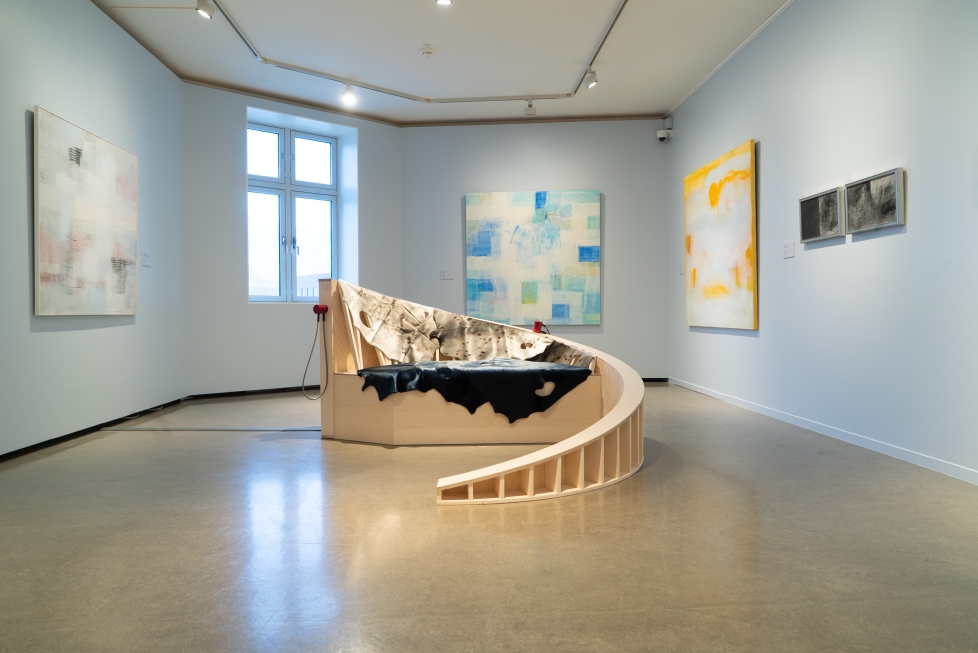
Reading the wall text for Synnøve Persen’s exhibition The Sea Rocks, the Sky Whispers at the Nordnorsk Kunstmuseum (NNKM) in Tromsø, we learn that for Persen abstraction became not just a stylistic choice, but a form of emancipation – particularly from the “expectations of traditional Sámi representation.” The compact yet somewhat unfocused solo exhibition further reveals how this freedom has enabled her to redefine both notions of identity and the representation of the North Norwegian landscape.
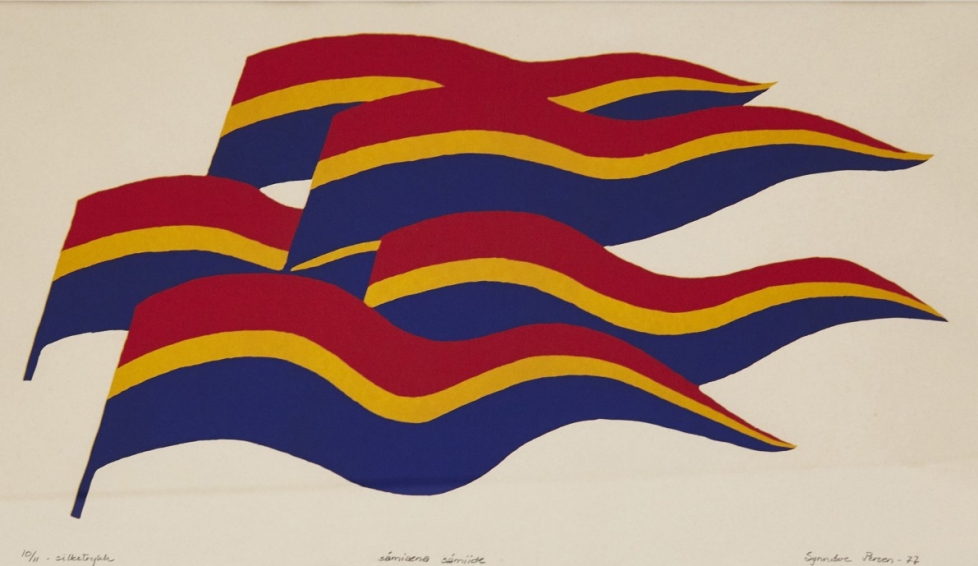
The most tangible manifestation of this defining power is the story of Persen’s draft for the Sámi flag, designed while she was a student at the Oslo Academy of Fine Art, which soon became a symbol of resistance during the protests against the damming of the Alta River in the late 1970s. In the exhibition, this legacy is evoked through the silkscreen print Sámiaena Sámiide/Sámiland for the Sámi (1977), where the flag is rendered as five fluttering banners, their abstracted forms suggesting a kind of ceremonial procession. Persen’s flag design also served as the conceptual foundation for her participation in Documenta 14 in 2017, where she deconstructed its original symbolism through monochrome paintings that reference Barnett Newman’s iconic 1960s series, Who’s Afraid of Red, Yellow and Blue (a body of work once accused of perverting the German flag). Moreover, Persen co-founded the legendary Mázejoavku (the Masi Group) in 1978, whose influence on the very notion of Sámi art remains incalculable. Her receipt of the John Savio Prize last August, awarded biannually to a distinguished artist with a Sámi background or affiliated with Sámi culture, is the prelude for this exhibition.
The Sea Rocks, the Sky Whispers primarily features landscape paintings in oil and acrylic from the 1990s to the present. In this context, it is difficult not to also interpret Persen’s draft for the Sami flag as a landscape. Particularly striking is its resonance with the triptych Roađđi/Red Landscapes I, II, III (1993): Intense colour fields in blood red and a cinnabar-like orange are disrupted horizontally by a black, undulating line that stretches like a horizon across all three canvases. The visible brushstrokes surrounding this line are among the few subtle yet precise elements that provide the image with depth. There is an intense tension between the violent colours and the attempt to impose geometric control over the pictorial space, causing the triptych to virtually vibrate, almost like an alarm. This graphic minimalism and affective use of colour are further accentuated by silver-painted frames – a recurring feature which serves to elevate the artist’s landscapes into emblems, more than mere abstractions of topographical forms.
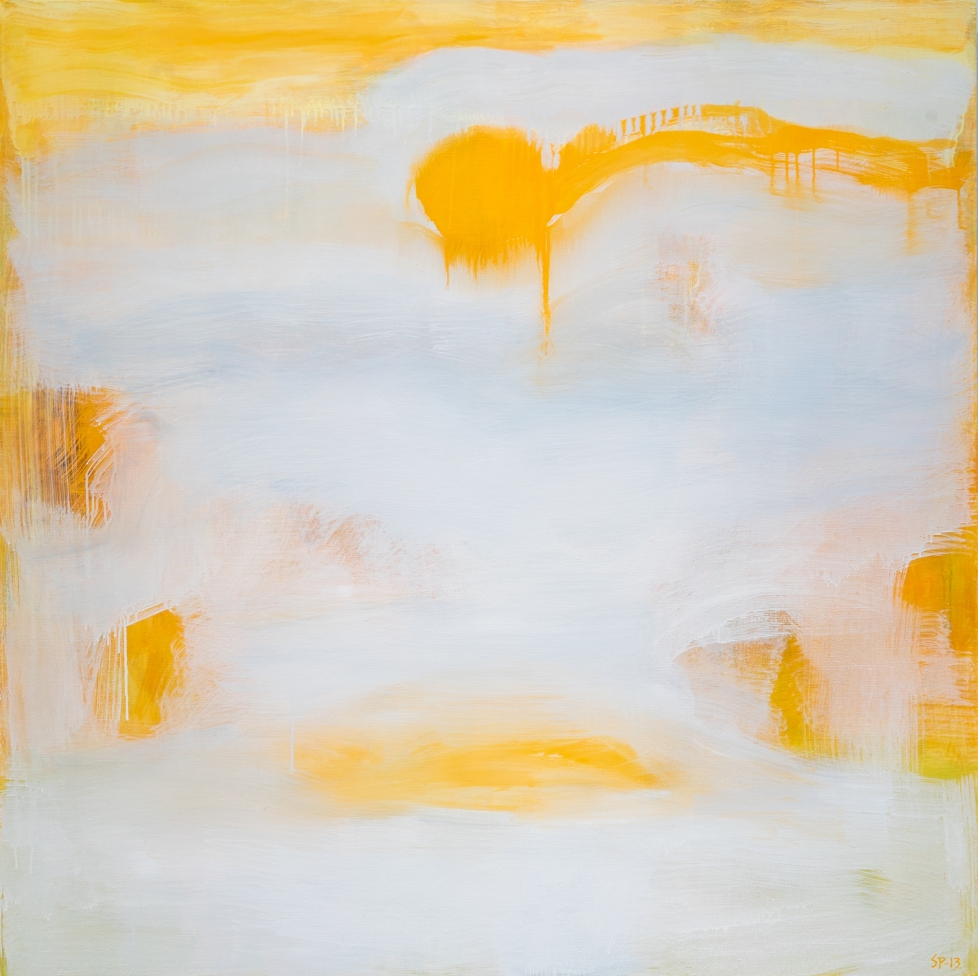
In other works, Persen’s non-figurative freedom echoes that of Abstract Expressionism, with fields of egg-yolk yellow partially obscured by broad, dripping brushstrokes of restless, milky gray-white (Vardi beaivváš/Bleeding Sun, 2013), or grid-like patterns alluding to textiles or woven fabric, where the direction of the drips of paint betrays the fact that the canvas was flipped multiple times during the process (Labirynta/Labyrinth IV, 2010). For several art historians, abstraction represents the logical endpoint of landscape painting and the rejection of imitation – a possible trajectory that we could also read into Persen’s work. After all, her academic mentors included Arne Malmedal (1937–2018) and Ludvig Eikaas (1920–2010), both pioneers of abstraction in Norway. Yet it is striking how the natural forces that inhabit Persen’s pictorial processes, also seem to reassert representation. The demonstration of forces is palpable in the unsettled diptych Áhkáid suolu/Island of the Goddesses I, II (2019), where the pictorial plane is divided vertically, mirroring two parallel worlds or spliced moments, and overlaid with swirling, textured strokes of black. The title itself evokes the idea of landscapes as sacred sites, a concept that in Sámi culture is expressed through the animation or ritualisation of natural formations.
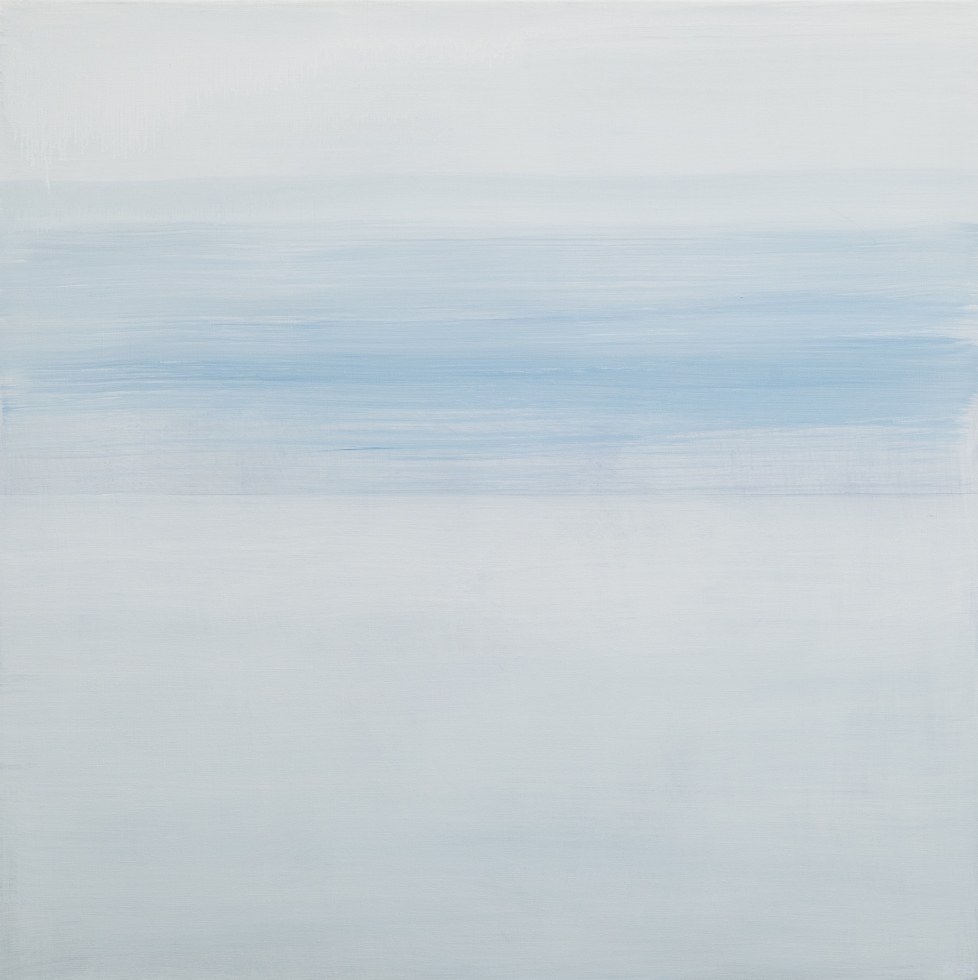
Overall, the exhibition seems intent on sketching out the range of Persen’s distinctive engagement with landscape. This is a physical and experiential challenge in the relatively small exhibition space, especially since the works alternate between the monumental (particularly the Roađđi triptych) and the restrained. In the most recent works on display, Davvi/North I, II (2025), Persen returns to the horizontal line, here rendered as muted gray-blue brushstrokes against a gray-white background. A more economical selection of works could perhaps have provided more focus, but the spatial constraints press the viewer close up against the paintings and their traces of movement, amplifying the dissolution of form and pattern into something more emotional, not to say auratic.
Persen, who only learned to write her native Northern Sámi as an adult, is also an author and poet – this is reflected not only in the exhibition title, which is taken from her poetry collection Vindløs sti (Windless Path, 1992), but also in an inventive listening station and book sculpture created for the exhibition by artist and architect Joar Nango. Sheltered by a leaning birchwood semi-circle, visitors can read Persen’s publications or listen to the author reading from her poetry collection Meahci suvas bohciidit ságat (2005) and its Norwegian version Av skogens sus spirer nytt (From the murmur of the forest new things sprout, 2006), which deals with the loss of a child. The brutality and void that the language conveys bind the personal to the ritual, while also rejecting the idea of nature as idealised, Edenic, or a redemptive source of existential meaning. While landscape might be a cultural category, a mediated optic of sorts, Persen’s work also expresses a bond with nature that arises from being nature oneself.
The experience of landscape as encountered and sensed, penetrating rather than contemplative, stands in stark contrast to the countless images of the Northern Lights that, over the past decade have re-enchanted the Arctic as a tourist destination, now fuelling its own kind of neo-colonialism in Tromsø and Northern Norway. It is a new form of extractive industry that profits precisely on the circulation of images of sea, mountain, and sky, and its associated attempts to stage the sublime. The development lends new depth to the idea of the landscape image as what art historian W.J.T Mitchell calls the “dreamwork of imperialism,” providing a critical framework in which Persen’s liberated and soulful engagement with landscape as identity still has a job to do.
Translated from Norwegian