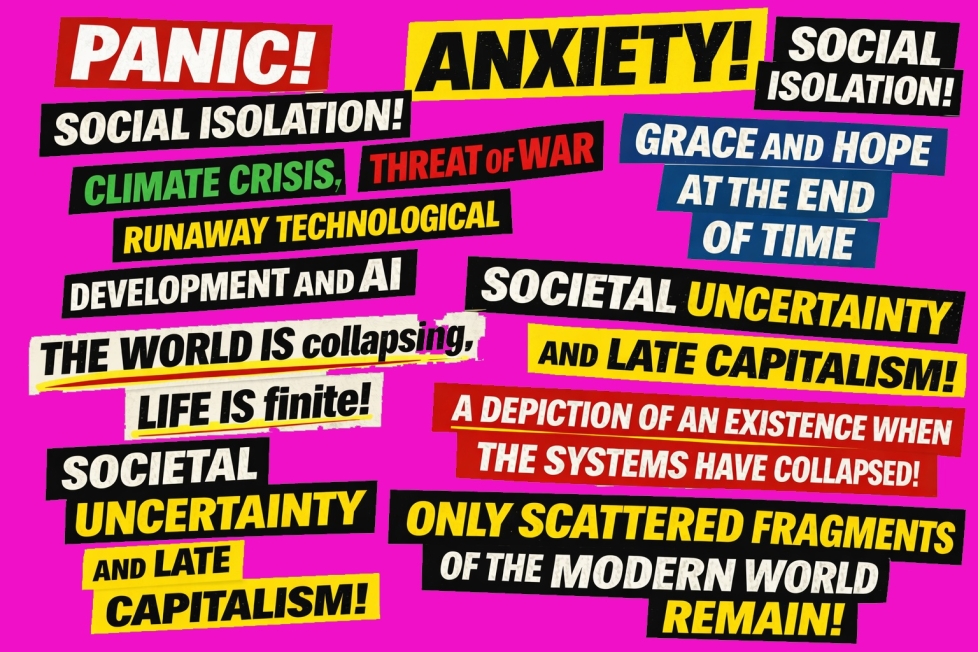
People today seem touchingly united on at least one point: the present is pitch-black and the end is near. And fair enough, it is hard not to join the doom-chanting laments about war, climate, capitalism, techno-feudalism, pandemics, discrimination, ad infinitum. Some call it a polycrisis, where clusters of catastrophes reinforce one another and appear as a new totality, a condition too sprawling to grasp and too entrenched to solve. You might think that all this pessimism would generate some friction, since it is supposedly aimed at the order and the institutions that present themselves as both the cause of collapse and its caretakers. Which is precisely why it is so strange how little actual conflict this dark dogma in fact produces.
In a Coca-Cola commercial from a few years ago, sans-serifs flash across the screen to pompously urgent music: panic, anxiety, social isolation, doomsday. “In the moment of darkness, light shines the brightest,” the ad concludes – the light in question being the saccharine soft drink, we assume. These “we live in dark times” mantras now circulate with all the mindlessness of weather talk, turning up everywhere from op-eds to Grammy speeches, on the catwalk, from left and right. In the age of polycrisis, oppositional language has transformed into a neutral common denominator, a vibe rather than a diagnosis: you can simply say “dark times” without specifying the crisis at hand, inviting everyone to project their own preferred vision of decline onto it.
This half-specific (or often wholly unspecific) pessimism works just as well as copy as it does in the form of decorative filler in gallery wall texts. Suddenly, contemporary art finds itself in the strange position of merging with a pessimistic mainstream that cloaks itself in a contrarian, antagonistic aura – without offering any real resistance.
A few recent examples from the Swedish art scene: In the art-historical survey exhibition Apocalypse at the Gothenburg Museum of Art, doom stretched from the Last Judgment to “climate crisis, threat of war, runaway technological development and AI.” At Bonniers Konsthall, the same basic pitch ran through last year’s much-talked about group show Playa! Art as Poetry in the Nordics. Situated in “the twilight of late capitalism” and in “a time of cascading shifts and unravelling certainties,” it presented art and poetry as “a necessary means of self-defence.” At the Stockholm venue Konstnärshuset, the group show Mary Shelley Must Never Die linked the return of goth to “social uncertainty and turbulence.” Solfångare (Suncatcher) at the artist-run Korvfabriken was described in the newspaper Dagens Nyheter as “an image of an existence in which the systems have broken down and only scattered fragments of the modern world remain.”
My objection is not aimed at these themes as such, or at the individual exhibitions themselves. The reason my eyes start rolling back into my head the moment I encounter these mournful pronouncements on the present, now converted into PR clichés, is that they have dissolved into a kind of comfortable style that sets the terms of viewing in advance: we can all solemnly lament the times and thereby fall into agreement with the work before it has done anything at all. Darkness becomes an affective shortcut and is rewarded with recognition and moral self-assurance – for institution and viewer alike – without anything having to snag, surprise, or be renegotiated.
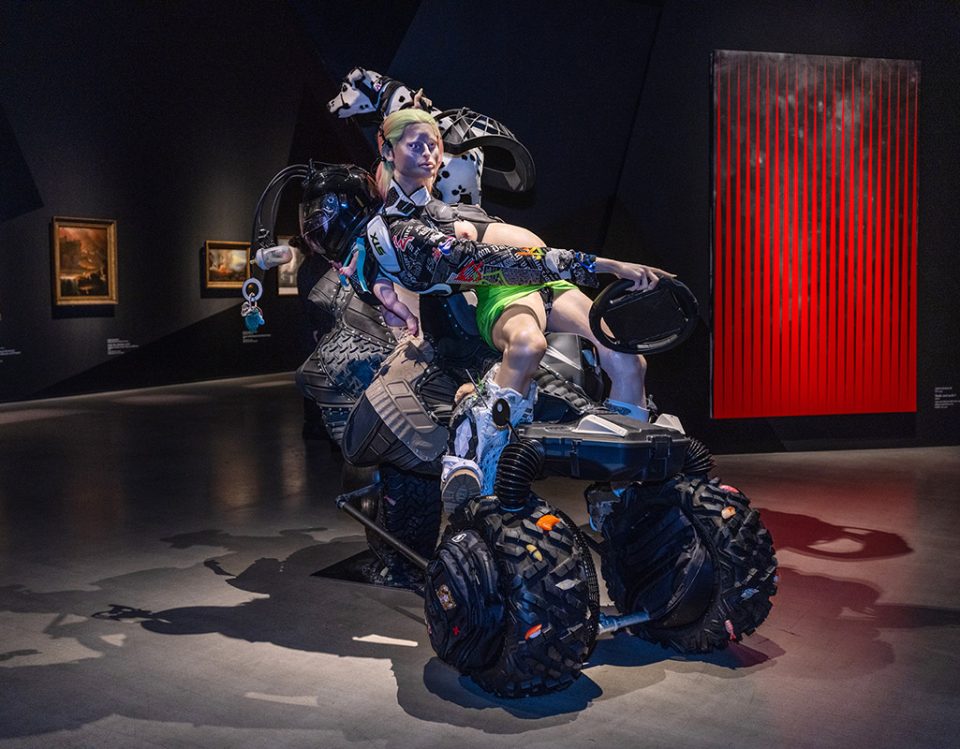
I do not necessarily think this is a matter of stupidity or cynicism. It is better understood as a drift in what art is now expected to be and do. As museums and institutions increasingly see themselves as public service providers competing in the vast experience economy, they come under pressure to speak broadly, quickly, recognisably. Art is supposed to be ‘for everyone’, and once that premise becomes governing, you inevitably reach for what can function as a lowest common denominator: a language that can circulate without much explanation and be slotted neatly into press releases, educational material, and communication plans while still feeling relevant. Here, the “dark times” rhetoric is perfect. The art world lives off the myth of its own avant-garde radicalism. That is precisely why the supposedly socially critical language slips so smoothly into the institutional apparatus, where it can be deployed in a way that reaffirms art’s subversive aura while gently stroking the audience the right way.
But which audience are we actually talking about? About a year ago, it emerged that Moderna Museet in Stockholm had placed a black square over the iconic sequence in Luis Buñuel’s Un Chien Andalou (1929) in which a razor slices through an eyeball. After criticism, the museum reversed the decision, but the incident was telling. It exposed a contemporary institutional fantasy in which the audience is not an initiated crowd seeking out art for its subversive charge or historical relevance and mature enough to look away if necessary, but an all-inclusive everyone presumed to be perpetually at risk of offence. Once the imagined addressee becomes literally everyone – including those pesky Instagram trolls – institutions begin to fear friction, opacity, and anything too internal. When you are trying to speak to the whole world, you start worrying about stepping on toes or putting people off. This also has everything to do with demands for increased visitor numbers – good metrics – underwritten by an advertising logic in which people appear primarily as target demographics whose preferences and aversions can be statistically averaged.
What this produces is a rather strange displacement: antagonism gets directed toward an abstract elsewhere – times and places beyond the exhibition space – while being anchored in a generalised social anxiety that almost anyone can subscribe to.
The result often feels like activist make-believe, as in Polish artist Karol Radziszewski’s opening at Moderna Museet the other week, where naked men in pink balaclavas danced in what looked like campy Pussy Riot cosplay. “The Fag Fighters,” according to the artist, are “a queer force of resistance,” but everyone at the museum cheerfully clapped along as though it were the Eurovision Song Contest. The Royal Dramatic Theatre of Sweden (Dramaten) falls into the same trap with Swiss director Milo Rau’s RAGE, which sets out to problematise the #MeToo movement. Both audience and ensemble get to leave the premises feeling as though they have “taken a risk” and “said what can’t be said,” even though the alleged conflict is already historicised.
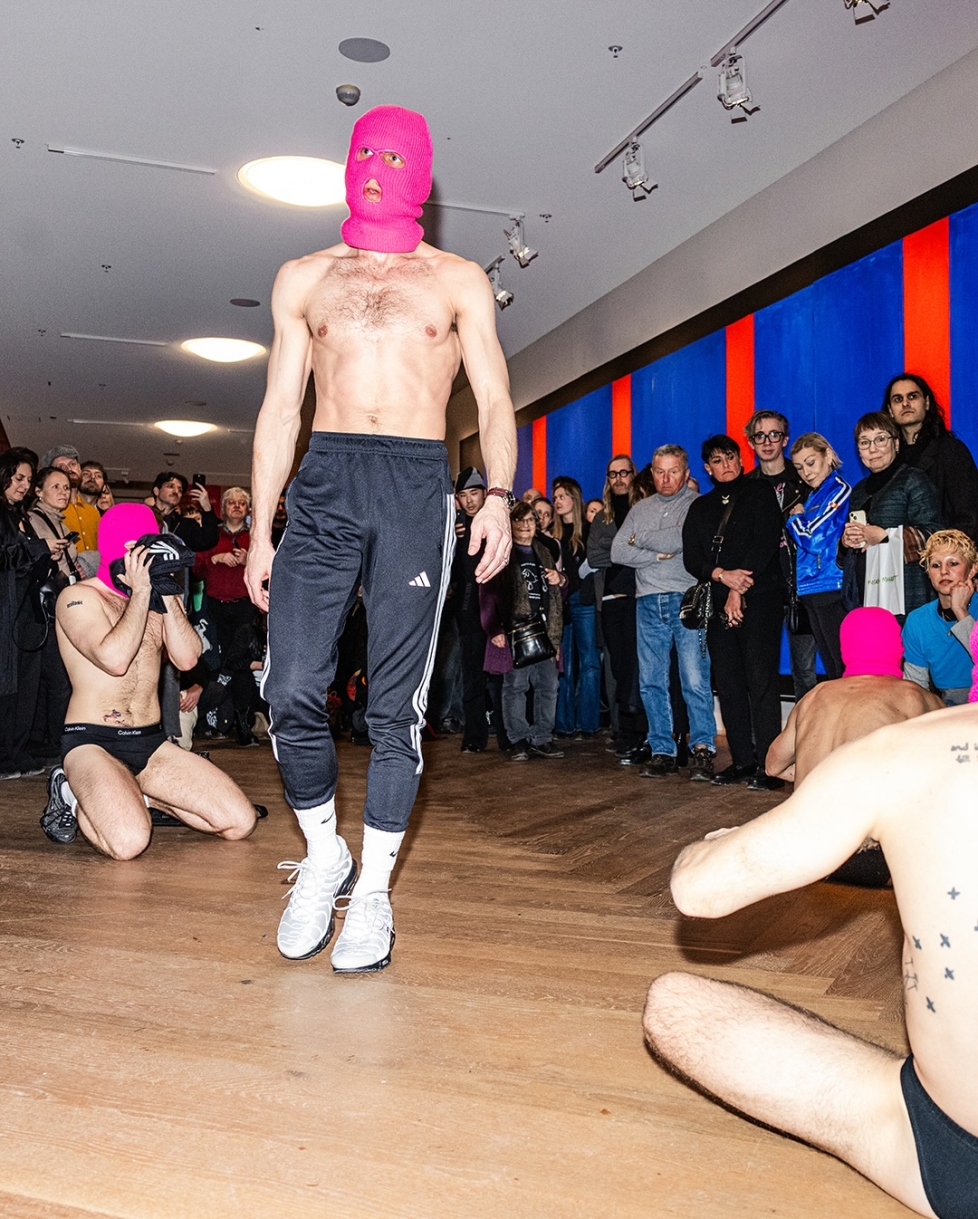
When friction never materialises as an actual conflict, or results in any consequences for the institution itself, it becomes fair to ask what this resistance really amounts to. Resistance that can be enacted without risk may function as experience, but rarely as antagonism in any meaningful sense – precisely because it is so remarkably easy to live with.
Personally, I cannot help thinking that all of this is bound up with another, less flattering side of the same logic: a rather patronising idea of the public. Under the sign of pessimism thrives the notion that we are surrounded by idiots – dim sheep, rage-baited right-wing keyboard warriors, clown presidents, and others who do not know what is good for them. When institutions speak of “accessibility,” there is often an unspoken anthropology underpinning the term: an idea of the viewer as a child or a fool.
What particularly irritates me is the anxiety among artistic directors and curators around challenging audiences with a sharper program, one that actually grapples with the difficulties of the present without dumbing them down or flattening them into simplifications. In the end, the block seems to rest on a nervous conviction that “no one gets it anyway” – a remarkable fusion of superiority and insecurity. And “no one gets it” often becomes a self-fulfilling prophecy, or more often a projection, whereby institutions end up addressing no one at all, speaking not to people but to target groups.
In all of this, it is easy to miss the simple truth: art is, in practice, always a kind of niche interest. Unless they’re looking for a refined bourgeois diversion, those who actively seek out art rarely do so in order to be moderately stimulated or handed a soft-focus summary of the contemporary condition. They come because they believe art can do something other cultural forms cannot: sustain experiences, conflicts, and contradictions in a state not yet reducible to an intelligible position or immediate consensus. If the institution instead begins orienting itself toward maximum reach, it forfeits its relevance.
To speak broadly does not have to mean dumbing things down. But when accessibility becomes an aesthetic demand, you risk sanding away precisely what makes art art: its right to be internal, jagged, self-sufficient, difficult, uncomfortable.
As it happens, the real winners in recent years have been the niche art platforms, both in terms of audience and content. Malmö Konsthall set visitor records despite thematically narrow group exhibitions and presentations of marginalised avant-gardists. The super-niche artist-run space Beau Travail in Stockholm won the hearts of critics and audiences alike, and received the not-so-niche free magazine Nöjesguiden’s art prize. What this shows is perhaps that culture is best made for those who genuinely care for it. Maybe we are not all as stupid as we are taken to be. And that, it seems, is the real light in all this darkness.
Translated from Swedish.