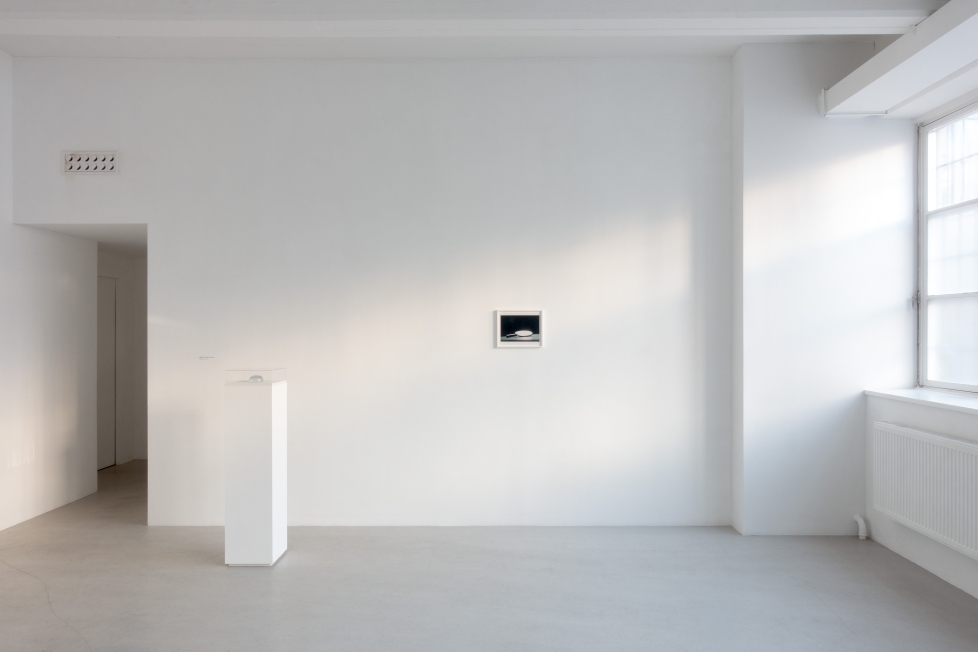
For a while now, I’ve felt it must be time for the comeback of photography art. Partly because the 80s and 90s – by the law of trend recycling – feel particularly hot right now, and partly because AI has destabilised the photographic image in ways that should open it up to new readings. Images are everywhere, all the time, in such abundance that it feels almost presumptuous – embarrassing, and a little thrilling – to single one out, frame it, and hang it on a wall.
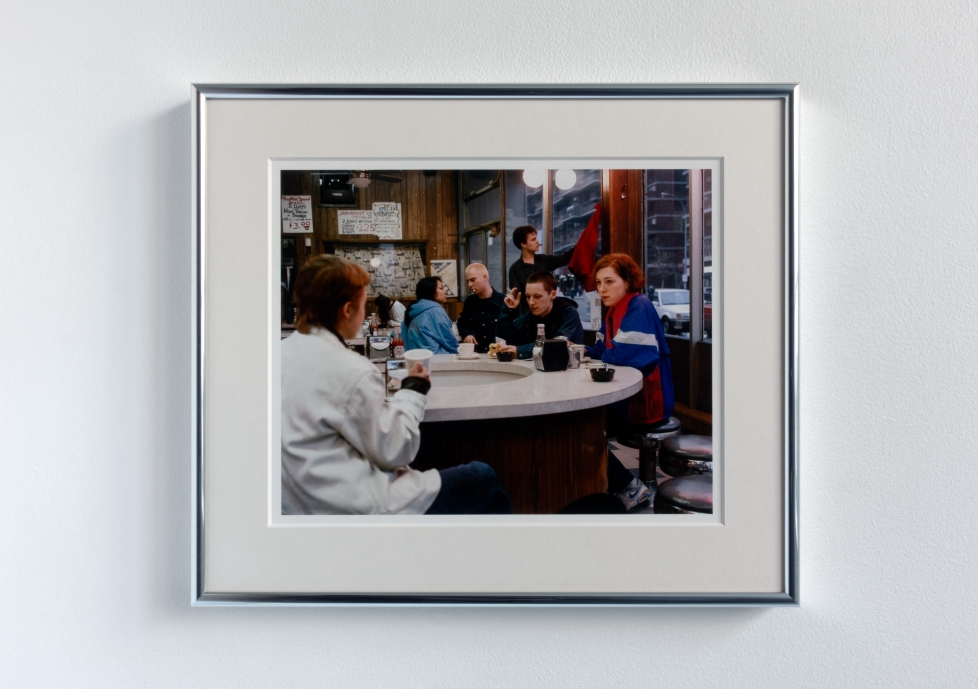
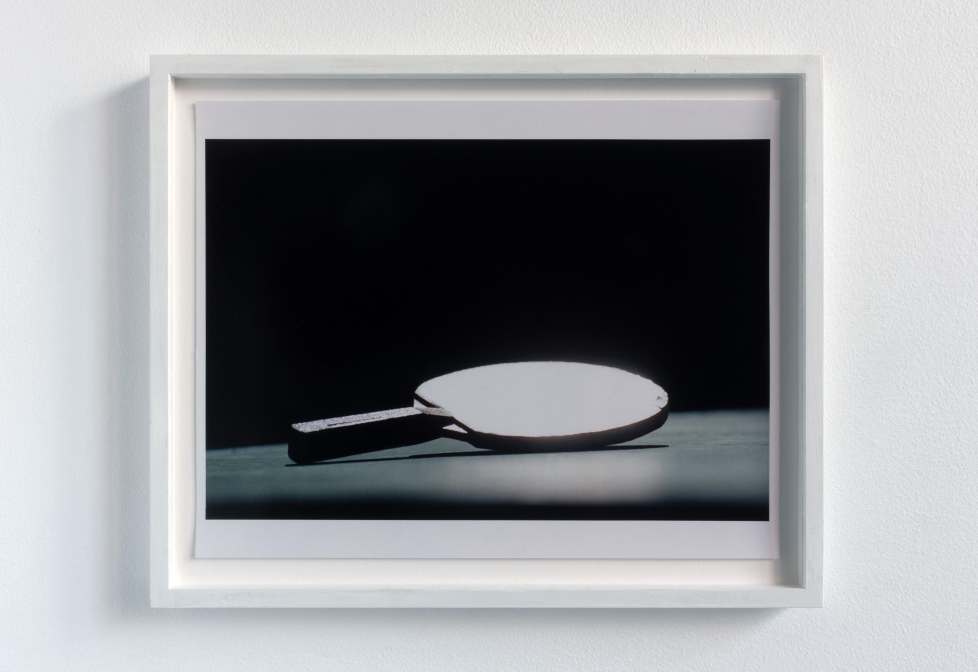
So I was predictably excited walking into Antics, where I met with a blush-inducing amount of framed photographs. Straight ahead, holding an entire wall on its own, sits a small, dramatically lit, black-and-white photograph of a table tennis racket by fashion photography legend Anders Edström. To the left: two 90s-era Art Club 2000 prints from the collective’s debut exhibition Commingle mounted and set in silver frames. The images show the group members in a posed-unposed tableau, sitting around a bar counter in a donut shop somewhere in New York in 1992.
Along the exhibition’s final wall runs an entire row of small standard-format prints depicting people at work photographed by Mona Varichon. They also have frames, only these ones are photographs themselves: images of gilded or wooden mouldings glued right to the paper edges.
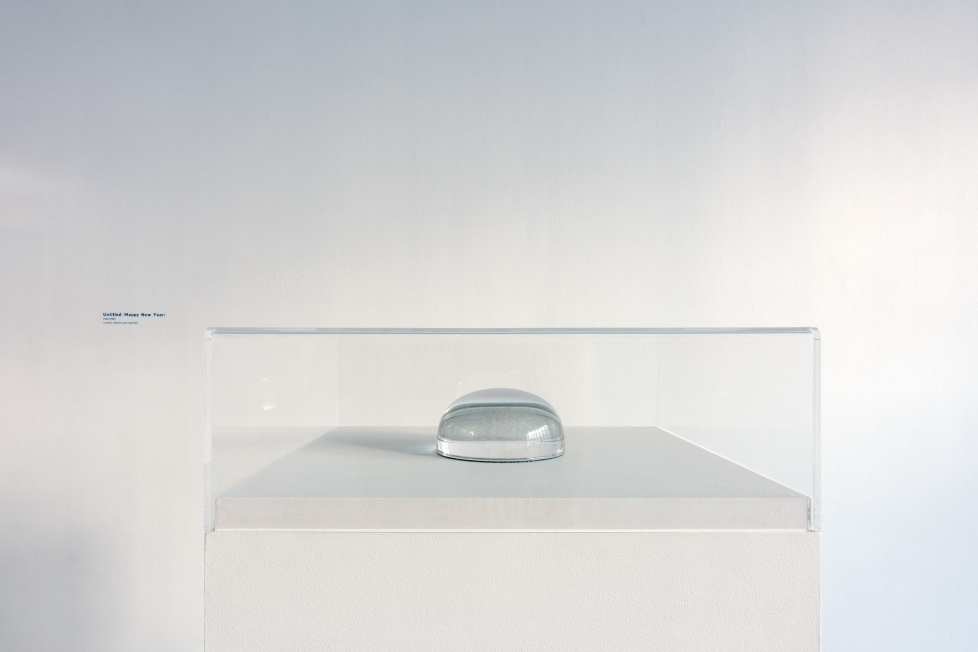
And as if all this framing wasn’t enough – photography must be bound so as to not dissolve into the infinity scroll! – embedded in the base of a glass paperweight, Louise Lawler’s image of a gallery space has been placed on a pedestal beneath a vitrine. It’s a delightful little thing. Shaped like a lens, the paperweight makes the picture feel 3D; the glass creates an optical illusion that magnifies and distorts the photograph, so it’s as if you’re looking straight down into a room somewhere else, a long time ago.
The selection of works is built like a narrative, one that is not primarily about the art or the artists, but about the curators themselves. The story is glued together through anecdotes: accounts of personal relationships, how and where works were found or how they ended up here. The slightly navel-gazing press text leans into coincidence and serendipity, encounters like puzzle pieces that click into place. Perhaps this way of laying bare the exhibition-making process has to do with the fact that the curators. Max Ronnersjö and Katarina Sylvan, are also artists, so curatorship, too, is treated as an artistic practice.
At times, matters become overly internal, making the exhibition tricky to read as a whole. With photography in general, I find it hard to get much further than the initial “nice” or “cool.” And because the motifs diverge so much – a cabinet, a ping-pong racket, a gallery room, a group of youths – what’s depicted doesn’t quite stick. But perhaps that’s the point: the medium is the message. Given that most of the works aren’t new at all, the title New Pictures, New Sculpture seems to point less to what we’re seeing than to a shift in how we see photography as such.
In an image economy where any visual material can be generated from text, where ‘photographs’ can be produced without any real referent – where feeds are saturated with deepfakes, synthetic stock, filters, and slop – the desire for the authentic image is a desire for flesh, bodies, and the real. The obsolete analogue photograph – framed, demarcated, and protected – pulls the show toward Susan Sontag’s insistence that a photograph is a physical imprint of reality, “a death mask or a footprint,” and away from our current visual landscape in which reality comes second.
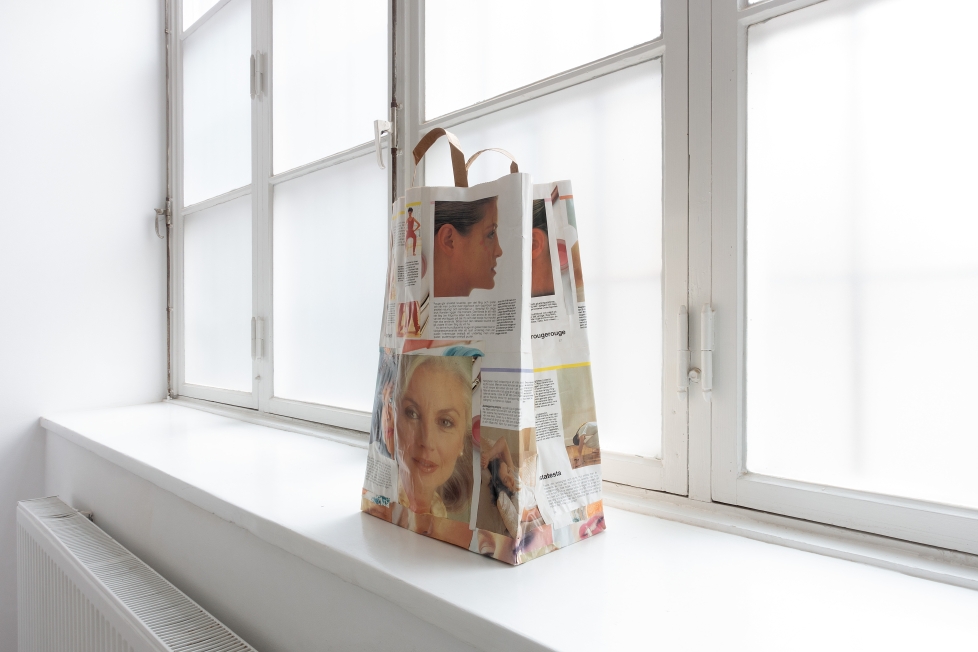
That idea also runs through the show’s matter-of-fact installation. Nothing here depends on big gestures; it’s lean, literal, and low key, a kind of pragmatic conceptual kitchen sink realism. Ingrid Blix’s paper bags are placed directly on the floor. Kai Yoshiura’s surveillance footage plays on an old monitor in the window.
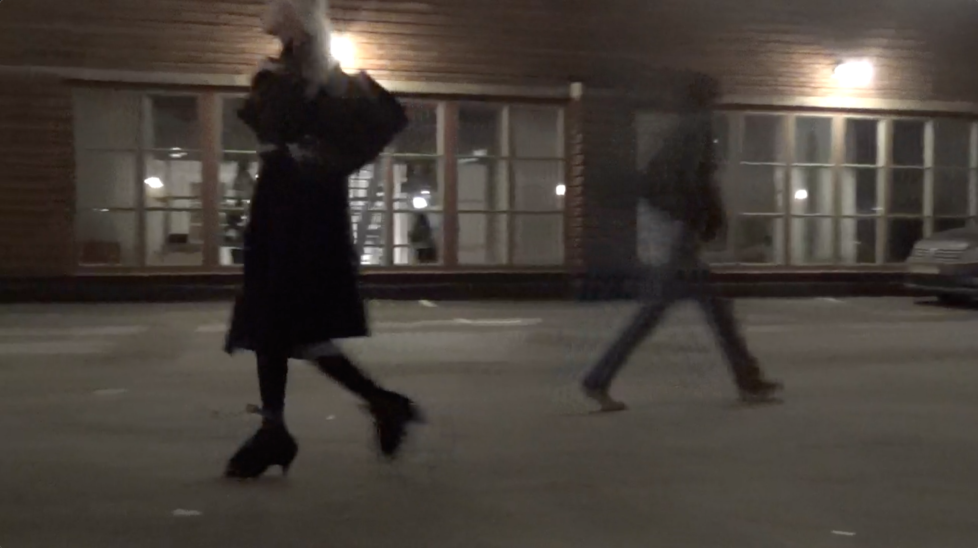
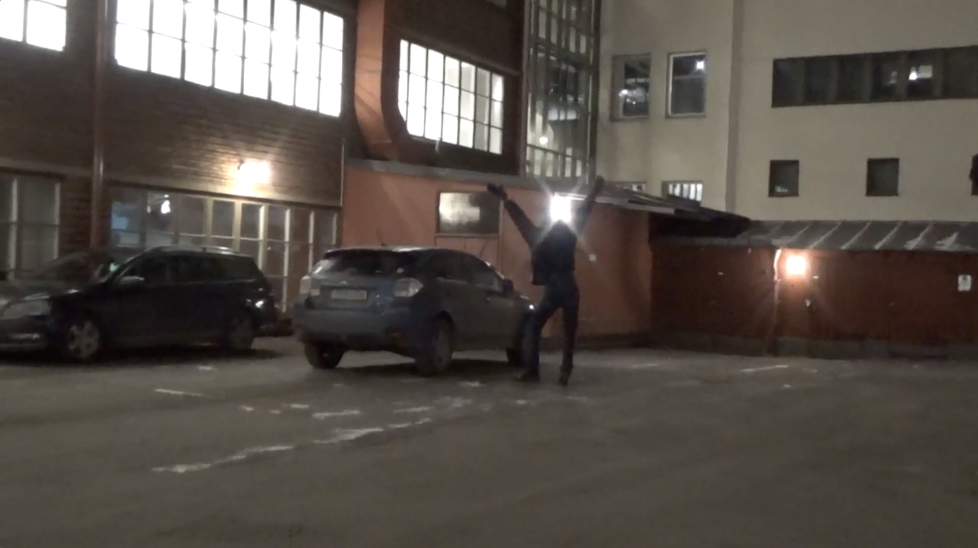
Tony Karlsson Savci’s performance takes this insistence on the real to a borderline painful extreme, as visitors are guided out into the cold, dark parking lot in the gallery courtyard, to do a catwalk under the banner of “just be yourself.” I refuse and hang back – obviously the single most embarrassing option available – but there’s nothing to be swept up in except obligation.
As a thought experiment, though, it’s funny: what’s a catwalk once you strip away all the fuss and glamour? Something like an awkward self-help exercise – “life is a runway, you’re the star” – where you hold the spotlight in your head, and it’s below freezing. Throughout the exhibition, fashion’s glossy promises – which pivot away from the real, toward a dream – always hover just outside the frame: the fashion photographer’s ping-pong pic; Blix’s bleached newspaper collages. Then there’s Art Club 2000, otherwise known for bending advertising’s idiom. But the image in this show has no GAP logos. Instead, it feels nearly documentary, as if it has drifted away from the context to which it belongs.
For Louise Lawler’s generation, photography was a way of liberating art from the sacredness of the original. It was about puncturing auratic demands for authenticity by showing how value is manufactured by the room, the institution, the mode of display, and the channels of distribution; how the ‘original’ is always the outcome of a chain of copies, reproductions, and commodifications. As images become less like windows onto the world and more like its synthetic substitute, the issue isn’t so much original versus copy as whether the image has any trace of the real, any material residue, at all.
That’s not saying Antics advocates for a nostalgic return to “analogue equals truth.” There is a certain backward pull in the space, but it also contains all kinds of images, staged and documentary. Still, photography here quietly reacquires some of that aura of authenticity it once tried to shed. The analogue prints serve as evidence – small traces of ordinary worlds – set against the contemporary production of generated images. All of a sudden, art photography, once so tangled up with advertising’s flows, feels almost archaic. The pictures arrive with a historical shimmer, as if they sit slightly to the side of our glossy, plastic present rather than squarely within it.