I see a friend at an opening. I mention to her that I’ve been asked to write this dispatch from Helsinki for the Something Is Rotten series. She points out that it’s more that everything is rotten, which might present a challenge for the writing.
At home I think about the everything more: how the faults in the art system have shifted from distinct complaints (“The collection policy at this museum is misguided!”) to a low-lying, total cloud cover.
Because I can’t figure out the right something, I think of the rotten. Transformations are taking place in the darkness. I read about fermentation and composting as examples of positive, controlled rot. Rotting is work that could return us back to undivided potential. At this point it’s difficult to tell the difference between necessary decay and frightening ruin.
Frame Contemporary Art Finland has put out a report on the state of the Finnish art market: ‘New opportunities in the Finnish art market and art investment’, written by Aura Seikkula, founder of the self-described “cutting-edge strategic advisory” Futuarts Ltd. I browse through the report and get stuck on a graph that reveals how the art sales of Finnish galleries have decreased from EUR 10.3 million in 2016 to EUR 5.2 million in 2024.
A lowly sum cut in half seems ridiculously, almost exhilaratingly low. This lowliness must have some explanatory power in relation to the defeated mood in the local art world. I think of individual supermarkets that might bring in EUR 10 million a year in sales. I remember an architect telling me that the construction of a single roundabout junction could easily cost EUR 7 million. Meanwhile, people in the cultural sector are fighting for their pennies.
Later, I talk to a gallery owner about the EUR 5.2 million figure in the graph. He says that the numbers are based on a voluntary questionnaire and that it’s not clear if all galleries have put their sales in, so the actual number of sales could be higher. Still, nothing I observe in Helsinki suggests that the art market is doing well, which might be related to the social circles I move in and the art I find attractive being a hard sell.
The contraction of an already tiny art market might not be of huge concern if it weren’t for the simultaneous wavering of public support for the arts. The Finnish economy seems pretty fucked at this point, and arts funding has been cut alongside health care, unemployment benefits, general housing allowance, development aid, and so on. At the same time, Finland’s right-wing government is announcing tax cuts most beneficial to the highest earners and loyally increasing its defence spending.
Perussuomalaiset (The Finns Party), the populist far-right party whose leader Riikka Purra is serving as minister of finance, seems to particularly loathe postmodern, fake, woke contemporary art, while other parties seem mostly absent-minded and confused on the matter.
Art is a low-status, non-urgent, marginal topic. If art is defended in the political arena, it usually happens through troubling appeals to cultural national defence or the promotion of economic growth. In a Nordic way, art might be a bit of fun that affects general wellbeing. It occurs to me that the decades-long dismantling of the notion of high culture might have been too successful: it feels impossible to make the case for art as just that.
I’ve been having these passive daydreams about an art star. Someone younger than me, someone who definitely isn’t me, becoming a global contemporary art superstar. A star making it from here, giving every other artist in Helsinki a glow by association. An art star would justify the continued need for arts funding by being a star, by being the result, the receipt.
I want to stand next to the star. I want to bask in the glow of the star. No Finnish artist has taken part in the main exhibition of the Venice Biennale since 2015. A new art star would be there, and do all the rest of it, too. I turn over on my daybed and continue this dreaming, ignoring the fact that it’s not the 1990s anymore and the art system is too frayed and deflated to produce a star with staying power.
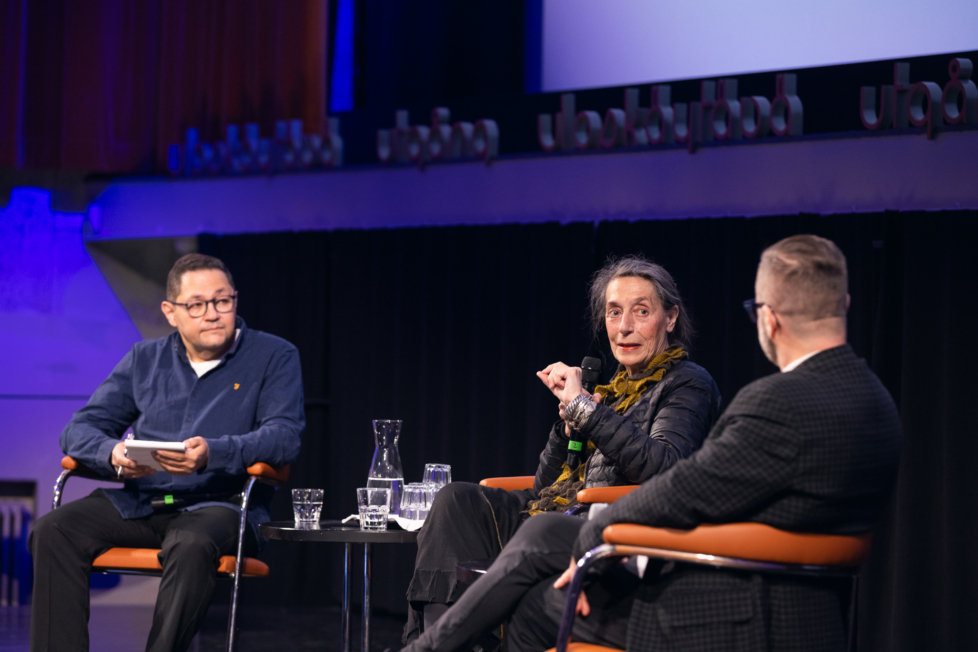
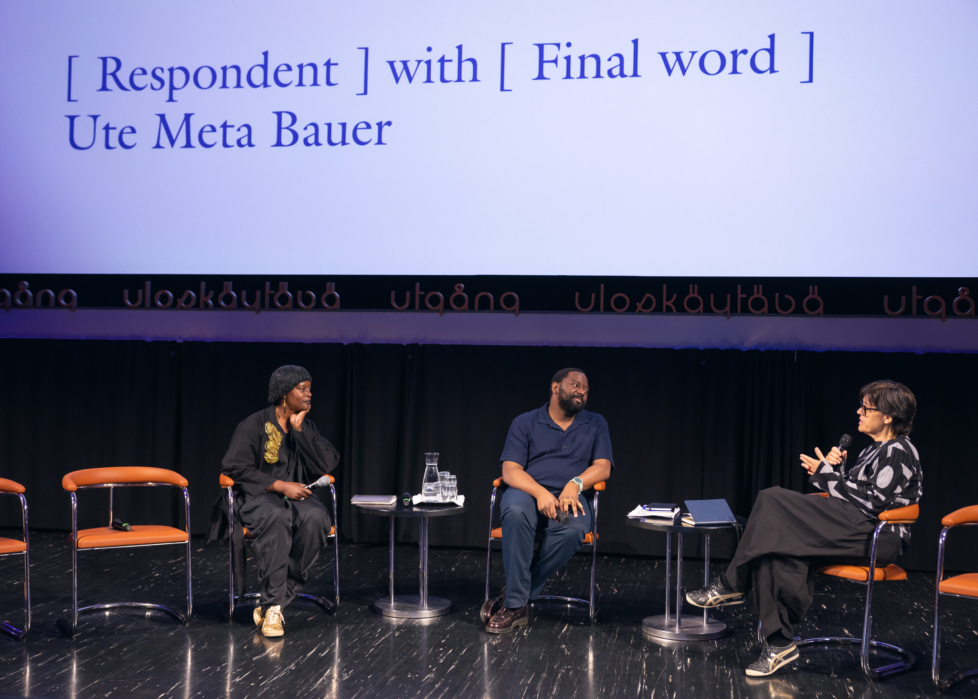
I attend a symposium. ‘Positioning – A Symposium on Curatorial Thinking in the Nordic-Baltic Region and Beyond’is organised by the art commissioning agency Publics and co-hosted by the museums Amos Rex and Kiasma. Despite being someone who makes art and writes about art and thinks about art all the time, I feel lost during much of what I am able to see of the symposium. It feels like curatoriality has truly left art behind and floated into its own stratosphere. Above it all, the curatorial still insists on being entangled and engaged, while resisting the possible necessity of dissolving into the social sciences or into philosophy or concrete political organising.
During the talks that I see (I don’t have the time to catch all of them), specific artists and artworks are rarely mentioned. Aesthetics in general are addressed scarcely and without passion. Being a curator seems to be mostly about etiquette – welcoming, hosting and encountering, offering tea, sharing bread, just talking.
Behind these caring acts is always the horizon of politics, the real struggle and real violence happening in a vague elsewhere. Somehow these political events are supposed to resonate in the theoretical acts of kindness and the boring acts of administrative labour described by the talking heads.
What seems unsaid and resonant in the room is a desire for each individual to distinguish themselves and achieve something, to be somebody, possibly a star. This maps out uncomfortably onto all the compassion and concern and selflessness flowing from the mouths of the heads that seem to be slightly detached from their bodies, levitating by millimetres.
Catherine David’s lecture on her curating of Documenta 10 stands apart from the other presentations I witness. She has the benefit of being able to discuss her Documenta turn with a few decades of critical distance, and she does so in a way that is disillusioned, charismatic, pragmatic, and funny. It’s like what she’s saying actually has something to do with making and presenting art, instead of some too-near or too-far imaginary. She might be a star that has been a star long enough to truly be over the hollowness of the star image. Maybe it’s the contact her feet have with the ground that makes her presence glow.
It’s 2 October. Finnish activists trying to sail to Gaza have been kidnapped by Israeli forces. There is a demonstration in solidarity with them and the other activists that took part in the Global Sumud Flotilla mission happening literally a hundred metres away from the Kiasma seminar room where the curatorial symposium is taking place.
I have the childish impulse to grab the microphone and ask people to leave the seminar room at 17:00 and join the demonstration, to be with the public in the public space with no more theorising about the public, but I know better than to listen to my childish impulses. Later, I see on Instagram that at least one curator has indeed joined the demonstration, while I myself am seated on a bus heading to an out-of-town museum opening.
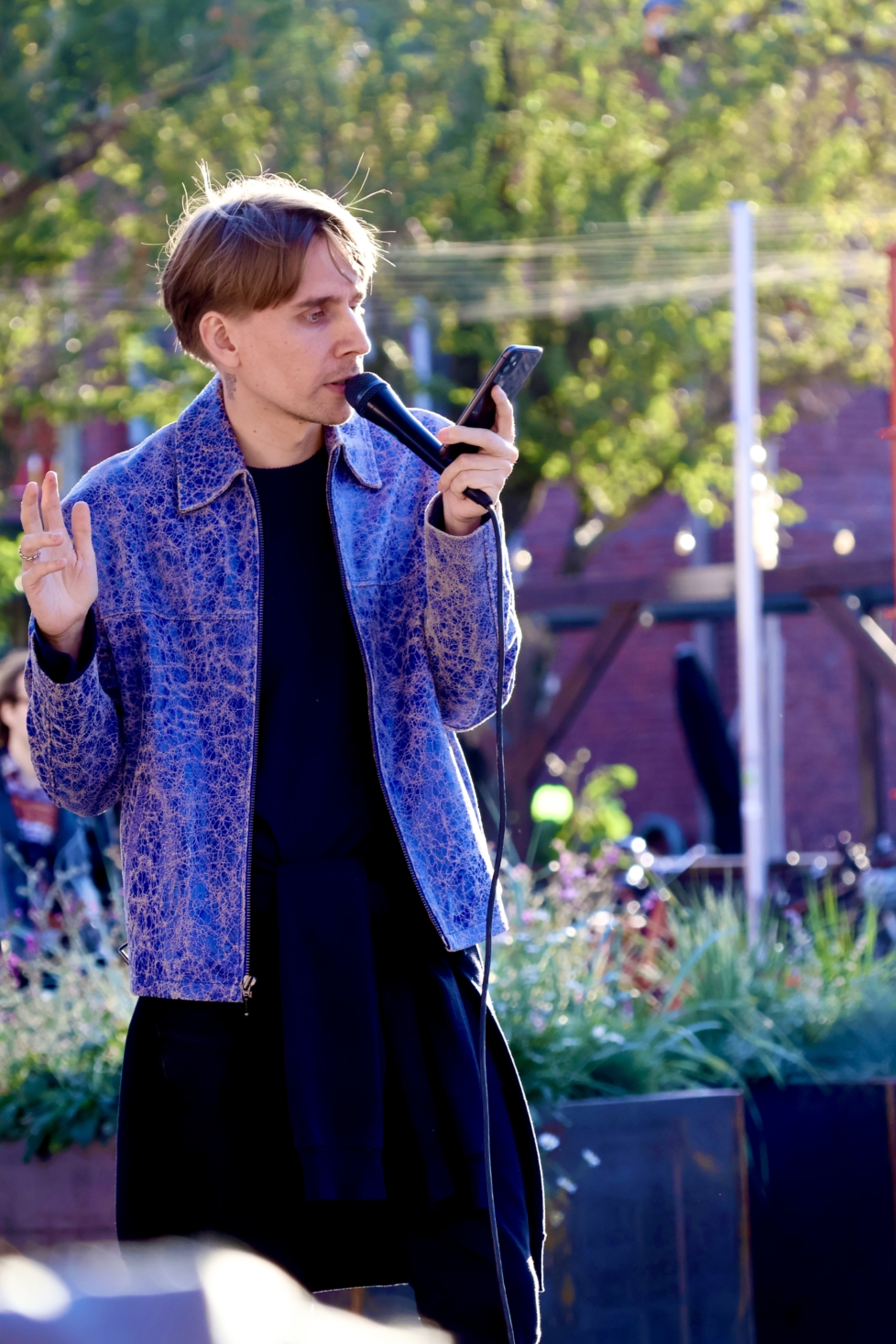
I think about a reading by novelist and performance poet Niko Hallikainen that I attended in late August. Organised by Helsinki Poetry Connection and Teurastamo, the event where Hallikainen read took place on an asphalt square with the feel of an empty parking lot. He placed a large agate stone on the asphalt in front of him and read from his phone:
It’s intentional, the way I’m turning my life into an open field. I decline all invitations to perform. I refuse to be on a jury that awarded me a prize last year, there was no money in it. I’m at the beach texting everyone: something is afoot, something so unexpected that I can’t come anywhere. I appreciate people, though I don’t understand where many of them think they are heading. Imagine if they knew about everything I’ve turned down. I miss a bunch of conversations now that I’ve truly withdrawn from their spheres, torn away for a reason.
Later in October, I see an exhibition in the spiritually confusing lobby of the Academy of Fine Arts in Helsinki. For this untitled exhibition, artists Josua Kerkis and Ville Karlsson have chosen to turn off the bright spotlights that usually illuminate the white walls of the space – the lights that tell you where the art is. At the opening, the exhibition is dim, while closed-off areas of the academy are illuminated by fluorescent lights visible through walls of obscure glass. It’s like the exhibition is drawing attention away from itself into what surrounds and enables it.
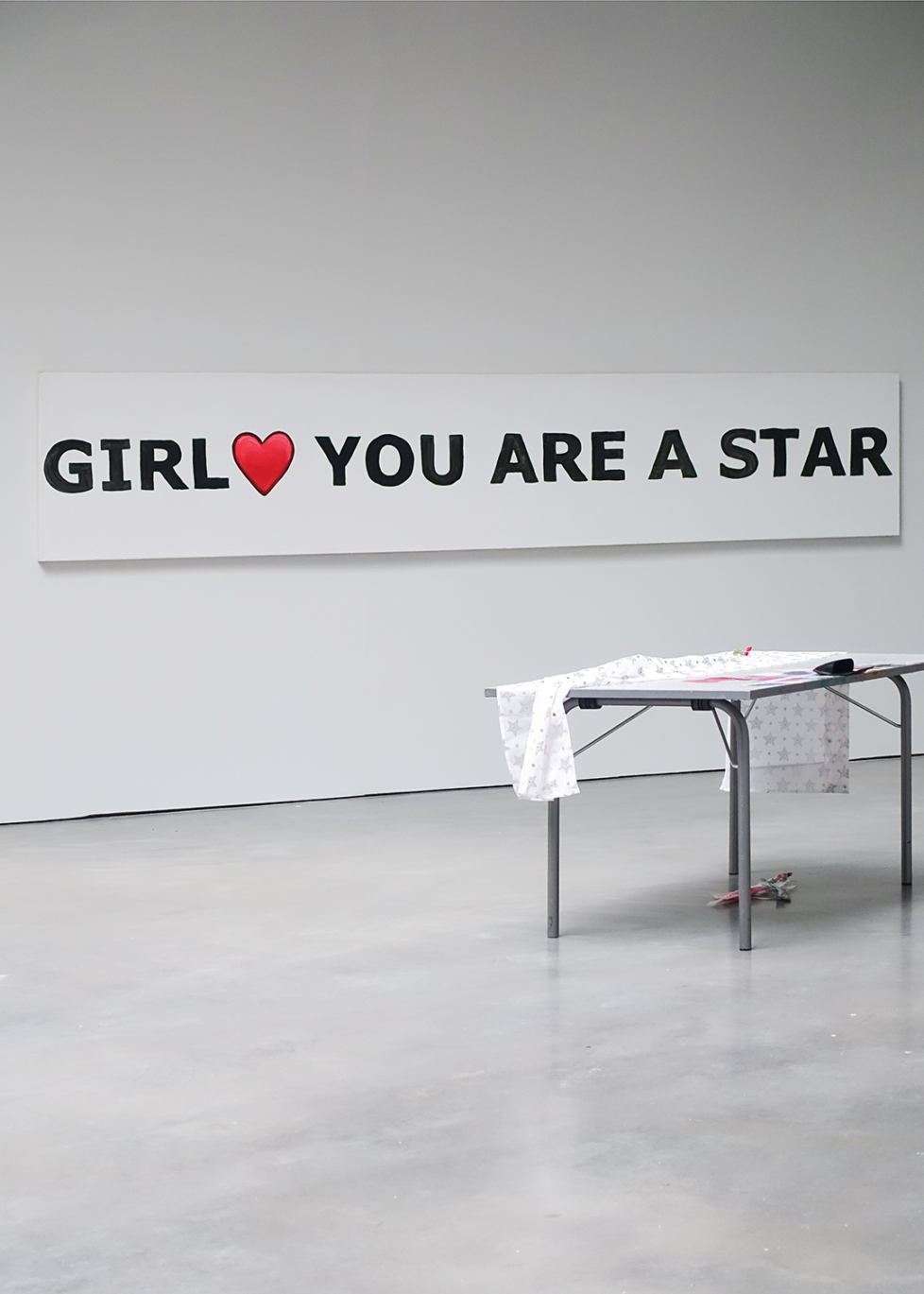
The exhibition features nebulous assemblages of found objects, mostly comprising a variety of textiles printed with stylised images of five-pointed stars, by Karlsson. The banner-like text paintings on the barely lit walls are by Kerkis. There are also A4 printouts of texts by Alexa Illi and Rasmus Östling taped to walls in the lobby area that are presented as a part of the exhibition.
It would be difficult to identify what is or isn’t an artwork here without the briefly worded list of works. I focus on two paintings placed on opposite walls. One reads “GIRL ❤️ YOU ARE A STAR,” the other one, “BOY ❤️ YOU ARE A STAR.” In the boy painting, only the ❤️ and the word STAR are coloured in. The other words are only present as faint outlines, like whoever was about to make this statement had been unconvinced and given up halfway through.
I look for context in Illi’s text, taped to glass, titled A Slip Of Absence (2025). Illi writes: “Don’t you want to go further into the zeitgeist? Go all the way? I would rather stay here. In this perpetual almost, putting out my tongue at the end to cross the finish line: near-fame, unfolding my life in front of you like a spin-dried dressing gown.”
It’s interesting to experience the architecture overwhelming the artworks. The Fine Arts Academy building, designed by in-vogue architecture firm JKMM, was completed in 2021. The building feels like a tasteful but ultimately crushing hybrid of a shopping centre and a panopticon prison.
It is hard to imagine that the meetings between the academy administration and the architects responsible didn’t include a subliminal desire to destroy the arts by mangling the definition of what an artist is and how an artist works, most obvious in the building by how it denies any wish for privacy or separation from others. Nothing is shielded from vision. (Ane Hjort Guttu’s 2020 essay ‘The End of Art Education as We Know It’ still holds up in this regard, identifying the design problems baked into these neoliberal, contemporary premises.)
At the opening of the exhibition, I imagine that the listlessness and succumbing of the artworks to the space itself would disturb its architects. I imagine the architects optimistically assuming that art students would triumph over any bleak, sterile condition they are placed in; that the art would differentiate itself from the building by being all the more creative, beautiful, and dazzling.
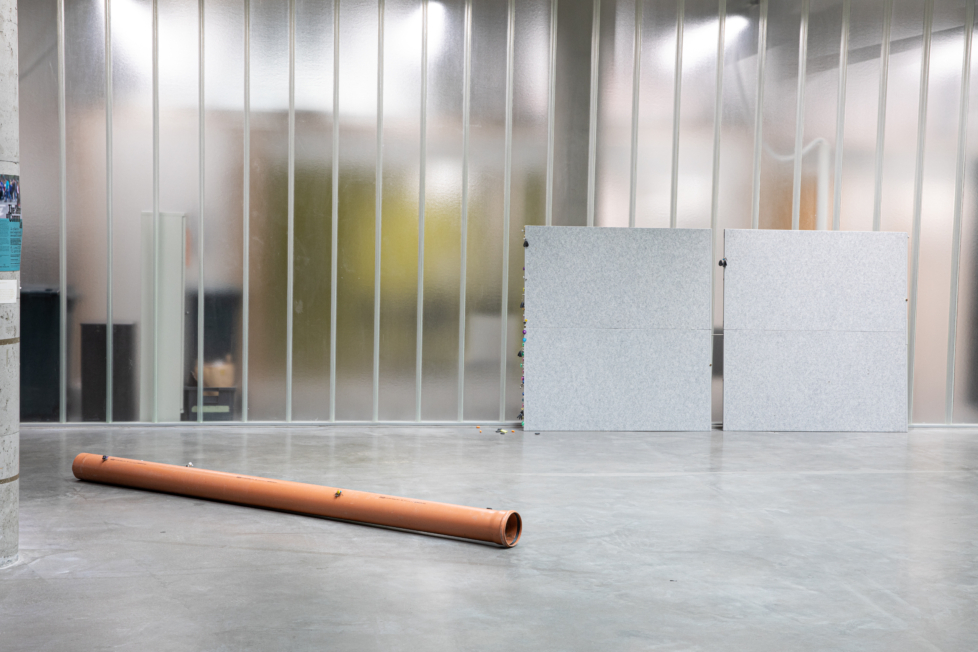
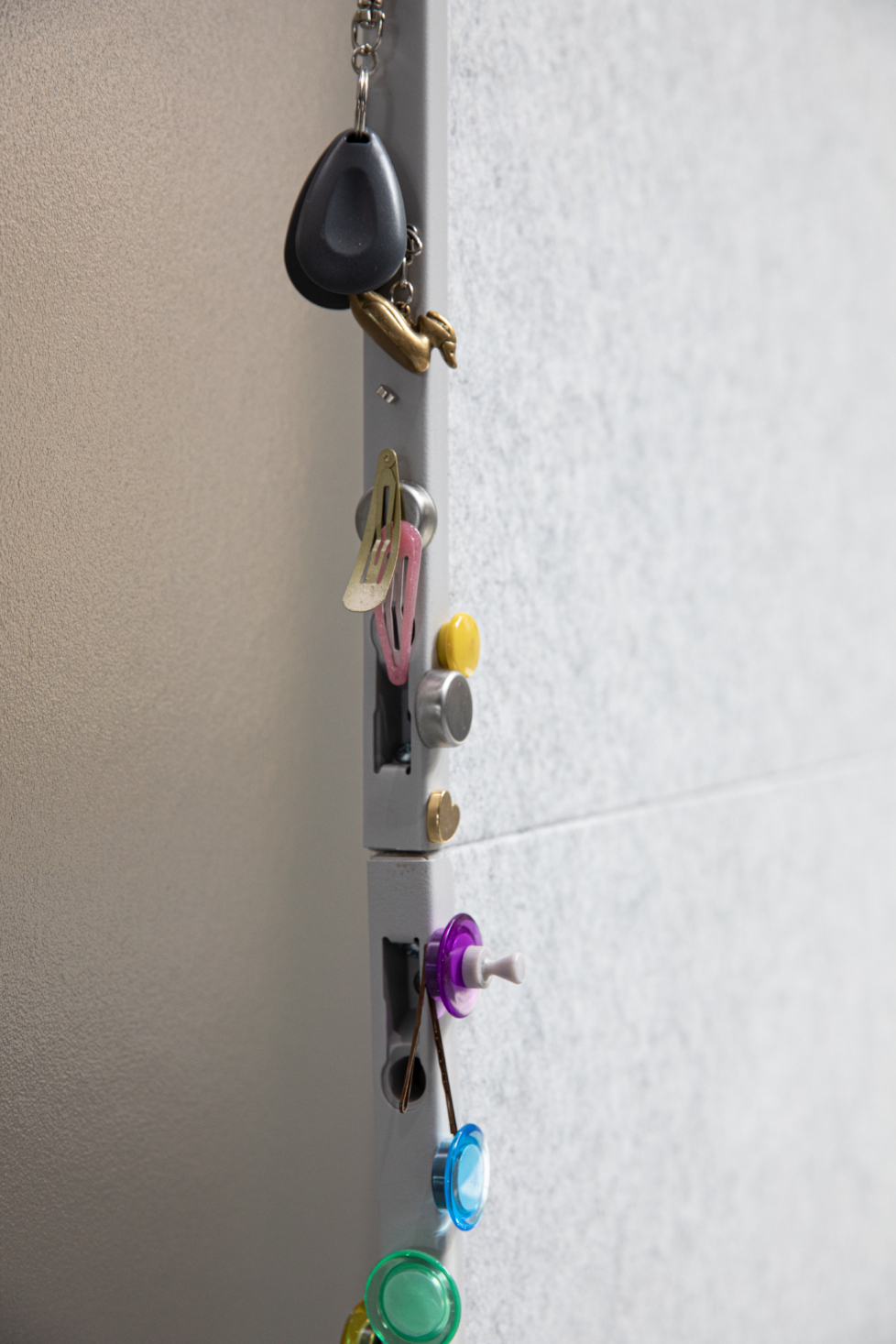
The exhibition brings to mind previous works that did something similar with this particular building. I think of Tuomas Lehtomaa’s installation in, 1–3 at the MFA degree show in 2024. This work is perhaps best described by its list of materials: “room dividers, threaded rod, drain pipe, bluetooth earbuds, magnets, id-tags, hair clips, key tags, earplugs, dvd player, container, night lamp, food essences (in a glass enclosure), pieces of an oil-bonded sand mould, film reels, coat stand, milk frothing cups, necklace string, curtain.”These materials were exhibited in this same dismal lobby and surrounding areas of the academy in a scattershot-but-probably-extremely-thought-out way.
I’m also thinking of Ville Laurinkoski’s MFA degree work 7.5. – 5.6.2022, which also came with a satisfying list:
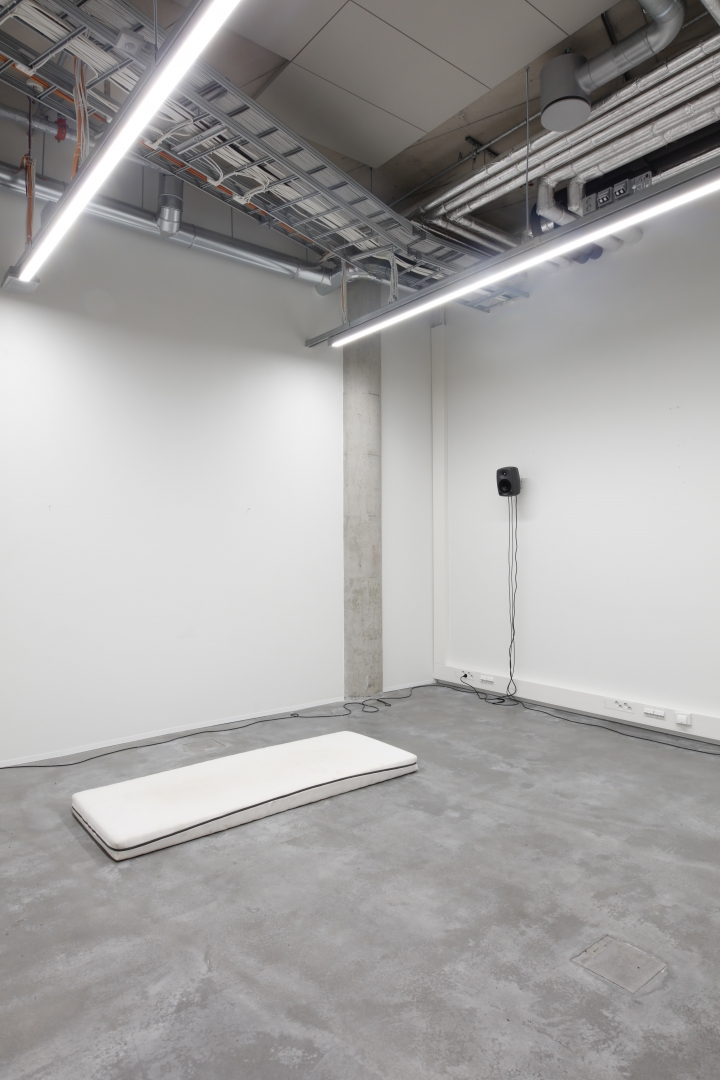
the installation comprises of the walls, the ceiling and the floor, a one-person mattress, the dirt on it, the light strips and the infrastructure of the building, the holes and a few nails on the white walls, of a bin next to the door, of the XLR cords and power outlets, a media player playing a file amplified through four loudspeakers mounted on the walls, of a voice and the sound of a piano reverberating in the windowless chamber.
Laurinkoski’s piece involved a 14-minute audio track consisting of what I’d describe as incoherent, loud, gay, French yelling. The voice charged the piece with an operatic and wounded affect, and made it more blatant and antagonistic than the other works mentioned here. Still, Laurinkoski’s installation, too, distinguished itself by emphasising the hilariously disenchanted room it was exhibited in.
I’m thinking of the way art students and young artists are presented with two trodden paths: there is on the one hand the expectation that you could become an artist-activist-influencer whose lived experience could be refined into magical speech and gesture in the narrative economy; on the other hand there is still some demand for image-artisans who make figurative oil paintings or other visually striking wall objects for the now dwindling and frankly unglamorous art market.
In between these two sometimes intersecting paths is an empty field, is this turning-away, the balancing act of working with your circumstances while more-or-less subtly rejecting them as insufficient. Possibly some type of art, echoing previous conceptualist, poetic, or minimalist turns is taking root in the barrenness.
In the early 1990s, in the aftermath of the dissolution of the Soviet Union, Finland experienced a banking crisis and steep economic depression. The Finnish word for the situation is lama, derived from the Swedish word “lam,” related to the English word “lame.”
The word lama feels more embodied and total than what the concept of economic depression can contain. Lamaantunut is the word for benumbed, frozen, paralysed. My age group – we were children then – are sometimes referred to as lama-ajan lapset: the children of that age of paralysis. For some reason, thinking about it now, on the precipice of another depression, a different cluster of Finnish words comes to mind: lohdutus, lohduttaa, lohduton. Consolation, to console, inconsolable.
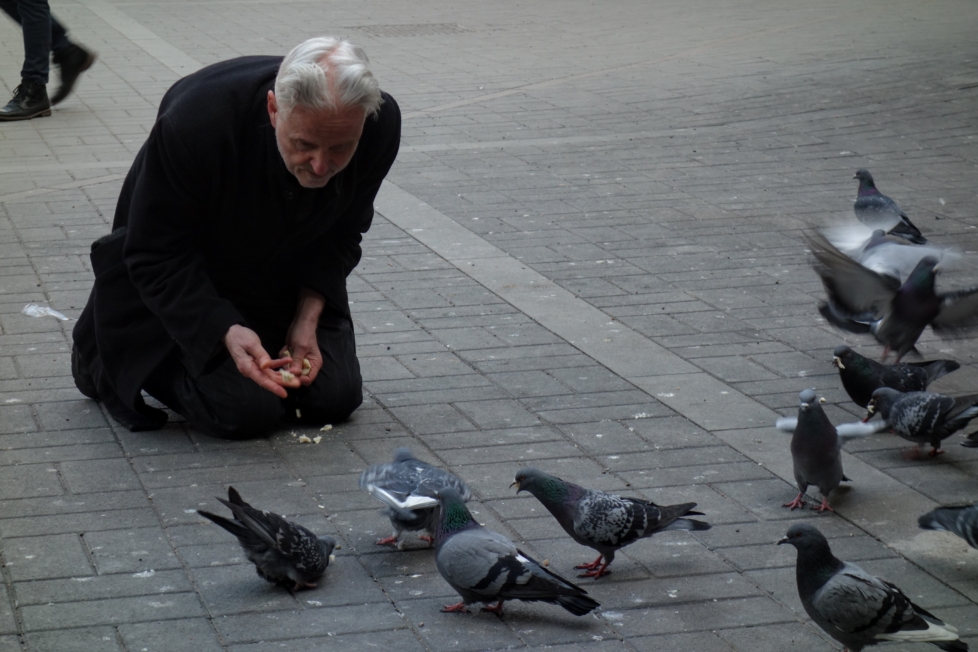
I’m watching a 37-second video on the Youtube channel of Finnish artist Pentti Otto Koskinen. The video documents a 1998 public performance titled Let’s Eat Christ in the Breadline. The short clip shows four people sitting at a set table on the sidewalk. The artist, dressed in black, is pouring red wine into their glasses. Behind this table, across the street, an actual breadline is visible to the camera.
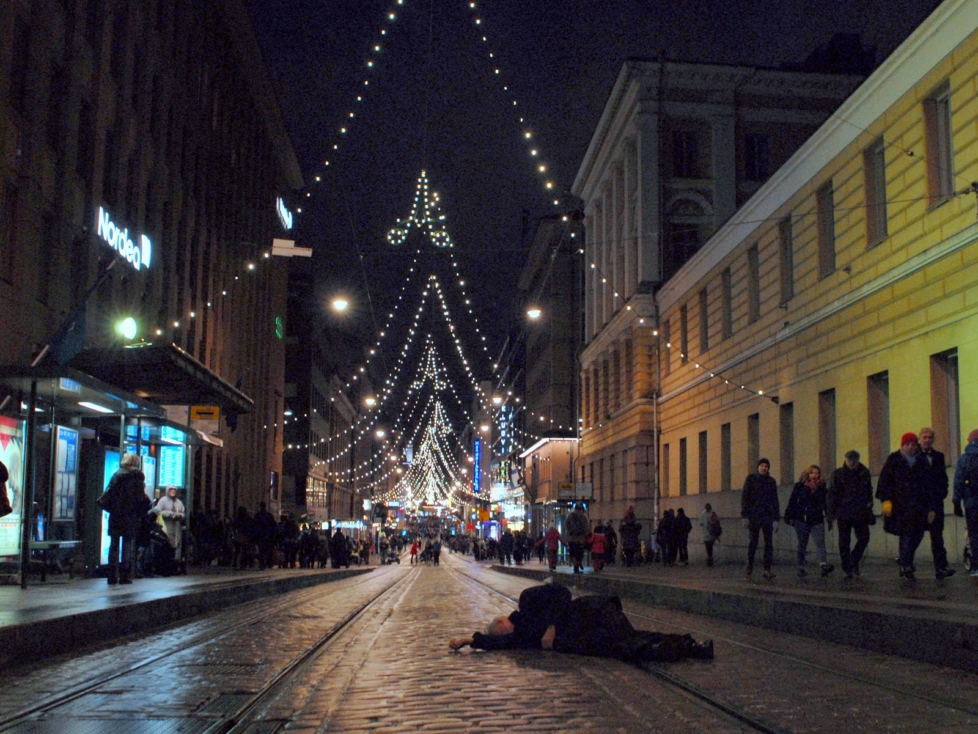
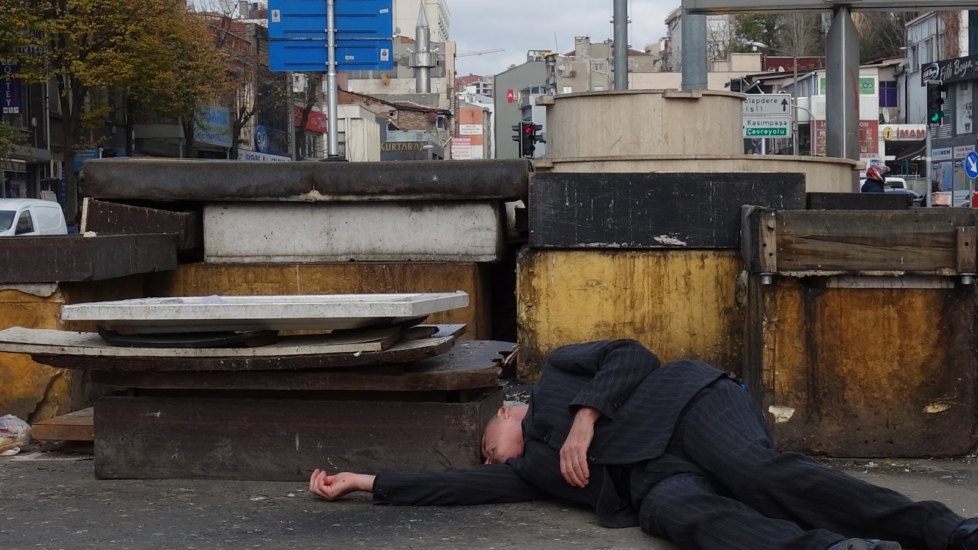
There is abundant documentation but little context for Koskinen’s work online. The artist is posting images and videos of himself laying down on the street, often next to a large rock, like the rock had fallen from heaven and landed on the artist’s head. People are stopping to ask if the artist needs help, not understanding that they’re witnessing a performance instead of an emergency.
The artist is begging on the street or feeding doves or writing the phrase “POVERTY SAVES!” on the wall of an abandoned building. Art is constructed out of bread, doves, rocks, streets, acts of mercy, in the spirit of Saint Francis. I’m trying to determine if this art is outsider art and if that definition even holds water at this point.
I’m thinking about the lobbying attempts to preserve arts funding or to increase it. I’m thinking of the constant, gnawing stress of my last few years as a freelance worker. I’m thinking of the phrase “poverty saves,” what it means to advocate for poverty in a time where many of us are on a tilted surface sliding towards it. I’m wondering what might be found at the end of the poverty rainbow. Grace?
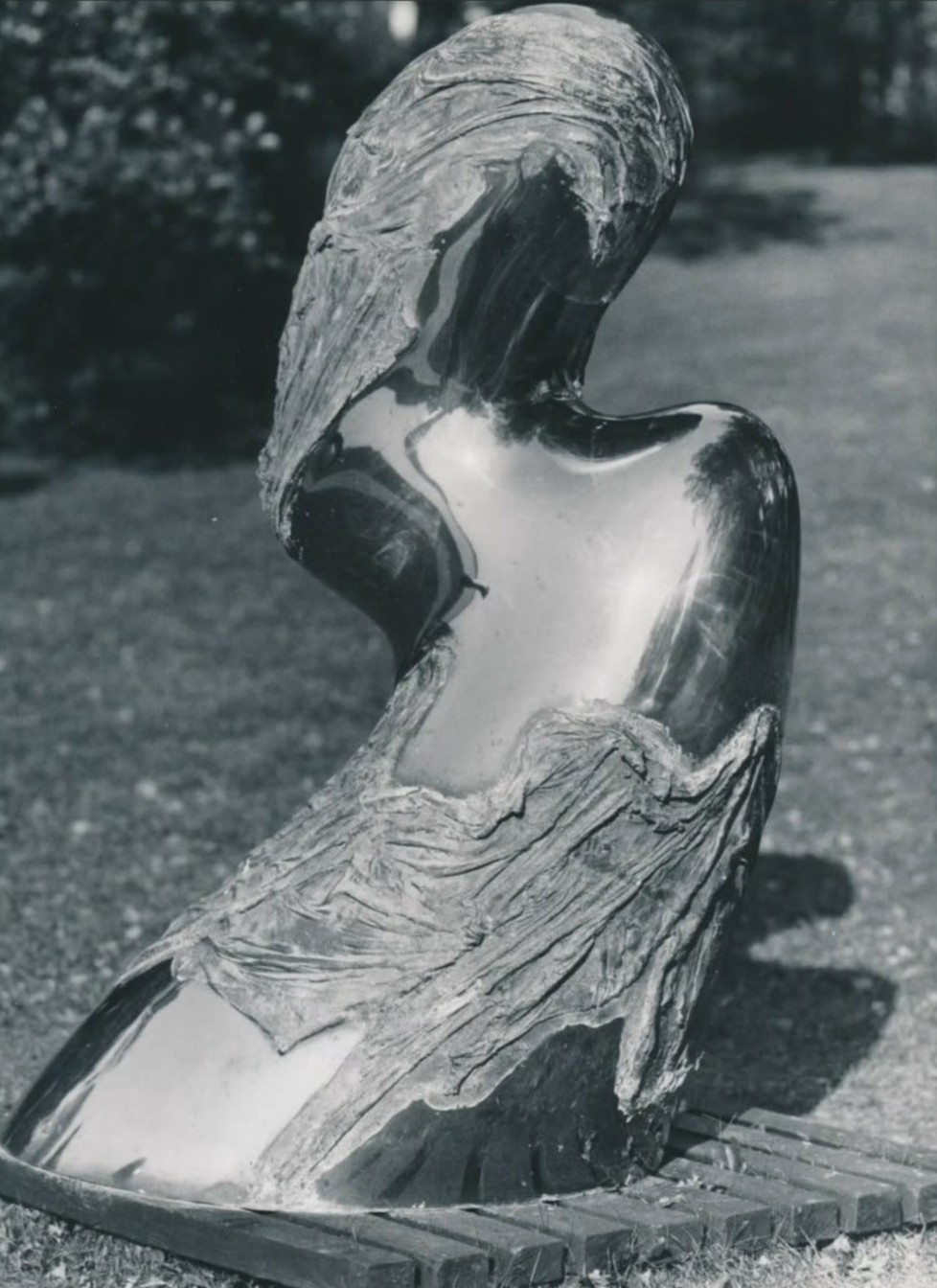
On 17 July of this year Yle, the Finnish Broadcasting Company, reported on the theft of two large-scale bronze sculptures by Laila Pullinen (1933–2015). The stolen sculptures are titled Torso (1971) and Escape into the Third Dimension (1972). The Yle article includes black and white photographs of both large sculptures. The sculptures look like busts that are landslides that are angels.
In an article published by the newspaper Helsingin Sanomat on the same day, Pullinen’s son, Jean Ramsay, is pictured next to another sculpture that the thieves tried to steal from his mother’s sculpture garden, but which they only managed to topple. The fallen sculpture is titled Daidalus (1996), after the mythical artist and craftsman who designed the Labyrinth and fathered Icarus.
In the article Ramsay suggests that the sculptures are most likely heading to Estonia to be melted down and sold on as raw material. I’m trying to imagine the point of view of the sculpture thieves, looking at what I perceive as a luminous artwork as a solid lump of valuable alloy.
In October, Niko Hallikainen releases the text he was reading on the asphalt in August as a book. While his two previous novels came out through one of Finland’s largest publishers, Otava, Prima Materia is made available as a self-published, free PDF on Hallikainen’s website.
From the interviews Hallikainen gives after the release of the book, I gather that novelists profit so little from their published works that the difference between publishing in hardcover through a mainstream publisher and giving the PDF of the book away online for free is not directly consequential to their ability, or inability, to survive as writers – especially for writers of artistic or challenging texts. In the beginning of 2025, Finland raised the value added tax of books from 10 per cent to 14 per cent, which means that the tax collector now makes more money on the sale of a book than the author does.
In a direct message I ask Hallikainen about the timing of the book’s release. He replies:
The book was published on October 6, 2025, at 12:45 PM in Helsinki. This makes the book a Scorpio Rising. In addition, its North Node is in the 3rd house in Pisces, meaning its purpose is to communicate psychic and/or emotional matters through language. Also, if I remember correctly, it had Mercury in Libra at 29 degrees. In astrology, 29 degrees is called the anaretic degree, which is the final degree of a sign, and it’s thought to encompass everything possible related to that sign and planet: basically, the entire spectrum of communication in this case. This last aspect is very risky, because it can lead to the highest peaks and the lowest valleys.
I wish I could read as much meaning into the movement of stars.
I’m reading Hallikainen’s book in the café of the newly renovated Finlandia Hall. I find myself returning to this institutional café time and time again. Designed in the 1960s by Alvar Aalto, the Finlandia Hall is a congress centre draped in lavish Carrara marble that keeps being replaced in expensive renovations because it’s so unsuited to the harsh climate here, or something. The floor of the café is marble, too. The plastic soles of my barefoot shoes are in firm contact with the troubled marble as I read:
Coming to a complete halt, one can begin to sense invisible structures, they approach you with curiosity when no one is working on their behalf.
Here I am far from everything. Aimless bustle. Political debates.
A secret meeting of the Prime Minister’s party. Whispering. Always something bad to say. Workplace bullying. A man who looks like as soon as someone has ejaculated in his ass, he’ll start filing his nails.
What about the corridor bending towards illusion?
Unrealistic notions of what it means to enter a scene are gone.
Every night as I reach the water’s edge a rare window is open for a few hours.
I no longer believe in the notion of a stream of consciousness. No offense. Some people truly don’t have their channels open, and something flows out of them still.
In Kunstkritikk’s commentary series Something is rotten – with a title inspired by the famous line “Something is rotten in the state of Denmark” from Shakespeare’s Hamlet – we invite Nordic writers to shed light on the art field in the Nordic countries.