How often do we forget that we live in a form of material amnesia? I realise I do each time I touch the world in a plain choreography of gestures on frictionless surfaces, which is to say, all the time. Smooth strokes that slide along what seem like the edges of reality leave me feeling like I am hanging on its margins with little to hold on to. A life lived under the illusion of an increasingly dematerialised existence that leaves me both scared of sliding off its glassy surface and longing for thicker relations to other intangible dimensions – gods whose existence I ignore, but that I hope are least less malign than the invisible cloud of exploited labour and extractivist scars that hides behind my fingertips’ dance floor.
The void left by this illusion of immateriality is filled by the sheer volume of stuff that accumulates around us. Things produced, shipped, and marketed through an invisible system of cables and enormous data centres clothed in the ineffable cape that once belonged to the Lord perched above the skies on fluffy, wondrous clouds. And while digital interfaces accelerate their taste for transparency and liquidity, and our visual structures, built on invisible data, tend toward vaporisation, we have to constantly remind ourselves that our systems of visibility are still grounded in opaque material processes.
Making sense of this dissociation between material and immaterial realities, and trying to stay healthy despite it, is perhaps one of our most complex tasks, given the power that invisible structures have in shaping our practical and affective lives. Perhaps it helps to remember that matter – the stuff the world is made of, that transforms and in some cases decays – has always been in a complex dialogue with invisible forces that shape material realities, and to look at the questions this has raised in other times.
The event of God’s incarnation in Christ is arguably the axis, in Western cultural history, of this relationship between invisible, immutable powers and transient, mutable matter. The bridging of the immense distance between God and the world in the paradoxical figure of Christ (at once human and divine) kept theologians and religious authorities busy for centuries, devising intricate arguments too often defended through the very material slaughter of the supporters of opposing beliefs.
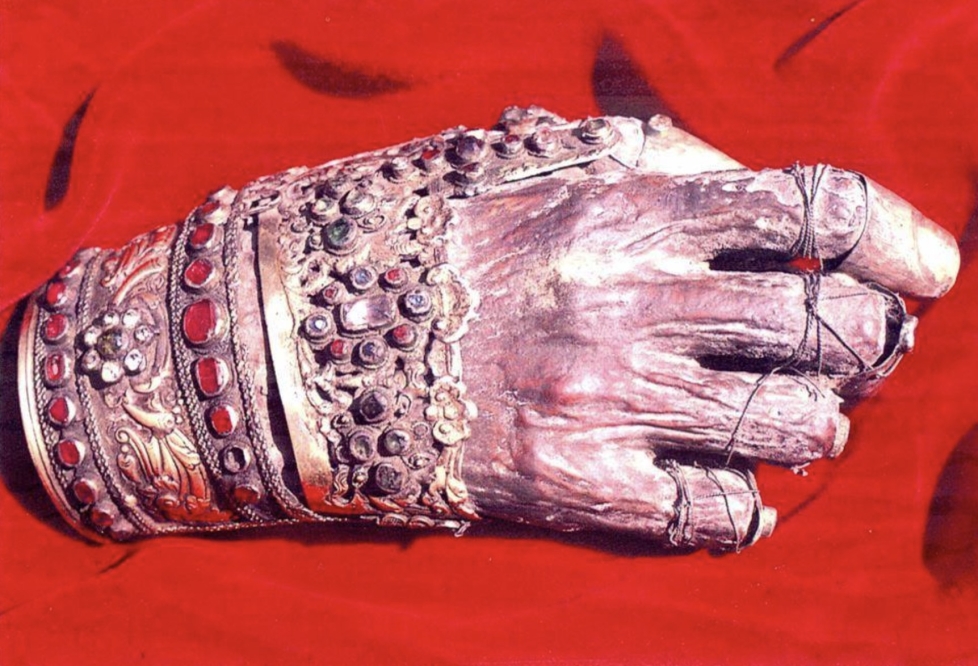
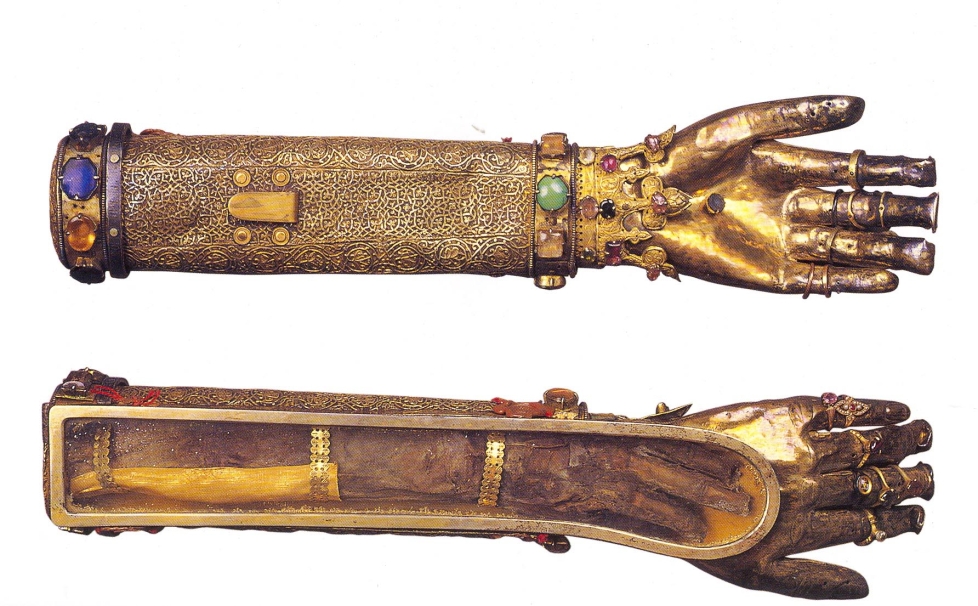
In Christian Materiality (2015), Caroline Bynum – the most prominent American scholar of medieval Christianity – explores how, during the 14th and 15th centuries, questions about the uncontrollable vitality of material substance, its transience and propensity to decay, came constantly into tension with the immutability and eternal quality of the holiness that certain materiality was believed to channel and contain. Elaborate reliquaries crafted in hard metals and encrusted with precious stones were to deliver fragile pieces of human bodies to the boundlessness of eternity. Think of saints and miracles: how can a holy body at once rot and be divine?
It is a theological and ontological paradox, an impossibility that cannot be contained by our mortal perspective, and yet this inexplicable excess of eternity within our finitude is the enigma that sparks divine visions. In Fyodor Dostoevsky’s The Brothers Karamazov (1880), Alyosha’s spiritual mentor, Father Zosima, is believed to be a thaumaturge (a worker of miracles), and his true sainthood is expected to be confirmed – according to popular beliefs of the time – by the incorruptibility of his body after death. But, to his disciple’s burning disappointment, the body begins to ooze a particularly strong deathly odour immediately after Zosima’s passing. The stench ignites Alyosha’s crisis of faith, yet it also triggers the spiritual transformation that culminates in his weeping tears of joy and kissing the soil in a state of religious ecstasy.
While I was reading Bynum’s book, I had a dream, from which a single still image lingered on: a green-hued hand breaking through a pile of freshly dug earth, the palm pierced by a bloodless hole delicately framed by torn skin. Christ’s hand, I immediately thought – dead, yet oddly zombie-like, as a friend remarked when I described my oneiric image. In the zombie trope, material and spiritual forms meet also in distorted ways as bodies return soulless from death, a kind of black mirror of the Resurrection. The central storyline of the second season of Tim Burton’s Wednesday, which I happened to be watching with my teenage daughter at the time, revolves around a zombie nicknamed Slurp, whose process of decay is reversed: his rotting flesh recomposes as he eats human brains.
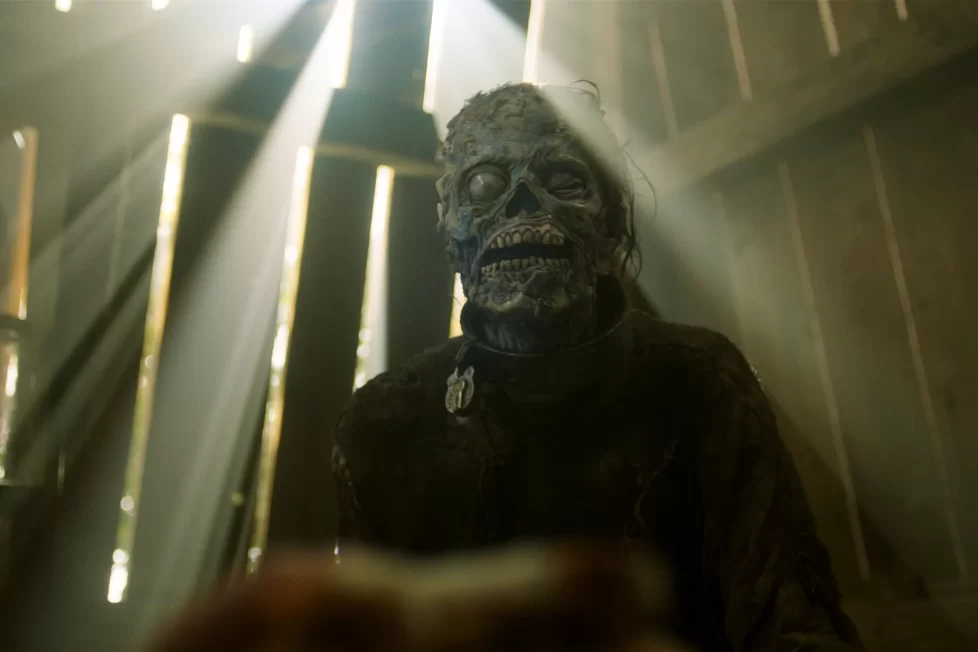
While this narrative pays homage to an iconography that originates with the 1985 horror-comedy Return of the Living Dead, where zombies eat brains to ease the pain of their bodies’ decay, I cannot stop thinking about the brain as digital capitalism’s most overworked and exploited organ – and my own sense of having my cognitive capacities gobbled up, extracted, and abused through constant engagement with an endless flux of digital information and servitude to so-called digital services. In this light, the plot’s reversed decay reads like a humorous allegory of our present, where digital capitalism slurps up our mental energies with zombie-like appetite, and what it returns to us is the foggy residue we’ve started calling brain rot.
On the day of my dream, its vision still clear in the morning light, I travelled to Milan to visit the Pinacoteca di Brera for the first time in decades. There, two holes pierced in hands surprisingly similar to the ones I had just dreamt of awaited me in Andrea Mantegna’s painting Dead Christ (ca. 1480), where Jesus’s body is famously depicted from the human perspective of his feet. The same view of a holy body recurs in another painting of the collection: The Finding of the Body of Saint Mark (1562-1566) by Jacopo Tintoretto, which almost made me lose my balance in front of its eccentric perspectival construction and eerie atmosphere. In the painting, the saint appears in the bottom left corner, his holiness marked by the aura around his head. He stands before his own dead body, which has just been exhumed from the tomb at the very back of the painting, where two men are still searching for his cadaver, torches in hand.
The painting binds visible and invisible forces into an image of simultaneity that holds them in tension without resolution. Tintoretto’s composition is full of startling juxtapositions: the saint’s transcendent, eternal body with his mortal, decay-prone one; the contorted limbs of the possessed man on the right with the spirit exhaled as a vaporous breath that condenses into a demonic figure beneath the arches; the transparent presence of two enigmatic figures in the background with the muscular flesh of the bodies in the foreground; the grave diggers at the far end with their shadows projected onto the illuminated surface of the open sarcophagus. Here, the open tomb – with its lanterna magica effect – becomes a proto-screen, inviting us to read the painting beyond its hagiographic narrative, as a meditation on representation and its magical, thaumaturgical powers.
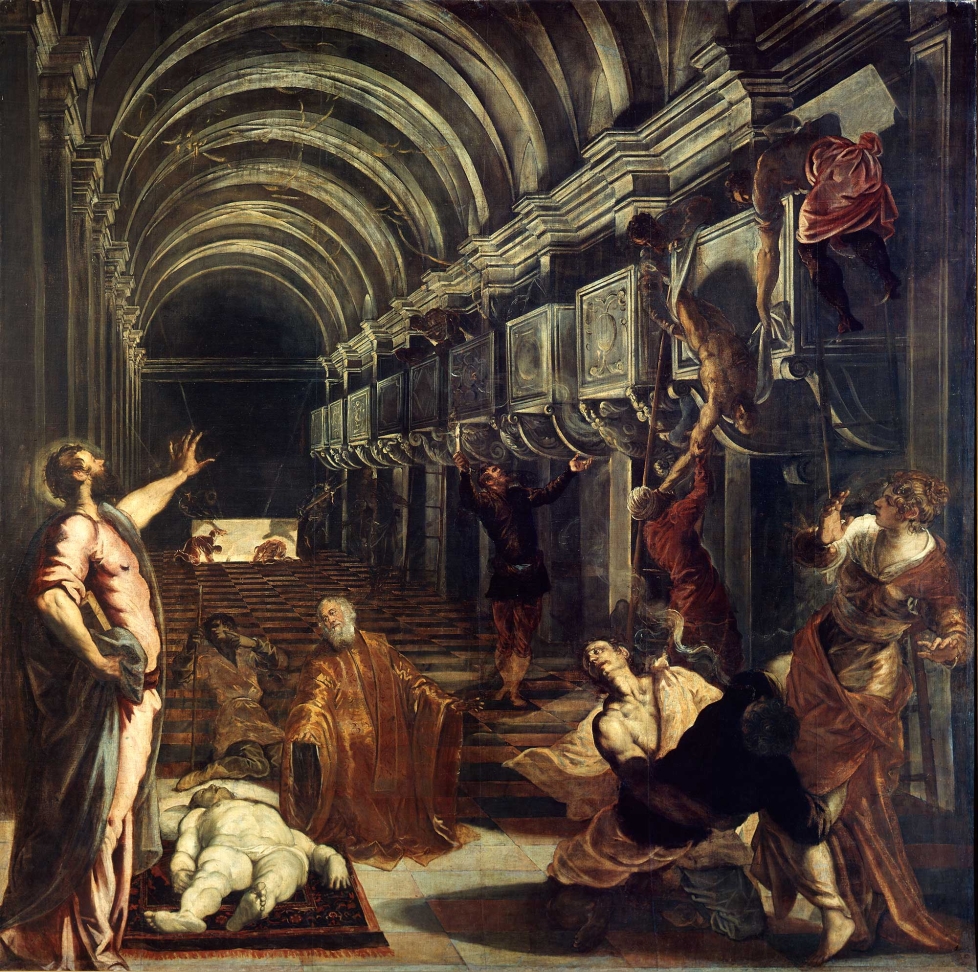
What touched me most, standing before Tintoretto’s scene (and what also resonates in both Alyosha’s spiritual crisis and the constant renegotiation of the status of matter in medieval theology) is the insistence that transcendence cannot be severed from decay, that the miraculous must press up against the perishable, and that divine spirit is unthinkable without the body’s vulnerability. As in ancient reliquaries, the sacred lies in the unsettled tension between infinity and impermanence, hard matter and soft limbs. Contemporary digital infrastructures operate through the opposite gesture: a promise of eternity built on the disavowal of decay, the suppression of material resistance, the fantasy of omniscience and frictionless cognition, where rot is left to our brains.
These religious-flavoured fantasies are paradoxically placed onto media whose in-built fragilities we are mostly amnesiac about. Electronic hardware is prone to degradation. The preservation of digital content depends entirely on the extraction of rare materials and time-specific labour conditions. “When the material conditions keeping its hardware operative will have collapsed, the digital archives to which this civilisation has entrusted its cultural legacy will also vanish […] as absent as they had never existed,” writes Federico Campagna in Prophetic Culture, Recreation for Adolescents (2021), which explores how to imagine a new form of life after the collapse of our current metaphysical, political, and technological frameworks.
In her current exhibition Canopy Collapse, on view through 15 February at Kunsthal Charlottenborg in Copenhagen, Aleksandra Domanović shows works that unfold the convergence of ideological collapse, technological innovation, and digital culture. Born in what is now Serbia in 1981, Domanović often uses her work to explore the simultaneous rise of the internet with the geopolitical and ideological collapse of the former Yugoslavia. The artist’s personal position within a wider political history – including her age when the Soviet Bloc fell in the early 1990s and during the subsequent years of political fragmentation – perfectly embodies the existential figure of the “adolescent” defined by Campagna as a type of subjectivity that lives at the “threshold between an apocalypse and a new cosmology.” For Campagna, the subjectivity of the adolescent is also the condition that defines the contemporary, caught between the ecological apocalypse that is sealing the definitive end of Western modernity and a possible new cosmogony that is yet to be imagined. In this sense, Domanović’s practice can be looked at not only as a reflection on the interrelations between technology and ideology at a specific point in political and personal history, but also as taking on the perspective of our own entrapment in the contemporary existential interregnum.
Domanović’s exhibition opens with a timeline composed by the artist, which makes visible the entanglement between gender, political ideology, technology, and different contemporary spiritual references – from Saint Isidore of Seville, patron of the internet, to westernised and commodified forms of yoga such as Jivamukti. The chronology also persistently returns to prosthetic technologies, beginning with Rajko Tomović’s pioneering “Belgrade Hand,” the first artificial limb capable of moving in response to the body’s electric signals.
The Belgrade Hand recurs throughout Domanović’s oeuvre, including in the sculpture Calf Bearer (2017-2021). This monumental piece, consisting of a high wooden plinth surmounted by a plaster calf, features two brass arms extending to hold the animal’s hooves, echoing the archaic Greek sculpture of the same name. The golden sheen of the sculpture’s arms, however, suggests an even more ancient reference: the Biblical Golden Calf, the idol fashioned in a moment of fear, when Moses’s long absence on Mount Sinai made the invisible God feel too remote – too immaterial – to trust.
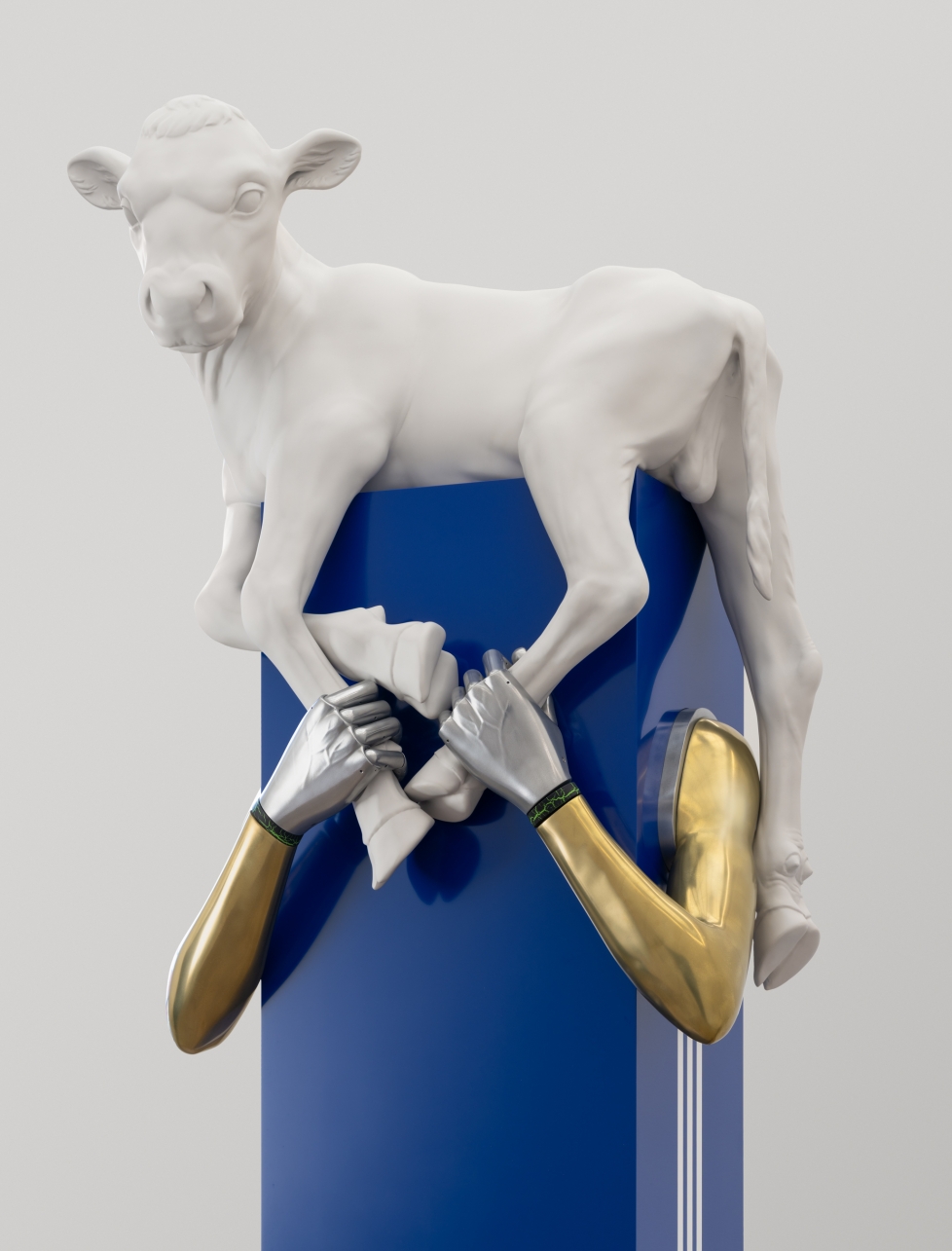
Upon his return, seeing his people worshipping a material artefact instead of the invisible God, Moses, overcome by fury, burns, grinds into powder, and disperses the idol in water, forcing his people to drink it. In the digestive process, the false god reveals its true nature – its gravitational propensity to become excrement. While the questions of religious idolatry are often read in terms of issues of representation, Bynum’s project in Christian Materiality shows that medieval anxieties around idols were never primarily about images but about matter’s unruly vitality. Material things can act, leak, ferment, heal, rot, or miraculously refuse decay. Idolatry, in this sense, is a question of material excess, a religious imagination struggling not with visibility but with the unpredictability of matter itself.
Bynum’s historical perspective can inspire us to realign our position toward digital capitalism’s thinning visual (and ethical) structures, to dive beyond the image and dig into visuality’s guts. In the contemporary scenario of material amnesia – fuelled by the ineffable architecture of images that infiltrate everything like smoke – our digitally-mediated experience of transcendence suppresses our ability to imagine decay, seducing us into forging an idea of eternity detached from mortality. I wonder how this, in turn, pushes us away from death’s closest relative, which happens to be life: our personal, embodied life, as well as that which exceeds any singular body – the life of our corpus, or the material body of the earth.
Ultimately, I also wonder how to find forms of resistance—places where life’s thickness can still be touched—while exploring the intuitive knowledge of the metaphysical connection of all beings, a form of connectivity that preserves the material ambiguity erased by information technologies. This essay is part of a personal, ongoing search for something to hold onto, something that sustains my longing for a kind of transcendence lodged in the body’s flesh and blood.
In Kunstkritikk’s commentary series Something is rotten – with a title inspired by the famous line “Something is rotten in the state of Denmark” from William Shakespeare’s Hamlet – we invite Nordic writers to reflect on the current state of contemporary art.