Identity has long been the new black in art, not to mention its new straitjacket. In recent years, few important biennials or major group shows have dared to deal with anything other than identity politics. But in the exhibition Echo, Delay, Reverb at the Palais de Tokyo in Paris, curator Naomi Beckwith – who was recently appointed artistic director of Documenta 16 (2027) – attempts to place the search for identity in a much-needed historical context. Beckwith has chosen to examine how Francophone thought – from postcolonial theories to queer and feminist voices – has seeped into contemporary American art, and how this art in turn reflects back a different view of Europe.
Beckwith has been a student at the legendary Whitney Independent Study Program, a melting pot for the fusion of French-American theory, where Michel Foucault merged with Black Studies, Jacques Derrida was crossed with feminism, and Frantz Fanon with Conceptual Art. So it does not come as a surprise that Beckwith’s show moves between artworks about diaspora, institutional criticism, and intellectual engagement, while also touching on what, for lack of a better term, could be called “the politicisation of desire.” But what happens when you want to give theory as much room as the artworks themselves?
The walls in the monumental Palais de Tokyo building are painted a deep red, as if viewers were stepping into an ideological bloodstream, where the postmodern gods of French Theory – Gilles Deleuze, Jacques Lacan, Julia Kristeva, Roland Barthes, Hélène Cixous, and Jean Baudrillard – literally hang like icons of a secular religion. In other words, this is a case of theory as decoration, which is a shame because these world-changing philosophers deserve to be shown on large video screens, in separate rooms with long lectures, not on posters and small TV monitors that only focus on their one-liners.
The overambitious approach, featuring sixty artists working from the 1970s to the present day, is interesting, but the thematically organised rooms appear isolated rather than integrated, making it difficult to get a sense of the ongoing dialogue between art and theory that the exhibition seeks to create. The overall impression? Everything is thought-through. Everything is important. But nothing feels urgent.
The exhibition is divided into five rooms. In the section entitled ‘La critique des institutions’ (the critique of institutions), Hans Haacke demonstrates how Pierre Bourdieu and Foucault’s analysis of power can be turned into method through a glass cube that captures the institution’s vapour (Condensation Cube, 1963–65), while Andrea Fraser’s filmed gallery hopping exposes the emptiness of her own discourse (Museum Highlights: A Gallery Talk, 1989). They both remind us that the networks of power are not just theoretical – they are built into walls, contracts, social codes, and sponsorship agreements. But in today’s hyper-conscious context, their radicalism seem more like institutional lubricant. What was once a scandal is now routine.
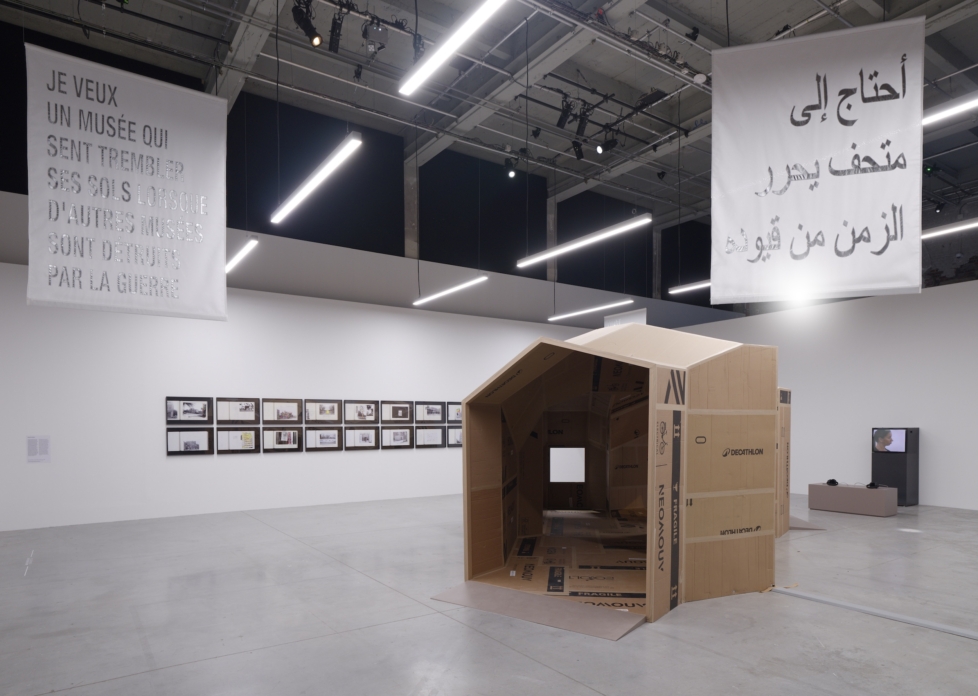
Institutional critique is also represented by Coco Fusco, who together with Guillermo Gómez-Peña, re-enacted human zoos in the 1990s. The performances are brilliantly documented in the video The Couple in a Cage (1993). However, only a couple of illustrational etchings of these actions are included here. Cameron Rowland, inspired by Foucault’s idea of “knowledge = power,” Félix Guattari’s works on prisons and psychiatric institutions, and Monique Wittig’s critique of patriarchy, has replaced the French flag, which usually hangs above the museum, with the green, red, and black flag of Martinique, accompanied by a text on colonialism and Martinican politics. However, the management of the Palais de Tokyo chose to take down the flag the day after the opening after receiving criticism from the government. “Was it out of fear that it would be considered illegal? Or because its colours are too similar to those of the Palestinian flag?” a journalist wondered in television magazine Télérama.
Another section of the exhibition is the room entitled “Machines désirantes” (Desiring machines), which pays tribute to Deleuze and Guattari. It features Paul Chan’s delicate and elegant watercolours of costume designs for his never-performed 2018 opera based on Foucault’s The History of Sexuality (1976). The French thinker’s analysis of power, body, and discipline is here transformed into form, fabric, and movement, a reminder that theory itself can be dressed up, worn, and acted out. On a nearby wall hangs photographic documentation of Lorraine O’Grady’s legendary work Mlle Bourgeoise Noire (1981/2007), in which the artist, dressed in beauty pageant attire, storms into a gallery and shouts: “Black art must take more risks!” But where is this risk-taking Black art? Not here, at least.
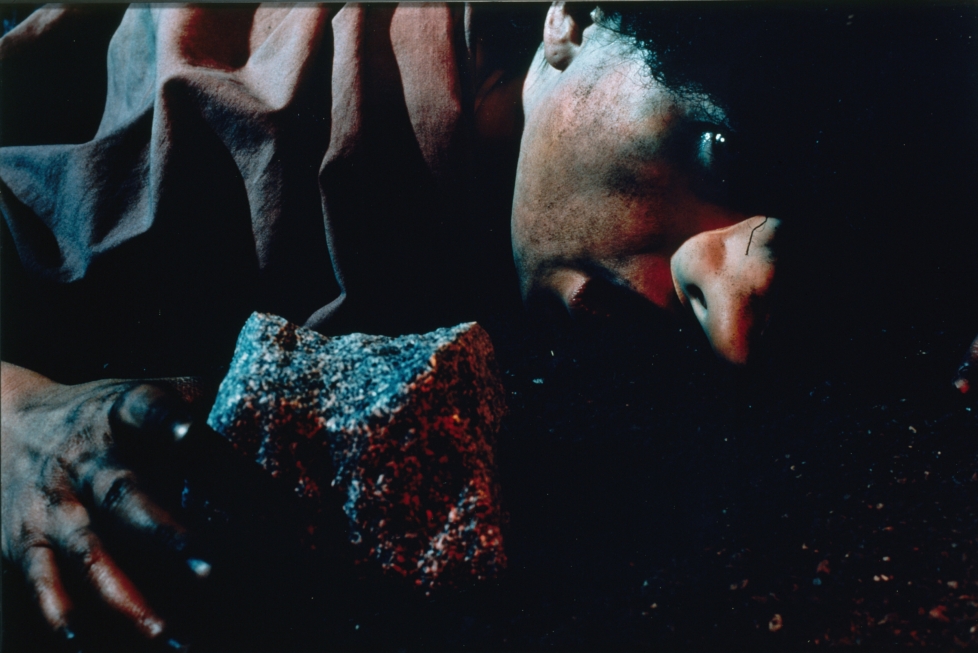
The room dedicated to Julia Kristeva’s theories on the abject hits different, featuring Tala Madani’s Shit Mom paintings in oil on linen from 2019, which depict the artist’s anxiety after the birth of her first child – especially the fear of being a “shit mom.” In a reversal of the virginal stereotype of the Madonna and Child, the maternal figures are depicted with abstract, shapeless bodies that appear to consist of faecal matter, surrounded by infants in compositions as grotesque as they are humorous. In the same room, Cindy Sherman’s photographs of surreal body deconstructions unfortunately feel a little worn at this point.
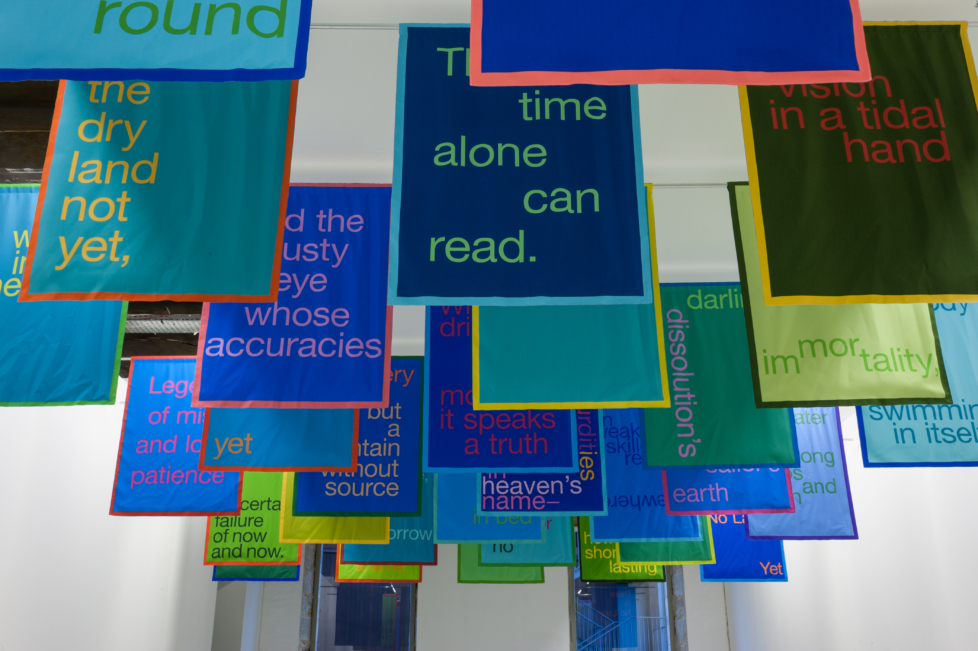
The weakest room in the exhibition is “Dispersion, dissémination” (Dispersion, distribution), where Derrida’s spirit hovers over Renée Green’s banner installation Space Poem #2 (Laura’s Words) (2009), in which the phrase “We cannot possess the meaning of our words” recurs in various fonts. Here we also find Felix Gonzalez-Torres’s now-hackneyed Untitled (Welcome Back Heroes) (1991), which consists of a pile of pink Bazooka chewing gum, where visitors are invited to take a piece of gum and thus participate in the slow disappearance of the sculpture, in a reminder of the society that celebrated the soldiers who returned from the war but ignored the ‘heroes’ who disappeared in the invisible war against AIDS.
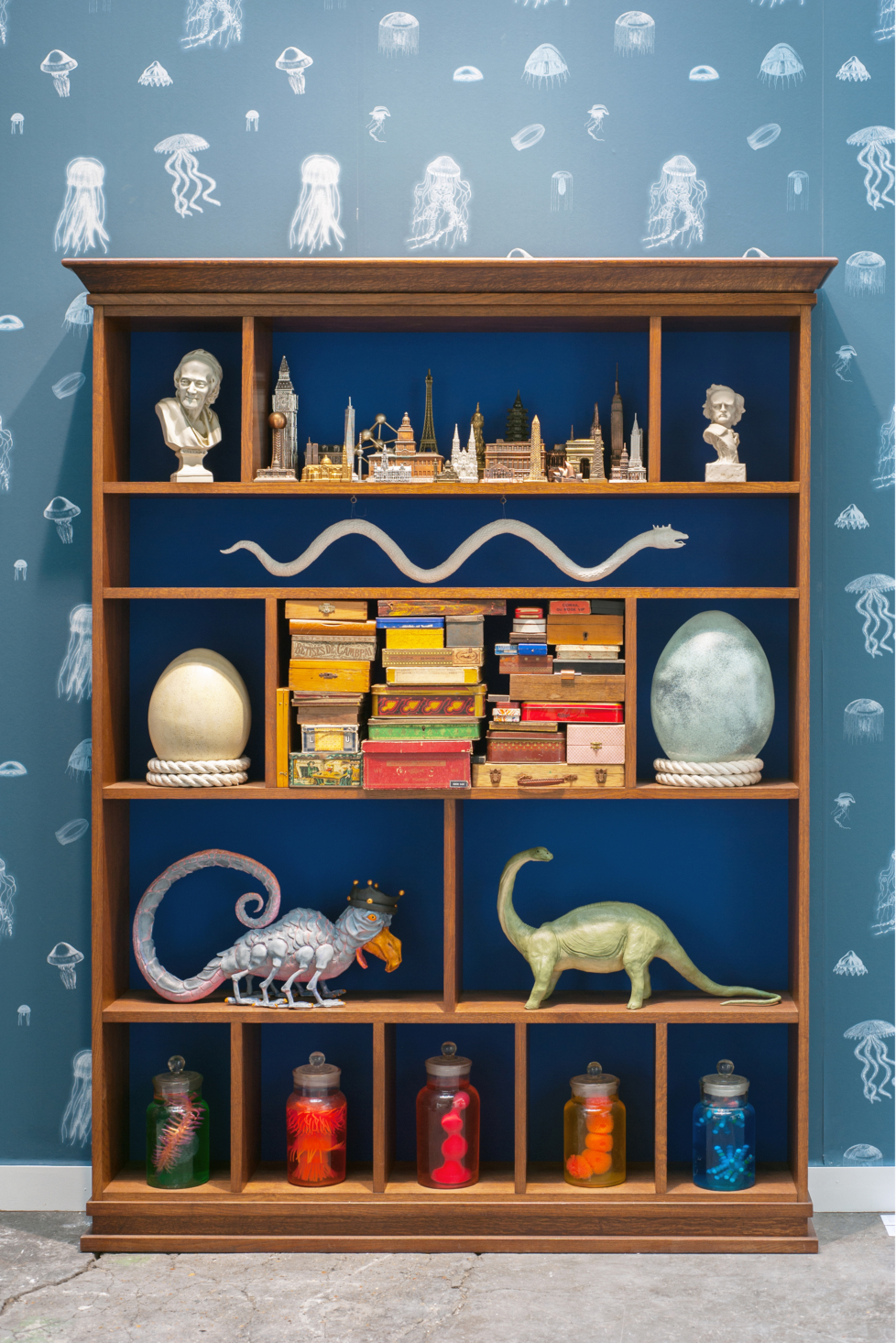
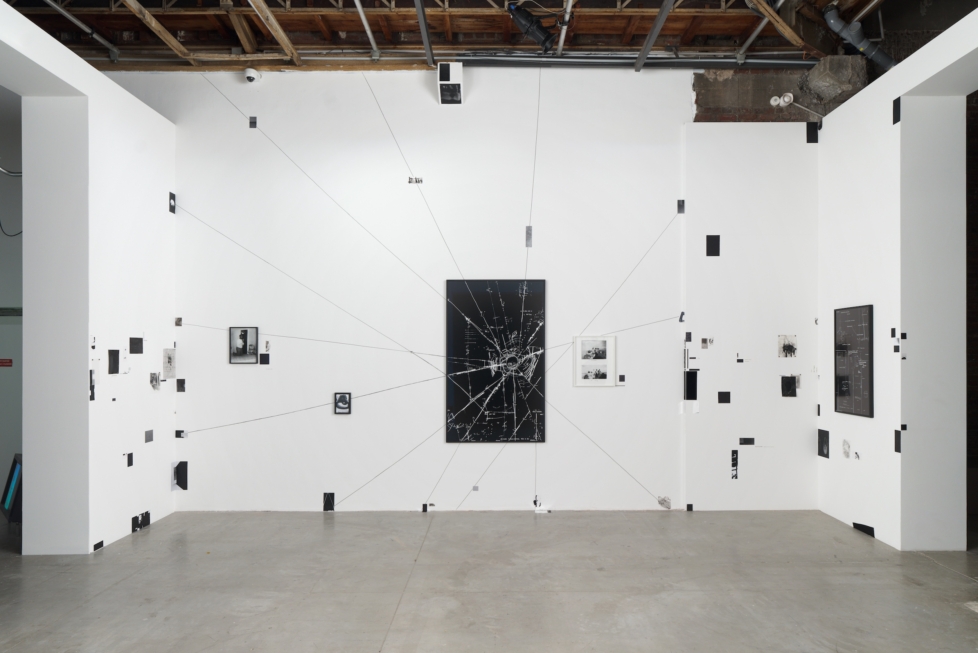
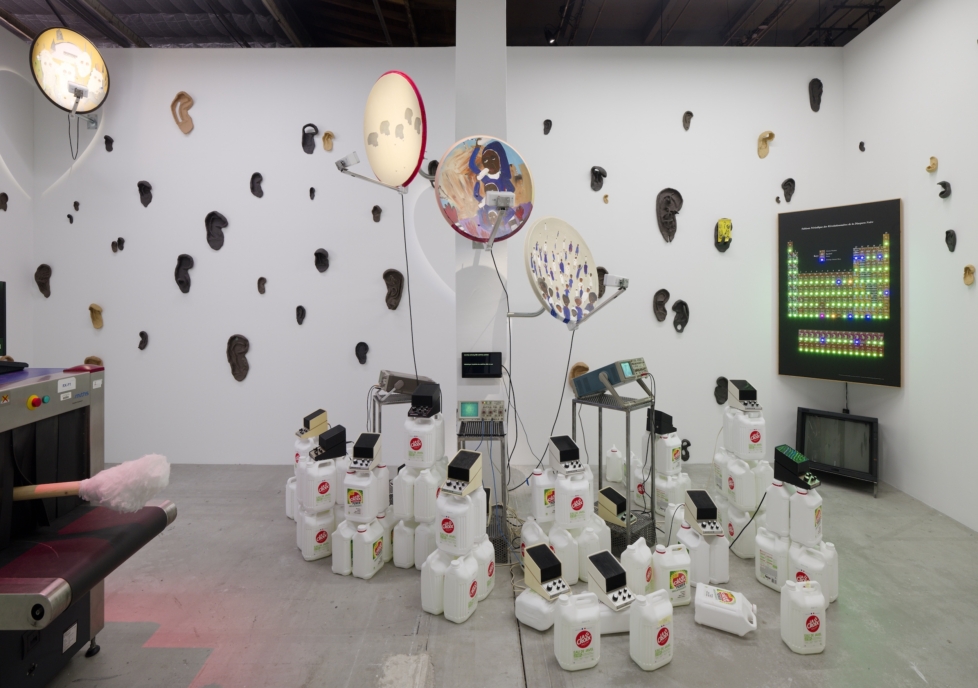
Nor is the room entitled “Géométries du non-humain” (Non-human geometries), featuring artists inspired by Donna Haraway and Édouard Glissant, particularly successful. Torkwase Dyson’s abstract tondo paintings deserve to be installed in a way that bring out their sacral dimensions. Mark Dion’s colourful cabinet of curiosities Between Voltaire and Poe (2016), which stages an ironic confrontation between the rationality of the Enlightenment and American irrationality, looks like a very tidy shelf in a child’s room. Nor do Julie Mehretu’s swirling paintings, which realise Glissant’s idea of the world as a network, a rhythmic and incomplete whole, come into their own in this overly cluttered space, where the artworks appear mostly as illustrations of their theoretical premises.
What is there to say about this wild mix of art and theory? The exhibition reminds us that the art world is still navigating the waters of theory. That we still speak, see, and think with the words that once shaped an entire generation. But the question is: do we still hear what they are saying – or just the reverb? I think it’s the latter. Beckwith should have selected fewer artists, stronger artworks, and given both the art and the theories more space. Instead, they cancel each other out in favour of a neat checklist. It’s a shame that the legendary journal October, which imported French poststructuralism and psychoanalysis to the United States, is only highlighted in the catalogue and not in the exhibition. The aesthetic debates it often gave rise to – including on “the artist as ethnographer,” “the return of the real,” “simulacra,” “post-criticality,” and questions of ethics and morality – contributed to the development of contemporary American art and should not be underestimated.
The exhibition catalogue features a text by Adam Schatz that links Fanon’s ideas about colonialism and violence to the current situation in Palestine. He argues that Fanon’s analysis of liberation struggles and oppression helps us understand Israel’s war in Gaza and the reactions to it, especially among young activists in the United States. The catalogue also includes a text by Elvan Zabunyan, the publication’s editor, who refers to Gonzalez-Torres’s work Forbidden Colours (1988) – four paintings in green, red, black, and white that refer to the Palestinian flag. Zabunyan explains that the catalogue cover reprises these colours as a call for hope and resistance through art.
What will happen with Documenta 16 (2027) now that Beckwith has shown clear sympathy for Palestine, given that Documenta’s management has previously intervened against what it has deemed anti-Semitic works? It goes without saying that Palestine-related perspectives will be included, but how far will she be allowed to go? We’ll have to wait and see. One thing is certain, though: Beckwith is a curator who dares to take historical and theoretical approaches to art without pigeonholing it into identity politics. We can only hope that she will give ideas as much space as the art and show art that in turn can generate new ideas.

Translated from Swedish.