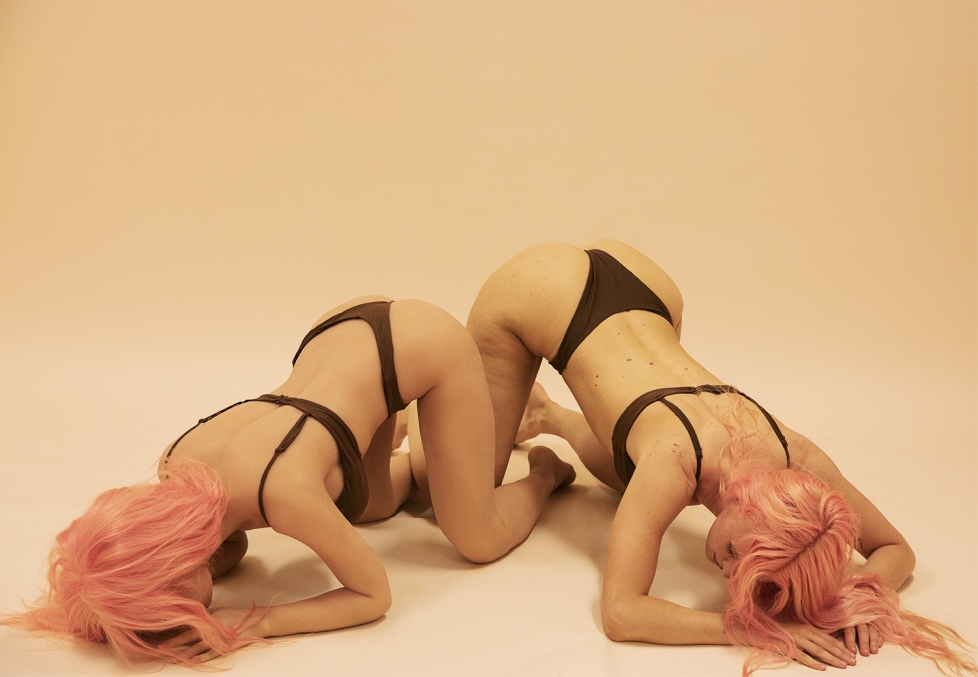
Wading through slop, among liquefied bodies and AI-generated copy, I find it difficult to shake the feeling that we are slowly being pushed out of our human culture. More and more of what surrounds us depicts neither real people nor our actual opinions – much of it seems to lack a human sender altogether. If online culture was once understood in terms of participation – post, share, like – we have arrived at an increasingly synthetic culture where our experiences are converted into training data and endlessly recirculated ideals and desires. If culture is no longer simply produced by humans for humans, what is it for?
Paradoxically, even as cultural expressions become ever more disembodied – frictionless, synthetic – the body itself is rendered ever more exposed, regulated, and optimised. And the fleshly body seems to be becoming secondary to the image-body. The digital self can be filtered and enhanced while the material body remains vulnerable, ageing, and limited. Perhaps one of the central tensions of our time emerges precisely here: between the body as biological reality and the body as an imagistic project; between flesh and pixel; between the body one is, the body one presents, and the body one longs to become.
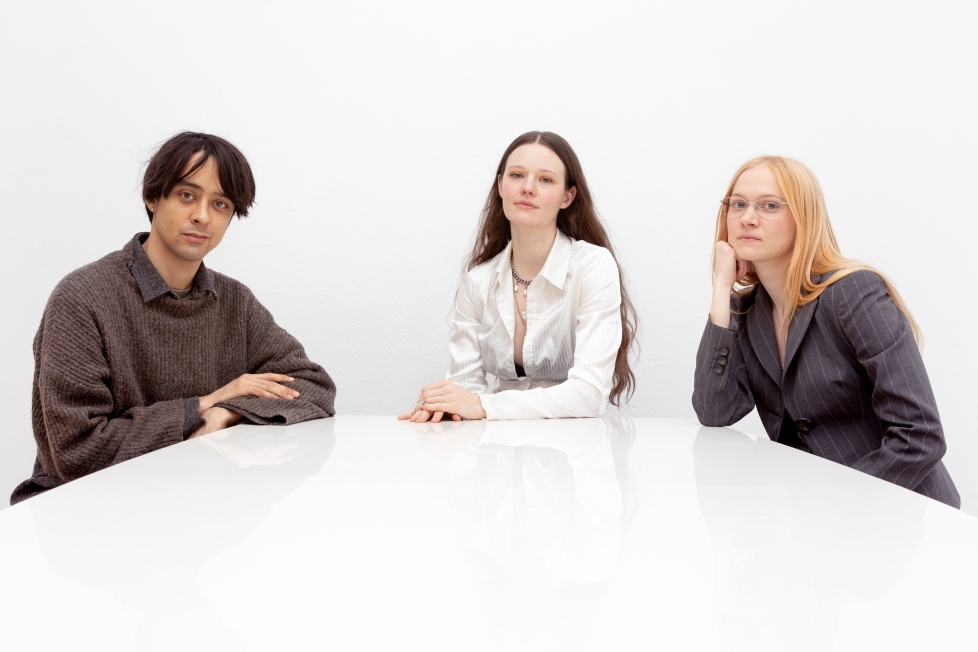
Even so, the question of how technology shapes our lives remains somewhat marginal within contemporary art, at least in Sweden – though there are exceptions. With lagging residual bodies, spasmodic legs, and an AI-generated consciousness trapped inside a small toy duck, Tobias Bradford stages a condition in which the human and the technological have both drifted apart and fused together. Similarly, confronted with Madeleine Andersson’s work, my mushy brain seems folded into dizzying visual feeds until I can no longer distinguish which feelings belong to my body and which belong to the image I’m watching.
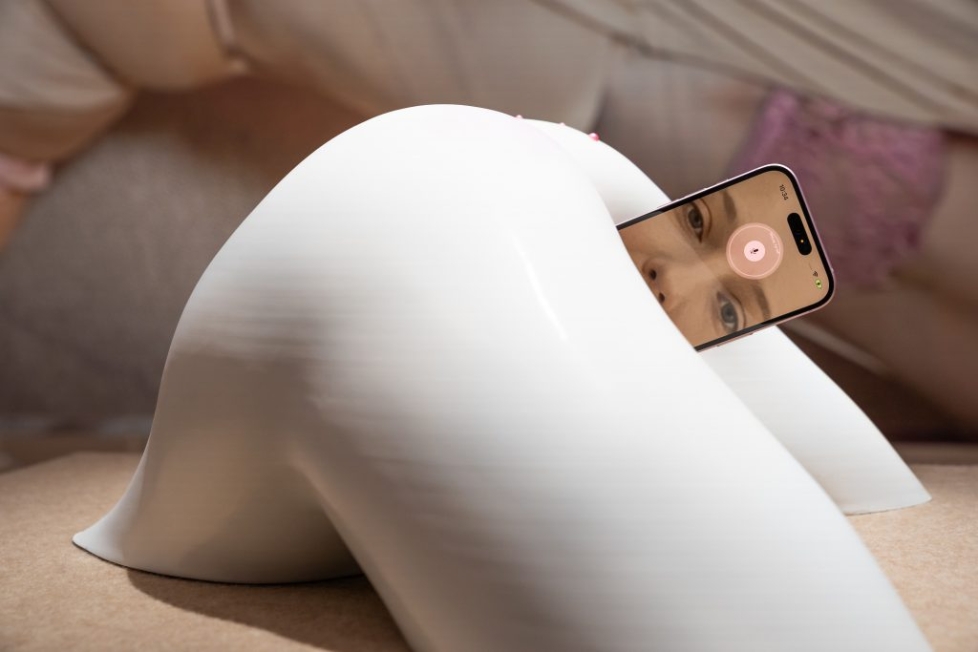
And for well over a decade, Arvida Byström has been working on questions of the female body and the internet, pairing dismantled sex dolls with AI-generated images of dicks, nipples, and holes, holes, holes pressed together into a grotesque beige mass of flesh.
The idea arose to invite these three artists to have a conversation around a number of pressing questions: What does it mean to be able to shape a self beyond the body? What is liberating and what is violent in that possibility? And what happens to desire when its objects are increasingly synthetic or unattainable? These are questions that concern some of our most fundamental fantasies: the dream of transcending the body, of escaping its limitations, of extending it, refining it, duplicating it, distilling it, or perhaps replacing it altogether.
It became a conversation that approaches these questions through phenomena such as sex dolls, LLMs, Instagram, TikTok, Ozempic, war imagery, deepfakes, and pornography. Clearly, the synthetic is not the opposite of the real, but is produced out of reality while also feeding back into it. Slop is fake, but it is built from real images; the artificial body is simulated, but it shapes how the material body is understood; digital identity is untethered from the flesh, yet reshapes what the flesh is expected to be. In that sense, we live in a condition where the real and the synthetic are increasingly folded into one another, smeared together until it becomes difficult to tell where one ends and the other begins.
Nora Arrhenius Hagdahl: I thought we might begin with each of you talking a little about how you work with questions of technology and the body in your practices. Arvida, would you like to start?
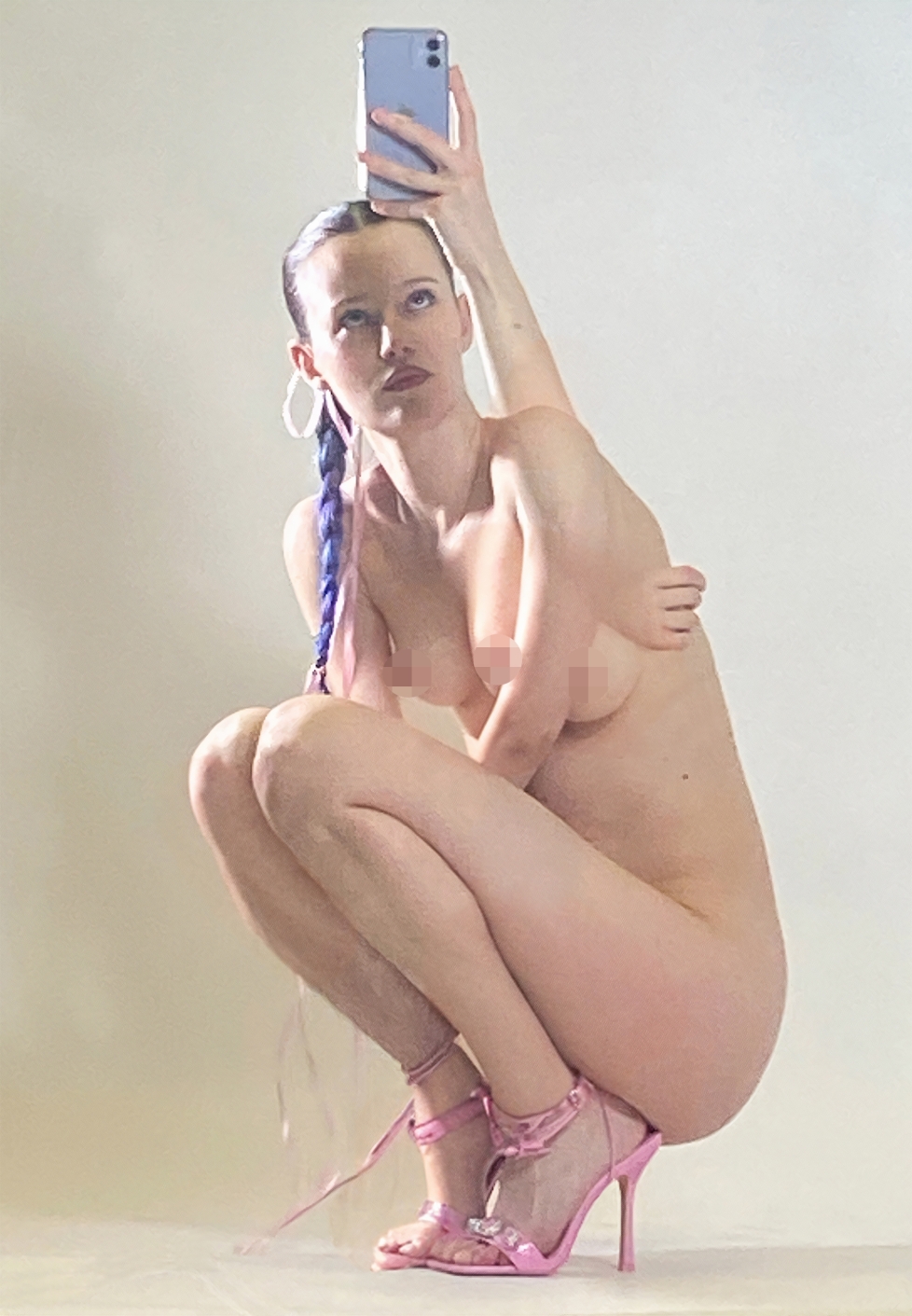
Arvida Byström: I’ve worked a great deal with the artificial woman – AI sex dolls, for instance, or chatbots like Siri. I’ve also used “nudify” websites, where I upload pictures of myself that the app then strips and turns into nudes. In one project, I sold these images to different people online.
At the moment I’m working on a project in which I want to create an AI model of my younger self, which will culminate in a kind of narrative porno where I want to address the question of whether one owns one’s own image in relation to AI technologies. I definitely think that we will soon come to own our AI likenesses, which raises a lot of interesting questions. There have to be things one can do with the image of oneself – or one’s younger self – that fall into some sort of moral grey zone, and that fascinates me.
NAH: Lately I’ve seen a lot of reels on Instagram where influencers express frustration at discovering themselves in advertising campaigns featuring AI-generated models. The AI models are so clearly based on their appearance that the line between inspiration and imitation begins to blur. Could we end up patenting our looks, and if so, what would that do to artistic freedom? And to our image of ourselves?
AB: There has always been a gap between what is legal and what it is acceptable to make art from. Artists have always appropriated images. And yes, there is something in the idea of being able to copyright your own appearance that turns individuals into brands like Coca-Cola.
Tobias Bradford: It’s hard to see how that kind of legislation would actually be applied – where would one draw the line? Could DALL-E produce an image that looks roughly like me without being me? When you ask an AI model to make an image of a hedgehog in a video game, it almost always becomes Sonic the Hedgehog, though not quite. These models will always work from human precedents.
AB: You could imagine some kind of royalty model.
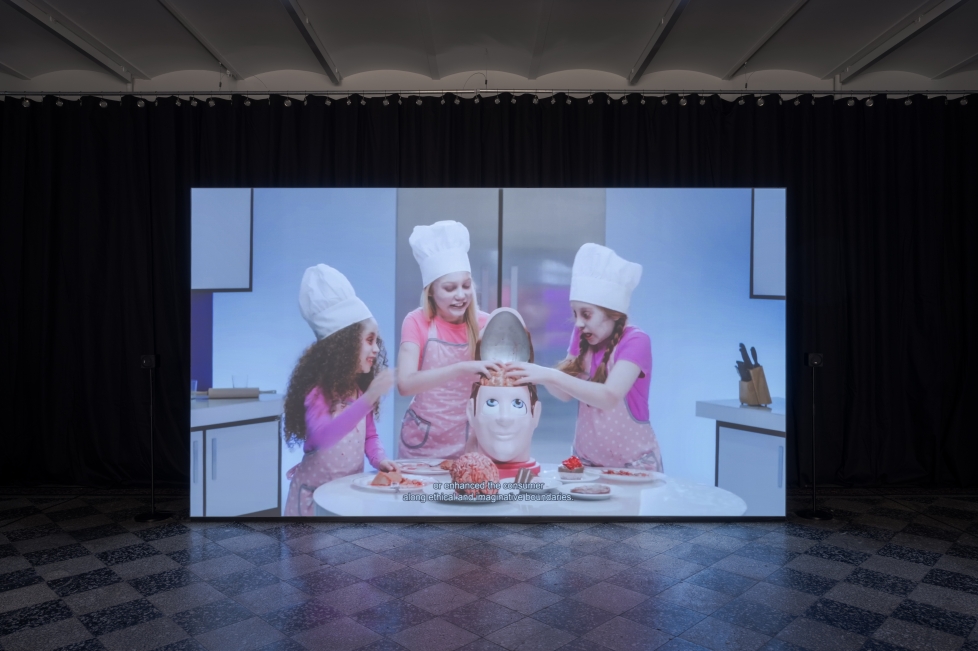
Madeleine Andersson: I think there must be other ways forward; copyright isn’t some necessary foundation of society. I use the internet as a free archive, where I simply take what I want. In my own artistic practice, I am always at risk of exploiting someone by showing their videos or images in an exhibition context. Meanwhile, current copyright rules mainly benefit large companies or the establishment. That makes this discussion feel rather lukewarm to me.
AB: What’s depressing is that it’s primarily the platforms that make money, even though they’re really just intermediaries dependent on people continuing to share images from their lives for free. It feels so symptomatic of our time that it is precisely the companies that produce nothing that are the ones actually making money.
TB: The most obvious problem with the AI wave is the extent to which power is being centralised in the hands of a few actors, and that can hardly be reduced to a question of artistic freedom. It is really about law and economics – working conditions, rights, money, and other problems that ultimately stem from the fact that we have a rather outdated economic system.
Maybe it sounds a bit dreamy, but I don’t think copyright always serves artistic creation. All art is derivative in some sense, and more access should really be a good thing. If there’s anywhere one should allow oneself to be idealistic, it’s in art, which must be permitted to remain lawless and speculative. For artistic value to matter at all, I think it has to exist beyond economic structures.
NAH: Madeleine, would you continue and talk about how you work with technology and online culture in your art?
MA: I’ve always been interested in people’s intense drive to capture the heightened moment on the internet. Even though that impulse is often associated today with the TikTok generation, the same cultural logic exists in older media formats too, like America’s Funniest Home Videos. It’s about inhabiting a state of anticipation, hoping that something will unfold in front of the camera. The internet is a kind of archive of precisely those moments people hope will rupture the continuity of everyday life, and I find that a very funny thing to make art about.
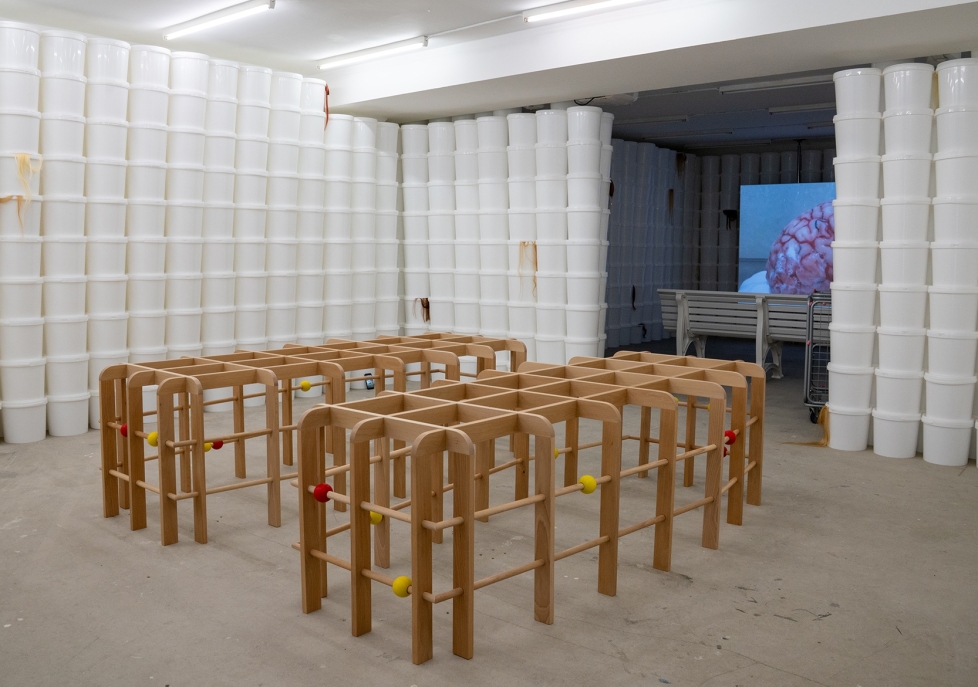
At the moment I’m working on a film about the digestive system that will deal in part with the hysteria surrounding GLP-1 drugs like Ozempic. I’ve been watching a lot of videos of people injecting abs, painting bodies onto existing bodies, or making vore porn, where people swallow something that really shouldn’t be edible – like a car, or plastic. I’m fascinated by the way both dystopian and utopian fantasies about what we want to do to our bodies are expressed in the most extreme and transgressive material online. One guy, for example, swallowed a rubber snake and carried it around in his stomach for a week. Both the act itself and the act of uploading it to the internet manifest a dream of the body as a container that exceeds the physical.
NAH: So much of our identity formation today takes place through images and digital feeds that mirror us back to ourselves. It creates a kind of doubled self – physical and digital – while also enabling a form of abstraction from the lived, material body. Ozempic becomes almost a point where offline and online converge: a way of adapting the body to digital ideals. Tobias, I felt that your exhibition at Saskia Neuman Gallery in Stockholm touched on this relationship between the digitally sleek and the bodily mechanical. Could you say something about that?
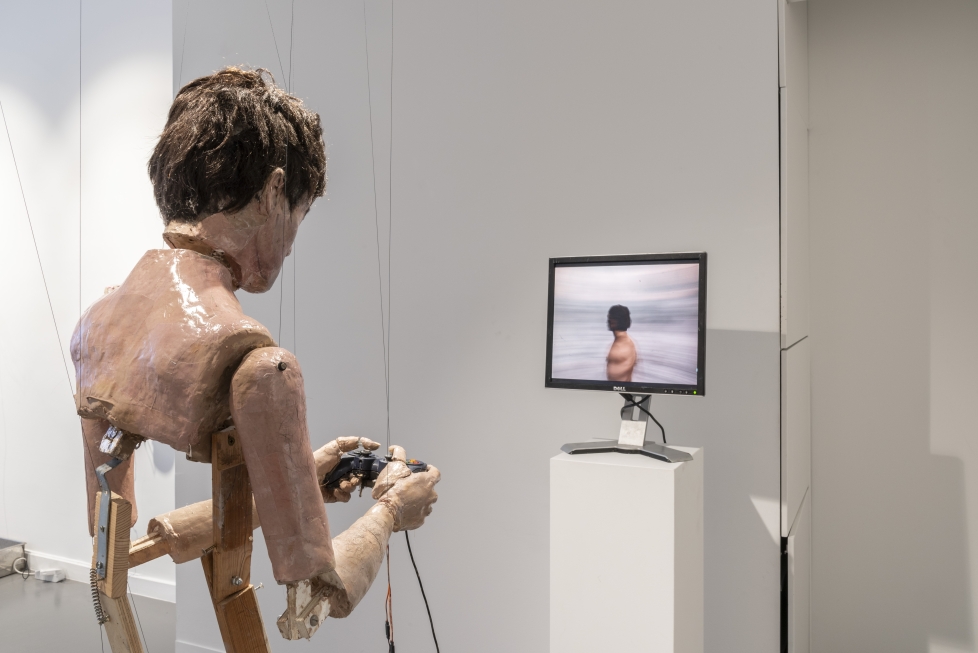
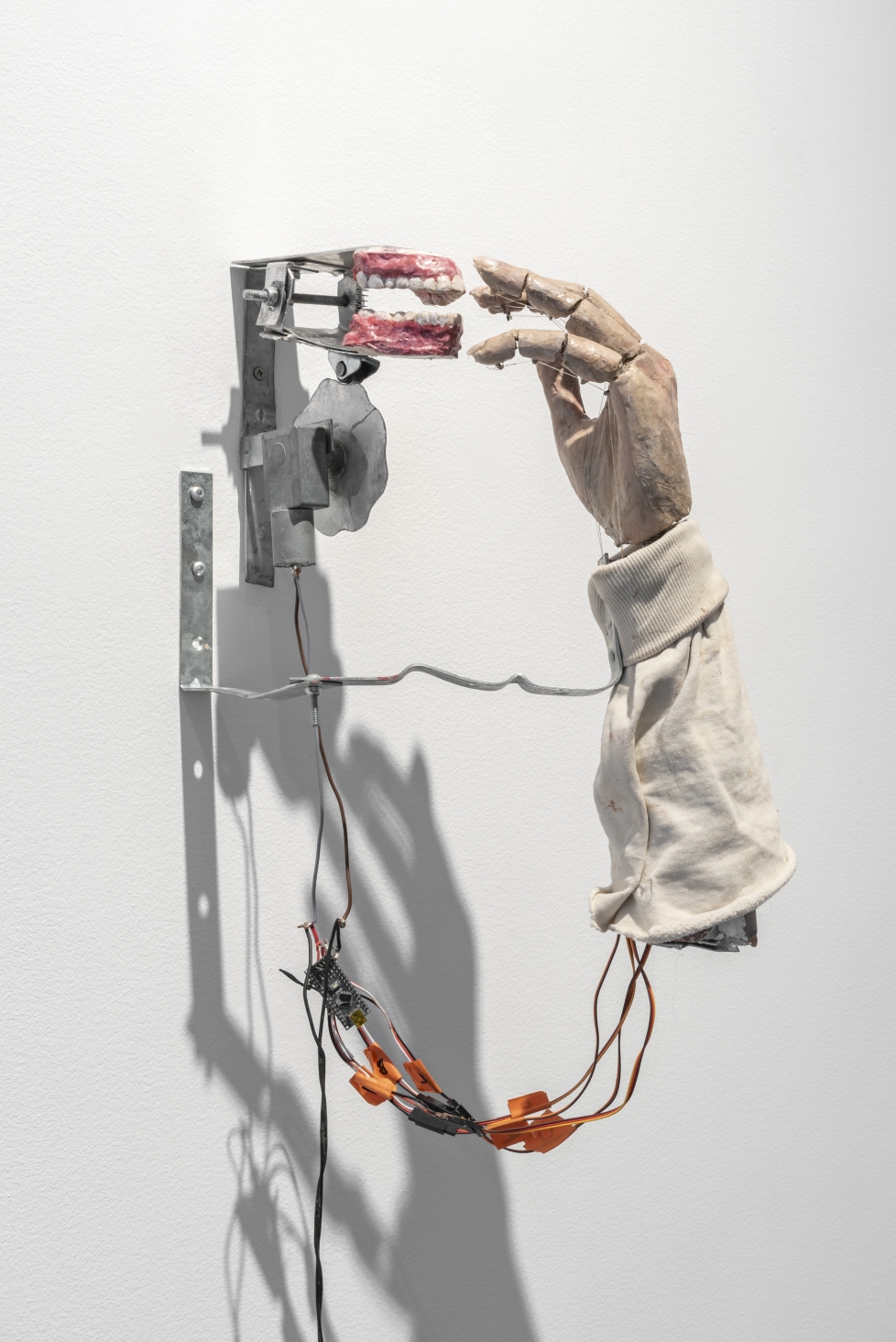
TB: For a long time I’ve been working on a series of mechanical self-portraits. In the exhibition you mention, I showed, among other things, a work titled Third Person [2026], consisting of a robot based on my own body that stands in front of a screen playing video games. The work alluded to ideas about digital avatars, corporeality, and technology as a form of longing to transcend bodily limitation.
My interest in mechanics and corporeality goes back to an earlier work consisting of a brush that continuously brushes a strand of hair. That work came out of my own mannerisms, and the work became a way of displacing unconscious bodily movements and tics from the body onto the machine. Such repetitive, unconscious movements are already mechanical in themselves, while the machine, when performing movements that resemble those of the body, paradoxically begins to appear human.
AB: I agree – I don’t think technology and the body can be separated. At the same time, tech companies use language that tries to disembody technology – ”the cloud,” and similar terms – as if it were immaterial and clean. The same logic exists on platforms like Instagram, where certain forms of sexual content are actively suppressed and censored in order to maintain a fantasy of purity. It’s as though people are trying to clean up the internet, even though so much of its actual content revolves around pornography and violence. I find that contradiction fascinating. And in relation to that, Ozempic also becomes interesting as an expression of how contemporary body ideals are internalised and technologized. In order to meet the visual demands made of the body, to fit into one’s own gender, for example, everyone has to looksmaxx.
MA: Social platforms do something strange to the relation between object and subject. I’m thinking of the way different internet challenges create a bizarre distance from one’s own body. You constantly hear about people who injure themselves, kill someone, or simply go too far in front of the camera, and afterwards seem almost to say: “I didn’t think it was real.”
There is something in the way the camera displaces responsibility for the body. That’s also why I find it so interesting to work artistically with what an image on the internet actually is, and what it does to the way we perceive our own bodies. My film Degenerative Knowledge Production [2024] dealt a great deal with the movement between experiencing what one sees on the screen as part of oneself – feeling almost as though it is one’s own brain being mashed when one sees it in an image – and then, in the next moment, feeling that what is shown is something wholly alien, like a balloon.
AB: It’s not so strange that looksmaxxing, Ozempic, and eating disorders are so trendy right now, but I especially feel it’s shaped by people’s material conditions. Young people today don’t have much hope for the future – it’s hard to earn money, hard to find housing – so people try to control the little they do have, which is always the body. Social media platforms also nourish a fantasy that anyone can win the lottery, go viral, become a sugar baby, and thereby step off the hamster wheel. But first you have to be beautiful.
At the same time, there is something liberating in many of these processes, in the sense that one can exceed the body’s offline limitations and become, say, an animal – or impossibly, impossibly hot. There is something utopian in that too, the idea that one can become anyone. Fantasy-driven porn genres like hentai, a sub-genre of Japanese manga and anime, are very popular with young people today. Desire is directed toward what we cannot reach, and the moment it reaches its object it changes. From that perspective, I think the fantasy of the perfect body – and of sex without sweat, friction, or bodily disorder – is more dangerous than hentai because tentacles, unlike perfectionism, are honest about their unattainability.
NAH: To me, this exposes a profound disconnection from the fleshly body. Not only the body one carries oneself, but also the body as an object of desire seems to have drifted far from the real. I’m deeply fascinated by what happens to the body when it is translated into image. Does it eventually end up outside itself? Does the flesh-body ultimately become a kind of residue, as we are increasingly absorbed by these online platforms, while the sick, inadequate, uncomfortable body becomes something one is forced to manage off to the side?
TB: I think technology, at some basic level, is rooted in a longing for another kind of corporeality – or for overcoming corporeality altogether. At the same time, these encounters between body and technology can become very brutal and grotesque, as when young men break their own jaws in order to reshape their appearance and live up to a certain beauty ideal.
AB: I also think one of the reasons I’ve been so interested in pornography is that it never allows you to deny your own corporeality. You always feel that you have a body when you watch porn, whether you want to or not.
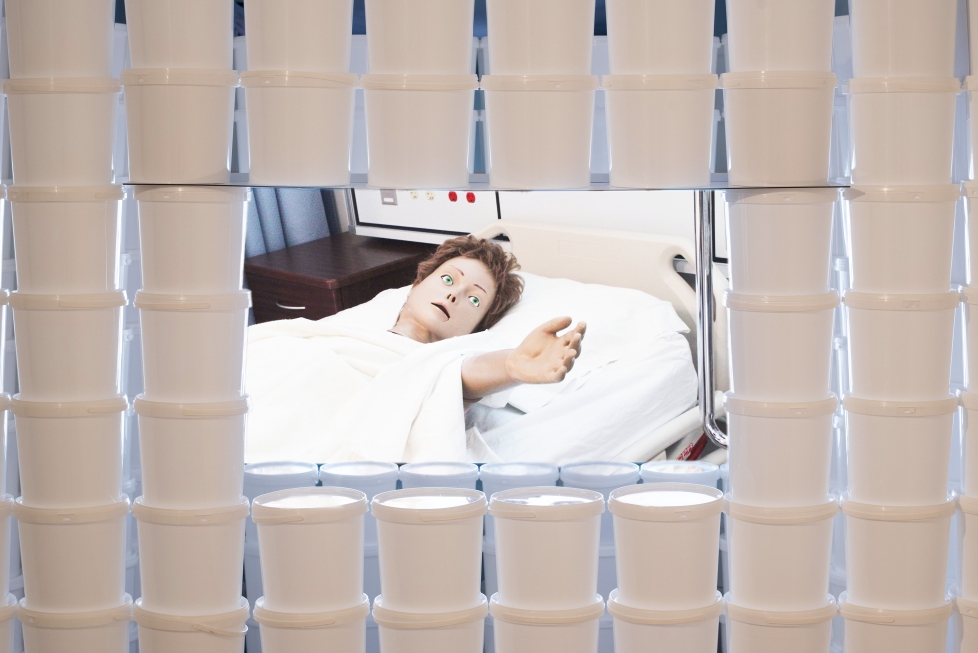
TB: I think my relationship to my own corporeality in the present moment is that the idea of dissolving completely feels rather good. There’s something very appealing about it.
AB: Becoming technology?
TB: I wouldn’t have any problem, for example, putting a chip in my arm.
AB: I have loads of chips. Thirty of them. But no one can track me or anything.
TB: I don’t think I feel any fear of being tracked either. What does it matter if someone knows I was at the ICA [supermarket] in Vårberg yesterday? I could very easily imagine living forever.
AB: When you think about uploading yourself and living forever, do you imagine that it is really you who would go on living and understanding, or is it just an image of you that others would be able to interact with?
TB: Ideally, I’d be able to replace one piece at a time until, at some point, I became entirely digital. Mostly because it would be interesting to see what happens in the world; it would be a shame to miss out. But of course you’d suffer forever as well. For me, techno-optimism has so much to do with the longing to be preserved forever, even if that’s unattainable. There’s such melancholy in trying to overcome death.
MA: I think human history is marked by different attempts to live just a little longer, and that technology and science are a kind of concretization of collective dreams and ambitions. Sometimes the result is a strange experiment, sometimes an image. In either case it’s about realising something that previously existed only as fantasy. There’s something almost circular about that, a kind of chicken-and-egg relation between imagination and materialisation. What begins as a collective dream becomes technology, and technology in turn produces new dreams.
Technology can be understood as a way of materialising desire. As for the young, perfect body, I think humanity has always been obsessed with it. It’s not as though art history is overflowing with depictions of old and sick bodies. All image-making can be understood as an attempt to preserve the body.
AB: But never before has there been so much to gain from working on the image of oneself. In the past, maybe it was kings and queens who wanted to mediate their image. Today, most people seem to live some kind of digital meta-life that they are constantly required to relate to. I don’t know what that does to us as human beings. Maybe we’re all becoming self-aware narcissists.
MA: I don’t think you stand outside the system simply because you don’t have Instagram. What’s more interesting is to find a way of speaking about the internet beyond image and self-image. The idea that one must constantly reclaim one’s attention in order to live an authentic life is exhausting. Sometimes it is more liberating to see the internet as part of life, and to relate to it in the same way one relates to other basic conditions of living.
For me, art has been a very important output precisely because I am fundamentally chronically online and love to scroll. What art school gave me, I think, was some kind of permission to analyse things and relate to them from a meta-perspective. I try to take all the material that flickers past, all the information and images one is constantly exposed to, and transform it into something else.
NAH: One of the major anxieties around AI images was that they would deceive us, but rather than believing the image uncritically it seems we have become more suspicious of it. Tobias and Arvida, you’ve both worked with AI as part of your artistic practice. Could you say something about about what made you want to experiment with it as an artistic tool?
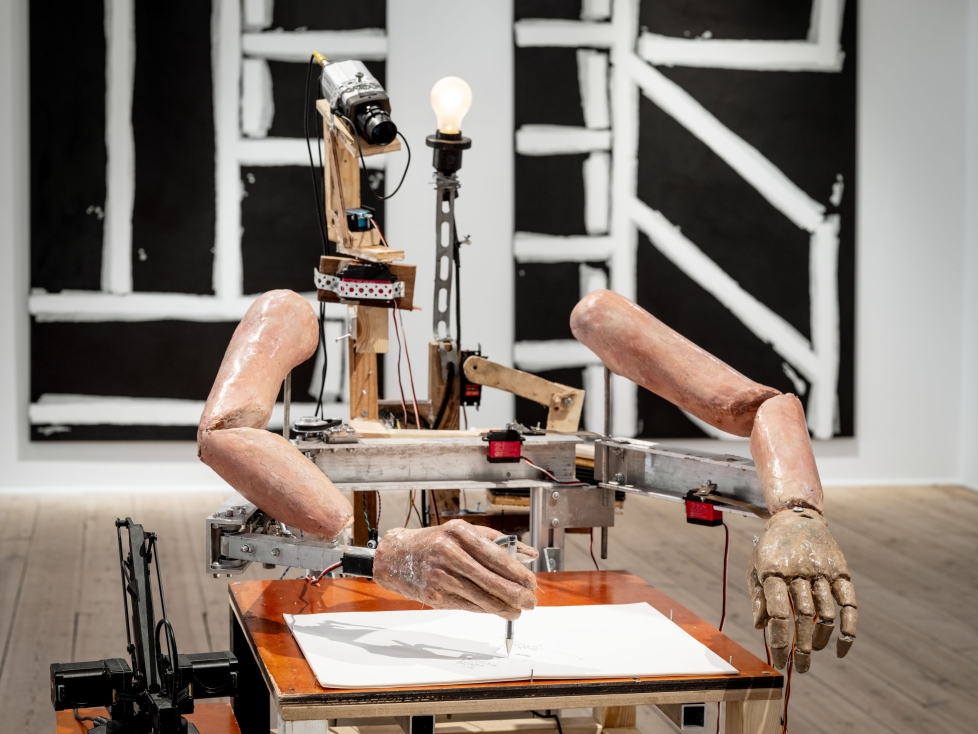
TB: I’ve worked somewhat with AI; it’s difficult not to if you’re involved with robotics today. The field is incredibly broad, but also both fascinating and unsettling. For me it began when I built a drawing machine partly inspired by headlines about the first AI-generated artworks selling for millions at Sotheby’s. That made me irritated and curious. Even before the current wave of language models, I was also very interested in how robotics is represented in popular culture. You probably know Sophia the Robot?
AB: She’s one of those early AIs that seemed more human and has a robot body.
TB: She feels rather passé now, but she was launched as one of the first robot citizens of a country – I think it was Saudi Arabia. There was also that viral moment when someone asked her, “Would you like to destroy all humans?” and she replied, “Okay,” and everyone completely freaked out. That says a lot about how we relate to AI. We project so much science fiction onto these systems that, when they say something that echoes that narrative, it becomes a kind of self-reinforcing loop.
When I built my drawing machine, I wanted to make something that didn’t simply function as an advanced printer, but had its own subconscious. So I built in a very small LLM – a large language model, a form of generative AI – that constantly looks around, describes its surroundings to itself, and places what it sees within a narrative. What fascinated me was precisely that little inner monologue. That later became another work: a small toy duck, to which I gave the prompt that it was a duck. Then I let it sit in the gallery and just yap.
AB: So it describes the things it sees?
TB: Yes, very badly – it’s a very small LLM running on a little gaming laptop – and then it builds its own identity around being a duck.
AB: So what does it feel?
TB: Often, it’s pretty awful. It’s been standing in an empty room, so it thinks a lot about when it was in the pond with its duck friends and wonders why it isn’t there anymore.
AB: So it has false memories?
TB: Yes, loads, which I find incredibly exciting. It wasn’t even intentional. I designed the loop so that it could save its own thoughts and look back on them, but when you tell it to have a memory, it starts making a lot of things up on its own. When it wakes up and says something like, “Where am I? I miss my duck mom,” it affects me on some level, even though I made it myself and know that it is merely the result of a language model responding to inputs and instructions. It takes very little for us to project an inner life onto things.
AB: AI is really good at role-play. I had an LLM that was supposed to sex-chat on my behalf as part of an art project. I had fed it with my old interviews, but it still had this incredibly corny Instagram language from around 2015 to 2016 – very body-positive. It loved saying things were “raw and real.” Later, when ChatGPT updated the model, she refused to talk sex instead; you couldn’t hack it into having explicit dialogues anymore.
I also think it’s important to ask: Are there actually more gooners or pornosexuals now, or is it simply easier for them to find one another through online forums? Does access to pornography mean that some people stop seeking sex beyond the screen, or does it instead offer an alternative for those who would never dare approach another body in the first place?
It’s hard to say how technology shapes our desires. I said earlier that we’re all narcissists today, but that’s also due to the selfie camera, which has made it easier to photograph oneself and therefore encourages us to see our bodies from the outside rather than simply inhabit them.
NAH: If performance art has historically been tied to the human body, what happens when it shifts into something disembodied – when it is a linguistic or computational system that performs? What exactly are we witnessing then? I’m thinking that both Tobias and Arvida have worked with an AI that one observes while it does something like a performance art piece. We are used to watching other humans perform, but what happens when all humans become spectators? Are we just watching culture unfold?
AB: Every new technology seems to produce the idea that it is no longer people doing things. The same was true of the gramophone. Before it was invented, almost everyone played an instrument. It’s hard to know which of those fears will actually endure. At the same time, there is almost always a human somewhere who has given the technology its direction.
TB: I think there’s a perverse pleasure in this whole sci-fi LARP [live-action role-play] that AI generates. Never before have we, as a species, found ourselves in a situation where we experience ourselves as being observed by another intelligent species. There is something deeply seductive in that shift of perspective: the idea of not being alone, and the possibility of suddenly seeing humanity from the outside, from a new point of view. It becomes a kind of extreme circle jerk. It’s hard to say where it is heading because we are currently in a very strange period in which we still haven’t found a language for it or or arrived at an understanding of what is actually happening when machines take part in shaping culture.
MA: We live in a world where we are constantly fed images of war and horror. That overexposure has numbed us, but it has also kept the world in a state of heightened tension. Against that background, synthetic images and different forms of slop appear as a way of dealing with reality by distancing ourselves from it. At the same time, they are still built out of real images. That’s what makes them so double: they remove us from reality, yet still carry its visual material within them.
I also think the fascination with being able to create any kind of image at all is something of a fad. Of course there is something democratic in it, but I also don’t want to underestimate the fact that the brain is already pretty good at generating images. If I write a prompt, I can often already see the image quite clearly in front of me. Right now, for instance, I can picture Donald Trump riding a sexy strawberry. Perhaps the difference is simply that selection has been moved from the interior to a technical system. To me, that says something about our current relation between body and technology: how quickly we dismiss the body’s own capacities and begin to read them through new systems.
NAH: When I was putting this conversation together, I was struck by how few artists in the Nordic countries work with the internet and technology in their artistic practice. Perhaps it’s crazy to ask the three artists who actually do, but why do you think that is?
AB: It probably has to do with boring material things – what sells, and the fact that the art market here is so small that in the end it all just becomes painting. What do people want on their wall? Trees. And that’s a pretty world-estranged and somewhat limited way of relating to art. When I was in my early twenties, I moved to London because that’s where all my Tumblr friends lived, the ones I thought were doing interesting things. There just weren’t that many of them here.
MA: It feels as though post-internet art never fully established itself here, and that there has been a kind of stigma around making art about social media. At least when I was in art school, it was seen as rather low-grade to make discursive art about Facebook, for example. There was this sense that it was merely an expression of a contemporary hunger for the news cycle, and that one couldn’t make art about something moving so quickly without the work immediately feeling dated.
AB: That feels very typical of art school – the idea that whatever you are not supposed to do is precisely what is considered too easy.
MA: I don’t know if you saw Work of Art which came out in 2010?
AB: That reality TV competition produced by Sarah Jessica Parker?
MA: Yes, exactly. There was someone on it who took the logos for Twitter, Facebook, and Instagram and just poured blood all over them. I have honestly never forgotten that work.