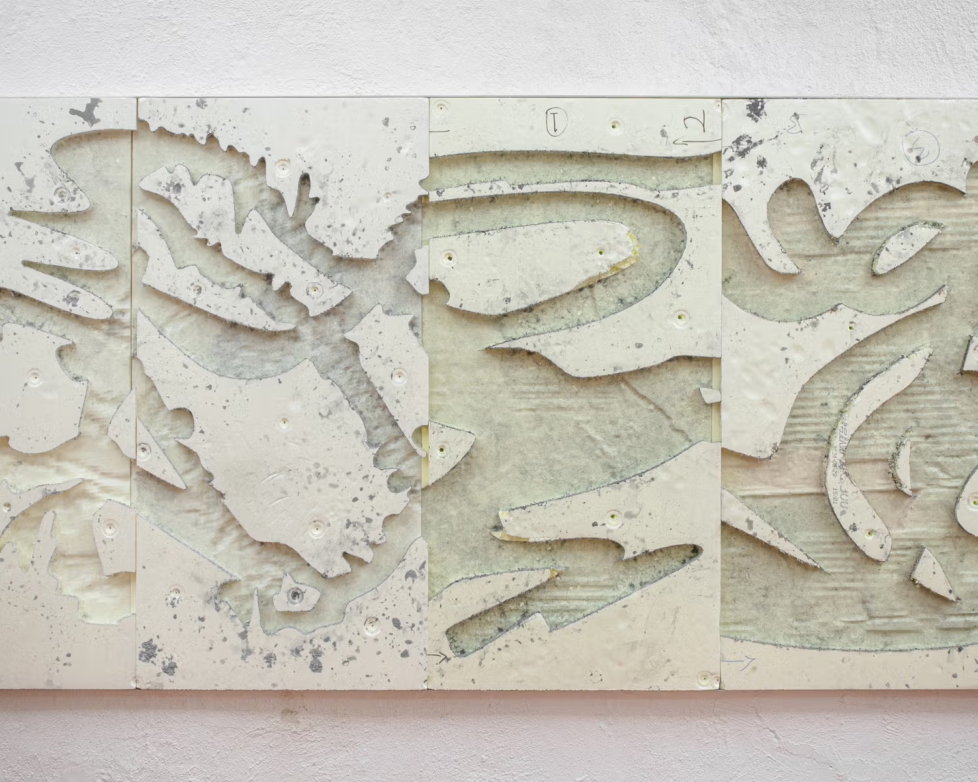
Damla Kilickiran, Semantically Threaded Like Prayers, Hulias, Oslo
Damla Kilickiran’s exhibition recalls pre-Gutenberg times, when paper was attributed magical powers and believed to carry secret alphabets and forbidden messages. Her abstract reliefs, composed from newspapers, documents, drawings, and insulation materials, form a dense semiotic terrain where light, absorption, and opacity carry meaning in place of written description. Across layered surfaces, images shift and dissolve: atoms merge with poisonous plants, X-rays with handwriting, and photographs of Oslo’s urban structures filtered through insulation material surface as clusters of seals. The exhibition was both an archaeology of paper and a metaphysical inquiry into its latent properties.
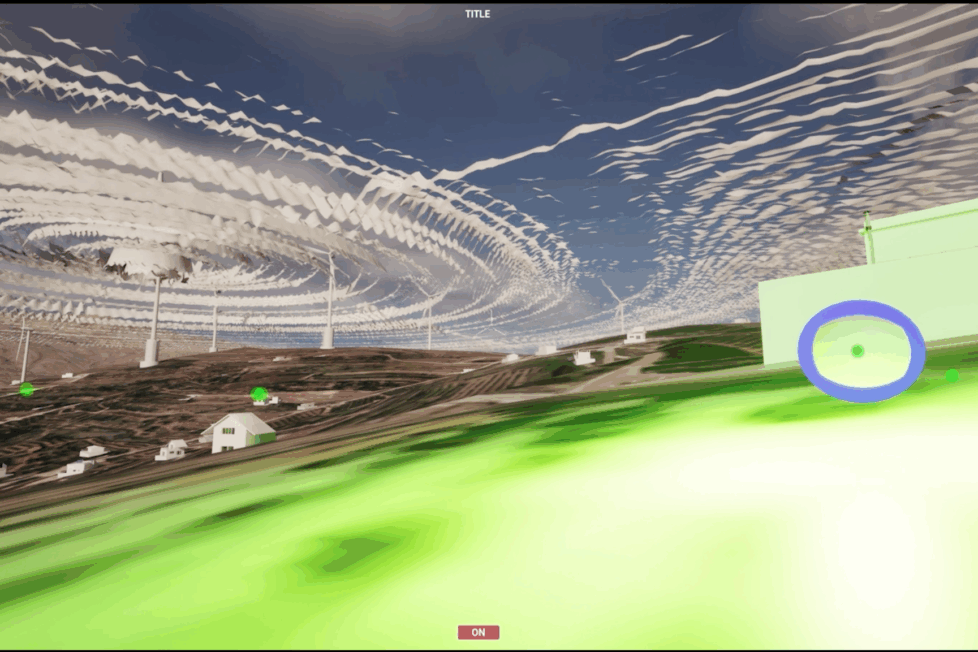
Lawrence Abu Hamdan, Zifzafa, Munch Museum, Oslo
Lawrence Abu Hamdan’s haunting study in acoustic displacement – where green-energy rhetoric meets colonial extraction – demonstrates how sound can carry violence, how noise can enforce control, erase presence, and occupy territory. His forensic audio investigation traces the transformation of the Israeli-occupied Syrian Golan Heights, where wind turbines threaten to overtake local landscapes. The wind becomes a carrier of disruption, reshaping the sonic memory of place. The sound of a saxophone, drifting from the balcony of a nearby small house, merges with the low mechanical drone of turbines. Air and vibration turn into testimony, each frequency registering the tension between life and disappearance.
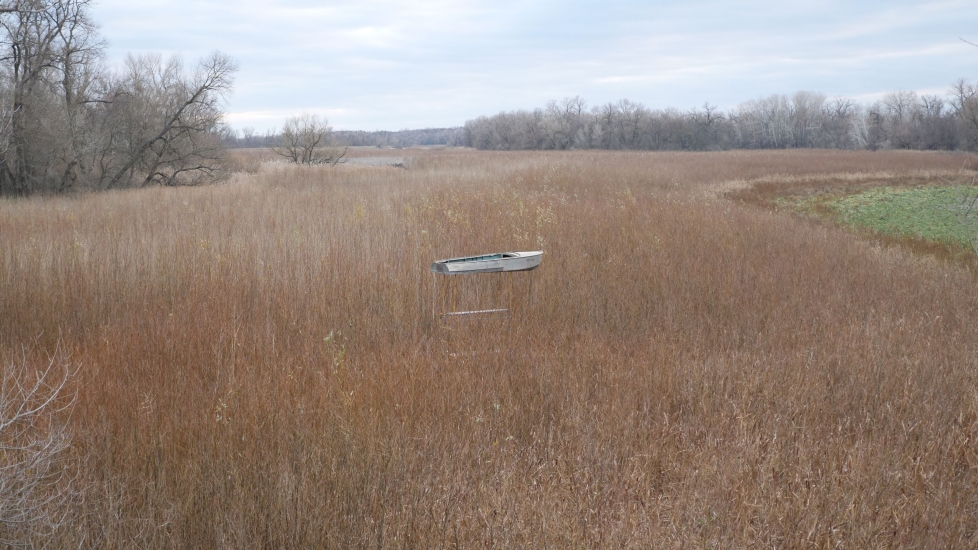
Zhanna Kadyrova, The Forest, IHME Helsinki, Helsinki
In this exhibition, the landscape functions as both a witness and an archive of war. After the Nova Kakhovka Dam in Ukraine was destroyed by Russia on 6 June 2023, a forest of weeping willows began to grow in the drained basin of the Kakhovka Reservoir, carrying within their growth the residue of the explosion that made their existence possible. Following a devastating act of ecocide, this forest stands as both aftermath and beginning – a living record of what has occurred and what continues to unfold. Kadyrova reveals a landscape whose past and future intermingle, enduring beyond human memory yet remembered by the environment itself long after people are gone.
– Lesia Vasylchenko is an artist based in Oslo. Her practice spans video, photography, and installation, focusing on the intersections of visual culture, media technologies, and chronopolitics. She is the founder of STRUKTURA.Time, an interdisciplinary initiative bridging visual art, media archaeology, literature, and philosophy. Her work has been exhibited at the Museum of Modern Art in Warsaw, the Lentos Art Museum in Linz, the Henie Onstad Art Center in Bærum, and the Munch Museum in Oslo.
For this year’s contributions to the Advent Calendar, see here.