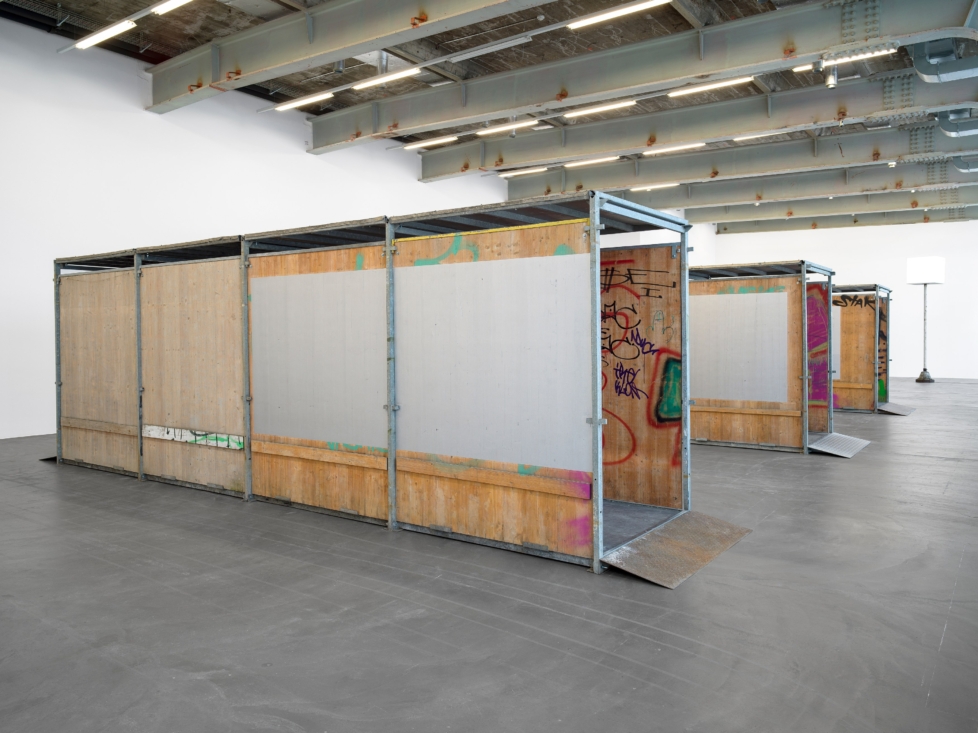
After visiting Klara Lidén’s exhibition at Kunsthalle Zürich this summer, I wrote a pitch to review it – but I never sent it. In the pitch, I posed a question: in this, our decade of appropriation, do Lidén’s works still possess the same subversive potential as they once did?
In some of the black-and-white, low-resolution photos I’m looking at while writing this, it feels like the poster stack is tearing down the wall. That is, it’s a door. And behind it, a small dark room with a table, an ashtray, some mugs, a bottle of liquor. The photos are from Art Basel 2007 and printed in Klara, the first monograph on the artist, which is also an artwork by Ei Arakawa-Nash, Nick Mauss, Nikolas Gambaroff, and Nora Schultz.
The many images in the publication are accompanied by a conversation between the four creators and Lidén. The conversation is loose and blurry at the edges: it limps, it stumbles. When one of them sketches a question with their faltering upper lip – “Maybe that the context is also… – like you stress it, or something, in certain ways. But that it can keep it, if you can keep it, it seems, um, that they are not planned by you or the artwork but……?????” – Lidén shows no interest in sweeping away the debris left by those five question marks. She says “yes” a lot. Outside the small, dark room, her “yes” makes sense because she seems used to being met with words that twist uncertainly, struggling to find their place in the air where they’ve been spoken.
I pick up my phone to look at my own photos from this year’s Art Basel, and find one of a TV screen showing a video in which Lidén is arduously climbing through a hole in a construction site door. I keep scrolling, but it’s like this: there is an inside and an outside, maybe – I don’t know. The year is 2025 and I’m still looking for people who are looking for the studio that sings and speaks, that gossips – where do the insects buzz, and the crickets creak? Outside. The question I posed at the beginning doesn’t matter, but the answer is yes. There’s a calm inside, which also exists outside if one is alert enough to see it. Klara Lidén sees it.
– Elmer Blåvarg (b. 1996) is an artist based in Stockholm, educated at the Royal Institute of Art.